
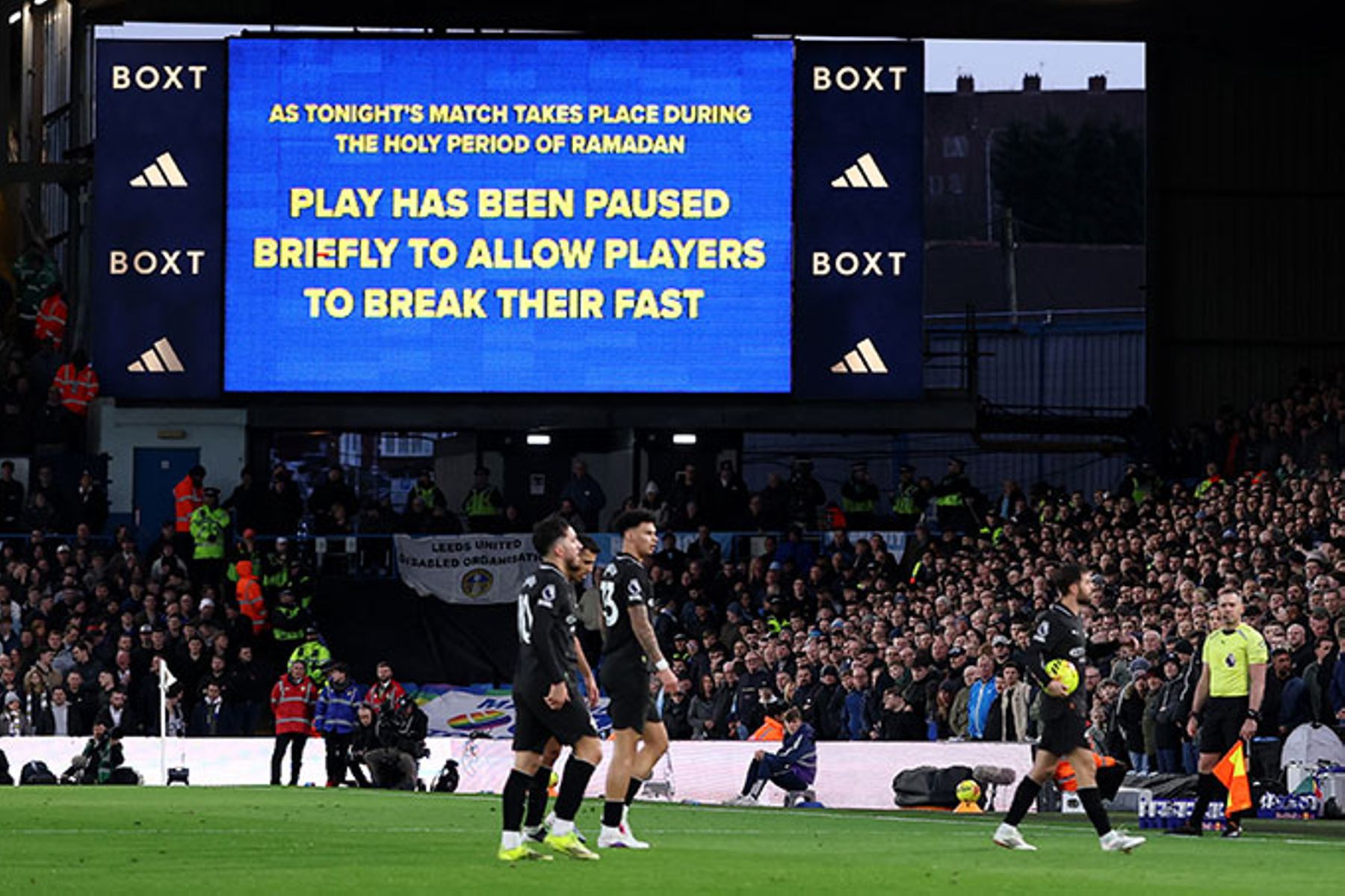
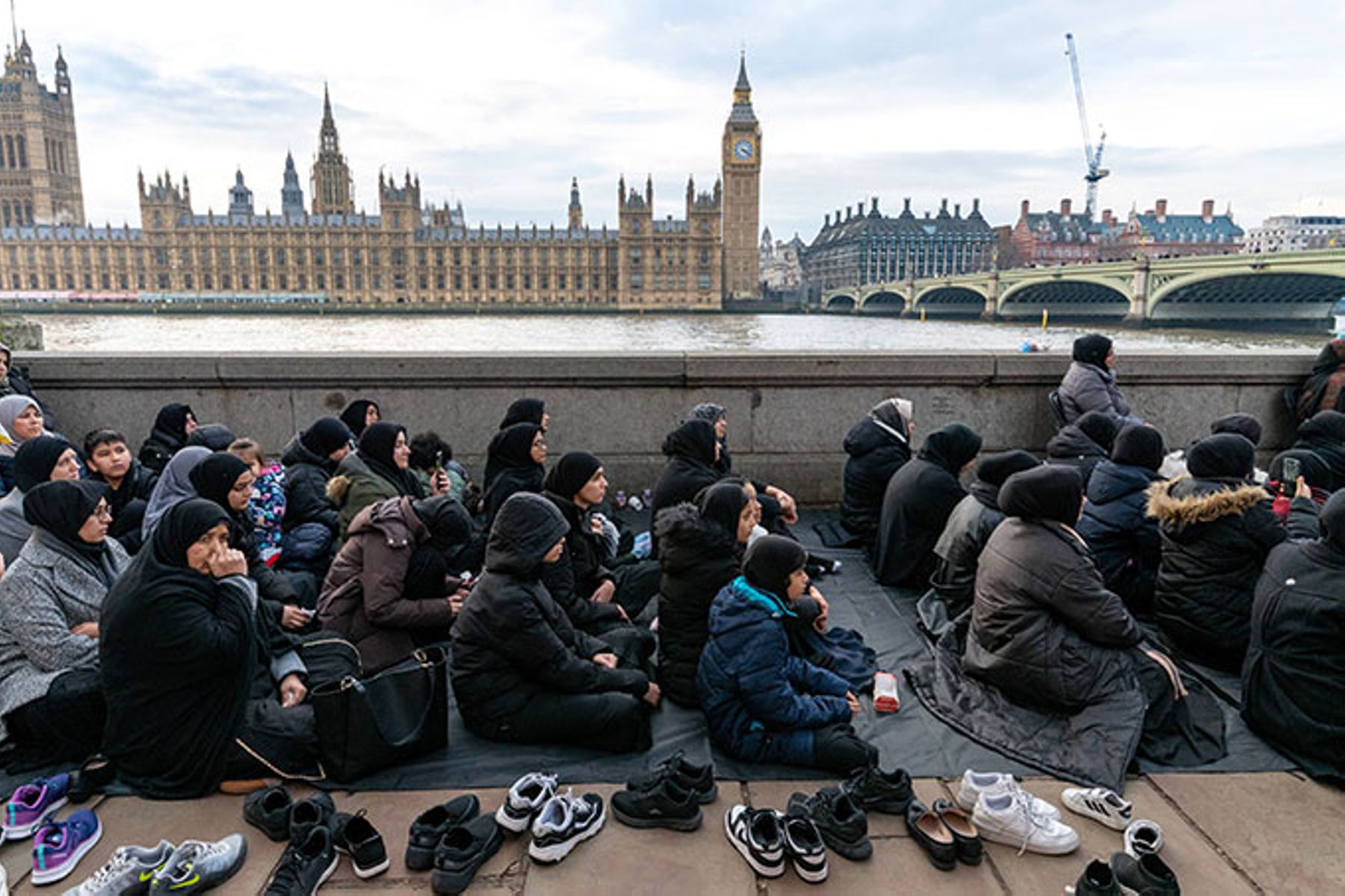
In Britain, March meant Ramadan. My local supermarket advised me to “Make this holy month meaningful” and offered “everything you need for Iftar, Suhoor, and beyond,” including a range of halal foods. At televised Premiership football matches, play stopped to allow Muslim players to break their fast. Days before Eid, Muslims gathered in London’s Trafalgar Square to pray in public. The Mayor of London, Sir Sadiq Khan, hailed the “power of being Muslim” as he addressed thousands at the “biggest Iftar in the Western world.”
It’s not that Britons have undergone mass conversion to Islam or, for the most part, have a deep interest in religious practices. Indeed, a leading politician sparked debate by condemning London’s mass public prayer gathering, and boos rang out around the stadium when a big screen announced that the match between Leeds and Manchester City would pause at sunset to allow Muslim players to break their fasts.
Finally, a reason to check your email.
Sign up for our free newsletter today.
Rather, a growing Muslim population has become more confident in asserting its identity, while Britain’s political and cultural elite increasingly insists upon respect for Islam as a show of support for the supposedly progressive values of diversity, multiculturalism, and anti-racism. The result is not just tolerance of Muslims but an extending Islamification of all aspects of British society.
The education system plays an important role in normalizing Islamic religious practices among all children. Thousands of schools have changed their uniform policies to let Muslim girls as young as five wear a hijab in the classroom or to ban all girls from wearing skirts, in compliance with Islam’s modesty rules. Halal meat is served in school dinners, often without parents being informed. Government guidance to teachers in areas with large Muslim communities warns that art produced by children, as well as music and dancing lessons, may be considered blasphemous or even “idolatrous” under Sharia law. Other advice to schools introduces double standards: one London council urged teachers not to punish Muslim pupils with after-school detentions during Ramadan so they can return home in time to break their fast.
One reason for these developments is, obviously, a growing Muslim population. According to the most recent national census, carried out in 2021, 3.9 million people, or 6.5 percent of the population, describe themselves as Muslim—up from 2.7 million, or 4.9 percent, in 2011. But these statistics don’t capture how recent migrants and second- and third-generation citizens from predominantly Muslim countries such as Pakistan, Bangladesh, and Afghanistan tend to concentrate in certain towns and cities, particularly in the north of England. For example, the 2021 census found that the Asian or British-Asian population of Bradford stood at 32.1 percent, while Birmingham is home to 195,102 Pakistanis, or 17.2 percent of the city’s population. A recent election in the Manchester constituency of Gorton and Denton highlighted the extent of ethnic and religious segregation, even within small geographical areas.
But population size is not the whole story. For example, Cowbridge Comprehensive School in Wales made headlines after a parent complained that the school canteen offered only halal meat—yet the 2021 census revealed that Muslims made up just 0.2 percent of Cowbridge’s population, suggesting that the school’s decision involved more than demographics.
More likely, those in charge of U.K. institutions lack the capacity to assert British values, traditions, and identity. The tendency of Muslim citizens to concentrate in particular areas enables Islam to gain disproportionate political influence, thanks to Britain’s “first past the post” electoral system, which lets even small groups exert outsize influence on the political agenda by acting in unity. Historically, the Labour Party has benefited from the collective “Muslim vote.” In 2019, well over 80 percent of Muslims likely voted for Labour, and more than 500 Muslims serve as local councilors across the U.K., three-quarters of whom are members of the Labour Party.
The relationship between Muslim voters and the Labour Party is showing strains, however. At the last general election, five independent Members of Parliament won previously secure Labour seats on a pro-Gaza platform. One such MP, Adnan Hussain, said of his victory, “This is for Gaza. I cannot deny that I stand here as the result of a protest vote on the back of a genocide.” At a “Free Palestine” rally in 2014, Hussain allegedly told the crowd: “They let Gaza burn, they hate Gaza. . . . Now let’s make Israel burn, let’s make Israel burn.”
In the election in Manchester’s Gorton and Denton constituency, the Green Party overturned a large Labour majority after appealing directly to Muslim voters. The Greens produced election leaflets and videos in Urdu, sent canvassers to mosques, and told voters to “punish Labour for Gaza.” One Green Party campaign video showed Prime Minister Keir Starmer shaking hands with Narendra Modi, the Hindu prime minister of India, and U.K Deputy Prime Minister David Lammy shaking hands with Israeli Prime Minister Binyamin Netanyahu. Ultimately, this sectarianism won the day: Hannah Spencer, frequently spotted wearing a red-and-black keffiyeh, prevailed for the Greens.
On the day of the by-election, volunteers monitoring procedures raised the alarm about so-called family voting, where voters either confer, collude, or direct each other on how to vote at polling places, in breach of secret ballot rules. The group Democracy Volunteers noted, “In Gorton and Denton, we observed family voting in 68% of polling stations, affecting 12% of those voters observed.” This alludes to the practice of Muslim men instructing their wives, who may not be fluent in English, on how to vote.
For more than a generation now, British politicians have told voters that “diversity is our strength,” and that multiculturalism should be welcomed. Yet, what has emerged are decidedly monocultural communities that are prepared to act collectively in their own political interests—and a political class afraid that commenting on the phenomenon will expose them to accusations of racism or Islamophobia.
The Islamification of British society is not without victims. Following the Hamas-led pogrom on October 7, 2023, people in Britain took to the streets—not to show solidarity with Israel but support for Gaza. These marches are now a weekly occurrence. Palestinian flags are a regular feature in British cities; one local authority feared their removal could “destabilise community cohesion.” In October 2025, an attack on a Manchester synagogue by Jihad Al-Shamie claimed the lives of two men. The U.K.’s Counter Terrorism Policing said that he may have been influenced by “extreme Islamist ideology.” The Union of Jewish Students claims that anti-Semitism has “become normalised.” One in five students expressed reluctance to share a house with a Jewish student.
Yet anti-Muslim hate crimes are twice as likely to be prosecuted as anti-Semitic hate crimes, and the British government, worried about losing more Muslim voters, has just announced a new definition of “anti-Muslim hate” that includes “violence, harassment and prejudicial stereotyping” and is intended to help organizations “understand, measure, prevent and address anti-Muslim hostility.” This backdoor blasphemy law effectively curtails free speech when it comes to criticizing Islamic practices or behavior.
Maintaining the right to criticize behavior associated with the Muslim community is vital in light of the failure, over many decades, to prevent the actions of so-called grooming gangs—more accurately described as “rape gangs.” These groups of mainly Pakistani-heritage Muslim men systematically targeted and abused thousands of vulnerable young girls in towns and cities across the U.K. An inquiry into abuse in just one town, Rotherham, conservatively estimated that “approximately 1,400 children were sexually exploited” between 1997 and 2013. In 2024, a government-backed Grooming Gangs Taskforce reported that police forces had identified and protected “over 4,000 victims” in the previous 12-month period. But even now, commenting on the true scale of such criminality is difficult, since many police forces shy away from even recording data on the ethnicity or religious background of perpetrators. And a hard-won national inquiry has yet to get underway.
Britain’s rape-gang scandal reveals the influence that parts of the Islamic community wield over British institutions—an influence abetted by a political and cultural elite more willing to tolerate the repeated abuse of girls than risk being called racist or Islamophobic. More broadly, Britain’s continuing Islamification has come at the expense of women’s safety, Jewish security, and core liberal principles such as free speech. Until the country can state clearly and defend confidently what it means to be British, it will struggle to integrate those whose primary allegiance lies with Islam rather than the British state.