Los Angeles’s Sixth Street Bridge was supposed to be a triumph. Completed in 2022 after years of delays and cost overruns, the new structure connecting Boyle Heights to downtown L.A. was hailed as a civic landmark. At $588 million, it was the most expensive bridge project in the city’s history. Its ten soaring arches and thousands of LED lights led its designers to call it the “Ribbon of Light.”
Today, the bridge is dark. Within months of its opening, thieves began tearing copper wire from its electrical infrastructure to sell for scrap. By one estimate, nearly seven miles of copper were stripped from the bridge, extinguishing what was meant to be its defining feature. The city’s new showpiece soon became a monument to broader civic dysfunction: deprived of its lighting, covered in graffiti, and dangerous for pedestrians. Despite repeated efforts to secure the electrical system, the thefts have continued. Officials now estimate that repairing and relighting the bridge in time for the 2028 Los Angeles Olympics will cost $2.5 million.
Finally, a reason to check your email.
Sign up for our free newsletter today.
The bridge’s plight is mirrored across Los Angeles. Thieves have stripped copper wire from streetlights throughout the city, leaving entire blocks dark for months. Reported copper-theft incidents surged from just nine in 2006 to 4,534 in 2021, and to nearly 16,000 in fiscal year 2024–25. The Bureau of Street Lighting warns residents that repairs now take, on average, more than a year because of “severe wire theft and vandalism.” Today, roughly one in ten of the city’s 225,000 streetlights is out of service.
Copper thieves are only part of the problem. Theft accounts for less than half of current streetlight outages, say city officials. Most result from ordinary repair and maintenance failures that the city has neglected. Since 2020, service requests for streetlights have nearly tripled; the city now fields more than 45,000 streetlight service calls annually.
This is Los Angeles in 2026: the nation’s second-largest city, the center of a trillion-dollar regional economy, and an entertainment industry mecca—yet one that struggles to perform the basic functions of urban government. And the troubles extend far beyond streetlights. The city seems unable to repair its sidewalks, repave its streets, or maintain aging infrastructure. It cannot keep public parks from becoming open-air drug markets or streets from turning into homeless encampments. It cannot build enough housing for its residents or attract and retain businesses. Its most famous industry, Hollywood, is struggling. Families are leaving and school enrollment is falling.
Los Angeles isn’t poor. Its tax base includes some of the most valuable real estate in America, and its economy is larger than that of many countries. The city’s annual budget hovers near $14 billion, larger than that of every American city except New York. Its police department alone spends more than the entire municipal budgets of Pittsburgh, Cincinnati, and St. Louis combined. Yet despite its vast resources, Los Angeles is falling into a cycle of visible decay and disorder that threatens its long-term future.
Los Angeles’s decline is readily apparent in an area where city government is least ideological: maintaining streets, sidewalks, and other basic infrastructure. The city has turned something as ordinary as cracked pavement into a billion-dollar governance problem. Its basic physical systems—streetlights, sidewalks, streets, and curbs—have become growing sources of legal liability and fiscal strain.
Consider the sidewalks. For decades, Los Angeles allowed its pedestrian infrastructure to deteriorate as tree roots buckled concrete slabs and intersections lacked curb ramps compliant with the federal Americans with Disabilities Act. In 2016, the city settled Willits v. City of Los Angeles—the largest disability-access class-action settlement in American history—by committing itself to spend $1.4 billion over 30 years to repair and upgrade the public right-of-way.
A decade later, the obligation remains largely unmet. At the current pace, the controller warned, fixing all the broken sidewalks could take 500 years. Residents requesting repairs face waits of over a decade. Meantime, the neglect keeps generating new costs. In recent years, the city received thousands of sidewalk injury claims and related lawsuits, paying out more than $86 million in settlements. In other words, Los Angeles now pays twice for the same problem: first through litigation, and then through the repairs it has yet to complete.
The streets are no better. Los Angeles is famous for its car culture, but it cannot keep its asphalt in decent condition, owing partly to a regulatory trap of its own making. Repaving a street triggers the mandatory installation of modern accessibility upgrades, including ADA-compliant curb ramps, as well as modifications required by the city’s Mobility Plan. In L.A., installing a single ramp now costs $50,000—up from just $3,000 in 2014, and far more than in other major cities. At that rate, a standard four-corner intersection can run to $200,000 for curb ramps—often more than the price of resurfacing a mile of roadway.
Rather than confront those costs directly, Los Angeles has largely stopped repaving its streets altogether. In the first nine months of the current fiscal year, the city resurfaced less than ten of the city’s 7,500 miles of roadway. Instead, it uses a workaround, relying on a temporary fix it calls “large asphalt repairs.” These projects patch small sections of roadway without legally counting as full repaving, so L.A. can dodge the federal and municipal mandates that would otherwise trigger accessibility upgrades.
This approach reduces short-term costs but leaves the underlying maintenance backlog untouched. Pavement continues to deteriorate; the curb-ramp work remains unfinished. A recent analysis estimated that Los Angeles faces an $8 billion street and curb-ramp maintenance backlog. Without a fundamental change in approach, much of the pavement will keep sliding into failed condition, and the repair bill could hit $15 billion by 2035—more than the city’s entire current budget. Instead of paying for smooth roads, the city pays millions of dollars yearly to drivers with pothole-damaged cars.
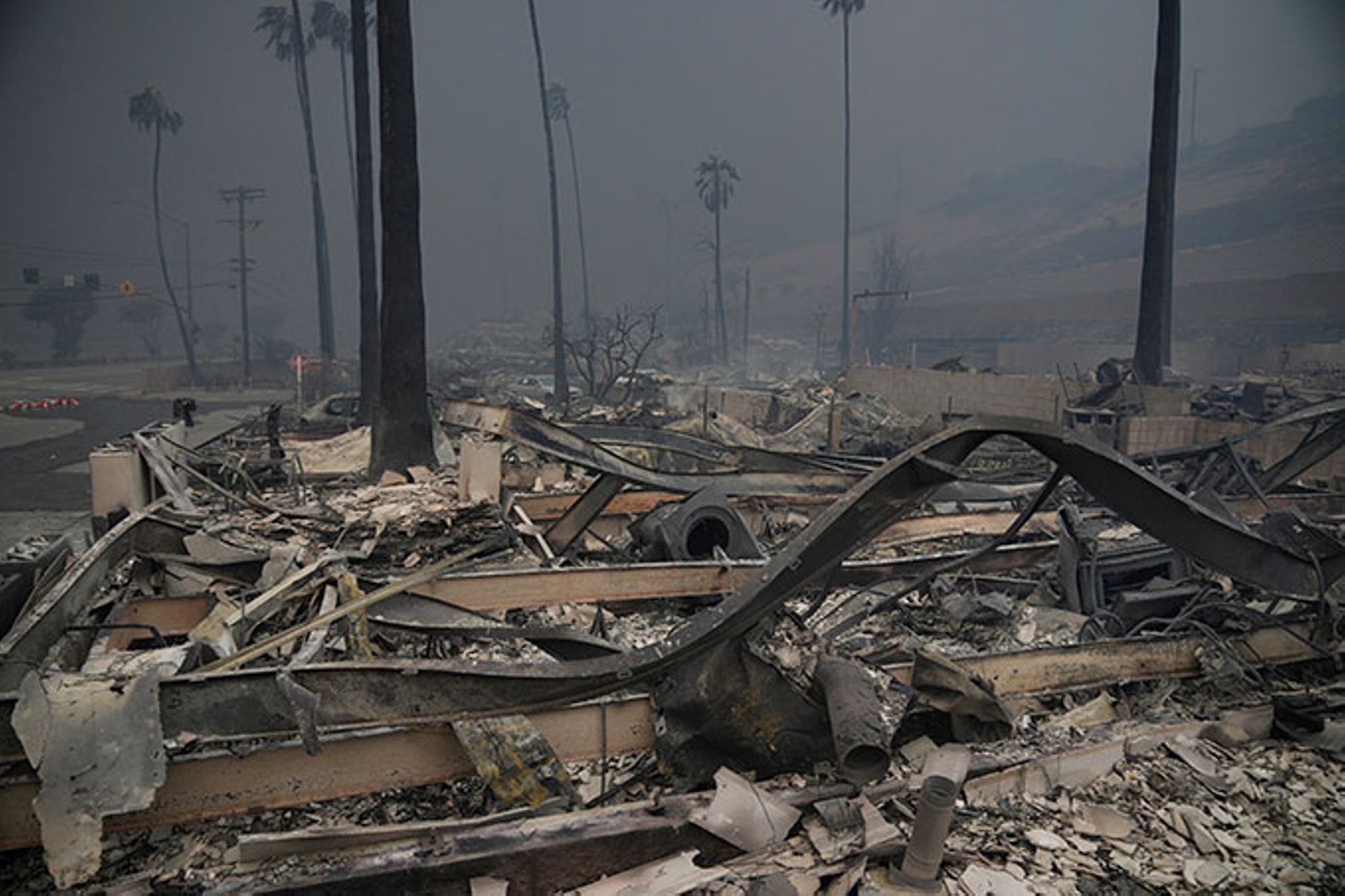
Beyond the physical decay, there’s a deeper malaise. Los Angeles is no longer the violent-crime capital it was in the worst years of the late twentieth century, but public disorder has become a daily reality. Homeless encampments line the region’s sidewalks, freeway embankments, and public parks. Open-air drug use, discarded needles, human waste, and severe untreated mental illness are common sights. According to county health data, drug-overdose deaths in Los Angeles more than doubled over the last decade, driven almost entirely by fentanyl and methamphetamine usage.
At the peak of the drug plague in 2022, a record 3,220 Los Angeles County residents died of overdoses. Even after a significant decline in 2024, the county still recorded 2,438 total overdose deaths—nearly seven per day. City leaders have largely normalized this tragedy by trying to accommodate severe mental illness and addiction rather than confronting them as the crises they are.
The city’s approach is perhaps best illustrated at MacArthur Park, a 40-acre green space a mile west of downtown. Once modeled on New York’s Central Park, it has come to symbolize Los Angeles’s inability to reclaim anarchic public spaces. For years, the park has functioned as a sprawling narcotics market and homeless encampment, with drugs sold openly at virtually any hour.
Rather than crack down on the disorder, the city has largely sought to manage it. Under Los Angeles County’s “harm-reduction” framework, public-health agencies and contractors distribute naloxone, sterile syringes, smoking supplies, and other materials—including sheets of aluminum foil used to inhale vaporized fentanyl—in an effort to reduce overdose deaths and disease transmission. Public-health officials defend these programs as disease-prevention measures; critics argue that they effectively surrender the park to lawlessness.
The situation came to a head this spring. In May, federal law enforcement targeted the park’s open-air fentanyl and methamphetamine market linked to the 18th Street Gang. Authorities charged 25 defendants and arrested 18, with officials alleging that cartel-supplied drugs were getting sold through street-level dealers around the park. Yet, within days, local reporting found that drug activity and chaos had already resumed.
Just east of downtown, Skid Row demonstrates the catastrophe on a larger scale. For decades, the area has served as the city’s primary containment zone for the most severely homeless and mentally ill. Originally a nineteenth-century hub for transient rail workers, Skid Row was deliberately concentrated by 1970s city policy. Today, it covers roughly 50 square blocks adjacent to downtown L.A.’s office towers. In 2024, Los Angeles County estimated that about 3,800 people were homeless there, roughly 70 percent of them unsheltered, with some of the county’s highest rates of substance abuse, mental-health crises, HIV/AIDS, and overdose mortality.
The breakdown of basic civic order is further evident in the city’s emergency services. The LAPD answers just 57 percent of 911 calls within the 15-second window that state law requires. Nonemergency callers can wait 40 minutes to over an hour. As of late 2025, the department had 92 unfilled dispatcher positions. For residents, a stolen catalytic converter, encampment fire, burglary, or other incident may not bring a timely response—or any response. Though official statistics show reported crime declining in recent years, these figures are widely doubted amid such response failures; when police rarely show up or answer the phone, many incidents likely go unreported.
The mayhem is no longer confined to Los Angeles’s urban core. More affluent residential zones such as Hollywood, Venice, and Santa Monica now contend with some combination of encampments, open drug use, theft, vandalism, and unsafe public spaces, making them less usable and desirable for families, workers, business owners, and visitors.
Despite years of rhetoric about compassion, affordable housing, and social justice, no major city tolerates as much human misery on its streets as Los Angeles. The city now has more unsheltered homeless people than anywhere else in the country. The Los Angeles Homeless Services Authority’s 2025 count found 72,308 homeless people countywide and 43,699 in the City of Los Angeles; most were unsheltered. Even as L.A. has claimed progress, rough sleeping—without a tent, vehicle, or any shelter—rose 20 percent in 2025 to its highest level in four years. Los Angeles has built a vast homelessness bureaucracy, yet the crisis remains one of the city’s defining realities.
Living in Los Angeles has long involved a certain implicit bargain. Residents tolerated high taxes, extensive regulation, and steep housing costs because, in return, the city offered economic opportunity, natural beauty, and cultural prestige. But as public disorder spreads and basic services worsen, that bargain looks like a bad deal for families, businesses, and entire industries.
The costs fall hardest on the residents and businesses closest to the trouble. On MacArthur Park’s perimeter is Langer’s Deli, a family institution operating there since 1947; Norm Langer has recently considered closing it, citing the surrounding drug market, assaults, mayhem, and the city’s failure to protect his staff and customers. In downtown Los Angeles, office vacancy rates have climbed past 30 percent. A recent survey ranked it one of the deadest downtowns in the world.
The commercial fallout has hit retail and tourism just as hard, even in upscale beachfront areas. Santa Monica’s Third Street Promenade, a pedestrian mall that once generated a substantial share of the city’s sales-tax revenue, now has a ground-floor storefront vacancy rate of 30 percent, too. The once-vibrant shopping corridor is marked by boarded-up windows, vacant retail spaces, and private security teams stationed outside the remaining businesses.
The entertainment industry, the source of Los Angeles’s global identity, has also seen better days. Film and television shooting days in Hollywood have fallen by roughly half since 2018. Productions are moving to Georgia, New Mexico, Canada, and overseas to the United Kingdom, where costs are lower and headaches fewer. The decline affects L.A.’s broader film economy, including camera operators, set builders, caterers, lighting crews, drivers, costume shops, and production-dependent small businesses. Even iconic Southern California projects, like the recent Baywatch reboot, have required political intervention and special favors to keep them filming locally.
Unsurprisingly, Los Angeles is now shrinking at an unprecedented rate. Los Angeles County has lost nearly 320,000 residents since 2020. By comparison, the New York City metro area gained 29,000 residents over the same period. The demographic flight is emptying L.A.’s schools. In 2015–16, the Los Angeles Unified School District enrolled roughly 640,000 students. By the 2025–26 school year, that figure had fallen to 392,654—a decline of nearly 40 percent that has left the district with empty classrooms and a compounding schedule of school closures.
The January 2025 Palisades and Eaton Fires made the city’s governance failures harder to ignore. The blazes consumed more than 16,000 structures, displaced tens of thousands of residents, and exposed failures of prevention and response—limited fuel treatment, confused firefighting decisions, and water systems that ran dry or failed. But the rebuilding effort has produced its own indictment of city leadership. A year later, only about 12 percent of destroyed homes had received permits to rebuild, paralyzed by bureaucratic red tape. More than 70 percent of fire victims remain displaced.
The L.A. political establishment too often responds to the city’s challenges in ways that make them harder to solve. Consider two of its most expensive: housing and the interconnected homelessness and drug crisis.
Housing construction has long been constrained. State law requires the city to plan for more than 456,000 new housing units by 2029, but its recent production is nowhere near meeting that target. L.A. permitted just over 17,000 housing units in 2024, roughly 30 percent of what it would need annually to satisfy its state mandate.
Just getting permission to build in the city is a notorious hassle. A recent index ranked L.A. 492nd out of 500 American cities for permitting efficiency. A new study by economists at Princeton and MIT found that developers in the city will pay a 50 percent premium for land that comes with permits already in hand—or about $770,000 for a typical building site. That is, buyers will readily shell out hundreds of thousands of extra dollars simply to escape the slow-moving grind of dealing with the city’s building department.
Rather than cut regulations to encourage more development, Los Angeles has pushed in the opposite direction. When Sacramento passed legislation designed to allow denser and taller apartment buildings near major transit corridors, the L.A. City Council instead adopted a strategy designed to delay its effects. Exploiting a loophole in the law, the city upzoned 55 low-density areas, just enough to qualify for a pause on the state mandate. The local plan caps development near transit at two to four stories, well below the six- to nine-story buildings that state law would otherwise have permitted to help ease the housing shortage.
Local policies intended to expand housing supply have often reduced it. Measure ULA, approved by voters in 2022, imposed a steep new transfer tax on high-value real-estate transactions: 4 percent on sales above $5 million and 5.5 percent on sales exceeding $10 million, on top of the city’s existing transfer-tax rate. Marketed as a “mansion tax” that would help fund affordable housing and tenant protections, the law was written so broadly that it applies not only to mansions but also to apartment buildings, commercial properties, industrial parcels, and development sites.
The unintended consequences were immediate and severe. The tax effectively froze the commercial real-estate market. UCLA researchers found that the measure reduces multifamily housing production in Los Angeles by roughly 1,900 units per year—an 18 percent decline compared with a pre-policy baseline. Because many new apartment projects are required to include below-market-rate units, fewer developments also means fewer affordable units. The tax has therefore reduced both market-rate and income-restricted housing production. A measure designed to fund affordable housing, in other words, made it less attractive to build housing of any kind.
The construction numbers are indeed grim. Multifamily permits in Los Angeles fell 46 percent from 2022 to 2025, sinking to the lowest level since 2013. Developers cite not only high interest rates and construction costs but also slow approvals, Measure ULA, and impact fees for the slowdown. City officials have acknowledged ULA’s effects and sought temporary exemptions from the transfer tax for new apartments, condos, and commercial projects, but such reforms have thus far not been adopted.
The same pattern of futility characterizes Mayor Karen Bass’s signature homelessness program, Inside Safe. Launched in December 2022 alongside a declaration of homelessness emergency, the program was intended to move people out of street encampments and into permanent housing. More than $320 million later, the program instead had placed about 5,800 people into interim housing—rooms in motels and budget hotels, at a cost of about $3,300 per person monthly. Roughly 40 percent have since returned to the streets, and only about 25 percent obtained permanent housing, at a cost exceeding $200,000 per placement.
Fraud and abuse have plagued Inside Safe. A court-ordered audit of the city’s broader homelessness spending could not determine where much of the money had gone or whether billed services had actually been delivered. One contracted service provider was caught billing the city $110 per person per day for food while supplying participants only with instant ramen noodles. Bass has since acknowledged that the program is “not financially sustainable” and ended the homelessness emergency in November 2025. On the streets, little has changed.
The city’s harm-reduction approach to drug addiction makes matters worse. Under the auspices of the Department of Public Health, mobile vans and outreach teams distribute “safe consumption kits” at MacArthur Park and other homeless encampments, providing materials that go far beyond traditional overdose-reversal drugs like naloxone. Here, again, the city spends heavily to manage the symptoms of a crisis while leaving the conditions that produce it largely intact.

Every year, Los Angeles’s leaders unveil ambitious new plans, emergency declarations, equity frameworks, climate initiatives, tenant protections, mobility strategies, and homelessness programs. Yet the city is failing at the unglamorous basics of governance: enforcing rules, permitting housing, filling potholes, answering phones, maintaining streets, and protecting public spaces.
Part of the explanation lies in the city’s fragmented structure. Los Angeles County contains 88 municipalities and a population of more than 10 million—larger than that of most states. County government is run by five supervisors, each representing roughly 2 million residents. The City of Los Angeles, meantime, has a powerful 15-member council with districts larger than most American cities. The districts operate like quasi-fiefdoms, especially on land use, homelessness siting, street services, discretionary funds, and neighborhood-level approvals.
The boundary between city and county responsibility shifts depending on whether the subject is homelessness, transit, fire, policing, or housing. Homelessness, for instance, belongs partly to the city, county, and jointly run public-health agencies, as well as contracted nonprofits. The fragmentation makes it hard to assign accountability for failures.
The City of Los Angeles’s budget clearly reflects those failures. Last year, the city paid $286 million in claims, nearly four times what it had budgeted. Many claims stemmed from residents injured on broken sidewalks, potholes, and other neglected infrastructure. Others came from police claims, labor disputes, and misconduct settlements. Such payouts have quietly devoured hundreds of millions of dollars that could otherwise fund basic civic infrastructure. To close the shortfall, the city proposed eliminating more than 1,600 municipal positions, though most of the cuts were later averted through labor agreements. A formal charter-reform process is currently underway to restructure L.A.’s governance system, but meaningful changes are still years away.
When conventional governance breaks down, challengers of all kinds gain traction. In June’s mayoral primary, anti-incumbent sentiment split in two directions. From the Right came Spencer Pratt, a former reality-television personality and Palisades Fire victim who ran an openly antiestablishment campaign against what he described as a corrupt city hall, calling for a wholesale overhaul of city government, the clearing of encampments, investigations into homelessness nonprofits, and the repeal of Measure ULA. From the Left came City Council Member Nithya Raman, a Democratic Socialist and former ally of incumbent Mayor Bass. Pratt briefly looked poised to advance to a runoff before late-counted ballots pushed Raman into second place. Raman will now face Bass in the November general election.
Pratt nevertheless drew substantial support by channeling anger over the fires, encampments, drug markets, homelessness spending, and the city’s broader decline. Raman has tried to position herself as a different kind of change candidate: a reformer calling for more housing production, less red tape, improved city services, and better management of a homelessness system that, she argues, no one at city hall currently controls. Yet she is hardly detached from the city’s failures. Raman has served on the city council since 2020, chairs its Housing and Homelessness Committee, and has had a hand in the very policies that have defined L.A.’s deterioration, from homelessness to housing regulation.
Raman offers a Los Angeles version of the socialist urban politics now ascendant in New York and Seattle. Like New York City Mayor Zohran Mamdani, a fellow Democratic Socialist, Raman mixes pro-housing rhetoric with deep skepticism of the developers and landlords needed to build and maintain housing at scale. Her platform calls for faster permitting, by-right growth near transit, and reforms to Measure ULA—which she originally supported—but also leans on social housing, organized labor, and robust tenant protections. And her approach to addressing the city’s homelessness and public disorder largely continues the same accommodation-first approach that has so far failed to reverse it. To her supporters, Raman represents the chance to make progressive government finally deliver on its promises. To her critics, she comes across as a more ideological version of the same politics that helped produce the city’s failures.
Los Angeles retains extraordinary advantages—wealth, beauty, history, and cultural power. Few cities are so richly endowed. Yet the City of Angels seems to have lost sight of the ordinary work of governing. Before promising grand transformations, its leaders must first prove that they can again do the basics.