
Three weeks into the bombing of Iran, too much of the debate remains focused on the legality of the Trump administration’s action. Most good-faith actors by now recognize that the regime there is evil and is developing nuclear weapons; they’ve also learned that the regime has intercontinental ballistic missiles, which it recently fired at U.S. assets in the Indian Ocean. But rather than focusing on the wisdom or timing of Operation Epic Fury, opponents have rallied around challenging its legality.
This is a spurious line of attack. While the Constitution grants Congress the power to declare war, even the most pacifist legal stickler recognizes presidential authority to use force to defend U.S. sovereign interests when they’re under attack. More broadly, presidents going back to the founding generation have engaged in limited uses of military force without congressional authorization. One of us (Shapiro) expanded on this overwhelming precedent in the context of American operations in Venezuela earlier this year.
Finally, a reason to check your email.
Sign up for our free newsletter today.
But by basic operation of geography, invoking a modernized Monroe Doctrine doesn’t work for Iran as it does for our operations in the Caribbean. And there’s no service of criminal warrants on the indicted head of a narco-state—though the Iranian regime is involved in all sorts of criminal activities, including the drug trade. Instead, the White House is rightly focusing on the continuing threats to American interests and personnel.
The historical precedent for unilateral presidential military action in that context is overwhelming. President Thomas Jefferson defended U.S. trade ships by directing a naval squadron to North Africa to attack the Barbary pirates—the militant Islamists of their day. Even the Korean War was technically just an “international police action,” and the congressional Authorizations for Use of Military Force against Afghanistan and Iraq lacked formal war declarations. As Trump skeptic Jack Goldsmith—a former head of the Justice Department’s Office of Legal Counsel (OLC) under George W. Bush—recently described, “the practice over almost 250 years has been growing unilateral presidential uses of force.” Several OLC opinions, most recently regarding Venezuela, have codified this state of play.
Furthermore, political limitations on presidential warmaking powers have real teeth. While the air campaign against Iran has been robust, President Trump has suggested that it will not last long. There’s no hint yet of a draft or full-scale deployment, as in Iraq or Vietnam (another conflict where Congress never formally declared war). And the operation has been mightily successful at relatively little cost in blood and treasure; in less than the time a think tank can produce a white paper, the Iranian government has been decapitated through air power alone—without the need for any “boots on the ground.”
Congress could certainly move to block further action in Iran—or cut off funding, as it did to precipitate the end of our involvement in Vietnam. But thus far it has chosen not to do so.
The Supreme Court, meanwhile, has never pronounced judgment on many of these questions, other than to defer to the executive or to the political process. Accordingly, Trump’s airstrikes face little legal opposition, apart from what Yale law professor Jeb Rubenfeld characterized as the “chattering of partisans . . . insisting that they know what the Constitution requires when in reality no one does.”
The question of whether Congress needs to declare war on Iran is also moot. The illegitimate regime in charge of that country long ago declared war on us, even to the point of adopting “Death to America” as a motto. The fact that Iran often enlists nonstate actors—assorted terrorist groups—rather than engaging us directly doesn’t matter.
Indeed, the Islamic Republic of Iran—as the current regime formally renamed the country—has waged war against the United States more or less continuously during its entire 47-year history, beginning with the taking of the hostages at the U.S. Embassy in 1979. In 1983, it directed its proxy Hezbollah to blow up an American military barracks in Lebanon, killing 241 U.S. Marines. During the Iraq War, the Iranian regime supplied insurgents with improvised explosive devices that killed and maimed many U.S. service members. Iran launched some 170 attacks on U.S. forces and assets from October 2023 through December of 2024 alone, and also tried to assassinate President Trump. While there were brief periods of rapprochement during the Gulf War and under the Obama administration, these were anomalies in a history predominantly defined by Iranian aggression.
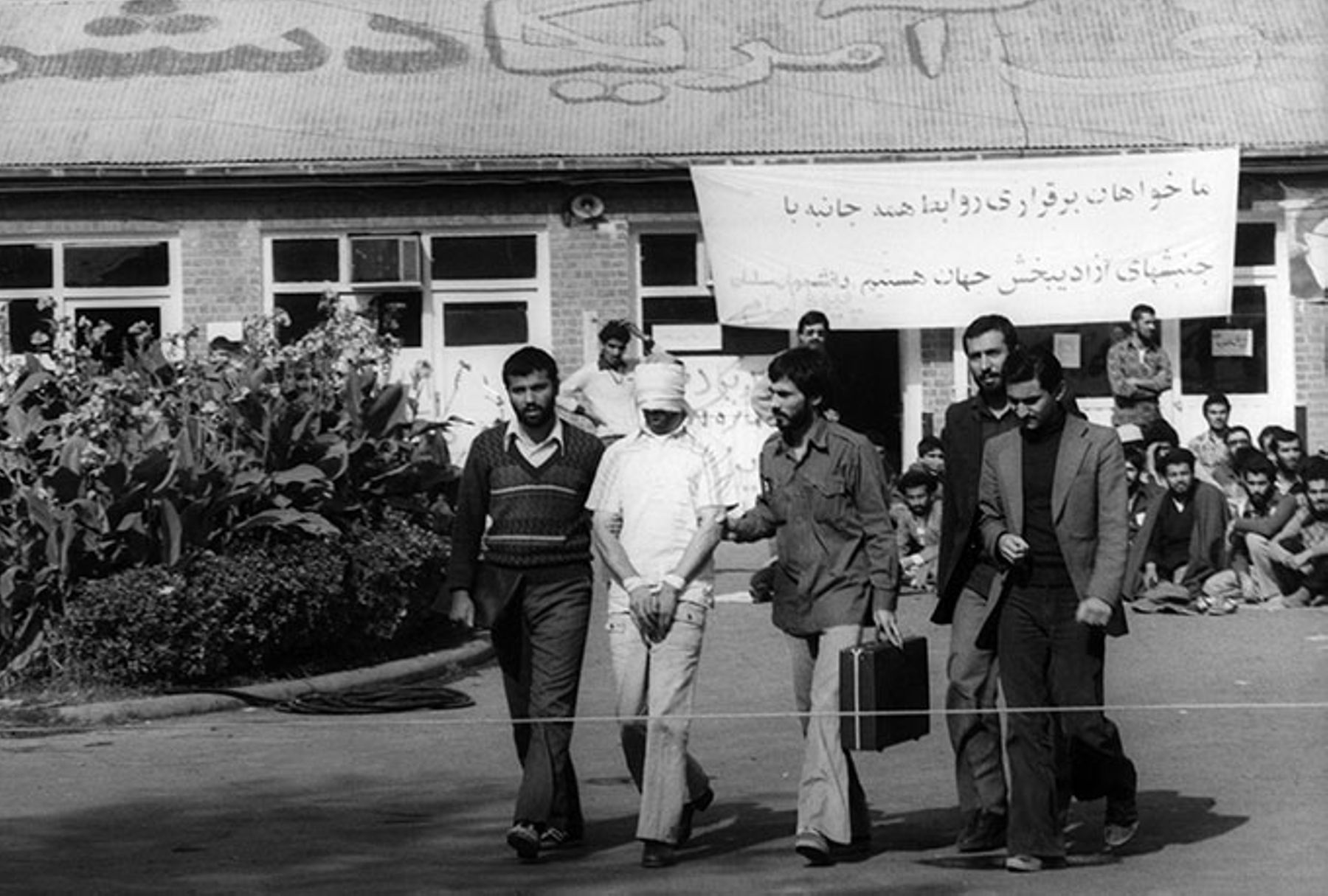
Is there anything more one needs to know to understand that the United States is already in a conflict with the Islamic Republic, whether Congress declares it or not? We can debate the policy merits of engaging in military action in Iran, or engaging in it now, but the legal justifications are both strong and, as Goldsmith put it, largely irrelevant.
Top Photo by Brendan SMIALOWSKI / AFP via Getty Images