
Homelessness remains one of the defining social problems of 2020s America. California and other blue states’ failure to get public disorder under control has helped reduce levels of trust in government to record lows. Homelessness even played a role in the emergence of the “tech Right.” In explaining why he bought Twitter (now X), Elon Musk told Joe Rogan:
if you’ve walked around downtown San Francisco, right near the ex-FKA Twitter headquarters, it’s a zombie apocalypse . . . what philosophy led to that outcome? . . . a philosophy that would be ordinarily quite niche and geographically constrained so that sort of the fallout area would be limited was effectively given an information weapon, an information technology weapon to propagate what is essentially a mind virus. . . . And the outcome of that mind virus is very clear if you walk around the streets of downtown San Francisco. It is the end of civilization. And it’s not just propagating the mind virus, but suppressing any opposing viewpoints. Yes. Well, in order for the virus to propagate, it must suppress opposing viewpoints. Because it doesn’t stand up to scrutiny.
Finally, a reason to check your email.
Sign up for our free newsletter today.
Though street conditions in West Coast cities are still bad, the nature of the crisis has changed, as Democrats are bringing more accountability to the homelessness problem. Enforcement is up and the numbers of tents in some major cities are down, as are mass encampments. Cities are increasingly embracing alternatives to the “Housing First” policy consensus that prevailed for decades, which assumed that only permanently subsidized housing, with no strings attached, could fix homelessness.
There’s still a long way to go, but America is tackling homelessness much more effectively than just five years ago. Whether the recent gains can be sustained will hinge substantially on November’s midterm election results.
The tide turned in 2024. That June, the Supreme Court handed down Grants Pass v. Johnson, overturning a 2018 Ninth Circuit ruling that prohibited cities from enforcing public-camping bans unless they provided shelter to every last “rough sleeper.”
Shelter is a vital tool of homelessness policymaking, but making universal shelter a condition of enforcement paralyzed city governments. Encampments swelled to hundreds of individuals, and—even more consequentially—city officials hid behind courts, claiming their hands were tied. Grants Pass greenlighted the enforcement of camping bans, striking a blow for accountability. West Coast Democrats ramped up enforcement after the ruling.
In an intriguing case of split-ticket voting, Californians voted in November 2024 for Kamala Harris by a 20-point margin but even more overwhelmingly— by almost 40 points—for Proposition 36, reinstituting meaningful criminal sanctions for drug offenses and low-level theft. Prop. 36 rolled back Proposition 47, a statewide ballot initiative Californians enacted in 2014 in a fit of absent-mindedness about how to manage drug use and other behavioral-health disorders. Offenders in California now face more consequences for their behavior than they did a decade ago.
In another positive sign, public officials in Los Angeles, Portland, and Seattle are scaling back participation in joint city-county homeless agencies. These entities were set up to broker tensions between cities and counties on how best to spend money on the local street crisis. But in typical American fashion, adding another governmental layer only made the tensions worse. The “collaborative” structures also stoked public distrust through their opacity and, in some cases, fraud. Politically compelled to care (or pretend to care) about outcomes from their communities’ massive investments in homelessness programs, officials in these three cities are taking policymaking back in-house.
How do those outcomes look? Every year, the federal government publishes a report for the nation as a whole. The most recent version, which details numbers collected in January 2025, shows that both street and chronic (i.e., disabled and long-term) homelessness remain at or near record highs.
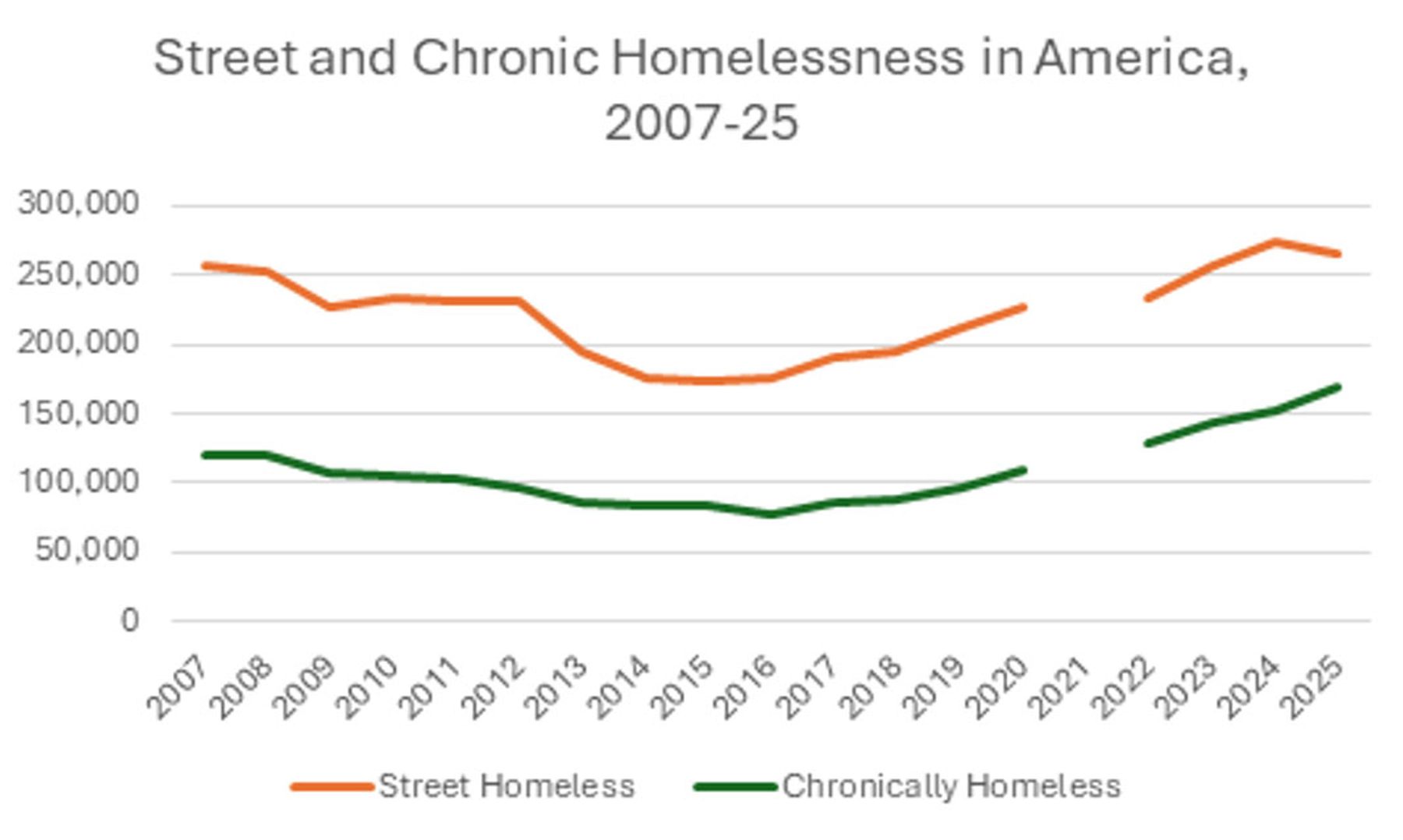
Major cities often release their numbers before the federal government does. In 2026, Los Angeles and Seattle/King County reported that their street counts were up. San Francisco’s count is down.
Tents are also down, according to tallies in San Francisco and Seattle. It’s now much rarer to encounter the massive, name-brand encampments (Spokane’s “Camp Hope,” Phoenix’s “The Zone,” and Orange County’s “Skid River”) notorious for their “medieval” public-health conditions, sexual exploitation, and despair.
The proliferation of tents in the 2010s created an authentic encampment culture that enabled lost souls to sink deeper into addiction and other social pathologies. “With a tent, the user can retreat not just mentally from the world but physically,” journalist Sam Quinones noted. “Encampments provide a community for users, creating the kinds of environmental cues . . . crucial in forming and maintaining habits. They are often places where addicts flee from treatment.” According to a recent Public Policy Institute of California study, Prop. 47’s effective decriminalization of drug and drug-related offenses not only increased street homelessness and drug use but also reduced the use of drug treatment programs. Critics wanted to know why governments allowed private individuals—some more predatory than “vulnerable”—to seize control of sidewalks and parks and other so-called public spaces.
Extreme disorder reigned not only because of judicial activism but also because of progressive officials’ commitment to Housing First. In the 2010s, Housing First proponents acted imperialistically, appropriating vast portions of the billions in new government funding authorized to improve street conditions—yet homelessness continued to surge.
Now, both the Trump administration and blue-state Democrats are exploring alternatives: publicly funded residential programs that get people off the streets but aren’t necessarily permanent and may come with behavioral expectations. Last year, Seattle’s self-described “democratic socialist” mayor Katie Wilson campaigned, in a sense, to the right of her opponent, incumbent Bruce Harrell, on homelessness by criticizing his policy for its “bias” in favor of permanent housing and against shelter. Major investments in shelter have been underway in Portland, Los Angeles, and San Francisco.
The Trump administration has been weakening Housing First’s influence over the federal government’s $4 billion Continuum of Care program. The Trump effort, which began late last year, became entangled in litigation with homelessness advocates, but it recently secured a major legal victory at the First Circuit Court of Appeals. As a result, the administration will likely be able to set aside $1.3 billion in Continuum of Care funding for alternatives to Housing First.
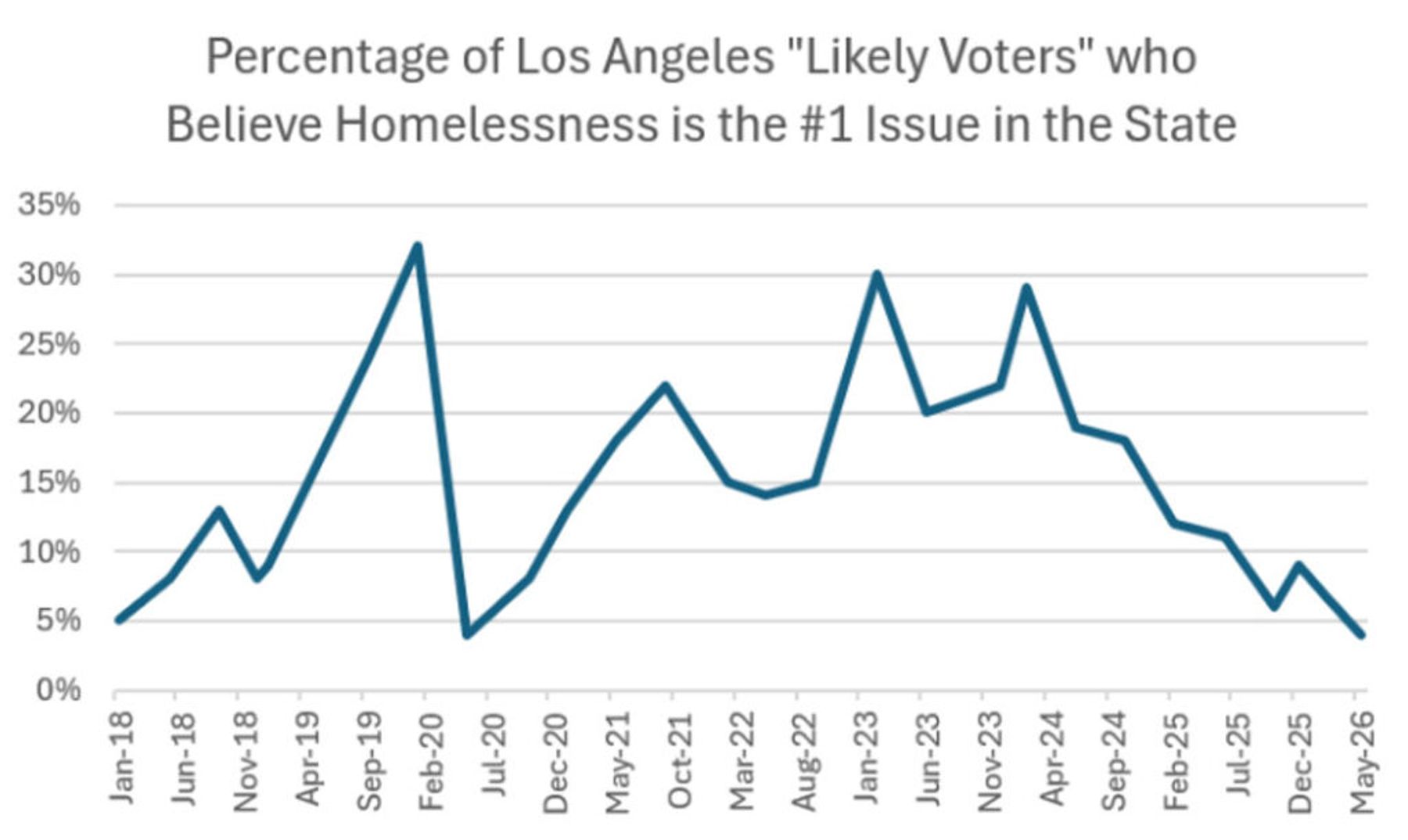
What comes next for homelessness in the United States will depend on two factors. The first is how much voters care about the issue in blue states, where homelessness is truly a crisis. Both Andrew Cuomo and Spencer Pratt’s mayoral campaigns failed because they overestimated how important homelessness was to voters in New York and Los Angeles. Cuomo and Pratt were, by and large, aligned with their electorates on the issue, but other concerns, especially affordability, mattered more. When Pratt lost, only 4 percent of voters in the Los Angeles region told pollsters that homelessness was their biggest worry, down from close to one-third a few years ago, while 42 percent cited ”cost of living, economy, inflation.” Affordability has eclipsed homelessness in Los Angeles voters’ list of concerns, much as Covid-19 did in 2020.
The second factor is the Democratic Party’s civil war. If Democrats score decisive wins in the midterms, homelessness will become one front in the struggle between the party’s center-left and far-left wings. Far-left Democrats in Congress will want to countermand Trump’s reforms to the Continuum of Care. Many centrist liberals don’t want a revival of Housing First, but it will take political courage for any Democrat to defend policies backed by Trump. The center-left has thwarted homelessness policy reform before.