Over three hours at Triple Moon Coffee on Middletown’s Central Avenue, Sam Ashworth gave me a firsthand account of the small Ohio city’s slide from its midcentury peak. He arrived in the summer of 1964 as a freshly minted college graduate, thrilled to join Middletown’s industrial icon, Armco Steel, working in what he describes as the company’s internal advertising agency. “I was really lucky. Armco was booming.”
It was indeed. Originally the American Rolling Mill Company, Armco had established itself in the postwar era as a pillar of the American industrial economy. Specializing in flat-rolled and corrosion-resistant sheets, it was one of the primary suppliers for General Motors as the Midwest surged to become the world’s top manufacturing hub. By 1960, Armco had climbed to number 40 among U.S. companies in revenue, pulling in more than $1 billion annually. Shortly after Ashworth’s arrival, the firm announced a $600 million investment in new technologies and processes to solidify its excellence and cement its Middletown Works at the center of the regional supply chain. Armco’s national stature was embodied by CEO Bill Verity Jr., later U.S. Secretary of Commerce under President Ronald Reagan.
Finally, a reason to check your email.
Sign up for our free newsletter today.
By the time Ashworth left Armco to launch his own design studio in 1979, he and his wife had been blessed with three children—native Middies, as the locals call themselves—and had put down roots that remain strong more than half a century later. Unknown to him at the time, however, Armco’s best days—and the city’s—were already in the rearview mirror.
In the ongoing discourse over Middle America’s hollowing out, no state is more emblematic than Ohio, where once-flourishing small and midsize industrial cities dot the map between the anchor metros of Cincinnati in the south, Cleveland in the north, and Detroit just across the Michigan border. Memories of a thriving Ashtabula—the hometown of former U.S. Trade Representative Robert Lighthizer—set the backdrop for No Trade Is Free, his influential book on globalization and the decline of working-class American life. The husk of Portsmouth, a once-proud steel town on the Ohio River, provides the setting for journalist Sam Quinones’s Dreamland, chronicling the opioid crisis’s toll on the heartland.
But it is Middletown—thanks to Vice President J. D. Vance’s 2016 memoir, Hillbilly Elegy—that has become the ultimate lightning rod for postindustrial America. In Vance’s politics, places like Middletown, Ashtabula, and Portsmouth are casualties of a global trading system rigged against them and in desperate need of policy fixes to stanch the bleeding. My visits this year to Middletown and Dayton, a larger city to its north, attest to the enduring challenges and dire prospects that their residents face. Local opportunities are no longer as remunerative as they were for Ashworth’s generation—or even for his Gen X children—and civic life is muted, sustained mostly by longtime residents.
Yet not all of Ohio tells the same story. While Vance’s portrait of decline remains relevant, just an hour and a half up Interstate 71 from his childhood home sits bustling Columbus, a growing metropolis attracting diverse industries and gaining national stature. It’s a city open to all Ohioans, ready to serve their needs—as it did Vance’s own, when he attended the state’s flagship university in the 2000s. Today’s economic trends and industrial developments suggest that Ohio, true to its motto, remains at the heart of it all.
Approaching Columbus from the west on Ohio’s well-maintained Eisenhower Highway, the prevailing impression is one of growth. New-build suburbs burst from the rolling farmland at the city’s edge, ten miles from downtown. Construction cranes and modern midrise housing developments just beyond the highway’s sound wall form a jarring contrast with the fields and silos that had stretched to the horizon only moments earlier. Curling north of downtown on Interstate 670, a sign of Columbus’s rising place in the national economy appears straight ahead: the new home field of Major League Soccer’s Columbus Crew. Though Ohio is a football state, Columbus’s young, professional, and more progressive population makes it a fitting home for one of America’s premier soccer-specific stadiums.
Approaching the city from the east gives a subtly different impression—one of techno-industrial expansion. Just off State Road 161, Intel is building a $28 billion semiconductor fabrication plant of biblical proportions. The scale of its plot in suburban New Albany—more than 1,000 acres—and the kinetic energy it exudes are awe-inspiring. From a vantage point north of the site along Green Chapel Road, I counted a dozen cranes, each over 300 feet high. At the fab-to-be’s west entrance along Clover Valley Road, American flags and signs proclaiming “Project Cardinal: Building the Silicon Heartland” and “Intel Foundry Construction Enterprises” greet visitors. On the plot immediately south of the entrance sits a Bechtel site; off to the southeast, a classic American farmhouse. Across Clover Valley are greenfield plots with commercial real-estate signs advertising the New Albany Tech Park.
Promising though it appears, Intel’s Ohio project has faced notable delays as the company works to stabilize its finances. In 2024, Intel reported an overall $18 billion operating loss and pushed the site’s expected chip-production date from 2027 to 2030. Yet construction at the megasite continues. Backed by federal CHIPS Act funding and state-level tax and infrastructure incentives, the project remains central to Intel’s future. In April, new CEO Lip-Bu Tan restructured the firm to cut management layers and bring engineers closer to top leadership. By shifting focus from chip design—where it trails competitors—to manufacturing, Intel aims to strengthen its role in U.S. supply chains and make Columbus a key national tech hub. Intel says that construction will put 7,000 Ohioans to work, and that the fab will support 3,000 jobs once operational.
Columbus’s most exciting development, though, lies ten miles south from downtown, where Rickenbacker Airport—among the busiest cargo-first airfields in the country—will become home to the defense-tech startup Anduril’s Arsenal-1 factory. After a fierce bidding process, Columbus won the contract for Arsenal-1 in January, beating out finalist sites in Texas and Arizona. Anduril hails Columbus as “the ideal home for this historic effort to rebuild the arsenal of democracy.” When I talked with him in May, Zachary Mears, the company’s senior vice president for strategy, cited the “density of [Columbus’s] existing workforce,” along with Rickenbacker’s rail, ground, and airport infrastructure. Slated to begin production next year, Arsenal-1 will be Anduril’s flagship factory for its autonomous aircraft and weapons systems.
Even to the untrained eye, Rickenbacker’s appeal to a defense manufacturer is manifest. The area includes Air and Army National Guard facilities, and the Rickenbacker Parkway—looping 270 degrees around the airport runways—and the intersecting Ashville Pike are lined with massive, modern distribution centers for companies like BASF and Goodyear. Amazon, UPS, DHL, and FedEx also maintain major operations there. Anduril’s 500-acre greenfield site will offer direct access to two 12,000-foot runways and a 75-acre private aircraft apron.
What seals the case for Columbus is the region’s embedded aviation and defense ecosystem. Just over an hour west lies Wright-Patterson Air Force Base, home to the Air Force Research Laboratory. Mears explained to me that, as with other businesses, it is “important for [Anduril] to be close to core customers” as it iterates upon its products—specifically, the Fury autonomous fighter jet.
In choosing Ohio, Anduril isn’t building a cluster from scratch; it’s integrating into an existing one, with strong agglomeration advantages. A key lesson from China’s manufacturing dominance in its Pearl River Delta—a 100-million-person megalopolis stretching from Guangzhou to Hong Kong, with manufacturing powerhouse Shenzhen at its center—is the power of tight feedback loops between customers and producers. With the Air Force selecting Anduril last spring as one of two vendors for its Collaborative Combat Aircraft program, proximity to Wright-Patterson offers a significant strategic edge.
As it did with Intel, Ohio’s state government sweetened the deal, offering nearly half a billion dollars in tax credits. In return, Anduril has pledged that Arsenal-1 will employ 4,000 full-time workers by 2035, with a projected cumulative annual payroll exceeding $500 million. The agreement commits Anduril to remain at the site through the 2050s. Together, Anduril and Intel tie Ohio’s economic future to the bipartisan reindustrialization agenda motivated by China’s rise as a geopolitical rival.
With its most ambitious projects requiring land at the city’s edges, Columbus retains a modest skyline. Its tallest buildings don’t crack national rankings, but the 47-story, 1927 art deco LeVeque Tower adds a distinctive touch. Nationwide Insurance anchors downtown with its multitower complex, Nationwide Plaza, and it sponsors the nearby home arena of the NHL’s Columbus Blue Jackets. Headquartered in Columbus for a century and employing more than 10,000 people in the metro area, Nationwide lends the city a blue-blood, philanthropic spirit that many smaller Ohio cities now lack. At downtown’s center stands the Statehouse, a mid-nineteenth-century capitol building in Greek Revival style.
Two miles north of the capitol is Columbus’s true beating heart: the Ohio State University. With more than 60,000 students and more than 40,000 employees, Ohio State ranks among the largest universities in the country. It’s not the oldest in the state—that title belongs to Ohio University in Athens—but it is Ohio’s academic center of gravity. Staying true to its land-grant mission, Ohio State thrives in the applied sciences: biomedical research, engineering, computer science, and more.
The university’s culture, the young and educated population it fosters, and the resulting knowledge spillovers are propelling Columbus forward, even as other Ohio cities stagnate. When Anduril notes the region’s talent pool as a key draw, it implicitly affirms Ohio State’s growing stature as an educational force. Like Arizona State University in the Phoenix area and the University of Texas in Austin, Ohio State is becoming not only a regional core but also a university of national and geopolitical significance. Columbus doesn’t yet boast the population of Arizona’s Maricopa County or the cultural cachet of Austin—but if Intel and Anduril flourish, it might get there.
“Like the University of Texas in Austin, Ohio State is becoming not only a regional core but also a university of national significance.”
Columbus’s regional GDP has climbed above $180 billion, up from $110 billion a decade ago. According to the Brookings Institution’s Metro Monitor 2025, Columbus ranks second in the Midwest among metros with more than 1 million people on its overall growth index. From 2010 to 2023, the city’s real median household income grew by 7.8 percent, outpacing the national average. Talking with Rea Hederman and Greg Lawson of the Buckeye Institute, a state think tank, from their office on Broad Street overlooking the Statehouse reinforced my optimism about Columbus. It’s a city with room to grow, they observe, with a welcoming housing and regulatory climate and a niche in the knowledge economy.
Though its economic fortunes have lapped the rest of the state, Columbus doesn’t stand apart from Ohio: it knits the state together. On fall Saturdays, Ohio Stadium—the “Shoe,” as Buckeye fans affectionately call it—swells with more than 100,000 people clad in scarlet and gray, chanting “O-H” and answering “I-O.” The communal ritual is as powerful a unifier as any in the country. Unlike most big state universities with proud football traditions—Alabama must contend with Auburn, Oklahoma with Oklahoma State, Michigan with Michigan State—Ohio State stands alone. Support for the Buckeyes cuts across race and class, in Columbus and throughout Ohio.
While Phoenix and Austin still outdo Columbus on many growth and productivity metrics, Columbus offers something that they don’t: genuine urban texture. Whereas most Sunbelt boomtowns sprawl across eight-lane arterials, Columbus preserves a walkable, lived-in core that urban traditionalists love. German Village’s narrow lanes and nineteenth-century brick homes feel closer to Philadelphia’s Rittenhouse Square than to the flat, staid image that many East Coasters have of the Midwest. Katzinger’s Deli on Third Street serves a Reuben that could make even a New Yorker’s mouth water. Between downtown and the university, Italian Village and the Short North evoke Washington, D.C.’s Shaw and U Street districts, with Fox in the Snow bakery offering galettes across the street from Peach Haus, Ohio’s self-proclaimed “first glute gym.”
Columbus isn’t just a city for laptop workers, though. It remains an affordable metro where people outside the professional class can thrive. Columbus ranks seventh nationally in the Brookings Institution’s measure of “geographic inclusion,” which tracks employment rates, income gaps, and poverty disparities across neighborhoods. Housing is still within reach for many: the average home sells for under $250,000, according to Zillow. In Grove City, a suburb southwest of downtown, a young HVAC technician or warehouse supervisor can buy a three-bedroom house with a backyard and a garage for under $300,000. Commutes are manageable. Crime is low. For those working in the trades, logistics near Rickenbacker, or the “pink-collar” jobs clustered around Ohio State’s medical centers, Columbus remains one of the few rising metros where it’s still possible to build a good life without a degree—and without leaving Ohio.
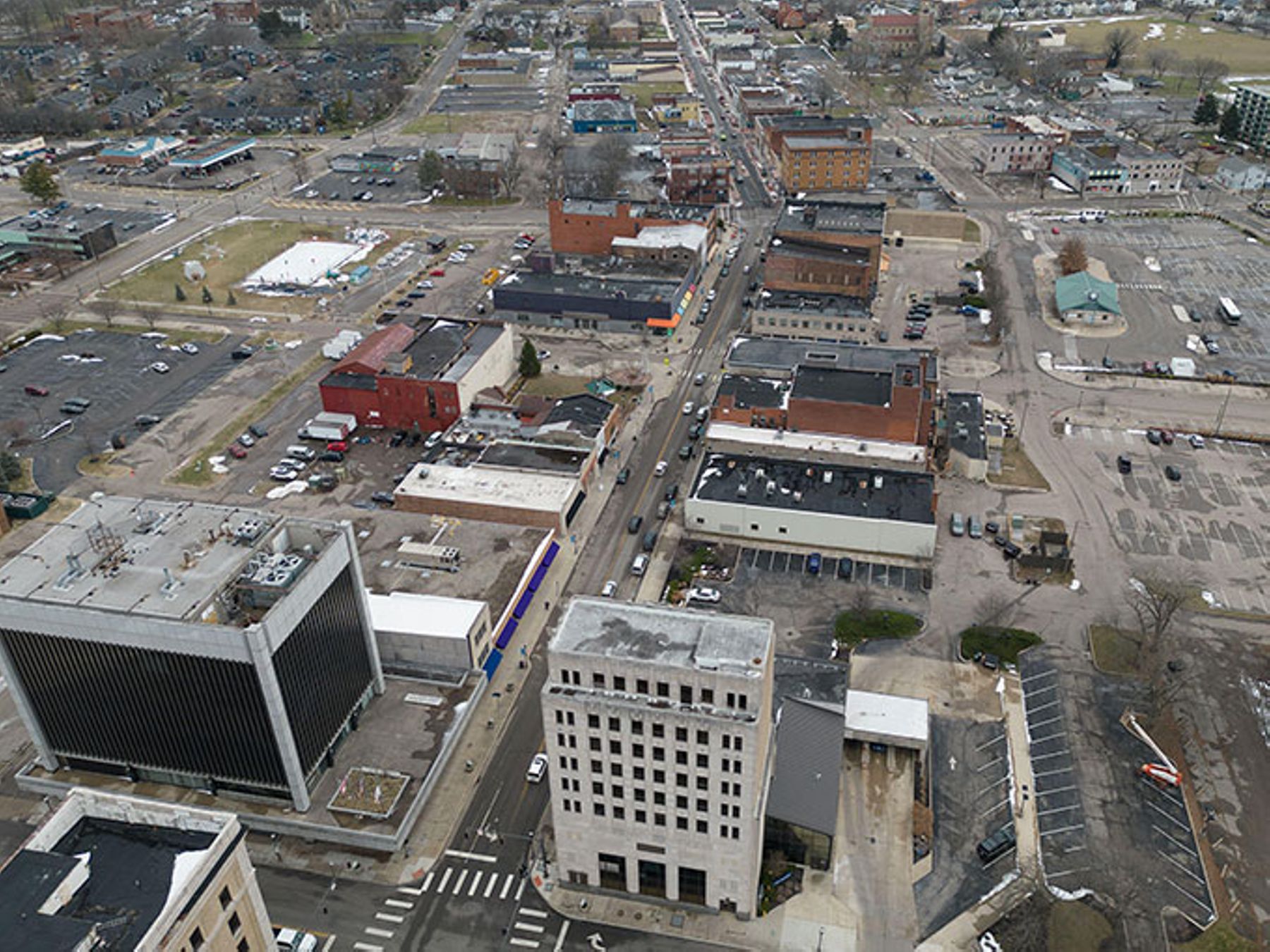
Middletown is the struggling counterpoint to Columbus’s rise. It peaked in the 1970s, just as the postwar economic tailwinds slowed. By the middle of that decade, the city’s population had climbed to about 50,000, and Armco employed more than 7,000 people—about 15 percent of the population. Wages were high, and life was good. But structural weaknesses soon began to undo Middletown’s—and much of Ohio’s—economic success.
“That narrative of deindustrialization,” urban historian Janet Bednarek told me in her office at the University of Dayton, “is central to the stories of Cleveland, Cincinnati, Dayton, Youngstown, Toledo, Akron—really, cities across Ohio.” In the 1980s, Bednarek was completing her Ph.D. in Pittsburgh and had a front-row seat to Steel City’s industrial collapse, a larger-scale version of Middletown’s. “There’s this tipping point,” she says, “where it goes from ‘we’ve still got some of this’ to ‘wow, it’s all gone.’ It’s a phenomenal shock to cities.”
For Ohioans, the results were ugly—and made even more painful by the galloping economies of major coastal metros. While inflation-adjusted household incomes rose nationally by more than 10 percent from the early 1980s to the early 2010s, Ohio’s languished, and even declined in stretches. In 2014, household incomes in Ohio were lower than they had been 30 years prior.
Bednarek identifies three successive pressures that reshaped Ohio’s industrial cities: automation, domestic labor competition, and, finally, outsourcing. “Automation was a big one,” she says. “Factories went from places where you’d see hundreds, even thousands, of people, then to machines, and eventually to robots.” Next came the shift to the Sunbelt, as industrial firms sought to cut labor costs to compete with rising economies in Europe and Asia. “They go to where those southern states are passing right-to-work laws, where unions are weak and getting weaker all the time.” In Dayton, for example, National Cash Register, founded in 1884, shut down all production and moved it to North Carolina. Others shifted manufacturing offshore altogether, seeking cheaper labor abroad. Armco never fully closed the Middletown Works, but the city declined nonetheless. Project 600, the major capital investment that Armco made in the 1960s, kept the mill competitive by boosting efficiency—but at the cost of jobs. Over time, Armco shed thousands of positions, leaving Middletown residents with fewer paths to family-sustaining work, even as the plant kept running.
Sam Ashworth began noticing Middletown’s decline in 1985. While the 1982 recession hit Armco hard, prompting layoffs, manufacturing had always moved in cycles. What happened in the mid-1980s was different. After 68 years at 703 Curtis Street, just blocks from Middletown’s historical core, Armco relocated its corporate headquarters to Morristown, New Jersey, 20 miles outside Manhattan. In November 1985, the New York Times described the move as part of new chairman Robert Boni’s “decentralization strategy.” Ashworth understood it differently: management wanted to be closer to financial markets.
The relocation made sense from a fiduciary perspective. Facing rising global steel competition in the 1970s, Armco—like many manufacturers of the era—tried to diversify by acquiring companies outside its core business. The results were disastrous. “In diversifying,” New York Times journalist Daniel Cuff reported in 1984, “Armco took on the problems of other struggling industries. Its oil-drilling equipment business, the National Supply Company, fell into the red when the oil industry slumped. And Armco is bleeding from the operations of its insurance companies, which it has been trying to unload.” By 1985, when Boni replaced longtime CEO Harry Holiday, Armco had posted three consecutive years of losses totaling over $1 billion. With the firm deep in the red, Boni saw easier access to creditors across the Hudson as key to survival.
In many ways, Boni’s corporate maneuvering succeeded. Armco weathered the tumultuous 1980s and formed a partnership with the Japanese conglomerate Kawasaki in the early 1990s, under the moniker AK Steel. In 2020, the American company Cleveland Cliffs bought AK Steel. The Middletown Works remains in operation today, though on a smaller scale and with fewer employees than 50 years earlier.
But when Armco moved its 22 top executives elsewhere, it robbed Middletown of something that no corporate balance sheet could measure: social capital. Ashworth saw the sharpest change in the schools. “When things started to move outside of Middletown—when not only the top management but eventually the middle management moved away—the school system started to go downhill,” he said. In the 1960s and 1970s, Armco executives’ families, especially the wives, served as community pillars, supporting the arts and volunteering widely. They also sent their children to Middletown High School alongside the kids of mill workers and firefighters. Midcentury Middletown was an egalitarian idyll, enjoying the same economic and social feedback loops that Columbus benefits from today.
Ashworth insists that something of that civic ethic survives. He points—literally—to a group of women whose husbands had worked at Armco, who raised their children in Middletown as he did, and who still maintain significant social capital. But they’re widows now, and none of the half-dozen friends who stopped by our table to chat at Triple Moon Coffee was younger than 70.
A semblance of the Middletown social scene that Ashworth entered when he arrived in 1964 may persist—for him. But Vance, an infant when Armco decamped for the East Coast, never experienced it. After Armco’s 1985 departure, Middletown’s social capital eroded, as the community members with the greatest capacity to lead drifted away. Today, though pockets of the city look cheerful and Central Avenue remains tidy, the abandoned Manchester Hotel, the vacant lots, the proliferation of dollar stores, and the vagrants shuffling around them tell the story of a city socially exhausted.
Similar civic tragedies unfolded across the state, Bednarek explained. “When the chief executive officer leaves, when the headquarters leaves, the people left behind do not have the social capital to do the things they did,” she told me.
In Charles Murray’s terms, drawn from his 2012 book Coming Apart, Middletown and Dayton are Fishtowns, while Columbus is a Belmont. Fishtowns have fallen into downward spirals: production grows less competitive, opportunity shrivels, talent flees, and both the economy and civic life deteriorate. Columbus, by contrast, is on the Belmont trajectory—attracting talent, sharpening competitiveness, and reaping the civic rewards.
Middletown’s most famous son, Vance, writes and speaks movingly about its struggles. But he does not fully confront how his own life choices reflect the town’s core problem. Like Boni pulling Armco’s executive team from Middletown in the 1980s, Vance sought opportunity elsewhere—moving to places with the people and institutions capable of advancing his ambitions. After serving in the Marines, he enrolled at Ohio State, as thousands of small-town Ohioans do yearly. From there, his intellect and drive took him to Yale Law School, the San Francisco venture capital world, the U.S. Senate, and now the Naval Observatory. At each step, he drew on social capital that places like Middletown no longer offer.
While no one could blame him for it, Vance’s pursuit of broader horizons deprived his hometown of the kind of person who, in a different era, might have become a local lawyer, a bank trustee, or even Armco’s chairman—a Middletown social pillar.
Uncomfortable though it is to acknowledge, it’s not just coastal enclaves that benefit from these talent migrations—Columbus’s boom, too, has been fueled by drawing in people like Vance from places like Middletown. The diverging fates of Ohio’s cities highlight the conundrum of America’s twenty-first-century economic and social geography: big-city agglomeration benefits are counterbalanced by small-town decline.
This widely recognized tension has spawned a cottage industry around “place-based industrial policy” (PBIP). On the right, Oren Cass and American Compass argue for PBIP on the grounds that every American has a moral claim to rising wages within durable, rooted communities. At the political center, Robert Atkinson’s Information Technology and Innovation Foundation and Adam Ozimek’s Economic Innovation Group advocate funneling talented immigrants to Middle America. On the left, Senator Elizabeth Warren and allied groups like the Roosevelt Institute evoke the New Deal and emphasize the need to address economic inequality.
The bitter truth is that any federal or state effort to channel investment into places like Middletown will inevitably siphon money and talent from places like Columbus, where returns are higher and better aligned with the nation’s requirements. Columbus is not only Ohio’s best asset; it’s also a burgeoning techno-industrial hub that America needs firing on all cylinders as its economic primacy is contested and China’s power grows. Growth in Columbus isn’t zero-sum—it’s a net positive. Thanks to the mysterious power of agglomeration, concentrating enterprising people generates outcomes far greater than if that talent were spread thinly across multiple struggling areas.
Trying to lock more Vances in place would not only make their lives less fulfilling (you don’t meet many Usha Chilukuris in Middletown); it would also weaken the country just as it confronts the century’s defining geoeconomic challenge. China’s major economic centers—Beijing, Shanghai, and Hangzhou, along with the enormous Pearl River Delta—already dwarf the populations of most American states.
America needs companies like Intel and Anduril to push the technological frontier. Their decision to invest in Columbus reflects a recognition of Ohio’s fundamentals: a strong labor pool, solid infrastructure, a favorable regulatory environment, and geographic centrality. Building on those strengths—and clearing the path for more people to join the mix—is the strategy that Ohio should pursue. At the national level, policymakers must recognize the importance of scale: industrial strength in the twenty-first century demands concentration.

For declining smaller cities like Middletown, the focus should be on securing the basics: public safety, education that prepares students for the economy that they will enter, and the preservation of quiet dignity. As Adam Ozimek has proposed, targeted measures like Heartland Visas for immigrant doctors could help support small-town health-care systems, where access and quality often lag.
Middletown could also reposition itself to take advantage of the rise in remote work. With its venerable architecture, Americana charm, and affordability, it has real appeal. Just 35 miles north of Cincinnati, Middletown offers the possibility of a Procter & Gamble employee living in a stately Victorian home and commuting a few days a week. Less than 100 miles from Columbus, it’s within range for occasional travel as well—allowing residents to enjoy small-town life while earning big-city incomes. What Middletown will not regain, however, is the self-sustaining wealth that came from a strong tradable sector, as the humming Armco plant once provided.
It is right to mourn what Middletown has lost. The human tragedy that Vance conveyed in Hillbilly Elegy deserves our attention. But it should not shape our economic policy. The path forward for Ohio is for Columbus’s gravitational pull to strengthen. The path forward for America is to let it.
Top Photo: Bustling Columbus, a growing metropolis attracting diverse industries and gaining national stature, with a welcoming housing and regulatory climate and a niche in the knowledge economy (Isaiah Williams/Alamy Stock Photo)