
A federal court recently ruled against the Trump administration’s imposition of a $100,000 fee on firms trying to hire foreign workers on H-1B visas. Though the fee will remain in place as the administration appeals the ruling, the policy’s future is in jeopardy.
This setback, however, is an opportunity for the administration to reevaluate not just the fee but its whole approach to high-skilled immigration. While it has tried to stop real abuses in the system, the best way to pursue that goal is not through fees or the arcane weighted lottery system that the administration also implemented. A simple, clean approach is best: select visa applicants based on who has the highest earnings relative to their age.
Finally, a reason to check your email.
Sign up for our free newsletter today.
Shaky legal footing and haphazard rollout notwithstanding, the fee does seek to address an important concern: the number of visas going to IT outsourcing firms. These companies are infamous for violating H-1B rules and paying their employees low wages. Because the fee applies only to H-1Bs filed from abroad, which account for over 80 percent of H-1B holders working at outsourcing firms, it has reduced the number of visas these firms get. But that success comes with collateral damage: the many lab technicians, postdoctoral researchers, and other talented professionals prevented from coming to the United States.
The administration has made some attempts to prioritize such people. Last year, the Department of Homeland Security replaced the old H-1B lottery with a new weighted version that gives applicants a better chance at winning if they are categorized at a higher “Wage Level,” a system used by the Department of Labor that sorts wages into one of four categories. An applicant classified at Wage Level IV, for instance, now has four times the chance of being selected as an applicant classified at Wage Level I.
The problem is that a high Wage Level ranking doesn’t necessarily mean high wages. That’s because rather than using just an applicant’s salary, Wage Levels are based on salary relative to occupation and worksite location. For example, a family therapist earning $65,000 in Huntsville, Alabama has twice the odds of earning an H-1B as an aerospace engineer in the same location earning $130,000. Moreover, because wage levels are calculated within occupations and locations, the system tends to benefit experienced applicants in lower-wage fields over fresh talent in advanced fields.
In fact, the new weighted lottery boosts the number of H-1Bs that will go to the IT outsourcing firms. H-1Bs employed at these companies are typically certified at Levels II and III. That means their lottery submissions have double or triple the chances of success compared to recent graduates, who have higher earning potential but are certified at Level I.
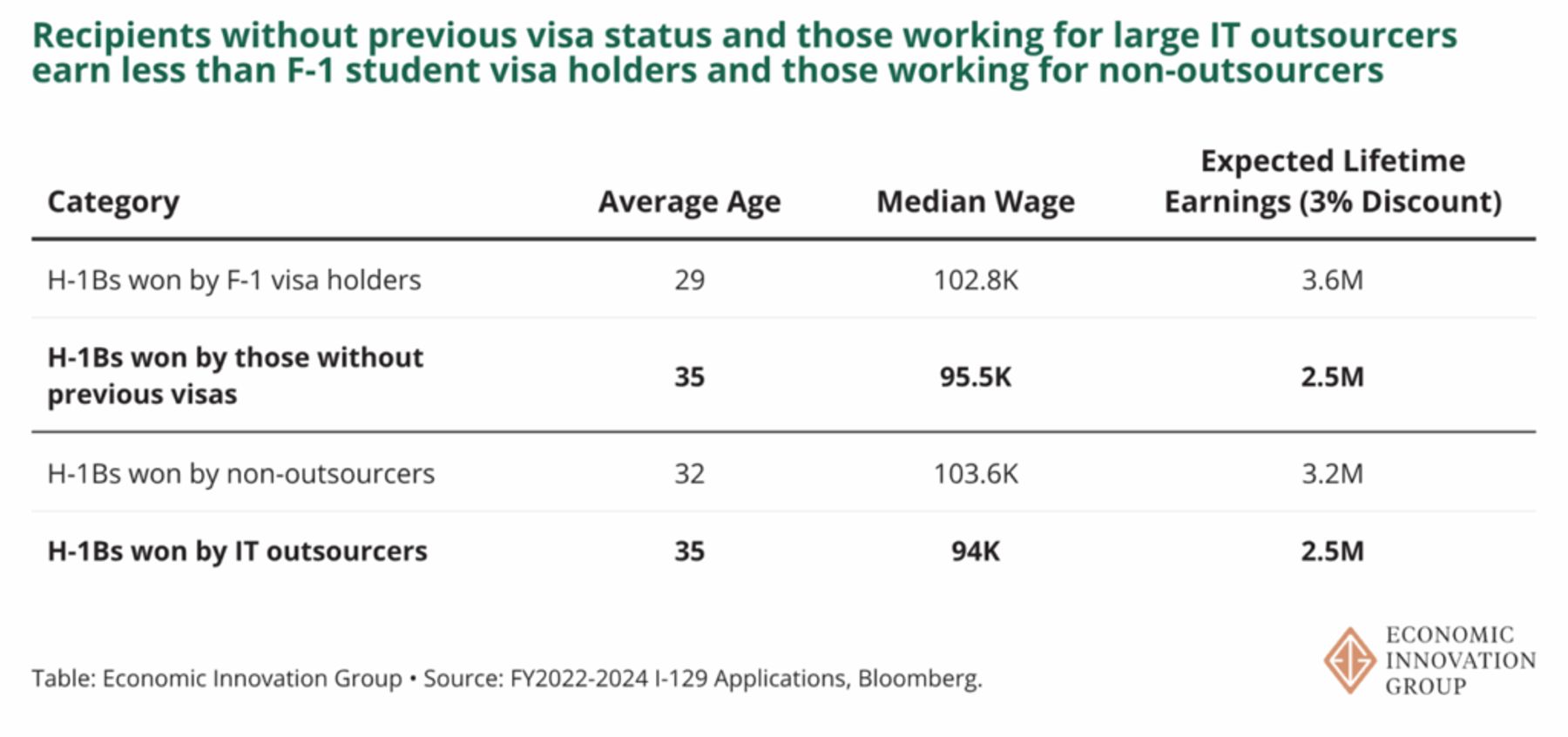
IT outsourcing firms frequently hire H-1B visa holders who initially appear to earn high wages in their respective fields—until you adjust for age. Overall, H-1B lottery winners employed by these firms are generally older and paid less relative to their age group. They are still certified at higher Wage Levels because they make more than younger workers in the field. This enables outsourcing firms to pay their workers less relative to their actual experience.
The administration may be inadvertently making these problems worse. A new proposed rule from the Department of Labor would raise the Wage Levels used for H-1B applications. Specifically, the minimum wage for a Level I worker would rise from the 17th percentile to the 34th percentile of all U.S. workers employed in the same occupation and location , while a Level II worker’s minimum wage increases from the 34th percentile to the 52nd.
To illustrate how this helps outsourcers and harms the next generation of top talent, consider a recent Stanford computer-science graduate seeking certification for a Level I position. He might be earning well above his peers, yet still struggle to clear the new wage floor by virtue of being early in his career. On the other hand, an H-1B worker employed by an outsourcer might have years of experience and can easily meet the new Level II threshold, thus making it more likely he’ll get a visa. While he might make less than similarly experienced IT workers, he still earns more than his younger peers due to his seniority.
In short, wage ranking—just like the H-1B fee—is a bad solution to a real problem. It’s time to try something else.
Thankfully, the administration has also presented an alternative proposal, Experience Benchmarking. Unlike the primary proposal, Experience Benchmarking would set the Level I prevailing wage at the 50th percentile relative to a worker’s projected education level and work experience. This would address the problems with age and tenure inherent in the current system.
We estimate that Experience Benchmarking would reduce the prevalence of IT outsourcers by 27 percent and raise median wages of H-1B lottery winners by $13,000. Since Experience Benchmarking better selects for young, highly educated people who have stronger future earnings prospects, it also raises average expected lifetime earnings by $800,000 and the tax revenue that follows.
While the Labor Department’s adoption of Experience Benchmarking would be a significant improvement to the default proposal, the most transformative change to the H-1B program would be to scrap the lottery completely and select H-1B holders with the highest lifetime earning potential. This would be done by evaluating an H-1B applicant’s salary and making adjustments based on age. Absent the $100,000 fee rule, our research finds that the Trump administration’s changes to the H-1B lottery and the prevailing wages would allow over 18 percent of H-1B workers to go to IT outsourcers. A lifetime compensation system, on the other hand, would reduce overall outsourcer participation to under 4 percent. It would, on average, increase the annual positive federal and state net fiscal impact by over $20,000 for each H-1B holder. This proposal would also favor critical industries—for example, tripling the number of H-1Bs going to workers in artificial intelligence, according to our estimates.
The administration is right to take H-1B abuse seriously. But by focusing on the most valuable potential immigrants, it can both kneecap the outsourcers and make sure that America gets the best and the brightest.