|
Forwarded this email? Sign up for free to have it sent directly to your inbox. |
|
|
|
Good morning,
Today, we’re looking at a dubious weatherization program in California, changes to the Nation’s Report Card, foster care’s “kin-first” culture, and the destructive criminal-justice policies of the Commonwealth’s Attorney for Fairfax, Virginia.
Write to us at editors@city-journal.org with questions or comments. |
|
|
|
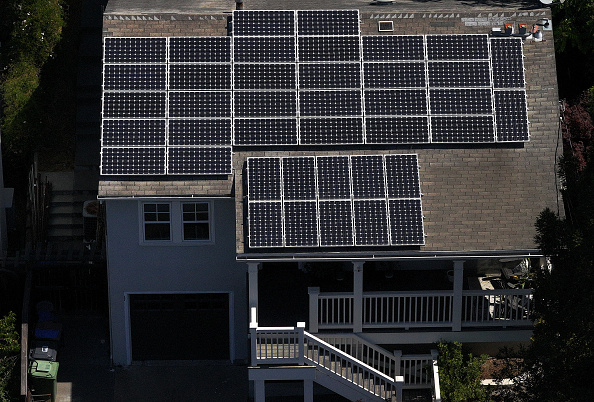
Photo credit: Justin Sullivan / Staff / Getty Images News via Getty Images |
California’s Farmworker Housing Component of the Low-Income Weatherization Program provides free solar panels, windows, and refrigerators to farmworkers. The initiative is part of the state’s “cap-and-trade” system, which taxes carbon producers and redistributes the revenue to left-wing causes. The kicker? Many of those farmworkers receiving the freebies are illegal immigrants.
“Despite a $49 million budget and nearly seven years of operation, the farmworker ‘weatherization’ program has only provided services to about 2,000 families,” Christopher F. Rufo and Austen Hufford write. “That means the State of California has allocated roughly $23,000 per household for its program to provide free solar panels, refrigerators, and other services—a number that raises serious concerns about financial accountability.”
Read more about the program. |
|
|
The National Assessment of Educational Progress (NAEP), also known as the Nation’s Report Card, publishes state-level data only for fourth- and eighth-grade reading and math. That’s about to change, with the National Assessment Governing Board recently announcing that the NAEP will begin publishing state-level data on 12th-grade math and reading and eighth-grade science, and will add an eighth- and 12th-grade civics exam.
“Publicly available data are especially needed because states are increasingly diverging in their approaches to public education,” Danyela Egorov explains. “NAEP data can help assess the impact of these varied strategies and identify which approaches yield better outcomes for low-income students.” Read more.
|
|
|
Earlier this year, two-year-old Jaxon Juarez was placed under the care of his father’s relative after officials in Santa Clara County, California determined his own father was unable to care for him. But the relative they placed him with—his foster mother—had a felony conviction for child endangerment. The placement proved fatal. Jaxon was sexually assaulted by his foster mother’s son and died from the injuries. “Unfortunately, questionable placements like Jaxon’s are increasingly common,” Sarah Font and Emily Putnam-Hornstein explain, “as advocacy groups have pushed federal leaders and state child-welfare agencies to adopt a ‘kin-first’ culture, which prioritizes ‘preventing unnecessary family separation, partnering with families at every stage of decision-making, and supporting families holistically.’”
Read more about the practice and how it has led agencies to ignore warning signs. |
|
|
The lax criminal-justice policies of Steve Descano, the Commonwealth’s Attorney for Fairfax, Virginia, have repeatedly resulted in tragedies for the community he serves, argues former Virginia Attorney General Jason Miyares. One of those tragedies: Stephanie Minter. Earlier this year she was “murdered by an illegal immigrant previously arrested multiple times on rape, robbery, and violent assault charges—nearly all of which Descano’s office had dropped.” “Descano’s defenders want to frame his failures as a philosophical disagreement about immigration enforcement,” maintains Miyares, but the truth is that “Descano spent years systematically undercharging violent criminals—regardless of their immigration status.”
Descano claims his policies are needed to build “community trust.” But the reality is that the “catch-and-release of violent criminals destroys communities,” writes Miyares. |
|
|
“I had a professor in college (Political Science, no less) tell us all in his class that, outside of the professional disciplines like medicine or law, if you can’t get someone to pay for your graduate school, you don’t deserve to be there.”
|
|
|
|
A quarterly magazine of urban affairs, published by the Manhattan Institute, edited by Brian C. Anderson. |
|
|
|
Copyright © 2026 Manhattan Institute, All rights reserved. |
|
| |
|