
Late last week, Zohran Mamdani announced that his administration would end homeless encampment sweeps in New York City. The mayor-elect thus staked out a position on homelessness far to the left not only of public opinion and Mayor Eric Adams, but also of his progressive Democrat predecessor, Bill de Blasio. Local optimists, convinced that Mamdani has abandoned his past extremism, have some explaining to do.
New Yorkers share mainstream Americans’ values when it comes to encampments. A 2021 Manhattan Institute poll found that three-fourths of New Yorkers supported “Empower[ing] police officers to remove homeless encampments if the people living there are offered social services and housing in shelters.” New Yorkers have consistently registered their opposition to encampments by making tens of thousands of 311 complaints annually.
Finally, a reason to check your email.
Sign up for our free newsletter today.
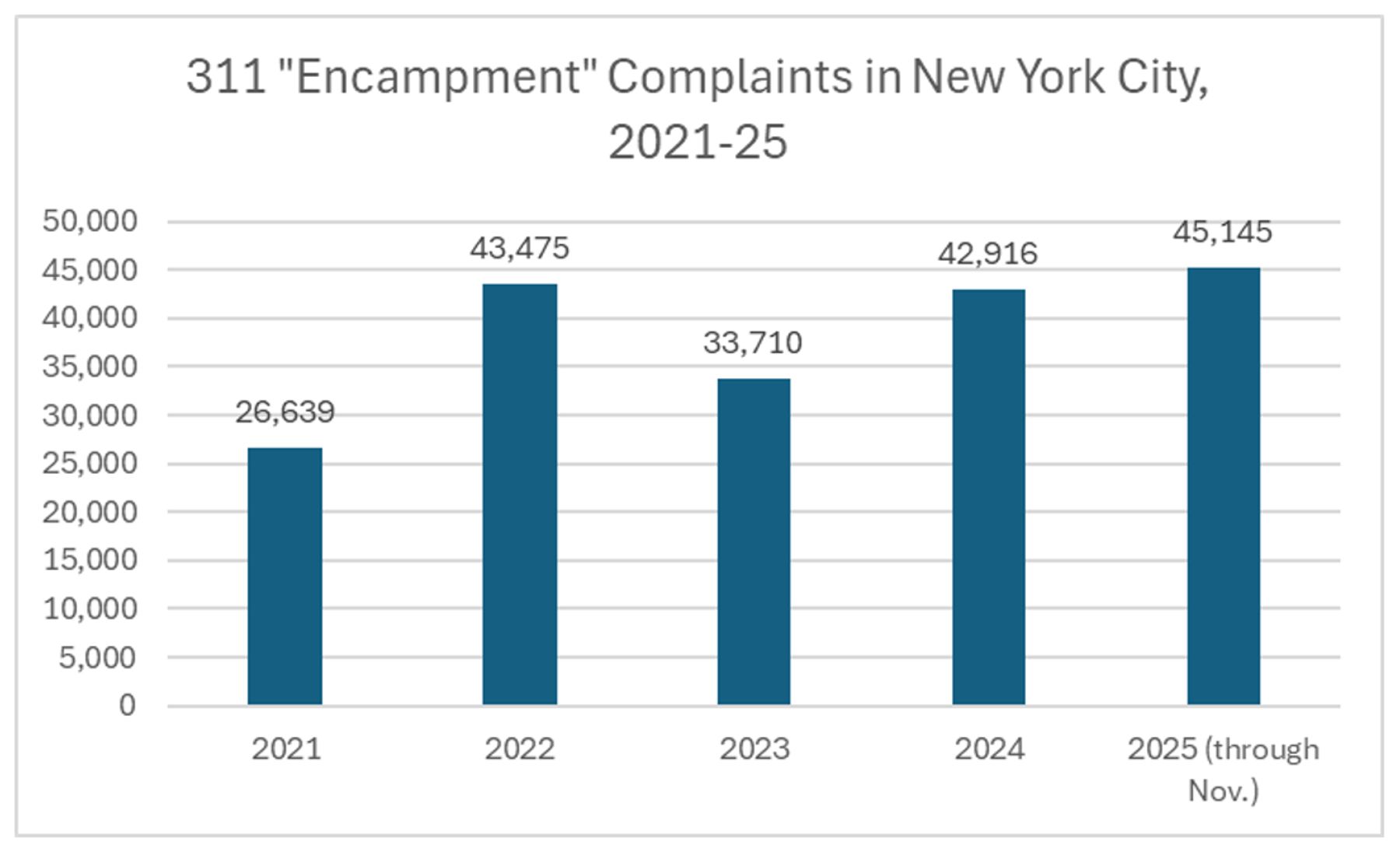
De Blasio opposed encampments. As also reflected in his defense of Broken Windows policing, de Blasio disliked public disorder and realized that, when left-wing politicians keep the lid on crime and quality of life, the public will give them a freer hand with much of the rest of their agenda. The de Blasio administration conducted hundreds of sweeps per year.
The Trump administration, obviously, opposes encampments. President Trump’s July executive order “Ending Crime and Disorder on America’s Streets” called for prioritizing grant funding for communities that “enforce prohibitions on urban camping and loitering.” Thus, Mamdani’s tent-hugging could jeopardize the $174 million New York receives in homelessness funds from the U.S. Department of Housing and Urban Development.
A recurring fallacy in progressive reasoning on criminal-justice issues goes like this: if the status-quo response to addiction, mental illness, or street homelessness isn’t 100 percent effective—and if police play any role in that response—then the police must be the reason it’s not working.
But housing-focused and behavioral health-led responses to social problems fail, too, even without the cops. The figure below presents trends in permanent supportive housing units and street homelessness. Note that the two lines don’t cross, scissors-style, as they would if expanding the stock of housing for the homeless pushed down street homelessness in the straightforward way that many advocates promise.
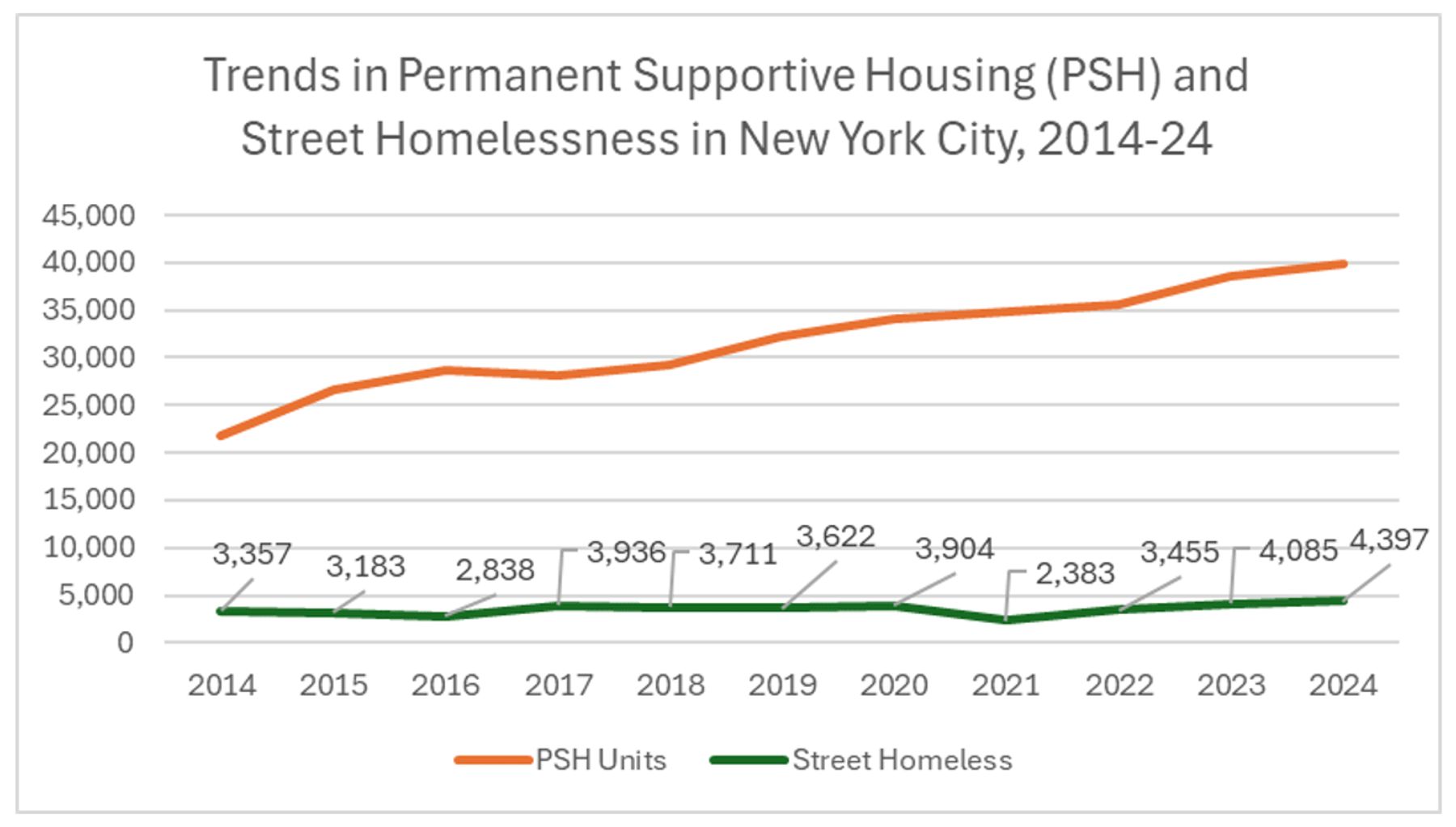
According to data published by the Coalition for the Homeless, between 2014 and 2024, New York placed more than 17,000 individuals in supportive housing. But as the figure shows, street homelessness actually grew by about 1,000 across that span.
Reasonable people may disagree as to whether New York presently has too much street homelessness. But it is unreasonable to insist on higher standards of effectiveness for your opponent’s position than for your own. Mamdani’s criticism of sweeps echoes that of a knuckleheaded 2023 report by City Comptroller Brad Lander, which contended that Mayor Adams’s cleanup efforts failed because relatively few of the encampment residents wound up housed post-sweep.
The client of a homeless shelter is the homeless person. The primary client of a homeless-encampment cleanup is the public. Sweeps can offer a secondary benefit by helping outreach workers persuade rough sleepers to enter shelter (guaranteed as a right in New York City). But their main justification is simpler: normal cities do not allow tent dwellers to colonize sidewalks, parks, and other public spaces.
One potential beneficiary of Mamdani’s affirmation of street homelessness is California governor Gavin Newsom. New York and California, simply by virtue of their sizes, will play leading roles in settling the current debate over whether the Democratic Party should veer centrist or socialist. Newsom and other California Democrats have much to atone for in homelessness policy. Of late, though, they’ve prioritized enforcement. Tents are down in San Francisco.
Will Newsom, who has taken care over the years to get himself photographed participating in cleanups, use Mamdani’s encampment laxity to position himself as a sensible centrist? Around this time in 2021, many centrist Democrats looked hopefully at New York and Eric Adams’s law-and-order brand, while California Democrats still had much to sort out. What a difference four years can make.
Photo by BG048/Bauer-Griffin/GC Images