The first thing to note about Walter Isaacson’s new book is its remarkable title: The Greatest Sentence Ever Written. If you’ve forgotten that we’re approaching the 250th anniversary of America’s founding, you might assume that this is a book by a tweedy English professor—a dreary, pedantic treatise on “the sentence” as a literary artifact, complete with footnotes lamenting grammar’s role in oppression and colonialism.
Fortunately, you’d be wrong. Instead, Isaacson offers a brisk dive into the nation’s origins, viewed through Thomas Jefferson’s scintillating string of words in the preamble to the Declaration of Independence. What makes these words the greatest sentence of all time? Not the grammar, rhythm, or diction—though they linger in the mind—but what comes into view when we lift our eyes from the page: the richest, freest 340 million people on earth, dominant in science, medicine, technology, and nearly every other human endeavor. This chaotic, headlong rush to greatness flows from words inked by rebels on a piece of decaying parchment. For 250 years, Americans have tested their implications, explored their limits, and expanded their possibilities.
Finally, a reason to check your email.
Sign up for our free newsletter today.
That sentence now rests in the National Archives in Washington, D.C., inside a bespoke titanium-and-aluminum encasement no one can touch, sealed behind bulletproof glass no one can breach, and flooded with argon gas no one could ever breathe. All of this protects the wellsprings of our life, liberty, and pursuit of happiness—secure for centuries, the archives assure us, so long as the humidity remains calibrated, the temperature holds at 67 degrees, and sensors stand guard against oxygen, moisture, and light.
But is that enough to preserve the spirit of the American Revolution? It isn’t. When it comes to damage, decay, and fracture, philosophy is more corrosive than time. Even as America stands atop unprecedented achievements, it teeters toward bankruptcy, with bipartisan agreement on only one point: unlimited spending. Faction and disorder prevail. Cities are too often corrupt, filthy, unsafe—and they burn. Elite universities have become woke madrassas run by intellectual sideshow clowns, producing graduates who campaign for office on promises of wealth seizure. Assassins roam. Birthrates have collapsed. Tech titans and eco-warriors sermonize about impending apocalypse, while talk of civil war or impeachment greets each new crisis. The bonds that once held Americans together are fraying.
Isaacson’s meditation is a reminder of what binds us as a people—the deepest source of our greatest achievements—and of how we might yet correct the nation’s perilous course. At just 67 pages, it is more essay than book, yet more powerful than the preservation technologies of the National Archives. Above all, it is a welcome attempt to conserve and restore the meaning of the ideals that animated the nation’s founding.
In his biographies of Leonardo da Vinci, Benjamin Franklin, Steve Jobs, and Elon Musk, Isaacson has shown a gift for making complicated ideas clear and engaging. He brings the same lucidity to the story of America’s birth. I only wish the book were longer, for our future depends on our past. Between the cheap fireworks, barbecues, documentaries, the 1619 Project, land-use acknowledgments, and America 250, we are long overdue for a serious examination of the document that made us Americans in the first place.
What do we mean by the Revolution? The war?” John Adams asked Thomas Jefferson in an 1815 letter. He answered himself: “The war? That was no part of the Revolution; it was only an effect and consequence of it. The Revolution was in the minds of the people . . . fifteen years before a drop of blood was shed at Lexington.”
What propelled the colonies into rebellion was not merely a decade of hostile legislation from Parliament but the principle behind it: Parliament’s claim to total sovereignty over the colonists. At bottom, the conflict was a philosophical dispute about the source and limits of political authority. Parliament could annul colonial laws, reverse court judgments, and impose unconstitutional taxes—the Stamp Act, the Tea Act, and others—only as symptoms of that deeper quarrel.
By 1775, the dispute over sovereignty had hardened into open confrontation. Parliament renounced protection of the colonies, thrusting Americans back into a state of nature. It declared their ships lawful prizes, dispatched foreign mercenaries, quartered standing armies in homes and public buildings, and flooded colonial governments with parasitic placemen and officials. When fighting erupted at Lexington and Concord in April 1775, it still took over a year—after towns were torched and cities occupied—for the colonists to abandon hope of reconciliation.
The colonists revered the unwritten English constitution under which they had long lived. Within that legal tradition, petitioning the king for redress of grievances was a formal practice with deep roots. Twice—in 1774 and again in 1775—Parliament refused even to answer the Americans’ lawful petitions.
“Between the cheap fireworks, the 1619 Project, and America 250, we are long overdue for a serious examination of the Declaration.”
So what was the Declaration? Its primary purpose was not philosophical. First and foremost, it marked the end of a legal process that had begun two years earlier: the failure of reform by petition. In violation of its own constitution, Britain had refused to offer remedies for colonial grievances or even to acknowledge them.
Second, and here the history is often muddled, the Declaration did not itself make the colonies independent. That was accomplished by a resolution of the Continental Congress on July 2. (John Adams wrote in 1776 that July 2 would be forever celebrated.) The Declaration was the public announcement of that earlier act, which explains its structure: a preamble followed by a bill of particulars justifying the decision.
Finally, it was also a declaration of war—or, depending on one’s point of view, a public declaration of treason.
The drafting of the Declaration began in early June 1776, and Jefferson did not start from a blank page. He worked from a substantial body of precedents. Isaacson opens his book in medias res, in the thick of an editorial process. Congress appointed a committee of five—Benjamin Franklin, Thomas Jefferson, John Adams, Roger Sherman, and Robert R. Livingston—to prepare a declaration. The others tasked Jefferson with producing a first draft, which they edited and annotated before submitting it to Congress on June 28, where the full assembly undertook a final round of revision.
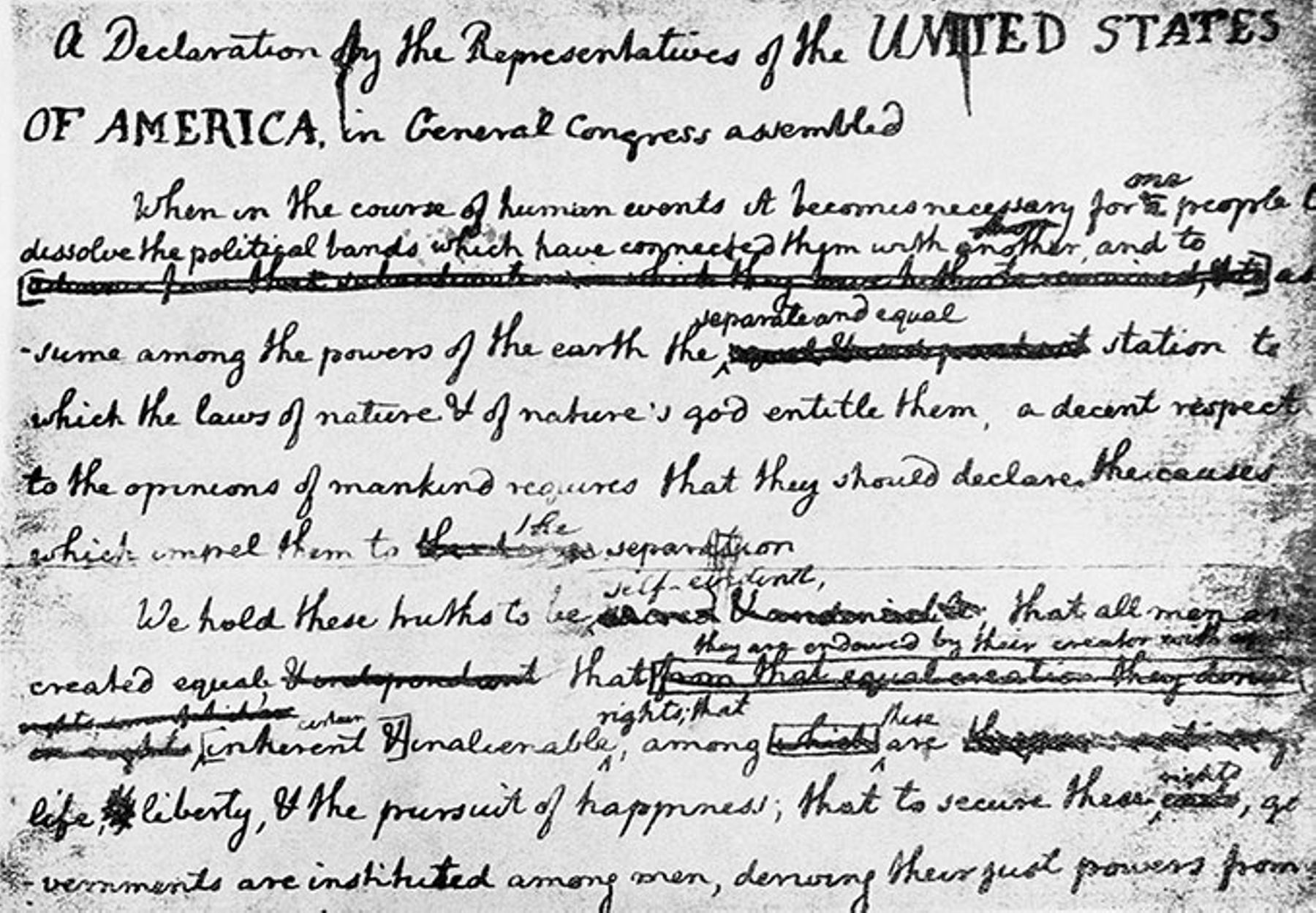
We still have a copy of Jefferson’s draft bearing edits by Franklin, Adams, and the others. In it, Jefferson wrote: “We hold these truths to be sacred.” Someone crossed out “sacred” and replaced it with “self-evident.” We cannot say with certainty who made the change or why. But Isaacson argues that this tiny shift marks a hinge in intellectual history, a decisive break with the past.
“Sacred” and “self-evident” rest on fundamentally different foundations. Here we see a step away from governments grounded in ancient tradition and divinely sanctioned hierarchy—kings, dukes, earls, viscounts, and barons—and toward a nation in which, as Isaacson puts it, “our rights are based on reason.” Historians have long debated the authorship of the edit. Isaacson believes that he can identify the hand, recognizing in the cross-out the heavy backslash strokes that Franklin used throughout his career as a printer.
The Declaration, in any case, was not invented out of whole cloth. Over 15 years of conflict with Britain, the colonists developed a loose but connected set of arguments to justify resistance to British authority. The revolution “in the minds of the people” that Adams later described was everywhere—in speeches, newspapers, broadsides, and pamphlets—touching on natural rights, liberty, representation, sovereignty, and consent.
Drawing on these ideas, colonies had already begun issuing their own declarations of independence in the months before July 1776, along with new constitutions. Even towns and voluntary associations produced their own declarations; historians have collected more than 90 of them. In Virginia, Jefferson’s home state, George Mason drafted a Declaration of Rights that the legislature ratified. Jefferson almost certainly read it on June 12, 1776, in the Pennsylvania Gazette. Its first clause states:
That all men are by nature equally free and independent and have certain inherent rights, of which, when they enter into a state of society, they cannot, by any compact, deprive or divest their posterity; namely, the enjoyment of life and liberty, with the means of acquiring and possessing property, and pursuing and obtaining happiness and safety.
Thus, when Jefferson sat down in Philadelphia, and when Adams and Franklin proposed edits, they were not beginning anew. They were transforming materials already at hand. Reaching back to received traditions, constrained by centuries-old institutions, and informed by the charters and constitutions then taking shape, Jefferson and his colleagues were less creators than revisers and amenders—above all, master condensers of a profound poetic crystallization:
We hold these truths to be self-evident, that all men are created equal, that they are endowed by their Creator with certain unalienable Rights, that among these are Life, Liberty, and the pursuit of Happiness.
Here, Isaacson submits, is “the greatest sentence ever crafted by human hand.” To make his case, he leads the reader on a word-by-word tour, showing how a single choice can open onto a vast panorama of philosophy, history, and character.
Take “all men,” and then “all men are created equal.” Isaacson devotes a chapter to each. Did “all men” mean all of humankind? At the time, that was the common usage, giving the claim a broadly inclusive scope. It meant all people. But how, then, could the colonists accept slavery, exclude women and non-landowners, and wage war against Indians? Here, Isaacson largely shrugs. The Founders, he argues, were pushing into new intellectual territory while remaining creatures of their age; even the most radical Enlightenment figures, Rousseau included, held views now indefensible.
There are, however, clues to a broader meaning. In the next chapter, Isaacson highlights a puzzling passage from Jefferson’s original draft—a complaint against King George III that Congress ultimately struck. In it, Jefferson makes an impassioned, if deeply unfair, claim that the king alone was responsible for slavery and the slave trade, which he condemns as “a cruel war against human nature itself, violating its most sacred rights of life and liberty in the persons of a distant people who never offended him.” He goes on to accuse the king of keeping open “a market where MEN should be bought & sold.”
Jefferson was a man of profound contradictions. Over his lifetime, he owned some 600 slaves. And yet in this omitted passage, he capitalizes “men,” signaling a universal claim—not only about men in the narrow sense but about women and children as well, all of whom were bought and sold in those markets.
Soaring idealism was meant to clash with reality, to test how far it could bend without breaking. Jefferson lost this particular battle; the delegates struck the passage. But the seed planted in the preamble endured. A dynamic process had begun, one in which moral principles would steadily limit and reshape politics.
The rebels of the American Revolution are rarely given sufficient credit for jump-starting the abolitionist movement. The glaring contradiction of proclaiming that all men are created equal and endowed with unalienable rights while holding thousands of black laborers in bondage was obvious to contemporaries, from Jefferson himself to the British, who exploited the hypocrisy to denounce the American cause.
That same charge has acquired strange modern allies. The perceived hypocrisy has led contemporary leftists to question the legitimacy of the Revolution. In August 2019, Nikole Hannah-Jones of the New York Times launched the 1619 Project in a special issue of The New York Times Magazine, portraying the American Revolution as a racist effort aimed at protecting slaveholders’ interests. (See “The Truth About Slavery and America.”) In her introductory essay, she wrote: “One of the primary reasons the colonists decided to declare their independence from Britain was because they wanted to protect the institution of slavery.” The claim was swiftly challenged by prominent historians—among them Gordon Wood, James McPherson, and Sean Wilentz—and the Times later issued a partial correction, revising “the colonists” to “some of the colonists.”
But was that correction enough? Worldwide abolitionism began in the American colonies, and it grew out of the ideals of the revolutionary spirit. As the Harvard historian Bernard Bailyn shows in his sweeping study The Ideological Origins of the American Revolution, in the three decades before 1776, pamphleteers, ministers, scholars, journalists, legislators, poets, madmen, and tavern drunks alike launched a sustained assault on the institution of slavery. These revolutionaries were following the internal logic of the philosophy that they were advancing for themselves.
Again and again in the decades-long buildup to 1776, the colonists framed their discontent as a struggle against enslavement by Britain. “We are taxed without our consent expressed by ourselves or our representatives,” John Dickinson wrote in his widely read Letters from a Farmer in Pennsylvania in 1768. “We are therefore—SLAVES.” Such language appears throughout revolutionary writings, in diaries, letters, and broadsides alike. The contrast between what the colonists demanded for themselves and what they imposed on others was an obvious embarrassment. It required no great leap of logic to extend their revolutionary principles to the enslaved black population denied those same rights in their midst.
Even before Jefferson drafted the Declaration, abolitionist action was under way. In 1775, American Quakers formed the first antislavery society in the Western world. Rhode Island and Connecticut freed any slave imported into their territory. Pennsylvania taxed the slave trade out of existence and abolished slavery in 1780; Vermont did so in 1777. The First Continental Congress banned the slave trade in 1774, though the issue later reverted to the states. In the 1780s, enslaved people in Massachusetts won their freedom by arguing before the state’s highest court that slavery violated their rights as free and equal men.
True, nationwide emancipation would not come for nearly another century, and only at immense cost and tragedy. The setbacks were many and horrific. Yet it must also be acknowledged that slavery’s eventual dismantling began only because the philosophy of the American Revolution contained the seeds of its destruction. The Declaration was foundational.
What, then, is the greatest sentence ever written actually saying? Far from serving as the permanent or singular foundation of American politics and identity, it was, at its birth in 1776, unexceptional to the colonists themselves, and largely forgotten for the next 15 years. It restated ideas that they had already expressed elsewhere. As Jefferson later recalled, his aim “was not to find out new principles, or new arguments, never before thought of; but to place before mankind the common sense of the subject, in terms so plain and firm as to command their assent, and to justify ourselves in the independent stand we are compelled to take.”
Even the Declaration’s harshest British critics paid little attention to the sentence that Isaacson celebrates. Soon after its publication, two loyalists, Thomas Hutchinson and John Lind, produced lengthy refutations, devoting hundreds of pages to rebutting the specific charges against King George III, while largely ignoring the preamble’s claims about rights. “Of the preamble, I have taken little or no notice,” Lind wrote in 1776. “The truth is, little or none does it deserve.”
Only with time did the preamble’s ideas acquire a kind of sacred halo, as though handed down by wiser ancestors. It took half a century or longer for the sentence to assume the symbolic power it holds today.
By the mid-nineteenth century, Abraham Lincoln would call those principles “the definitions and axioms of a free society.” For him, they became the moral yardstick by which all governance, even the Constitution itself, must be judged: principles antecedent to government, more fundamental than its institutions, and therefore limiting to them all.
The South advanced many rationalizations for secession. Yet the Civil War was, at bottom, fought over a single clause in the Declaration: that all men are created equal. The Confederacy’s intellectual architects could have ignored that claim; instead, they spent decades insisting that it was false. They opposed it so fiercely because they recognized it as part of the philosophical bedrock of freedom and knew their way of life could not rest upon it.
That is why the United States remains unique: the first nation founded not on ethnicity, territory, language, or religion—or through “accident and force,” in Alexander Hamilton’s phrase—but on an idea. What that American idea means has been contested from the beginning.
The Constitution has generated countless commentaries, interpretive theories, and a secondary literature that no single person could ever hope to master. Supreme Court cases routinely turn on clashes among various schools of thought. Though it is not a legal document, the Declaration has likewise inspired enduring debate over its original meaning, the intent of its authors, and the reach of its principles.
What, then, is more fundamental than the Constitution? On this point, many now agree: the Declaration. That’s why we mark the nation’s birth on July 4, 1776, rather than in 1788, when the Constitution was ratified. Every act of American governance ultimately claims fidelity to—or seeks to implement—the self-evident truths of the preamble. Like physical gold, those truths are rare in human history, immensely valuable, and not created by institutions; they exist independently as the moral foundation of the system, setting limits on what legislatures, presidents, and courts may do.
A major crisis of governance tends to drive appeals down to first principles. That is what happened in the Civil War. When statutes or constitutional interpretations fail, debate returns to the Declaration’s self-evident truths as the ultimate standard: equality before the law, unalienable rights, and the consent of the governed.
“Every act of American governance ultimately claims fidelity to—or seeks to implement—the self-evident truths of the preamble.”
That’s where we find ourselves again in 2026, in a struggle over what it means to be an American. The Civil War settled whether private citizens could own slaves; it did not settle whether the state itself could become a master. We are drifting toward debt servitude. With nearly $38 trillion in debt, the United States risks financial collapse, social fragmentation, and disorder. Each new crisis accelerates distrust and deepens division. The preservation of liberty has always required resistance to adversity, and it always will.
On one textual detail, Isaacson’s account merits a closer look. The greatest sentence ever written did not end, originally, where he says it ends—after “the pursuit of happiness.” As scholar Danielle Allen has maintained, that period appears in neither Jefferson’s draft, nor Adams’s copy, nor the engrossed version signed by the delegates. It entered the text later, when a printer accidentally inserted a period. (The National Archives reproduces the period on its website, drawing from an 1823 copperplate made from the printer’s rendering.)
The sentence as originally drafted affirms not only rights but the right of revolution when government becomes corrupt, wasteful, or destructive of those rights:
We hold these truths to be self-evident; that all men are created equal, that they are endowed by their creator with inherent & inalienable rights; that, among these are life, liberty, & the pursuit of happiness; that to secure these rights, governments are instituted among men, deriving their just powers from the consent of the governed; that whenever any form of government becomes destructive of these ends, it is the right of the people to alter or to abolish it, & to institute new government, laying it’s foundation on such principles & organising it’s powers in such form, as to them shall seem most likely to effect their safety & happiness.
The remainder of the sentence reminds us that governments exist for a purpose, and that when they cease to serve it, or become hostile to liberty, the people retain the right to alter or abolish them.
As storms gather again, Americans will return to these fundamentals. The nation’s future may hinge on recovering the rights that Isaacson leaves out: a consent that is real, not hypothetical, and a revolution understood as creative renewal rather than civil war. Our first revolution, after all, need not be our last.
“Let us re-adopt the Declaration of Independence,” Abraham Lincoln said in Peoria in 1854, “and—with it—the practices and policy which harmonize with it.” That, he believed, would not only save the nation but make it worthy of saving.