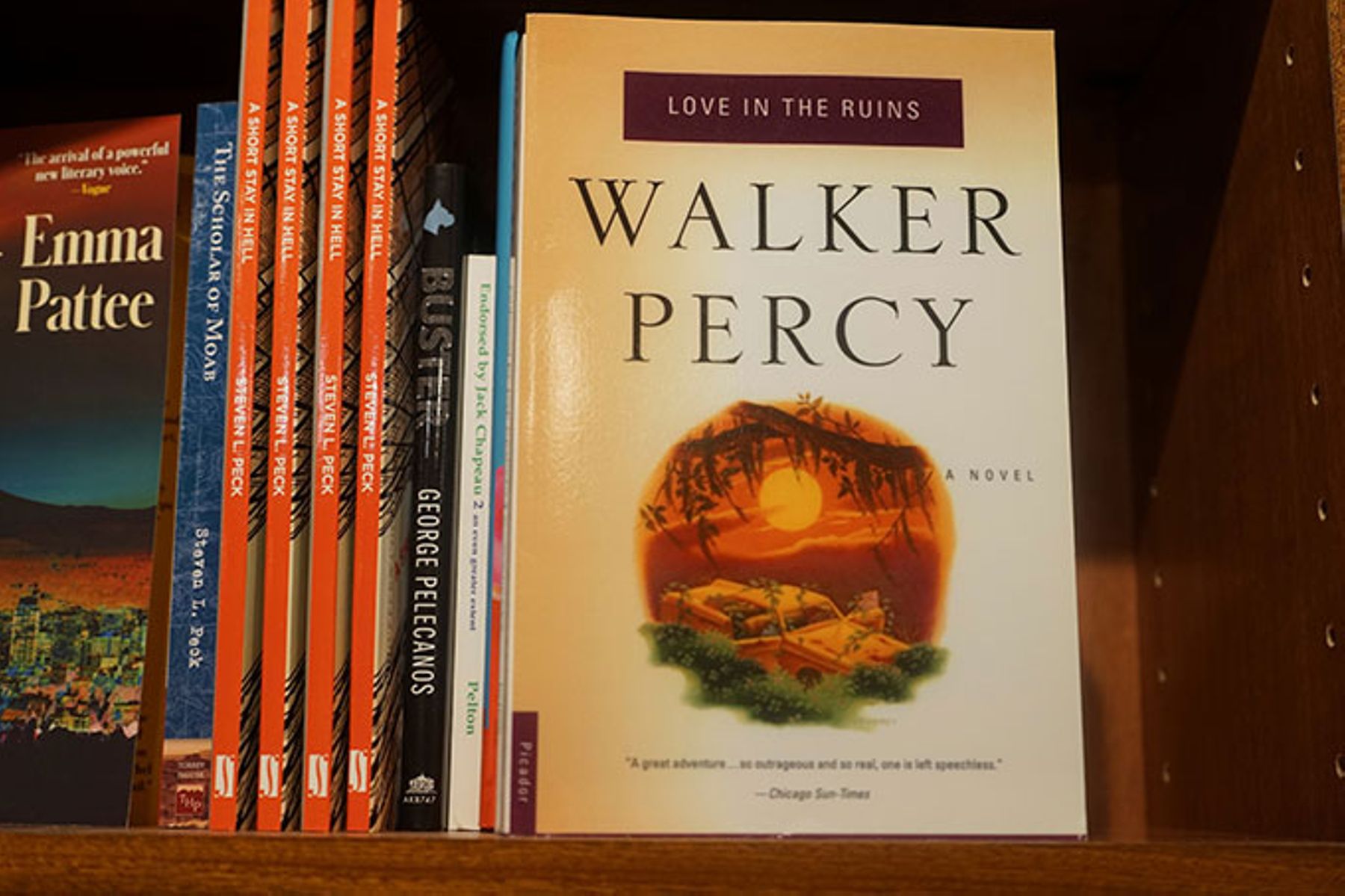
Walker Percy’s 1971 novel Love in the Ruins now reads like prophecy. Set in a collapsing America riven by ideology, technological upheaval, loneliness, and spiritual exhaustion, the novel captures the strange mixture of decadence and despair that often marks contemporary life. It meditates on what Americans forget when political disorder obscures human nature, moral responsibility, and the civic inheritance embedded in the Declaration of Independence—timely, if sobering, themes as the United States observes its 250th birthday.
A doctor trained at Columbia University, Walker Percy left medicine after contracting tuberculosis while conducting Skid Row research in the 1940s. He turned instead to fiction and philosophy, producing novels and essays that retain remarkable power and relevance. Though rooted in the modern South—a South of air conditioning, civil rights, suburbs, and prosperity—Percy’s work reaches beyond region, exploring the anxieties and moral disorientation that accompany modern affluence and equality.
Finally, a reason to check your email.
Sign up for our free newsletter today.
In Love in the Ruins, America has lost not only political unity but also a shared understanding of reality. Citizens have retreated into ideological, racial, religious, and cultural camps, viewing one another less as fellow citizens than as abstractions and enemies. Persuasion gives way to tribal loyalty; coexistence becomes increasingly difficult. The novel’s protagonist, Dr. Thomas More, observes that “our beloved old U.S.A. is in a bad way”—it is a country divided by “race against race, right against left, believer against heathen.”
Percy’s society is visibly decaying. America’s great cities have fallen into disrepair: wolves roam the streets of Cleveland; motorists abandon broken-down cars along the roadside; roads and sidewalks crack as weeds and vines creep through the ruins of civic life.
The novel unfolds in Feliciana Parish, Louisiana. More lives in Paradise Estates, a wealthy, heavily guarded enclave, whose residents divide between religious traditionalists and scientific progressives. He practices medicine locally while conducting research in nearby Fedville, a federally funded sector where scientists seek to understand the nature of man.
Beyond the ordered world of laboratories and gated neighborhoods lies a neglected social wilderness. Bordering Feliciana Parish is a swamp inhabited by hippies, social castoffs, and Bantu fighters—black Marxist revolutionaries living on the margins of society. No one appears interested in reintegrating them into any genuine civic or moral community. Their presence, lingering at the edge of federal power and upper-class comfort, casts an ominous shadow over a civilization in decline.
For More’s Fedville colleagues, scientific materialism provides the only legitimate account of man. Human freedom, love, courage, hatred, violence, and the capacity for self-destruction—all are dismissed as pathologies or relics of a less enlightened age. Religion survives only as the residue of humanity’s intellectual adolescence. At Fedville’s “Love Clinic,” even sexuality is reduced to stimulus and response, a set of impulses to be studied, managed, and ultimately mastered.
More’s own invention reflects the telos of this project: the “Ontological Lapsometer,” a device purportedly capable of detecting the psychic imbalances tearing apart “the soul of Western man.” It measures electrical activity in the brain and promises to quantify anxiety, rage, lust, and despair, offering a scientific diagnosis—and eventually a supposed treatment—for such afflictions. Percy uses the lapsometer to expose the technocratic temptation to treat moral and metaphysical disorder as if it were merely an engineering problem, even when his fictional diagnostician knows better.
For More ultimately stands apart from the technocratic worldview. A kind of Renaissance man, he possesses a grounding not only in science but also in religion, history, and the tragic dimensions of politics. Unlike the ideological partisans who surround him, he understands how political movements become dangerous when detached from the realities of human nature.
Yet More remains embedded in his society: he has family, friends, colleagues, and acquaintances on both sides of the novel’s cultural divide. He observes that “most Americans do well enough,” and on the surface, he doesn’t “notice a great deal of difference” between the two warring ideological camps. His right-wing neighbors descend into “unseasonable rages, delusions of conspiracies, high blood pressure, and large-bowel complaints,” while his left-wing neighbors “contract sexual impotence, morning terror, and a feeling of abstraction of the self from itself.”
The gated community that More calls home includes residents from both the Right and the Left, making it one of the few places in the novel where coexistence survives. More recognizes that, while his Fedville colleagues cannot grasp the full measure of the human person, his reactionary neighbors relegate man no less aggressively to a political instrument. Both sides reduce the person to ideology.
On the Right, political and religious commitments merge into a suffocating orthodoxy. Partisan loyalty becomes so intense that believers abandon churches that refuse to conform to the latest ideological demands. The Catholic Church has splintered into rival wings. One “believes in relevance but not God.” Another plays the “Star-Spangled Banner” during Mass and champions “property rights and the integrity of neighborhoods.” Rather than transcending political division, religion itself becomes captive to it, as man’s longing for God, forgiveness, and peace is bent toward ideological conflict.
More, however, remains within the official Roman Catholic Church. He attends Mass in the old slave quarters, where the local parish has retreated into humbler surroundings. A self-described “bad Catholic” at the novel’s outset, More ultimately finds in faith the means to endure the death of his daughter from cancer, the collapse of his marriage, and alcoholism. As a coda reveals, he remarries, has children, recommits himself to medicine, and—most important—learns to love and forgive others, something that had long eluded him.
Political violence and assassinations have become almost routine in the America of Love in the Ruins. More observes that his mother predicted four of the last five assassinations and concludes that American democracy is not long for this world. He sees these recurring eruptions of violence as signs of profound disrepair. As citizens lose any shared understanding of themselves and one another, violence becomes a tonic—a path toward self-recognition through an emphatic release of passion in service to ideology. Citizens no longer react to aggression by trying to improve society. Instead, they mentally bypass the violence, refusing to reflect on its ominous implications.
“Don’t tell me the U.S.A. went down the drain because of leftism, apostasy, pornography, polarization, etcetera, etcetera,” More perceptively reflects. “All these things may have happened, but what finally tore it was that things stopped working and nobody wanted to be a repairman.” Many point to single causes or grand explanations for America’s problems, but More looks around his family, town, workplace, and parish and instinctively understands why society is cracking up: ideological groups exaggerate partial truths while overlooking the deeper bonds that hold a society together.
Much of the novel’s diagnosis turns on Percy’s broader theological and anthropological project, which sees man as an in-between being, suspended between God and the beasts. Human consciousness makes us uniquely aware of the possibilities of freedom, autonomy, intimacy, and misery. Yet the very qualities that distinguish man from the clockwork-determined universe also allow him to lose himself in ways no other creature can. Only man wonders about himself and others, longs to know what is true and real, and creates symbols to interpret reality. And only man descends into alienation, loneliness, depression, and madness.
Is citizenship possible once we lose the signs, clues, and mystery of who we are? A recurring theme is that if man exists between angels and beasts, he must avoid the twin temptations of “angelism” and “bestialism.” Angelism abstracts the person from both self and world. It is the disposition of the ideologue, though Percy uses the concept more broadly to illuminate what it means to live as an embodied human being. Rather than seeing the dense web of memory, family, community, and attachment that shapes human life, the angelist imposes theory upon a world treated as an experiment.
More observes that adherents of angelism become captive to abstract visions of how humanity and society ought to be organized, regardless of reality. Their ideals become the lens through which they interpret the world. Several key characters in the novel embody this tendency.
One example is Uru, a former black studies professor and athlete who leads the Bantu revolutionaries and seeks to build a socialist order from the ashes of a corrupt, capitalist, racist society. He captures More at gunpoint—but More’s life is spared by a black church deacon whom Uru mocks for showing compassion toward his supposed enslavers. From this near-death episode, More concludes that ideological commitments can justify terrible violence and scapegoating. For both More and Percy, what matters most is what binds man to love and responsibility: community, faith, and family. The church deacon possesses these things; Uru despises them.
We can describe man’s bestial aspect as a descent into desire and primitivism, in which we cease to see ourselves as persons and citizens but only as members of a tribe or collective. In Love in the Ruins, reactionary citizens profess religious belief, but politics becomes primary. Faith plays only a supporting role. Percy’s America features a Mormon president and a Southern Baptist vice president, both committed to a religious-nationalist ideology and convinced that their political enemies must be destroyed.
Love in the Ruins ends curiously. It offers no real resolution to the creeping social disorder and violence. Bantu guerrillas continue organizing for revolution, while a devious federal agent, getting hold of More’s invention, manipulates the local population toward orgiastic brutality. More collapses and awakens several days later beside Ellen, his loyal clinic nurse and eventually his new wife. She assures him that little has happened and that life has largely returned to normal. The murders that punctuate the novel turn out to have been committed by the “Love Community,” a collection of swamp tribes ignored by wider society. They profess belief in freedom (license), love (casual sex), and environmentalism elevated above the human person. In them, angelism and bestialism merge.
In later remarks on the novel, Percy said: “What interested me is what can happen in a free society in which Orwell and Huxley have carried the day. . . . For this novel deals not with the takeover of a society by tyrants or computers or whatever, but rather with the increasing malaise and finally the falling apart of a society which remains, on the surface at least, democratic and pluralistic.” Percy suggests that liberal democracy can conceal a deeper disorder of man. The regime has long depended on the moral inheritance of biblical religion and the virtues necessary for human flourishing. Yet it cannot easily restore those virtues once they erode. When modern ideologies discard the religious and classical understanding of the person, liberal democracy offers little guidance about what should replace it.
Percy’s analysis applies readily to America’s disordered condition today. The novel’s memorable opening, though written more than a half century ago, speaks in an apocalyptic register that sounds familiar:
Now in these dread latter days of the old violent beloved U.S.A. and of the Christ-forgetting Christ-haunted death-dealing Western world I came to myself in a grove of young pines and the question came to me: has it happened at last?
Two more hours should tell the story. One way or the other. Either I am right and a catastrophe will occur, or it won’t and I’m crazy. In either case, the outlook is not so good.
Many Americans in 2026 seem to be operating at a similar pitch. Many of our most influential citizens have embraced angelism. The dominant intellectual tendency combines radical individual autonomy with social and economic collectivism, both requiring an expansive federal state guided by progressive ideology. This worldview often speaks as if loneliness and social fragmentation are problems of management or neurological adjustment, as though Percy’s lapsometer had escaped the novel.
We also see a bestial tendency emerging within parts of the new Right, where religion and politics fuse into an identity seemingly immune to persuasion or compromise. Figures such as Nick Fuentes represent a strain of thought influential in some right-wing circles. Conspiracy, isolationism, and, increasingly, anti-Semitism become elements of a pseudo-Christian politics that ignites fury online and in public life.
If we leave Percy’s fictional America and turn to our own, we find a nation deeply divided and increasingly incapable of civic trust. America remains a constitutional republic, but more as a fading habit than a confidently sustained achievement. A 2023 Pew Research Center survey found that 58 percent of Americans believed that life was better 50 years earlier. Yet 1973 marked nearly the end of one of the country’s most violent and destabilizing periods. In 1971–72, the FBI recorded roughly 2,500 domestic bombings, nearly five per day. Violent crime today remains well below the levels reached in the late 1960s and 1970s. Still, the comparison is unsettling.
The first decades of this century have also been turbulent: unpopular wars in Iraq and Afghanistan, presidential impeachment battles, the investigation into Donald Trump’s alleged ties to Russia, and a Covid-era public-health regime that dramatically expanded state authority. The pandemic, in particular, fostered distrust by teaching Americans to regard neighbors as potential threats. Vaccines became, for many, instruments of social and economic coercion, with some citizens facing loss of employment if they refused them. Later revelations that officials in the Biden administration pressured social-media companies to suppress dissenting information deepened public suspicion.
The skepticism extends beyond government into ordinary relationships. Americans once understood politics as a sphere distinct from friendship, religion, family, and work. That separation has eroded. A widely cited 2020 Pew study found that nearly half the country had stopped speaking to someone because of political disagreements.
Political violence has followed. During the 2024 campaign, Trump survived two assassination attempts, one missing him by less than half an inch. Had either succeeded, the consequences for the country would likely have been catastrophic, convincing many Americans that political force, not persuasion or elections, had become the decisive instrument of power.
Nor were these isolated incidents. The 2017 shooting of Republican congressmen during a baseball practice, the attempted assassination of Justice Brett Kavanaugh, the murders of UnitedHealthcare CEO Brian Thompson and conservative activist Charlie Kirk, and the murders and shootings of Minnesota lawmakers and their families all reveal a political culture increasingly drawn toward purification through violence. Add to this the rise in anti-Semitic attacks, school shootings, and ideological extremism, and Percy’s warnings no longer appear distant or exaggerated.
The United States sometimes seems like the kind of society that Percy described: one in which citizens struggle to trust one another or practice the ordinary habits of self-government. The deeper cause is not merely polarization but the triumph of ideological and paranoid politics among citizens who have abandoned the richer moral anthropology on which our American constitutional order once depended.
Much contemporary political thought either dismisses this constitutional framework or quietly transfers sovereignty to an administrative class that distributes rights and privileges according to its own moral priorities. In doing so, it reduces political life to two actors: the isolated individual and the state. In Democracy in America, Alexis de Tocqueville warns that this democratic tendency will weaken liberty and normalize the soft despotism of an egalitarian administrative order.
What America requires instead is a prudent restoration of constitutional self-government and the common good through the symbols, principles, and inherited practices that Americans still share. Yet we continue down the opposite path, toward resentment and perpetual reaction. Citizens increasingly lack the humility and decency necessary for honest disagreement, and political settlements therefore do not endure. Ideological parties, plebiscitary elections, overactive presidents, and an increasingly unbounded judiciary produce a politics of continual escalation.
We need repairmen, but it is not clear that anyone still wants the job.