
The faculty, administrators, and trustees who establish graduation criteria at America’s most prominent colleges and universities have made a clear set of judgments about what every educated citizen should know. Their choices suggest that familiarity with diversity, equity, and inclusion (DEI) is more essential than an understanding of economics, American history, and the Constitution.
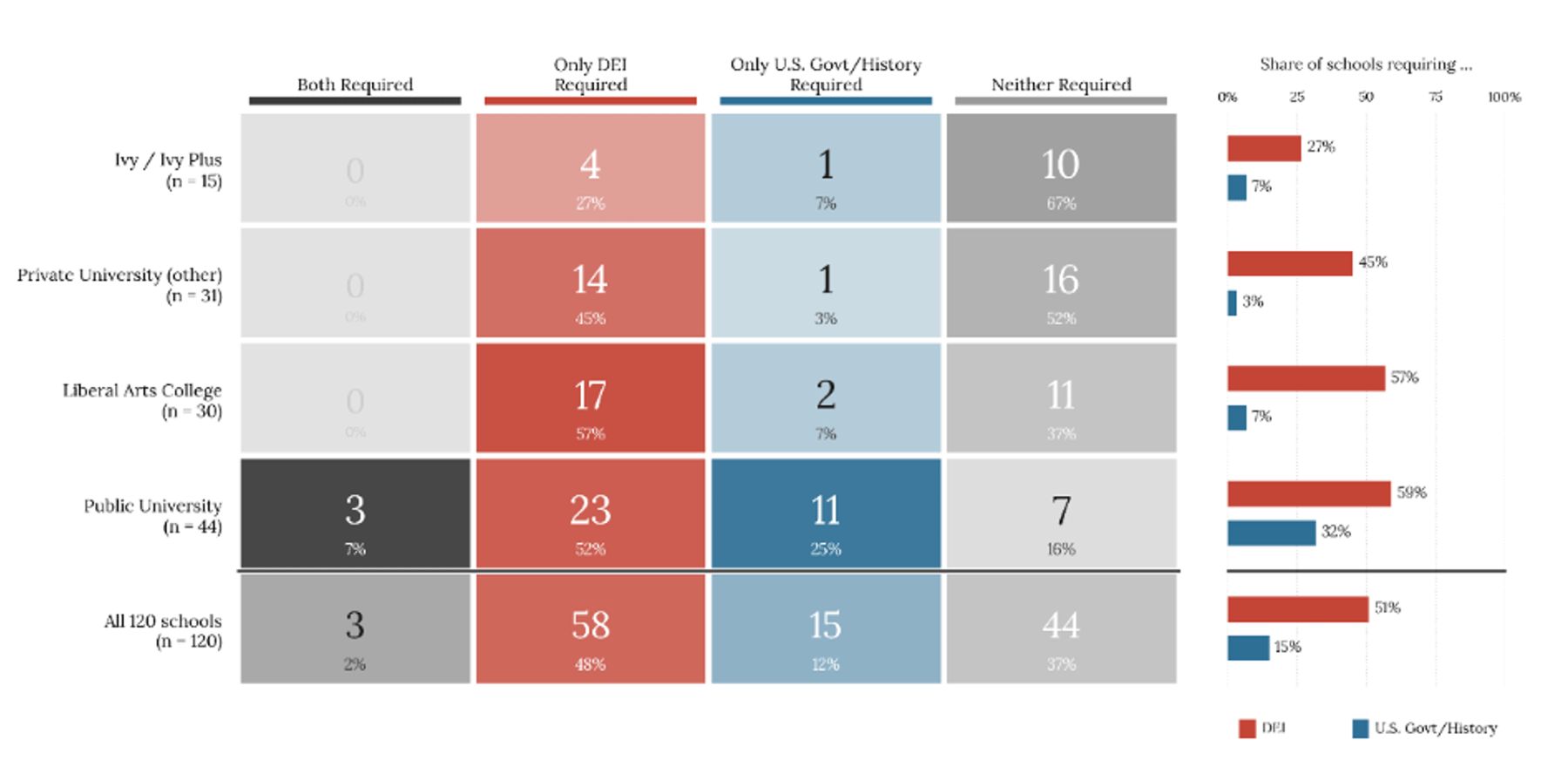
City Journal’s College Rankings track graduation requirements across a wide range of prominent colleges and universities, including top public flagships, elite private research universities, leading liberal arts colleges, and the Ivies. While none of the 120 schools currently ranked requires an economics class to graduate, and only 15 percent stipulate a course in U.S. government or American history, 51 percent mandate coursework organized around the conceptual vocabulary of diversity, equity, and inclusion. These schools—which have long produced a disproportionate share of the nation’s lawyers, judges, editors, executives, and senior civil servants—make clear to their students that material centered on race, gender, power, and inequality is essential, while material on the U.S. Constitution, American history, and sound economics is not.
Finally, a reason to check your email.
Sign up for our free newsletter today.
Strikingly, every type of higher education institution in City Journal’s College Rankings prioritizes DEI coursework over basic civic education. Among private schools (Ivy, “Ivy Plus,” private research universities, and private liberal arts colleges), course requirements in U.S. government or history are virtually nonexistent, appearing at fewer than one in ten schools. Despite legislative mandates in nine states obligating students to take U.S. government and American history, fewer than one in three public universities makes these classes necessary for graduation.
By contrast, mandatory DEI courses are widespread, appearing in the general education curriculum of 27 percent of Ivy League and Ivy Plus universities; 45 percent of private research universities; 57 percent of private liberal arts colleges; and 59 percent of public flagships. For example, Georgetown University now demands that all students complete a “Seminar in Race, Power, and Justice” to develop “a baseline vocabulary for discussing racial difference and marginalization.” The “Difference, Power, & Equity” prerequisite at Williams College “encourages students to confront and reflect on the operations of difference, power and equity” and seeks to “provide students with critical tools they will need to be responsible agents of change.” Students at the University of Vermont must take a class on “Race and Racism” that teaches the “meaning and significance of power and privilege.”
Regardless of one’s view of these priorities, nothing prevents coursework in U.S. government, American history, and DEI from coexisting within a general education curriculum. As Figure 1 shows, however, they almost never do. Only three of the 61 campuses mandating a DEI course for graduation also require a class on U.S. government or American history. In practice, then, colleges and universities are not crafting graduation requirements that supplement a dedicated focus on civic education with insights from DEI—instead, they are supplanting curriculum on U.S. government and American history with courses that emphasize identity, power, and inequality.
Figure 1: DEI and U.S. Government/American History Requirements at Prominent Colleges and Universities
The consequences of these curricular priorities are increasingly hard to ignore. Today’s college students know very little about American history or the functioning of American democracy. ACTA’s 2024 survey found that 60 percent could not correctly identify term lengths for senators and U.S. representatives; 48 percent wrongly believe that the president has the power to declare war; and only 31 percent know that James Madison was the father of the Constitution. We should not be surprised that an approach to higher education that makes U.S. government and American history optional is producing students who are historically uninformed, civically illiterate—and hostile to basic norms of free expression. In 2025, the Foundation for Individual Rights and Expression’s annual College Free Speech Rankings survey asked students whether six controversial speakers from across the political spectrum should be “allowed” to speak on campus. None of the speakers were endorsed for a campus appearance by a majority of students. Further, 34 percent said that “using violence” to stop a campus speech can be “acceptable.”
What colleges and universities choose to make mandatory may be just as important in shaping students’ perceptions, judgments, and moral instincts as what they leave optional. Studies of corporate training programs, for example, have found that DEI initiatives can generate a backlash effect, increasing racial resentment and negative perceptions of the workplace among some employees. More directly, experimental evidence suggests that assigned DEI coursework can meaningfully influence student attitudes. In a 2024 study by researchers at Rutgers University’s Social Perception Lab and the Network Contagion Research Institute, students exposed to short excerpts from widely assigned DEI authors became more likely to perceive prejudice in ambiguous situations and expressed stronger punitive impulses toward imagined offenders. If even brief exposure to assigned DEI material can measurably increase suspicion and strengthen retaliatory instincts, sustained semester-long exposure in a required course is likely to produce deeper and more lasting effects.
Of course, none of this is inevitable. These outcomes reflect a series of intentional curricular choices. These choices can be revisited and reversed. Two recent proposals have identified a path forward. Last month, citing polling data on socialism’s growing popularity among young Americans, Samuel Abrams argued that colleges and universities should add economics to their graduation requirements. A few days later, ACTA’s National Commission on American History and Civics Education called on colleges to require a foundational course in U.S. history and government centered on the Declaration of Independence, the Constitution, the Federalist Papers, the Emancipation Proclamation, the Gettysburg Address, and the major texts of the civil rights movement. These proposals build on long-standing traditions in general education, can be implemented at modest cost using existing faculty, and would meaningfully strengthen students’ civic and economic understanding.
But adding these courses to the required curriculum is only part of the solution. Colleges and universities should also reconsider whether to include DEI coursework among the small set of subjects every student must complete to earn a degree. Courses on race, inequality, identity, and power can remain widely available, but mandating such courses while leaving economics, constitutional government, and American history optional reflects badly skewed educational priorities.
Colleges and universities can correct this imbalance. Trustees, presidents, and faculty senates determine what every graduate must know. Many have recently used that authority to force-feed DEI courses while deemphasizing basic economic and civic literacy. The same authority, exercised differently, could restore a more balanced and beneficial core curriculum.
If institutions refuse to act, legislatures can—and should. The curricular data from public flagships discussed above show that state mandates can compel schools to make U.S. government and American history part of general education. The Civics Alliance’s American History Act offers a particularly promising model, providing legislators with a detailed framework for reestablishing American history and constitutional government as foundational elements of undergraduate education.
Public universities often adapt in ways that violate the spirit (if not the letter) of laws mandating curriculum. In California, some institutions have diluted the state’s American Institutions requirement by letting students satisfy it through courses in Africana Studies, American Indian Studies, or Chicano Studies rather than through direct study of American history or constitutional government. Similarly, publicly funded universities in 12 states that have enacted statutory bans on DEI programming still require DEI coursework. Legislation can set the direction of reform, but only sustained oversight can ensure that reform is implemented faithfully.
A university that makes the Constitution optional but DEI mandatory has lost sight of its civic purpose. Reviving that purpose begins with restoring the curriculum.