This August, investors around the world watched a strange American spectacle unfold. Treasury Secretary Scott Bessent—once a hedge-fund manager and a creature of free markets—decided that, when it came to the interest rate that investors were demanding to lend to the U.S. government, the market had it wrong and he had it right. Investors were seeking yields above 5 percent to lend to the U.S. government for 30 years, up from about 3 percent four years ago and reaching levels not seen since before the 2008 financial crisis. Such high rates, Bessent told CNBC, “don’t reflect the underlying fundamentals.”
The secretary announced that his department would double its scheduled buybacks of longer-term bonds, to $4 billion; in mid-September, he raised the amount again, to $6 billion. By boosting demand for these securities and reducing the amount available on the market, Treasury hoped to push up their prices and bring down their yields. (Bond prices and yields move in opposite directions.) It didn’t work. As of late September, 30-year Treasury yields remained around 5.25 percent.
Finally, a reason to check your email.
Sign up for our free newsletter today.
There is something heartening in the market’s resistance. Governments can intervene in markets, sometimes on an enormous scale, but they cannot indefinitely suppress the signal that they send. Yet the fact that the U.S. government would even try is disquieting. Bessent’s move, if it continues to fail, may mark the culmination of four decades of bipartisan efforts to shield the economy from market discipline—beginning with the bailouts of too-big-to-fail banks in the 1980s and culminating in the Covid-era rescue of much of the domestic economy in 2020.
Before global markets discipline our government more sharply, we would be wise to heed their signal and adjust course, rather than try to resist it until it becomes too powerful to do so.
Nearly two decades have passed since the global financial crisis reached its nadir in the fall of 2008. That season, banks, investment firms, and markets disintegrated so quickly that only blanket, multitrillion-dollar government guarantees of much of the private financial system kept credit flowing for ordinary business activities, such as buying raw materials and meeting payroll.
Experts spent years and thousands of pages explaining the complexities that had triggered the meltdown—remember MBS, CDOs, CDS, CLOs?—and chronicling the purportedly villainous behavior of the figures who wielded these instruments for their own and their firms’ profit. But the underlying problem was ultimately simple: too much debt, much of it tied to mortgages that had inflated the housing bubble until it began to deflate in 2006. Household debt had doubled from about half of GDP in the mid-1980s to nearly 100 percent by the mid-2000s. Low interest rates, easy mortgages, car loans, and student loans all put more spending power in the hands of American consumers. In 2008, despite all the financial trickery foisted upon them, investors finally imposed discipline by withdrawing credit.
The U.S. government dug in. As household debt growth stalled, the government replaced it with soaring public debt and the biggest bailouts the world had ever seen. More acronyms followed: TARP, the Bush administration’s Troubled Asset Relief Program, injected hundreds of billions of dollars into the financial system.
Mostly, though, the government provided relief through ultralow interest rates and cheap borrowing. The Fed reduced its core interest rate to near zero, effectively the lowest it could go, and kept it there for most of the next decade. Those low rates also enabled the U.S. government to borrow cheaply to finance Obama-era stimulus.
The Fed went further, creating new bank reserves to purchase Treasury and mortgage-backed securities. Much as if you could add zeros to the balance on your bank statement, the Fed expanded its balance sheet from less than $1 trillion before the crisis to nearly $4.5 trillion by 2014, buying securities on a massive scale and pushing longer-term interest rates lower.
Yet even the extraordinary interventions of 2008 were less a rupture than they appeared. The U.S. government had long nudged its nominally free-market institutions toward more borrowing and lending. Its decades-long implicit guarantees of Fannie Mae and Freddie Mac, the chartered mortgage-guarantee companies, helped attract global capital to finance American homebuyers.
Beginning in the 1980s, the government also established the broader “too big to fail” regime with its bailout of Continental Illinois, then one of the nation’s largest banks. Continental relied heavily on wholesale funding, including the eurodollar market—dollar-denominated deposits held outside the United States. When confidence collapsed in 1984, depositors fled, and the government stepped in to protect Continental’s depositors and general creditors. The rescue helped establish the expectation that the government would protect creditors of systemically important banks, weakening market discipline and encouraging continued lending.
For an America running chronic trade and budget deficits, that steady flow of capital was vital, sustaining consumption and cushioning the pressures of globalization and automation. The 2008 rescues extended this policy.
The U.S. vastly expanded the bailout philosophy during Covid-19, when federal and state restrictions shut down much of the economy and tens of millions of jobs disappeared. Cratering stock markets and seizing credit markets sent a clear warning about the scale of the economic damage. Rather than allow those losses to run their course, the government intervened on an unprecedented scale, showering consumers, businesses, and state and local governments with aid; federal debt soared.
The bailout regime continued even after the economy recovered. In 2023, when Silicon Valley Bank teetered after relying heavily on fickle short-term funding to invest in longer-term assets that had plunged in value, the Biden administration took extraordinary measures to protect uninsured depositors—some of whom, under ordinary market rules, would have borne losses—rather than risk a broader financial panic.
The bailout regime may appear to have worked. Despite its political turmoil, America has enjoyed a growing economy and torrid financial markets in the 18 years since the 2008 financial crisis: the S&P 500 has risen roughly fivefold from precrisis levels. Unemployment remains low, and the economy has proved resilient to repeated shocks, from Donald Trump’s tariff regime to surging energy prices as a result of disruptions in Russia and the Middle East to the Fed’s efforts to tame inflation through higher interest rates and more expensive credit.
But buoyant markets hide real weaknesses. Beyond creating too much public debt for taxpayers to shoulder indefinitely, decades of government-backed borrowing have distorted the allocation of capital. Before the housing collapse that began in 2006, too much money flowed into housing rather than more productive domestic assets. After the 2008 crisis and Covid-19, too much money flowed into, well, everything: the government created trillions of dollars in new financial assets while somehow expecting markets to allocate this manna rationally.
The result is that we really don’t know which end is up. Marquee companies with access to vast amounts of investment capital can sustain losses for years before having to prove that they can turn a profit, postponing the market’s normal test of whether they are allocating resources efficiently. Space and artificial intelligence are obvious examples. Elon Musk’s SpaceX raised money on public markets earlier this year, despite multibillion-dollar annual losses, while AI companies such as OpenAI and Anthropic similarly expect to go public soon—again, despite years of cash losses. How can anyone perform a cost-benefit analysis of AI when investors’ willingness to tolerate prolonged losses makes the true cost of the resources devoted to it so difficult to discern?
Furthermore, over the past two years, the AI investment surge has taken a notable turn from the equity-heavy financing of earlier technology cycles. Unlike the dot-com era, which ended in the crash of 2000, today’s massive expansion of AI infrastructure is being financed not only with equity but increasingly through bond and loan markets. AI hyperscalers and their data-center suppliers have borrowed at least $300 billion this year to fund that expansion, and some estimates project annual borrowing of $1 trillion or more beginning next year. How will these firms repay that debt if the enormous economic returns they expect from their chips and data centers fail to materialize?
“The U.S. expanded the bailout philosophy during Covid-19, when restrictions shut down much of the economy and millions of jobs disappeared.”
It doesn’t help that American AI companies, operating in an economy already distorted by government intervention, increasingly measure themselves against Chinese firms operating under a different system. China’s AI sector is heavily influenced by state-directed investment and the priorities of the Chinese Communist Party. If competing with China means directing ever more American capital toward politically favored technologies, we risk competing on China’s terms. The U.S. should not try to beat China at central planning.
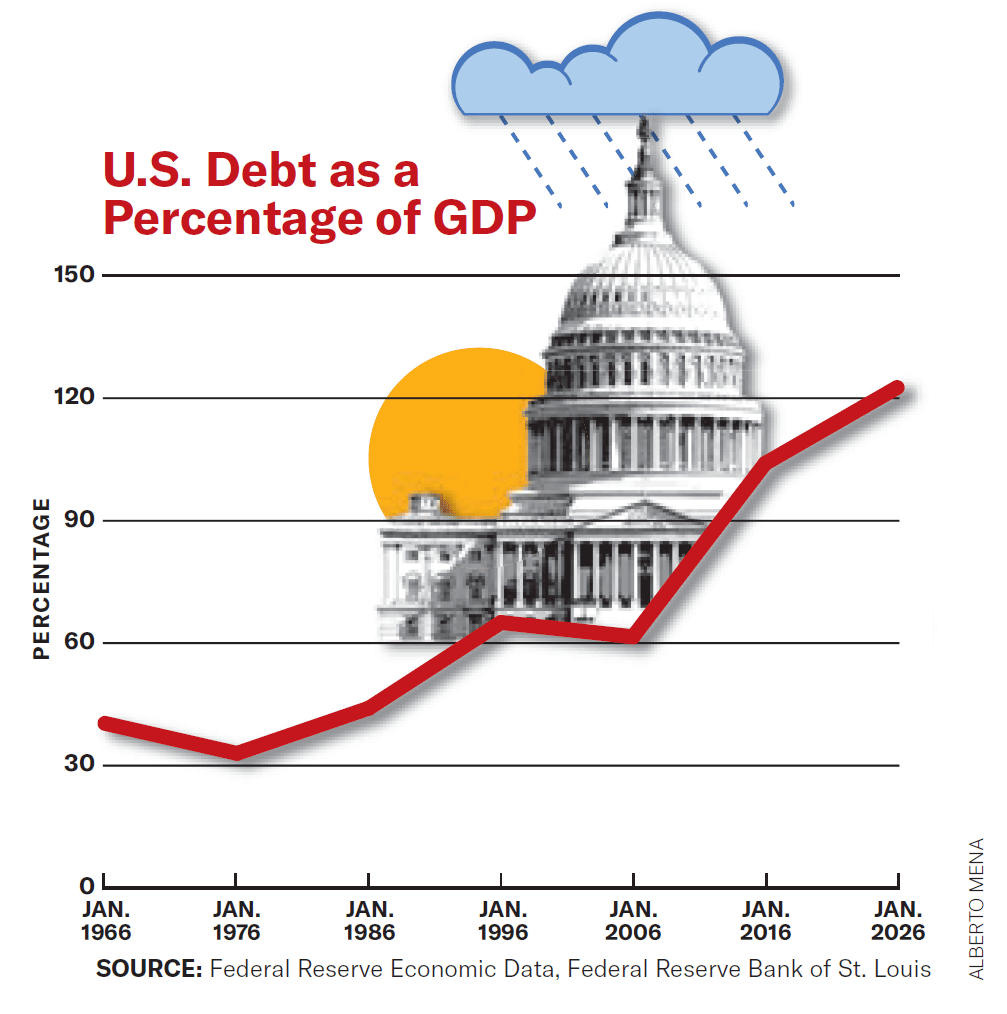
The U.S. government has used interest-rate policy and public debt to distort the economy for decades, and it might seem that this can continue forever. But signs of growing vulnerability have emerged over the past two years. First, the stock market’s extraordinary rise, driven largely by a handful of tech companies, has left valuations more and more stretched. Though corporate earnings remain healthy, stock prices have risen much faster. One key measure of overvaluation, the ratio of stock prices to earnings, is near a record high, approaching levels last seen at the peak of the 2000 tech bubble.
Several recent incidents also feel uncomfortably reminiscent of the period leading up to the 2008 financial crisis. Last year, auto-parts company First Brands declared bankruptcy, revealing that it had received billions of dollars in financing from major investment firms, allegedly in part by pledging the same assets more than once as collateral—as if you had taken out two mortgages on the same house, each lender believing that it had the same claim. This year, Situational Awareness, a hedge fund run by a twentysomething AI enthusiast, lost billions after borrowing heavily to invest in AI stocks, forcing it to unwind much of its portfolio in a deal with Citadel.
These incidents suggest a dangerous complacency in the markets. Sophisticated investors failed to detect the alleged misconduct in the first instance and, in the second, entrusted billions to an untested young investor. The episodes recall the mini-crises that began unfolding in 2007, the year after housing prices peaked. That spring, major mortgage lender New Century went bankrupt; months later, two mortgage-related hedge funds sponsored by Bear Stearns collapsed. It was easy enough for mainstream analysts to dismiss such casualties as free markets functioning properly: in a healthy economy, companies whose executives exercise bad judgment can and should fail. But the failures were early signs of a broader problem. Global markets had been distorted by years of easy credit that funneled trillions of dollars toward American housing and consumption, much as years of abundant capital may have distorted markets today.
With one big difference: this time, the American government has far less capacity to bail out the economy. That constraint is evident in the signals that markets have been sending to Washington over the past few months. Long-term interest rates have remained high despite Bessent’s efforts to bring them down, though major Treasury bondholders haven’t explicitly stated their concerns. Many are allied foreign governments, highly regulated domestic and international banks, and government-controlled sovereign wealth funds, from Norway to the United Arab Emirates, wary of antagonizing Washington.
But they didn’t have to say outright what they could say collectively by demanding higher interest rates. Investor concerns span several interrelated issues, from tariffs and inflation to war, but the biggest may be whether America can sustain its 40-year era of chronic deficit spending. It simply owes too much to keep piling on new debt. (One hypothesis is that AI-fueled corporate debt is itself pushing up Treasury interest rates, as investors prefer to lend their money to the hyperscalers at even higher interest rates; however, the profiles of risk-averse investors who purchase Treasury bonds and investors in riskier corporate debt are quite different.)
Bessent, in effect, was trying over the late summer to use the power of the U.S. government to bail out the U.S. government—an impossible task at sufficient scale. Treasury has no infinite source of funds with which to repurchase its bonds. On the contrary, just to pay its bills, the federal government is running an annual deficit of roughly $2 trillion, about 6 percent of gross domestic product, even in a strong economy. America must therefore keep selling vastly more Treasury debt to investors than it can buy back.
Any attempt by Bessent to influence this market is dwarfed by his dependence on it. Treasury could issue more short-term debt rather than lock in higher long-term rates, but that would merely shift the government’s exposure: short-term debt must be refinanced more frequently, leaving taxpayers more vulnerable to changes in interest rates. Nor is short-term borrowing especially cheap; the two-year Treasury yield has crept above 4 percent.
The U.S. government could sustain escalating bailouts in previous decades because federal debt was lower and the government retained enormous credibility in global capital markets. Its sovereign strength allowed it to support weaker institutions without seriously calling its own creditworthiness into question. Today, the danger is that successive bailouts, mounting debt, and repeated interventions in capital markets have eroded that strength and made the government itself—and its debt—the vulnerable target. We are too big to bail, and investors know it.
One critical arm of the U.S. government already understands this: the Federal Reserve, charged with keeping inflation under control by raising interest rates when necessary. In the crises of 2008 and Covid-19, Treasury intervention was accompanied by dramatically easier Fed policy. The Fed slashed interest rates, which, among other effects, made it cheaper for the government to borrow.
This time may be different. In late August, as Treasury Secretary Bessent tried to push down long-term rates, Kevin Warsh, the newly installed Fed chairman, signaled, albeit obliquely, that rates under his watch were more likely to remain high—or rise further—than fall. In mid-September, the Fed duly raised its key interest rate for the first time in three years.
Warsh has taken this stance because he knows that the Fed’s fight against inflation is not over. Headline inflation remains well above the Fed’s 2 percent target, at 3.4 percent, though core inflation, excluding food and energy, has improved to 2.4 percent. Inflation has remained elevated since Covid-19, when extraordinary debt-financed relief under both Trump and Joe Biden helped push prices up; annual inflation topped 8 percent in 2022 and has yet to return to the Fed’s target. “Price stability is not self-executing,” Warsh said at this August’s annual Jackson Hole Fed confab, and “it is the Fed’s job to deliver stable prices. . . . High inflation itself is very harmful to economic prosperity.”
In one way, the fact that Warsh’s signal appears to have prevailed over Bessent’s—that long-term rates rose, rather than fell, after these competing efforts to influence market sentiment—is encouraging. It suggests that global investors, who ultimately determine long-term Treasury yields through their buying and selling of U.S. debt, expect the government to prioritize long-term price stability over the temporary boost to deficit spending, housing, and consumption provided by ultralow interest rates.
The positive scenario would be for Treasury to accept the market’s signal and help the government adjust to a world of persistently higher interest rates, creating pressure to reduce public- and private-sector borrowing. Higher rates could also encourage more rational capital allocation. AI firms, for example, would have to demonstrate that their products can generate sufficient returns to justify their enormous investments—or cut back on their debt-financed expansion.
In another way, though, this public tension at the top of the U.S. government over economic and fiscal policy is troubling. What if Bessent resists the market’s signal and attempts even more aggressive intervention in Treasury markets? This scenario could produce a disruption instead of a gradual rise in rates: an abrupt jump from, say, 5.25 percent to 7 percent. Such a shock could make the 2008 crisis look tame, as holders of Treasury bonds around the world, including major banks, confront enormous paper losses on their holdings and respond by severely restricting credit to companies and households.
Unlike in 2008, Treasury would have far less room to respond. Any large-scale bailout would ultimately have to be financed somehow—either by borrowing still more from wary global markets or, in an extreme case, by relying on the Fed to print money and buy government debt, as it did on a massive scale after 2008.
In a market crisis, the Fed would come under tremendous pressure from Treasury and Trump to repeat its earlier interventions: create money to buy Treasury and mortgage securities and hold down rates. But Warsh has a powerful reason to resist that pressure: if the Fed fails to maintain its credibility, markets may impose their own discipline.
This year has already shown that long-term interest rates have a mind of their own. If markets won’t heed Bessent, they may not heed Warsh, either, if investors lose confidence in the Fed’s commitment to price stability. Even if the Fed held short-term rates steady following the September hike—or, in future months, acceded to Trump pressure and cut them—investors could continue demanding the same or higher yields on long-term U.S. debt if they expected persistently higher inflation to erode the value of their holdings. Counterintuitively, Warsh and the Fed are raising rates now in order to keep them low in the long term.
The United States can take a long holiday from functional free markets, as it has demonstrated over four decades. But the government would be wise to heed the markets’ insistent signal. “We can be held accountable for delivering on our remit—the only true test of our credibility,” Warsh said in August. If the government won’t discipline itself, eventually the markets will do it instead.