
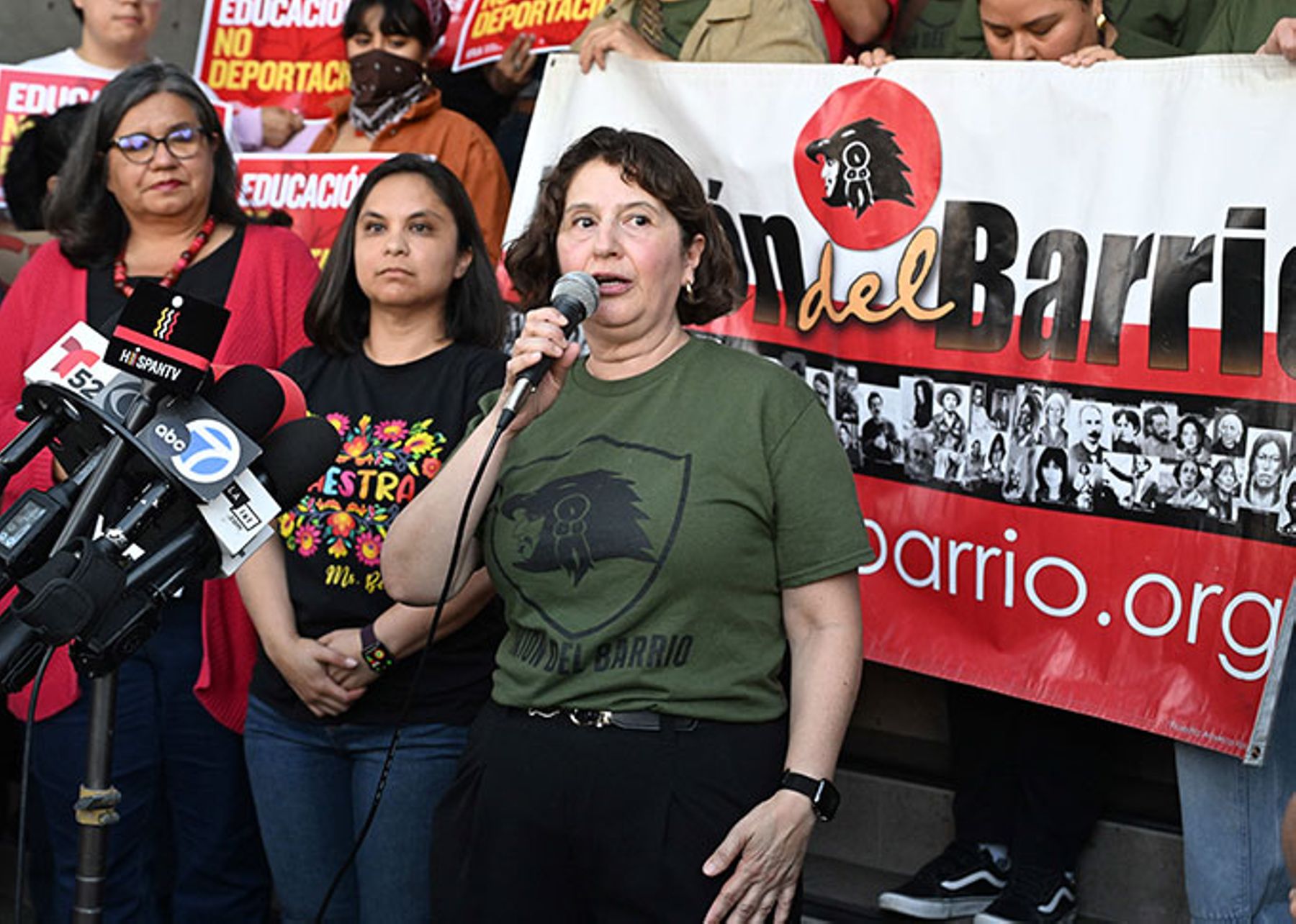
Union del Barrio (UdB) is one of California’s most prominent radical advocacy groups. The self-described “revolutionary organization” has taken a leading role in disrupting federal immigration enforcement in Los Angeles, and its collaborators were a driving force behind California’s controversial ethnic-studies curriculum. Now UdB is again turning its attention to California’s education system. Members of UdB and its offshoot, the Association of Raza Educators, are running for leadership roles within United Teachers Los Angeles. If elected, these activists could further inject their radical politics into an already-struggling school system that hardly needs more leftism.
UdB was founded in 1981 as an organization for “Chicano Movement activists” to fight against “capitalism and colonialism.” The group built out those commitments in 1992, when it created the “community patrols program,” a Black Panther Party–inspired initiative to monitor federal immigration enforcement.
Finally, a reason to check your email.
Sign up for our free newsletter today.
Two years later, California passed Proposition 187, a ballot initiative that denied illegal immigrants access to various social services, including public education. The measure was later deemed unconstitutional and never enacted, but its passage prompted UdB members to found a breakaway schooling group, the Association of Raza Educators (ARE). The group’s founders hoped to create a “mass movement of teachers” to participate in “the struggle for human rights and the self-determination of oppressed nations.”
Today’s UdB members embrace the same ideologies and tactics as their predecessors. In its political program, UdB calls for a “socialist México” and a “unified continent.” It rejects individualism as a “bourgeois egotistical trait” and “calls for the establishment of a socialist society.” The group glorifies authoritarian leaders like Fidel Castro, Hugo Chávez, and Che Guevara, whom it calls “raza patriots.”
UdB’s immigration patrols are winning sympathetic national coverage. The Intercept reported last year that UdB members in Los Angeles were “driv[ing] the streets in search of federal agents”; members sometimes alert others upon discovering suspected ICE vehicles. Francisco Romero, a longtime member, told Rolling Stone, “We walk it up to the point just shy of [ICE agents] having an excuse to get us an obstruction charge.” A New York Times piece on efforts to “halt President Trump’s agenda of mass deportation” mentioned UdB by name.
“We don’t want to use violence,” founding member Ron Gochez told the Times. “[B]ut what is happening to our community is completely violent.”

Those aren’t Gochez’s only cryptic comments about violence. In October 2025, for example, he warned that while he was not calling for violence, ICE officers in Los Angeles “are not the only ones with guns.” At a protest after Renee Good’s death in Minneapolis, he said: “There’s TV here, so I won’t say the words.” Later, he added, “Going back to history class, there’s only one way to defeat fascism.”
Gochez is a high school social studies teacher who won the California Teachers Association’s 2025 Human Rights Award.
For years, members of ARE, the UdB offshoot, have fought to change California’s ethnic-studies curriculum. Now, Gochez is teaming up with one of those ARE members in a bid to lead the Los Angeles teachers’ union.
The campaign comes amid a long-running dispute over California’s ethnic-studies requirement. In 2016, California passed a law that directed the State Board of Education and Instructional Quality Commission to start working on a model curriculum for ethnic studies. By summer of 2018, the state board agreed on a guideline and began recruiting for the Model Curriculum Advisory Committee.
In 2019, the State Board of Education appointed ARE members Theresa Montaño and Guadalupe Carrasco Cardona to the advisory commission tasked with drafting an ethnic studies curriculum. Critics argued that the curriculum they created used “classic anti-Semitic stereotypes” and advanced a “blatant anti-Israel bias.” Eventually, the state rejected their work and extended the deadline for the curriculum until 2021.
By February 2021, Montaño and Cardona had grown disillusioned with the curriculum’s new, more moderate direction. They signed a joint letter asking California to remove their names from the model curriculum and urging the state not to capitulate “to the pressures and influences of white supremacist, right wing, conservatives.” The following month, the State Board of Education approved the more moderate ethnic studies curriculum, and in October, Governor Gavin Newsom signed a law requiring future high school students to take a semester of ethnic studies.
After signing the letter, Montaño and Cardona joined other radical academics to create the Liberated Ethnic Studies Model Curriculum Consortium. The Consortium worked in parallel to the state’s official commission, developing ready-made classroom materials, educator trainings, and content designed to foster “racialized intersectional identity.” The material was designed to meet the state’s baseline requirements while advancing the group’s revolutionary values. Eventually, the Consortium established partnerships with more than two dozen school districts.
Legal challenges followed the initial roll-out. In October 2023, Concerned Jewish Parents and Teachers of Los Angeles filed a complaint against the Consortium, alleging that its curriculum involved “denounc[ing] capitalism, the nuclear family, and the territorial integrity of the lower 48 states of the United States” and seeking “to expunge the idea of Zionism, and the legitimacy of the existence of the State of Israel, from the public square.” The suit was dismissed, but the ethnic-studies controversy continues to rage.
Not content with pushing extreme learning materials, UdB and ARE members are now running to control United Teachers Los Angeles, the city’s teacher’s union. Gochez is running for UTLA secondary vice president; ARE chair Cardona is seeking the UTLA–AFT vice presidency; and Ingrid Villeda, a UdB collaborator, is heading the ticket.
The North American Values Institute (NAVI)—a nonprofit that “supports liberal principles” and “opposes the imposition of ideology”—recently released a detailed analysis of the slate. NAVI noted that it includes a Party of Socialism and Liberation associate and a former elementary school teacher dismissed for what school officials reportedly described as “anti-Semitic views shared online.”
Opposition to ICE is a near-universal theme in the candidates’ official statements. Gochez pledged to “defend our communities from Trump and ICE.” Cardona notes that she has created curricula organized around “Community Self–defense Against ICE Terror.”
“Unión del Barrio has been active for decades, but it has finally found a cause that can mobilize an already receptive and radical class of teachers, softening the ground for the introduction of its political program into education spaces,” said Mika Hackner, NAVI’s research director.
While Californians can’t control how UTLA members vote, they have significant power to influence their children’s education. Parents should participate in school board elections, make aggressive use of the California Public Records Act to review contracts with outside organizations, and demand that schools adopt clear and unbiased academic standards. If Gochez’s slate succeeds, such vigilance will become increasingly vital.
Top Photo: Ron Gochez (Carlin Stiehl / Los Angeles Times via Getty Images)