
To Bobby Fijan, bringing the townhouse back to the American city is more than a real estate endeavor. It’s a quasi-religious calling to make cities welcoming for families and return America to the development patterns that flourished throughout the nineteenth and early twentieth centuries.
Fijan is not alone. His American Housing Corporation is one of several development firms looking to bring attached single-family housing back to the forefront of U.S. homebuilding. And as buyers increasingly seek out a combination of space, privacy, and walkability, the townhouse is having a moment.
Finally, a reason to check your email.
Sign up for our free newsletter today.
The resurrection of the townhouse—and what it might mean for the future of the American city—is a development everyone in real estate, from homebuilders to institutional investors, should be watching.
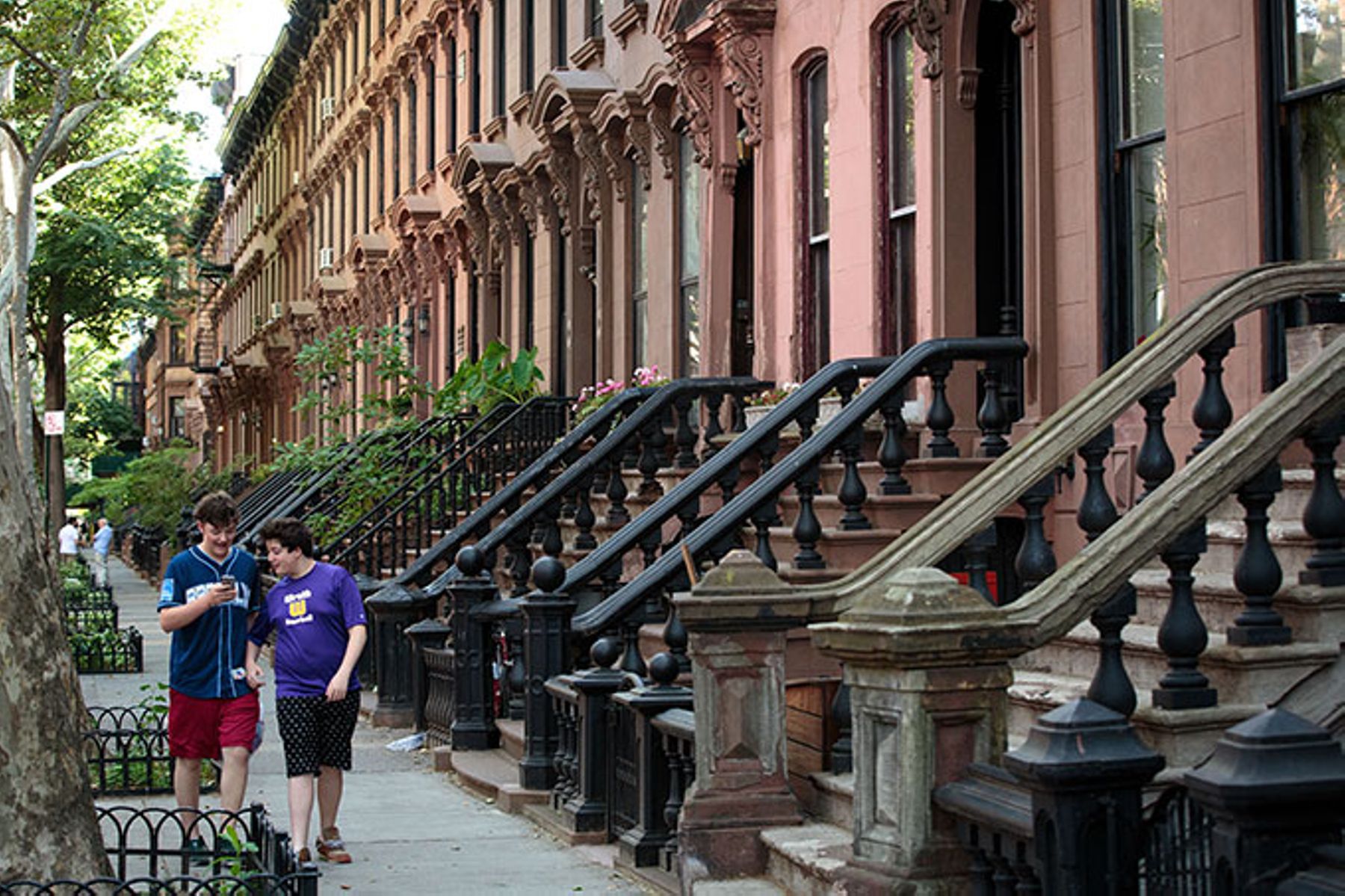
Anyone who has walked through a major U.S. East Coast city is familiar with the townhouse. It’s perhaps the most common and sought-after form of housing in places like Brooklyn, Boston’s Back Bay, Philadelphia, and much of Washington, D.C. Midwestern cities that boomed in the nineteenth century, like Chicago, Cincinnati, and St. Louis, have similar models, and even the downtowns of old Sunbelt cities like Charleston and New Orleans have their own flavors of townhouse blocks.
Technically speaking, a townhouse is an attached single-family home. It may have a garage and is usually two or three stories, perhaps with a partly below-grade “garden level” with outdoor access. While modern large-scale homebuilders often put single-family homes in close proximity with narrow side setbacks—enough to make any lot-line windows useless—they typically avoid the party walls that define townhouses.
The history of the townhouse mirrors the broader arc of U.S. urbanism. In the second half of the nineteenth century, developers produced townhouses en masse on greenfield land as cities expanded and industrialized. Critics derided even the now-prized Brooklyn brownstone as cookie-cutter, mass-produced, and low-quality.
The single-family townhouse slowly fell out of favor in the early twentieth century as urban development shifted to multifamily, with many existing townhouses in cities like Chicago, Philadelphia, and New York converted into three- to six-unit dwellings, if not 15-room boarding houses and single-room occupancies. Postwar flight to the suburbs and the resulting urban decay further doomed the single-family townhouse. Upper middle-class families that would have happily purchased a townhouse in 1875 wanted nothing to do with city living in 1975.
But as crime rates began falling and the allure of urban life returned in the late 1990s and early 2000s, interest in the townhouse revived. Townhouse neighborhoods in gateway cities like New York and Boston drew demand from global buyers and smashed sale price records. Today, it’s not unusual to find townhouses in the West Village or Beacon Hill listing for more than $10 million.
Zoning and building codes, however, were less accommodating. Over the past half century, cities had accumulated legal cruft—setback rules, minimum lot sizes, caps on floor area ratio (usable floor space divided by lot size), and other regulations—that made traditional townhouse blocks nearly impossible to build. On top of that, fire departments tend to view any connected structure with skepticism, dragging out construction timelines, if not derailing them entirely.
“I could make substantially more money with less effort building things that check the boxes that cities are used to doing,” notes Austin Tunnell, founder and CEO of Building Culture, a developer of townhouses in Oklahoma. “The regulatory side has been pushed so far one way over time.”
It’s no surprise, then, that the recent townhouse renaissance is closely associated with Houston and its laissez-faire regulatory regime. Over the past 20 years, Houston has seen the development of more than 20,000 townhouses, mostly in the city’s “inner loop,” where they make up more than a quarter of all new housing. Houston’s adoption of very low (1,400 square-foot) minimum lot sizes made its townhouse boom viable.
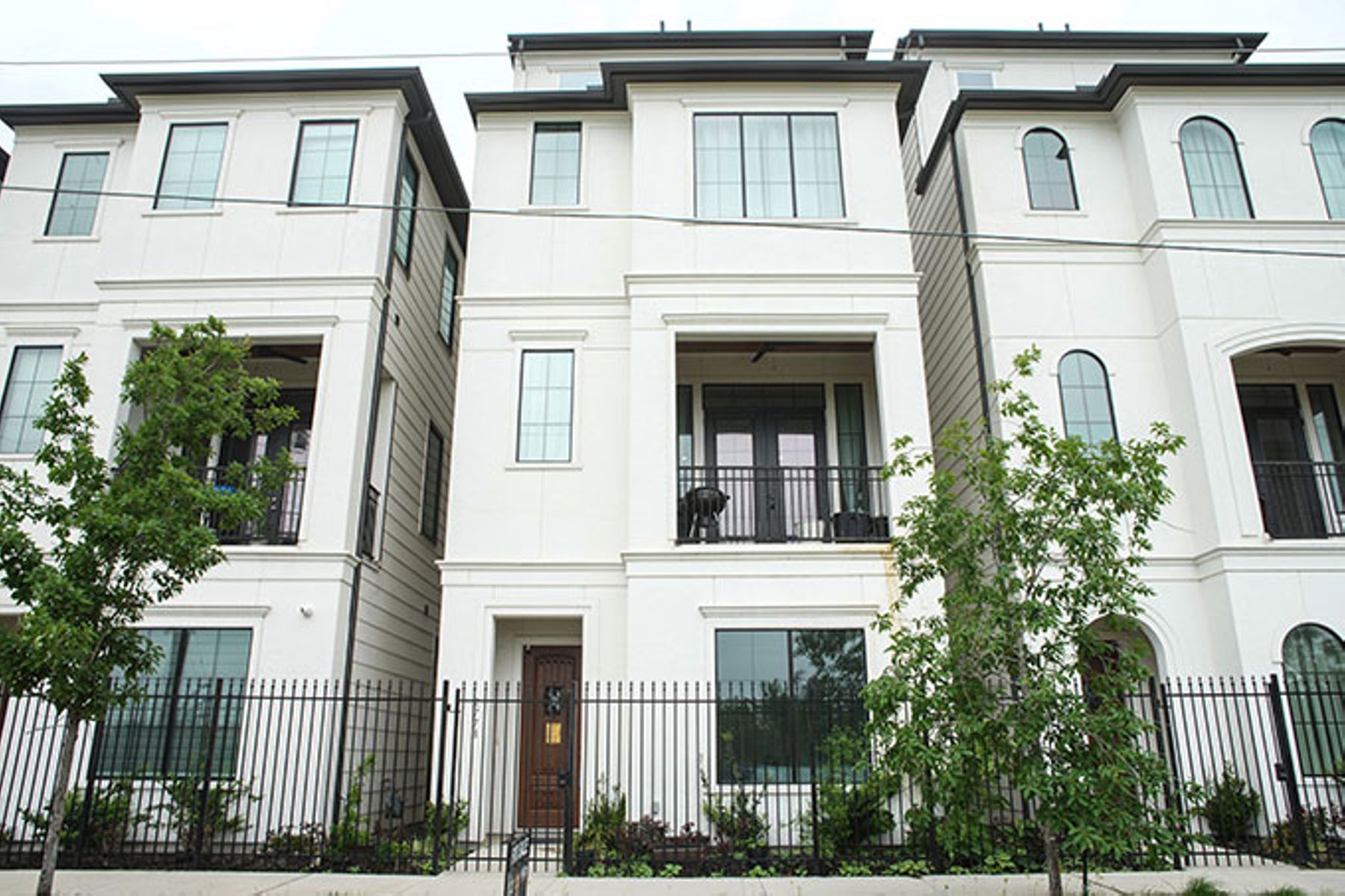
Houston’s townhouses have a few key differences from the classics of Brooklyn and Boston. Most are not technically townhouses—they’re detached, albeit barely. They’re also frequently anchored by large garages, a concession to Houston’s car-centered design.
Perhaps the most important difference is that Houston’s townhouses usually lack the context and urbanism of those traditional townhouse neighborhoods, as Matt Yglesias observed recently:
Not only is the architecture lacking compared to a traditional rowhouse neighborhood, . . . the neighborhood does not have remotely the layout or vibe of a city rowhouse neighborhood. The streets are suburban-style cul-de-sacs rather than connected grids, and there’s no shopping street to walk to. You have the built environment that urbanists dislike about the suburbs, but then you also don’t have the large yards that make suburbs appealing.
At its worst, the modern townhouse is simply the logical conclusion of the trend toward smaller lots in single-family greenfield developments. But a group of developers is looking to bring back the townhouse’s spirit in addition to its form.
Building Culture’s Tunnell has two developments underway in the Oklahoma City metro area. He’s aiming to recreate the look and feel of a traditional townhouse neighborhood by orienting the units away from main streets—a sort of courtyard block for the modern American city.
“We create our own little magic world ‘inside the block,’” Tunnell explains. “We have 18 townhouses, each between 1,200 and 2,400 square feet, on 1.1 acres with a mix of live-work and commercial space.”
Tunnell’s first project, Townsend, is in Edmond, an Oklahoma City suburb where cars are essential. But the project is located near a budding walkable downtown district, where restaurants, breweries, and other daily needs lie within a ten-minute walk. To meet parking needs without orienting the townhouses around garages, Tunnell placed spaces in the alleys behind some of the homes. “Most townhouses have at least one spot directly behind the home, with a few about 100 feet away.”
Despite the project’s relatively small scale, its commitment to mixed use extends beyond a simple coffee shop. Apollo, Tunnell’s homegrown workspace operating company, will open its first location on-site. “I’ve realized we are going to have to get into operations, not just building, if we really want to create what we want and deliver an exceptional end-user experience,” he notes. Apollo will offer private offices, dedicated desks, and boutique, ground-level storefronts when it opens, capitalizing on the popular neighborhood workspace trend identified by operators like Industrious and Switchyards.
Tunnell’s next project with partners—also in downtown Edmond—will offer 34 townhouse rental units of 1,200 to 1,600 square feet. It will use a “pocket neighborhood” design similar to his Townsend project. He has additional efforts planned in Oklahoma City proper.
While Tunnell’s use of alleys and courtyards is aesthetically appealing, it also reflects a delicate dance with the force blocking the development of quality townhouse neighborhoods across the United States: the local fire department. “We have three or four townhouses in a row, then a passage. That’s for fire to come through,” he explains. “Even on an acre, you can run into issues if the fire department can’t get to everything with a 200-foot hose.”
Tunnell has worked to appease the local fire authorities. “We went in assuming we’d put in 13D sprinklers and masonry with higher fire ratings. You have to keep that in mind from the very beginning when you’re designing.”
You could be forgiven for thinking Bobby Fijan was planning a run for elected office. On X, he’s a vocal advocate of building more housing for families. He’s recently run the podcast circuit, appearing on shows with Megan McArdle, Statecraft, New Founding, and more—all focused on why cities are losing families and how they might win them back.
As it turns out, his next big move was not into politics but real estate development: he recently co-founded the American Housing Corporation (AHC), a vertically integrated manufacturer and developer of prefabricated, panelized townhouses. Starting with a factory in Austin, Texas, the company plans to build and ship panels to its own development sites nationwide.
The company’s development model reflects its views on who might buy a townhouse, and why. “People buy rowhomes when they particularly value the location and are willing to compromise on things like a yard and home size in order to get the trade-off of location and walkability to certain amenities,” explains Fijan.
For AHC, that means focusing on relatively small, infill lots in desirable urban locations. The company’s focus on these smaller sites takes them out of competition with large homebuilders. Fijan notes that the complexity of this kind of sub-scale development scares off the largest, most sophisticated firms like Lennar and D.R. Horton.
“We are building in areas where land values are high, and our projects are small,” he explains. “If we build 1,000 homes a year, it’s going to be very complicated logistically to make sure the right pieces are going to the right places. So we’re going to have to try to see how big we can make these projects while still being infill.”
Given AHC’s infill targets involve relatively expensive land, the company is emphasizing quality of construction while balancing the need to scale manufacturing. Structurally, the company’s townhouses are made of fiberglass-reinforced cement board with steel framing in floor panels—fire-rated materials that may reduce scrutiny from local officials.
Fijan sees his work at AHC as putting his views on family-oriented housing into practice. “The point of society is so that people who choose to can have children,” he explains. “This is, in fact, good and better than other ways of doing things. We are building this company because other people are not, and we know there’s demand for it.”
Tunnell and Fijan are part of a developer cohort that sees townhouses not just as a way to squeeze more dwelling units into a given acre but as a tool to make a better city. Neither is a typical developer: Tunnell is an artisan, committed to building a beautiful product even at the expense of profit or scale, while Fijan is a militant who sees building housing as a path to society’s salvation.
Neither chose this professional direction because they see it as the easy way to make a lot of money in real estate. Both could have made careers in traditional multifamily, niche industrial, hospitality, or some other more conventional vertical. Building townhouses in recalcitrant municipalities is an uphill battle.
The townhouse is drawing attention well beyond its relatively small footprint in the real-estate market. But the townhouse market remains relatively immature. It’s drawing neither institutional interest nor that of major homebuilders. In fact, the concept itself resists institutional focus: done well, townhouse developments happen in relatively dense, walkable urban centers. Unable to compete against multifamily developers for large infill sites, townhouse developers find themselves building 20- to 50-unit slugs on sites too small for multifamily and too expensive for tract homes. And that’s not a temporary waypoint on the path to institutionalization—that’s where it makes the most sense to build townhouses.
The nascent sector still doesn’t even use standard terminology. Fijan, for instance, favors the term “rowhouse” to describe what AHC is building.
“There’s no technical difference,” he says, “but ‘rowhouse’ is more evocative of Georgetown, Brooklyn Heights, or an English rowhouse.”