
When former General Secretary of the Communist Party Mikhail Gorbachev visited Stanford University in the early 1990s, former Secretary of State George Shultz asked him what he thought brought about the end of the Cold War. Gorbachev reportedly answered, “Reykjavik.” That’s how J. K. Simmons as Shultz tells it in The Brink of War, the new film from Angel Studios now in theaters.
As fodder for cinema goes, the 1986 Reykjavik summit between President Ronald Reagan and Gorbachev wouldn’t necessarily leap to mind as fodder for a two-hour feature. Indeed, the meeting about arms control was considered a failure at the time. Yet in the hands of novice director Michael Russell Gunn, who based the screenplay on conversations with Shultz and declassified transcripts, the October 11–12 encounter in Iceland becomes a densely scripted, tautly paced political drama.
Finally, a reason to check your email.
Sign up for our free newsletter today.
In the background is an arms race and Reagan’s Strategic Defense Initiative, nicknamed “Star Wars” by its critics, which succeeded in bringing Gorbachev to the negotiating table. The relatively young Soviet leader (as the film notes, the previous three had died before Reagan could meet them) wished not only to reform the Soviet system from within but also reportedly to seek arms control. Whether Gorbachev was posturing or not, Reagan believed that dialogue might be possible.
The film opens with Jeff Daniels as Reagan, deep in thought, looking toward the sea crashing against the rocky cliffs of Iceland. Reagan believes he has failed. The reason, we learn, is that Reagan and Gorbachev, over 30 hours of negotiation, came remarkably close to agreeing on bilateral denuclearization. The film then takes us 72 hours back, as the president prepares to meet Gorbachev at the literal and figurative halfway point between America and the Soviet Union. Adding some humble authenticity, the film was almost entirely shot in and around the house, known as Höfði, in which the actual meeting took place.
Reagan, much to his advisors’ consternation, insisted on making an issue of human rights at the negotiating table, imploring Gorbachev to allow the sister of Soviet defector and conductor Mstislav Rostopovich to visit her brother in America for his birthday. Shrugging off such matters, Gorbachev proposed a 50 percent reduction in nuclear arsenals, including Intercontinental Ballistic Missiles (ICBMs), but the Strategic Defense Initiative, or SDI, remained a sticking point.
In one haunting shot, Gunn shows two military aides from the United States and the USSR outside the room in which the two leaders are arguing. With nuclear codes in their satchels, they face each other with stoic detachment. In tense close-ups, Reagan agrees to pause the deployment of SDI for ten years in exchange for a sweeping denuclearization agreement taking effect, but he won’t agree to confine testing to the laboratory—the “one word,” as Reagan puts it, which killed the deal.
Reykjavik might not have seemed to yield results, but the meeting proved to the two leaders that dialogue was indeed possible. It opened the channel of communication for the 1987 Intermediate-Range Nuclear Forces (INF) Treaty to be signed by Gorbachev and Reagan, a pivotal point in ending the Cold War.
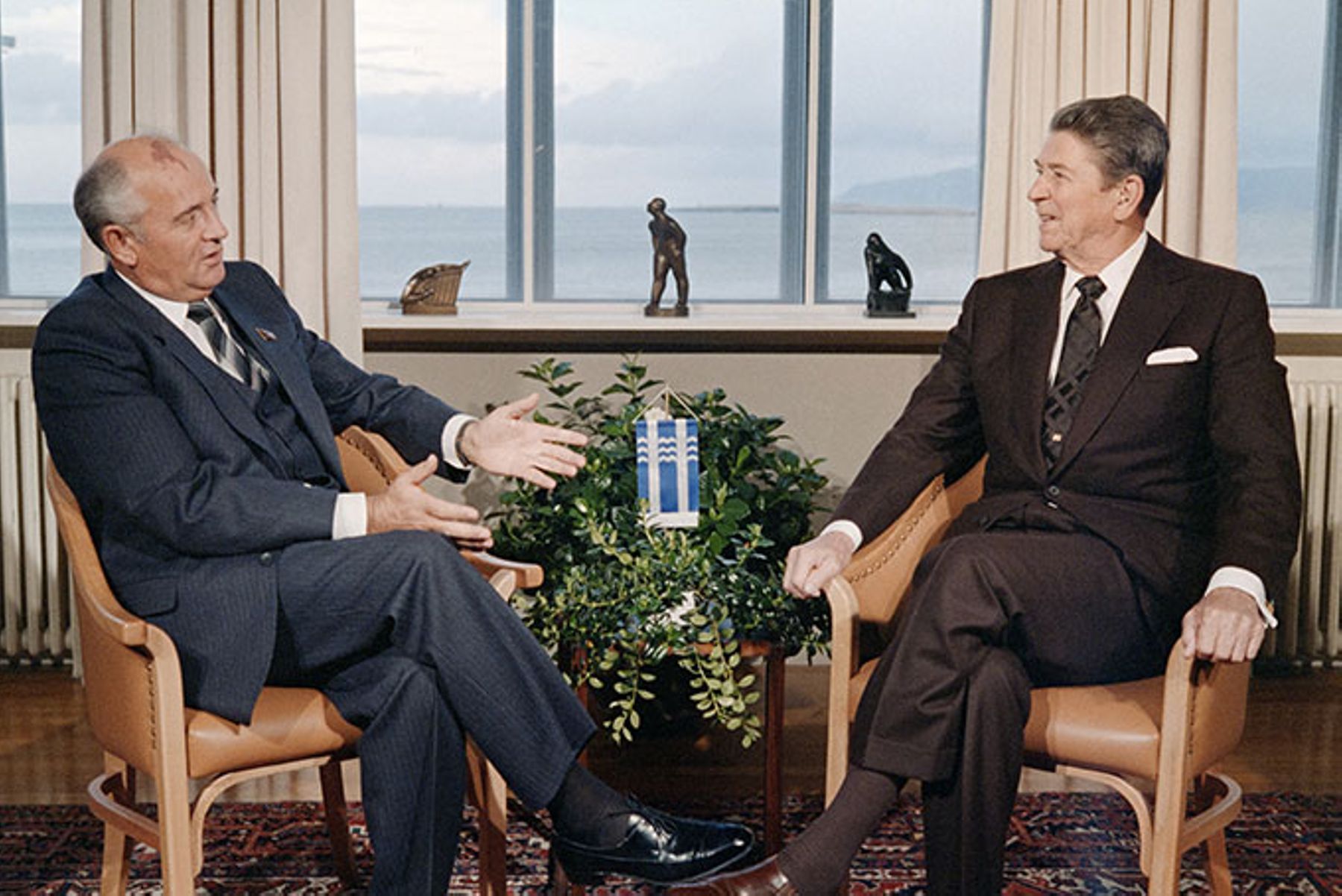
Daniels, the Dumb and Dumber actor whose endearing jowls here may be more reminiscent of Nixon than Reagan, seems a mismatched choice to play the fortieth president. Nonetheless, channeling Reagan’s trademark wit and steely jaw, he delivers a performance that goes beyond mere characterization. And his chemistry with Jared Harris’s Gorbachev works dramatically. It’s no small achievement when two actors arguing in a single room can hold an audience for two hours.
Unlike Sean McNamara’s 2024 biopic Reagan, starring Dennis Quaid (who certainly looks more like Reagan) as the fortieth president, Gunn’s film is relatively confined both temporally and geographically. There are some subplots, such as Raisa Gorbachev (Branka Katić) picking a fight with Nancy Reagan (Hope Davis) for remaining at the White House, and several superfluous scenes following two English-speaking journalists pestering Mrs. Gorbachev. But much of the film itself takes place in the Reykjavik house. While Gunn’s technique is no match for Sidney Lumet’s in the claustrophobic 1957 drama Twelve Angry Men, it succeeds in using physical restriction to heighten dramatic tension.
In his biography of Reagan, Dutch, Edmund Morris complained that Reagan made a poor biographical subject because he was so intensely private and supposedly allergic to self-reflection. The Brink of War, which draws upon Morris’s book, more effectively captures Reagan’s mind and his acute understanding of the war of ideas. Schultz realizes at the end that Reagan saw the crucial issue not as arms control but showing Gorbachev that America’s system of democratic capitalism would win out over Soviet Communism—implicitly understanding that Gorbachev’s reforms of perestroika and glasnost were fundamentally incompatible with authoritarian rule. The movie takes seriously the fundamental ideas undergirding the Cold War conflict.
The Brink of War is not the last glimpse of Reagan that audiences will see in theaters this year. McNamara’s biopic will be rereleased as a director’s cut on September 25 to commemorate America’s semiquincentennial and promises ten new minutes of footage tied to that theme. When first released two years ago, the film encountered challenging circumstances including a contentious election season, Facebook’s attempts to suppress marketing efforts, and critics’ predictable thrashing.
Angel Studios, the “values-based entertainment” company behind not only The Brink of War but also the well-crafted George Washington biopic Young Washington earlier this summer and the compelling 2023 thriller Sound of Freedom, seems to have found a niche as an alternative to mainstream Hollywood. It has produced films appealing to conservatives yet not so preachy as to alienate a broader audience. Angel may not overtake Netflix or Warner Bros. any time soon, but it’s making dents in box-office tallies in ways that media companies of its kind might not have thought possible.