|
Forwarded this email? Sign up for free to have it sent directly to your inbox. |
|
|
|
Good morning,
Today, we’re looking at the increasing activism among New York teachers’ unions, the Park East Synagogue attacks, a new milestone for Supreme Court Justice Clarence Thomas, and a dubious civics campaign in Chicago.
Write to us at editors@city-journal.org with questions or comments. |
|
|
|
Photo credit: Pacific Press / Contributor / LightRocket via Getty Images |
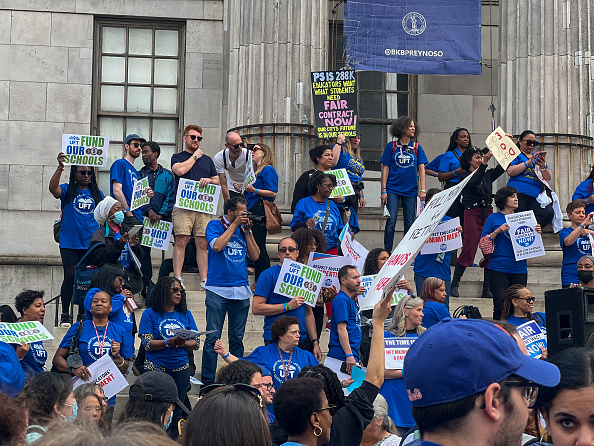
Teachers’ unions have one basic job: representing teachers. But in New York, they’re increasingly losing sight of that task. And several union members are growing uneasy. Take the United Federation of Teachers (UFT), the sole representative of teachers in New York City. Former union members say that its activism now conflicts with teachers’ interests.
Karen Feldman is one such former member. She taught for 26 years, and points to the Movement of Rank and File Educators (MORE) caucus as a reason for the union’s extreme left-wing shift. “The implication of MORE’s radical agenda is that public education and unions would become mere vehicles in the pursuit of a state conforming to its leadership’s vision of social justice,” Adam Lehodey writes.
Teachers’ unions have also been representing nonteachers—bus drivers, nurses, and others. “Representing these divergent interests is inherently difficult,” Lehodey explains. “That gives union leadership an incentive to focus on other topics. As a result, social justice gets prioritized over issues more directly related to work conditions, such as the negotiation of benefits and oversight of organizational rules.”
Read more. |
|
|
Earlier this week, New Yorkers interested in moving to Israel gathered for an event inside Park East Synagogue. Outside, 150 rioters attempted to storm the barricades, injuring two police officers. The rioters called for an “Intifada revolution,” chanting, “NYPD, IDF, KKK you’re all the same!” and, “We don’t want no two states, we want all of it!”
Yael Bar Tur has seen enough of these kinds of demonstrations around New York. “Even if the Park East Synagogue protesters were justified in their concerns about the sale of ‘Palestinian land,’” she writes, “how much hate and violence are we willing to tolerate in this city? If a group of white men attacked cops outside a Hispanic church and yelled ‘go back to Mexico’ while waving Klan flags, would we say they’re just protesting lax border policies? No: we would tell them to get the hell out of our city.”
Read her take. |
|
|
Supreme Court Justice Clarence Thomas has just become the second-longest-serving Justice in the Court’s history. Thomas has always followed the Constitution wherever it leads. “He joins the Court when it moves toward the Constitution, but doesn’t trim his sails merely because a plurality of colleagues has stopped short of first principles,” Ilya Shapiro writes. For decades, his views were seen as angry and unserious, but his new milestone is a vindication of his vision. And he’s consistent. “For nearly 35 years he has written separately, dissented alone, returned to text and history, and refused to let bad precedent acquire moral authority merely by aging,” Shapiro observes.
Read more about Thomas’s tenure. |
|
|
In the U.S. today, just 36 percent of Americans can pass the citizenship test that immigrants are required to take. It’s no wonder: since the 1960s, schools have been moving away from teaching civics and history.
It should be welcome news, then, that Chicago is reviving civics education. Not so, Aidan Grogan writes. The Chicago Teachers Union (CTU) and Chicago Public Schools designated May 1 as a day of civic action, enlisting students as young as kindergarten to join pro-labor, anti-Trump protests.
“CTU’s ‘city-wide civics’ campaign exploited students as pawns to advance a partisan agenda,” Grogan writes, “disrupting the school day with political activism rather than genuine civics instruction.” And Chicago students could sure use some genuine instruction. Fewer than one in three can read at grade level. If they struggle with basic literacy, they’re certainly not ready for civic action.
Read more. |
|
|
|
Is America trading excellence for ideology? In this episode, Rafael Mangual sits down with Heather Mac Donald—author of When Race Trumps Merit—for a frank conversation about affirmative action, diversity mandates, and what happens when institutions prioritize identity over ability. They dig into the real-world consequences of diversity-driven policies in education and the workplace, the growing skills gap, and the cultural factors that shape outcomes. It’s a provocative and engaging discussion of issues many people try to avoid talking about.
|
|
|
|
“A symptom of a much larger and more disturbing problem.
There have always been mentally or emotionally disturbed people who have formed attachments to anthropomorphized objects. This isn’t new. What is new, as the author touches on, is the extent of the atomization of society, the breakdown of social institutions, and the corrosive effects of the deliberate poisoning of men and women against each other.
These are huge problems that spread misery and loneliness like a plague. Until those are addressed, discussions about AI romance are missing the forest for the trees.”
|
|
|
|
A quarterly magazine of urban affairs, published by the Manhattan Institute, edited by Brian C. Anderson. |
|
|
|
Copyright © 2026 Manhattan Institute, All rights reserved. |
|
|
|
|