
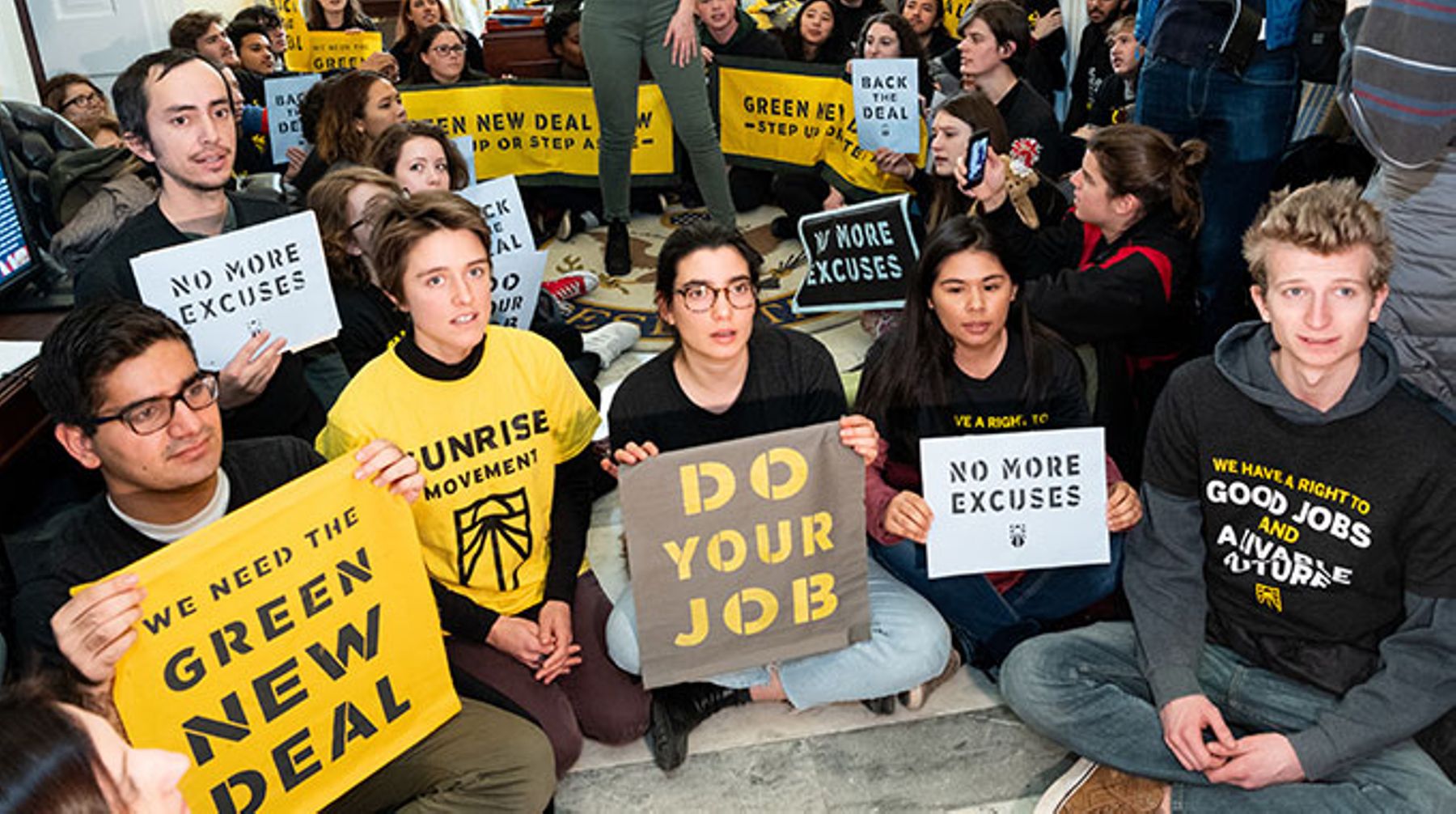
At its inception, the Sunrise Movement was a youth-led climate advocacy organization. The group made a major splash during the first Trump administration, with high-visibility protests, like a 2018 sit-in at Nancy Pelosi’s office—featuring New York Representative Alexandria Ocasio-Cortez—and a clear focus on climate change.
But, like many peer organizations, Sunrise underwent what some have described as an “identity crisis” during the Biden administration. Its ambit grew broader and more radical, especially after it broke decisively with mainstream Democrats following Biden’s support for Israel after the October 7 Hamas attacks. Last September, after years of mission drift, Sunrise shifted its purpose to “getting rid of the authoritarian government we’re in.”
Finally, a reason to check your email.
Sign up for our free newsletter today.
As part of this revamped mission, Sunrise has embraced increasingly confrontational tactics: training students to manufacture conflict with college administrators, coordinating campaigns to pressure corporations linked to ICE, disrupting hotel guests with late-night protests, goading workers into non-cooperation with federal law enforcement, and laying the groundwork for student mass general strikes. What was once a narrowly focused activist organization has increasingly become an incubator for a wide array of legally questionable tactics.
Sunrise’s drift highlights the growing extremism of America’s activist infrastructure—extremism that routinely turns to lawbreaking. Indeed, the group’s actions raise questions about whether Sunrise is still operating in a manner consistent with its original nonprofit filing status or has instead become a vehicle for organized disruption that crosses legal and regulatory lines.
Leadership changes and a greater emphasis on direct action campaigns, including ICE Out For Good and Students Rise Up on May Day, indicate that the Sunrise Movement’s original focus (to be “the climate revolution,” according to its old slogan) has transformed into a broader and more confrontational political identity centered on direct action.
One of the most dramatic changes in leadership was Aru Shiney-Ajay’s appointment as executive director in October 2023, replacing Sunrise Movement co-founder Varshini Prakash. Shiney-Ajay dropped out of Swarthmore to organize with Sunrise full-time and took part in the Pelosi sit-in. She was also a brigadista in The People’s Forum and the International People’s Assembly’s joint brigade to Cuba in June 2024—a deployment seen as a finishing school for far-left activism.
The day after the 2024 presidential election, the Sunrise Movement hosted a mass conference call outlining a multiyear strategy that extended well beyond climate advocacy. During the call, speakers—including Shiney-Ajay—presented a roadmap beginning with a “four-year strategy to build up to mass student strikes in 2027 and a general strike in 2028.” The organization also criticized the Democratic Party and corporate power, characterized America’s political system as broken, and asserted that the world has only six years to stop the climate crisis.
Shiney-Ajay explained that Sunrise has a “three prong strategy” to achieve its objectives. The first component is “build[ing] up the muscle of non-cooperation” over the next few years and developing movement discipline. The second aims at splitting the “MAGA Coalition” over environmental rollbacks and framing Donald Trump as a “corporate shill.” The third involves recognizing that all parties are “arenas of struggle,” and that the Democratic Party is in “shambles” with no “theory of how to win.”
Though the United States has not yet seen “mass student strikes in high schools, in middle schools, in colleges, across the country,” Sunrise is working to develop that “muscle.” It was especially active in 2025, organizing some of its largest mobilizations, including what it described as “the largest student walkouts” of Trump’s presidency in response to the “occupation” of the District of Columbia by the National Guard. One of Sunrise’s board members, Keya Chatterjee, who has served since 2019, also led one of the D.C. resistance’s most visible groups opposing Trump’s deployment of Guardsmen.
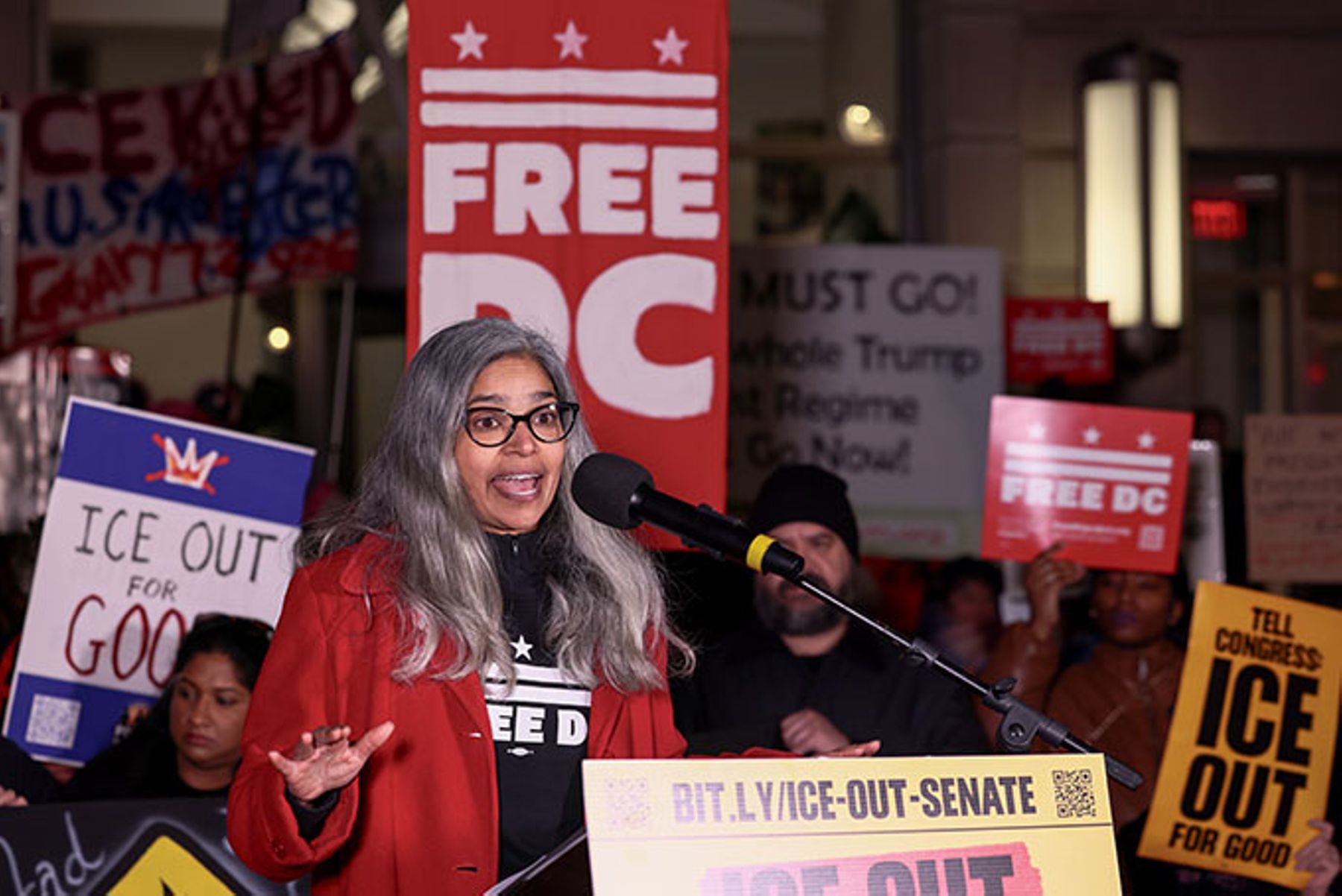
In 2025 and early 2026, Sunrise was also integrally involved in multiple ICE mobilizations across major U.S. cities, including Minneapolis, where Shiney-Ajay is based. Over many movement calls and public appearances, Sunrise organizers outlined tactics used to pressure Hilton Hotels, which sometimes played host to ICE agents. These included booking hotel reservations and cancelling them at the last minute, staging late-night “wide awake” protests designed to disrupt hotel guests’ sleep, placing anonymous tip forms in staff areas (for alerting Sunrise about ICE activities), advocating for local authorities to revoke hotel liquor licenses, and encouraging employees to be noncooperative with U.S. Immigration and Customs Enforcement officers.
Certain of these forms of protest appear to expose Sunrise to potential criminal or civil action. For example, Shawn Ramberg, a Minneapolis-based Sunrise organizer, explained that, though certain actions violated late-night noise ordinances, they were effective: “Typically after police tells us to leave or gives us a warning, a couple of warnings, then we’ll usually call it a night, but the job is still done.”
According to Shiney-Ajay, a member of Hilton’s branding team reached out to a member of Sunrise regarding the booking and last-minute cancellation campaign to say it wasn’t effective. She reacted with joy, saying, “If the branding people are calling you telling that your actions aren’t effective, it’s probably a sign that they are effective. So, good job everyone.”
The reported conduct raises potential issues under multiple legal frameworks, though each operates independently and would depend on specific facts and enforcement decisions. On the civil side, coordinated disruption of reservations or business relationships may amount to tortious interference if intent and economic harm are demonstrated. Separately, in Minnesota, sustained or focused disruption may be evaluated under statutes governing harassment, disorderly conduct, or trespass. In a distinct legal context, if such activity is carried out by, or in coordination with, labor organizations or their agents, it may also raise questions under Section 8(b)(4) of the Taft–Hartley Act, which restricts certain forms of action aimed at pressuring third parties to apply economic pressure on a target.
Hilton isn’t the only corporate recipient of such efforts. The Sunrise Movement partnered with Young Democratic Socialists of America, the American Association of University Professors, Higher Ed Labor United, Students for International Labor Solidarity, and 18 Million Rising to go after Target, Flock Safety, and even airlines used by ICE like Eastern, GlobalX, and Omni Air. The method of going after these corporations is to “[g]et hundreds of colleges to drop their contracts with ICE’s key enablers,” according to the campaign’s website. The campaign also has an online hub that lets users look up whether a school is among the “2,463 colleges” that “have confirmed contracts with companies that power ICE deportations.”
Rutgers Professor Eric Blanc, an AAUP and DSA member and a driving force behind the campaign, described the strategy behind planned actions: “Students can take more risks, we know, than paid workers. You can’t really fire a student, so, we understand there’s just different levels of risk. But particularly for students, the . . . there’s a lot you can do to really force the question.”
Sunrise hosted a “Bird Dog Training” session to teach student activists how to confront college administrators and members of the board about their ties to various corporations. In the training, Sunrise staff and partners instructed students to manufacture conflict for strategic advantage, approach administrators at their offices, trustee meetings, and public events, and shape these encounters into viral social media content designed to portray officials as “the villain.” Carly Shaffer, Sunrise’s national creative director and the session’s facilitator, also noted that Columbia encampment students later began blurring faces and altering voices in videos to reduce the risk of disciplinary action and concerns about doxxing.
With May Day coming up, segments of the broader Left are anticipating mass actions and demonstrations that could surpass those of the No Kings protests. Shiney-Ajay has described the moment as sending a potential “warning shot” to the Trump administration, suggesting it could signal that “millions of people [are] ready to stop letting society operate until you give us what we want.” She also characterized the day as “our chance to show the escalation that we actually are able to pull off.” Together, these statements point to an expectation for more disruptive forms of protest to come.
As a 501(c)(4), the Sunrise Movement is classified as a “social welfare organization” and is bound by clear legal and regulatory requirements. Yet the organization’s rebrand, the transparency of its multiyear strategy, its targeting of college leadership, calls for a general strike, disruptions involving Hilton Hotels, and going after corporations all seem at odds with this status. That should invite greater scrutiny from the federal government.
To be sure, there is a need for such efforts to be pursued cautiously. During the Obama administration, many nonprofits tied to the Tea Party movement faced scrutiny, delays, and extensive information requests from the IRS. Subsequent investigations and legal settlements later found much of that treatment to be improper. The Tea Party episode underscores the need for consistent, nonpartisan oversight of enforcement actions aimed at nonprofit organizations.
One clear standard would be criminality—specifically, whether a nonprofit’s leadership is actively encouraging unlawful behavior, not just in rhetoric but in practice. In Sunrise’s case, that conduct is part of a multiyear plan, with encouragement flowing from leadership down to rank-and-file activists who also participate in carrying out those protests. Even general strikes have historically raised concerns under Section 8(b)(4) of the Taft–Hartley Act, which applies not only to labor organizations (for example, the American Association of University Professors) but also to their agents. The applicability of that framework depends on whether participating actors (for example, Sunrise Movement or the YDSA) are acting under the direction or control of a labor organization or otherwise meet the legal standard for agency under labor law.
The central issue is whether there is sufficient political will to pursue such scrutiny despite what will be inevitable attempts to dismiss these efforts as unfair. Without consistent IRS enforcement, even clear-cut cases of nonprofit oversight risk being perceived less as regulation and more as partisan politics.