

For those of us who live in the Washington, D.C., area, the atrocities of September 11, 2001, were profoundly personal. I drove my children to see the scarred face of the Pentagon. I wanted them to remember that there was a cost to being American and that our way of life had been purchased in the blood of courageous men and women. Gazing at the wreckage, already draped in a huge flag, I felt a terrible sadness but great anger as well. That mix of emotions would shape our politics for years afterward.
But the consequences of 9/11 transcended the trauma and horror; they were primarily geopolitical. A struggle to the death began that day, dragging on for decades and only now, with luck, nearing its end in the fire and fury raining down from the skies of Iran. The conflict pitted the liberal West against the most radical forms of political Islam. Though the contest was quite disproportionate—“asymmetrical”—it has claimed American lives, drained American treasure, and shaped the world over the last generation.
Finally, a reason to check your email.
Sign up for our free newsletter today.
Most Americans remain unclear about the nature of the conflict. For that, we have only ourselves to blame. President George W. Bush was never the fool portrayed by late-night comics, but neither was he a strategic thinker. The “global war on terror” was a categorical error. We were not fighting terrorists—an endless and impossible mission, in any case. We were fighting the most radical and violent forms of political Islam: al Qaeda and ISIS on the Sunni side of the sectarian divide; and the Iranian regime and its proxies in Syria, Iraq, Lebanon, Yemen, and Gaza on the Shia side. These groups often fought one another, but they shared the same grim vision of human relations: a slaughterhouse of infidels, with Americans first in line and themselves as righteous butchers.
Osama bin Laden, the mastermind who emitted his high-pitched laugh over the bodies of thousands of innocents, got exactly what he wanted from the crime: recognition as a major global player by the world’s most powerful country. After 9/11, he could hardly be ignored. I was at the CIA when I watched the second airliner crash into the South Tower, and I knew immediately that the question I was asking myself would soon be asked of us, from the president on down: Who are these people? In the months and years that followed, I watched every bin Laden video and read every book by his second-in-command, Ayman al-Zawahiri—all in translation, alas, since I’m not fluent in Arabic—until a pattern emerged that could be applied, with reasonable accuracy, to Islamist movements generally, including the Iranian ayatollahs.
Like the precursors of National Socialism in Germany, the Islamists are creatures of cultural despair. History has betrayed and humiliated them. Promised by their religion a place in a dominant caliphate, they instead find themselves living in weak, insignificant states whose societies imitate Western culture and whose rulers they regard as stooges of Western powers. The urge to annihilate history is overwhelming—it has taken the form of smashing ancient ruins and vandalizing museums. A romantic longing for the glorious but distant past combines with a revolutionary loathing of the present. The explanation is simple: decline resulted from the corruption of the faith. Muhammad’s companions were a ragged band of virtuous believers who conquered half the world. That is the model. Islamists feel invincible because their religion makes them fearless, a conviction captured in their oft-repeated refrain: “You love life, while we love death.”
They were certainly fond of killing. History had to be redeemed at the point of a gun and purified in rivers of blood. Al-Qaeda murdered 2,977 strangers on 9/11. Between war and executions, ISIS was probably responsible for more than 100,000 deaths; in a fit of nostalgia, it also brought back crucifixion and slavery. Nobody knows the total number of victims who have disappeared into the maw of the Islamic Republic of Iran, but estimates for the repression that put down recent street revolts run as high as 43,000 deaths. Multiply that by 47 years of violent rule, add the toll from its terrorist proxies, and you arrive at a terrible bottom line of extinction and suffering.
By their own reckoning, until recently, the Islamists were winning. The United States fought a brutal war in Iraq only to leave the country a semi-protectorate of Iran. Syria was already an Iranian satellite. In Afghanistan, American forces withdrew precipitously as the Taliban swept back into power. Hezbollah dominated Lebanon. Hamas ruled Gaza. The ayatollahs were quietly advancing toward a nuclear capability. Few in the West seemed to care. The anger that 9/11 sparked had been exhausted by years of costly, inconclusive wars.
That was the situation on October 6, 2023. The next day, everything changed. October 7 stands as a kind of bookend to 9/11: the moment Israel—and, more slowly, the United States—awoke to the reality that indifference was not a safe option because Islamist violence would not simply burn itself out. The sociopolitical pathologies of the Middle East had to be confronted once again. On that day, Hamas added to the count of Islamist victims: about 1,200 were killed, many of them civilians, including women and children, with 251 taken hostage. The effect of these atrocities on Western opinion, however, was not anger or sadness but a surge of anti-Zionism that, in many quarters, spilled into anti-Semitism and has only intensified since. A considerable segment of the public in the United States and Europe, it turns out, shares in the Islamists’ repudiation of history.
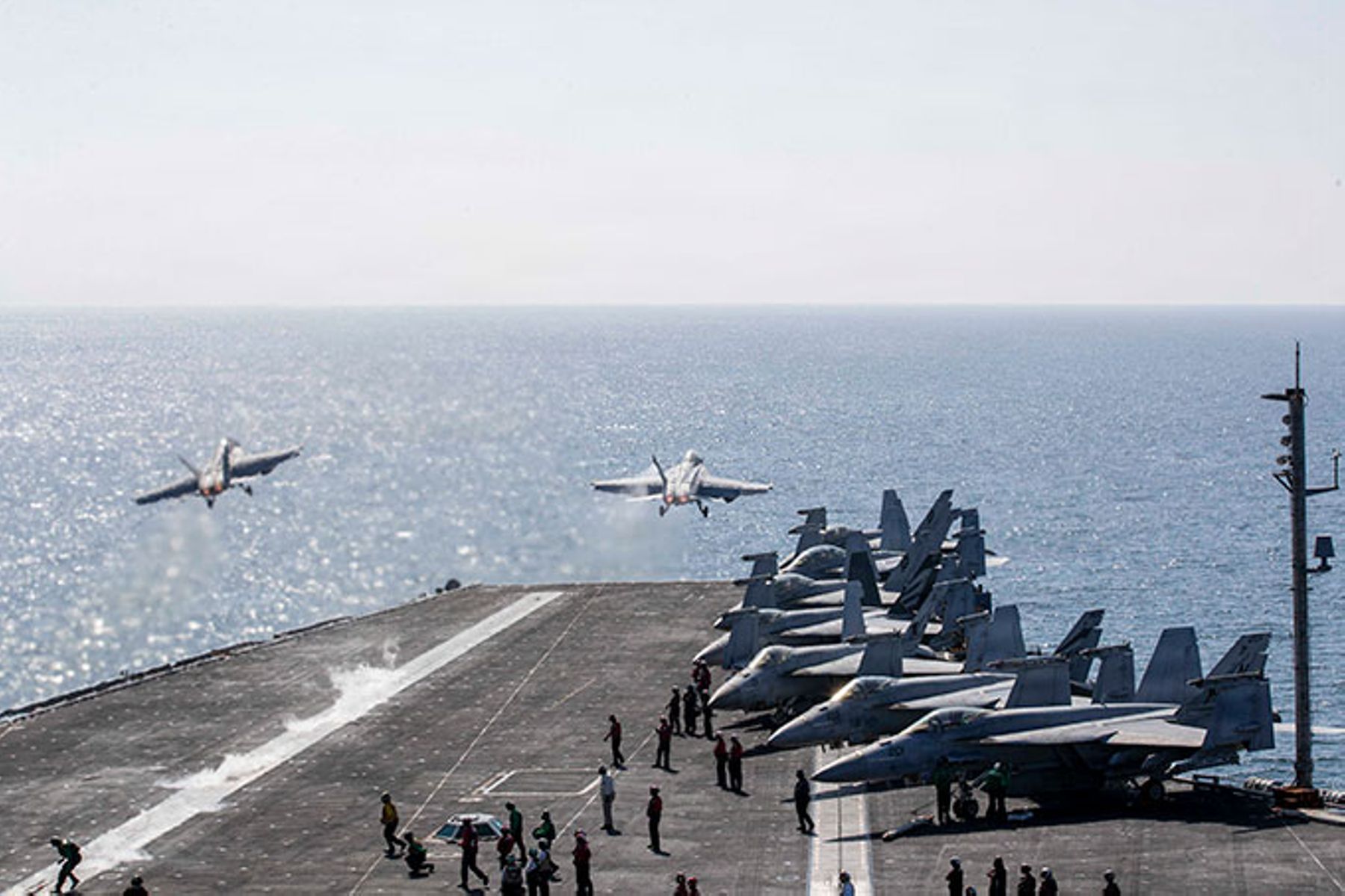
But the decisive shift, once again, has been strategic. From the vantage point of October 6, the region today looks almost unrecognizable. Israel has crushed Hamas and occupies much of Gaza. Hezbollah, defeated and decapitated by Israel, has lost its grip on Lebanon. In Syria, regime change has installed a government openly hostile to Iran. The prime minister of Iraq, head of a multi-sectarian, multiethnic parliamentary democracy, traveled to Washington to bend the knee before Donald Trump; it is by no means the least remarkable aspect of this moment that the Iraq War seems to have been won retroactively. In Iran itself, the leadership has been decimated, the economy crippled, and the regime’s nuclear program set back by years through coordinated U.S. and Israeli strikes. The long arc of violence that began with the shock and loss of 9/11 may, at last, be bending toward a satisfactory close.
The heart of the matter was always Iran, and here the conceptual blindness imposed by the “war on terror” led us astray. We treated terrorists as nonstate actors on the model of al Qaeda: enemies we could destroy anywhere, by whatever means we chose, without the least compunction. But Iran was an ancient civilization with a recognizable government and a seat at the United Nations. A succession of presidents felt what might be called a Westphalian reticence about imposing American military power on Tehran.
Barack Obama’s policies carried this logic to its conclusion. While relentlessly pursuing nonstate terrorists, he also released billions of dollars in frozen Iranian assets and struck a lopsided nuclear deal that, in effect, denied Tehran little of consequence. It was like sentencing the local bookie to death while desperately trying to befriend his boss, the mafia godfather. It couldn’t work, and it didn’t.
Though the architecture of the new Middle East will not be fully discernible until the Iran conflict is settled, much already seems decided. Russia is withdrawing from Syria. China declined to intervene on behalf of its Iranian ally. Europe is largely absent. Iran is a wounded shadow of its former self. The Islamist regime may survive, but it will require a long period of recovery, and it is unlikely ever to possess nuclear weapons. That leaves the United States as the region’s dominant power, with an opportunity to mold what comes next. The Gulf states—and perhaps Saudi Arabia, too—have discovered that they have more in common with Israel than with the Palestinians. The opportunity now exists to build a stronger Abraham Accords coalition capable of preventing any Iranian resurgence.
Twenty-five years after 9/11, we can acknowledge that the ensuing conflicts changed us—and not always for the better. At airports, we accept being groped by the TSA without a murmur. Through the Patriot Act, we granted the federal government unprecedented surveillance powers. We were afraid then, and with good reason. But perhaps the time has come to reconsider policies that treat every American citizen as a potential bin Laden. We are not the enemy. It is possible to be both safe and free. In the aftermath of 9/11, President Bush said that the Islamists “hate our freedoms.” That was not quite right. What they hated most was our power. It would be a fitting memorial to those who died—not only on that awful day but in all the struggles that followed—if we reasserted the freedom and primacy of the individual over the smothering protections of the state.