
America’s 250th birthday is now nearly upon us. The semi-quincentennial, whatever else one might say about it, has been a decidedly muted affair compared with the last big national anniversary, 50 years ago. The bicentennial was a major event, and not just on July 4, 1976, but for a long period leading up to it. It was such a big deal, in fact, that it wound up drawing into its orbit no less than four American presidents or future presidents.
Gerald Ford occupied the White House in 1976, and he presided over a series of patriotic events that many boomers and Gen Xers still view today with nostalgia. But his experience is only part of the bicentennial story.
Finally, a reason to check your email.
Sign up for our free newsletter today.
Richard Nixon assumed that he would be president when America celebrated its first 200 years. Nixon had won a second term in the White House with a landslide victory over George McGovern in 1972. His administration had been planning for the bicentennial for years and accelerated its efforts after the election.
In a postelection conversation, Nixon and advisor John Ehrlichman looked ahead to 1976 and a Republican successor. Nixon did not have a high opinion of his vice president, Spiro Agnew. “I’m not sure he’s the one to succeed me in 1976,” Nixon said, “but we may be stuck with him. He wants it, but we will not help him.” As if to give Agnew something else to do, Nixon wrote, “Give Agnew the Bicentennial to look after.”
Of course, that plan did not work out, for Agnew or Nixon. A scant ten months into Nixon’s second term, Agnew resigned from the administration over a bribery scandal from his gubernatorial days. In August 1974, Nixon himself resigned as a result of the Watergate scandal, elevating Agnew’s replacement, Gerald Ford, to the presidency.
Ford was a more unassuming man than Nixon, and the grandiosity of Nixon’s “imperial presidency” gave way to Ford’s midwestern modesty. Ford scrapped the Nixon team’s rechristening of Air Force One as “Spirit of ‘76”—too ostentatious. Another change was that the vice president—now Nelson Rockefeller—would not be the point person on the bicentennial. The president himself would be.
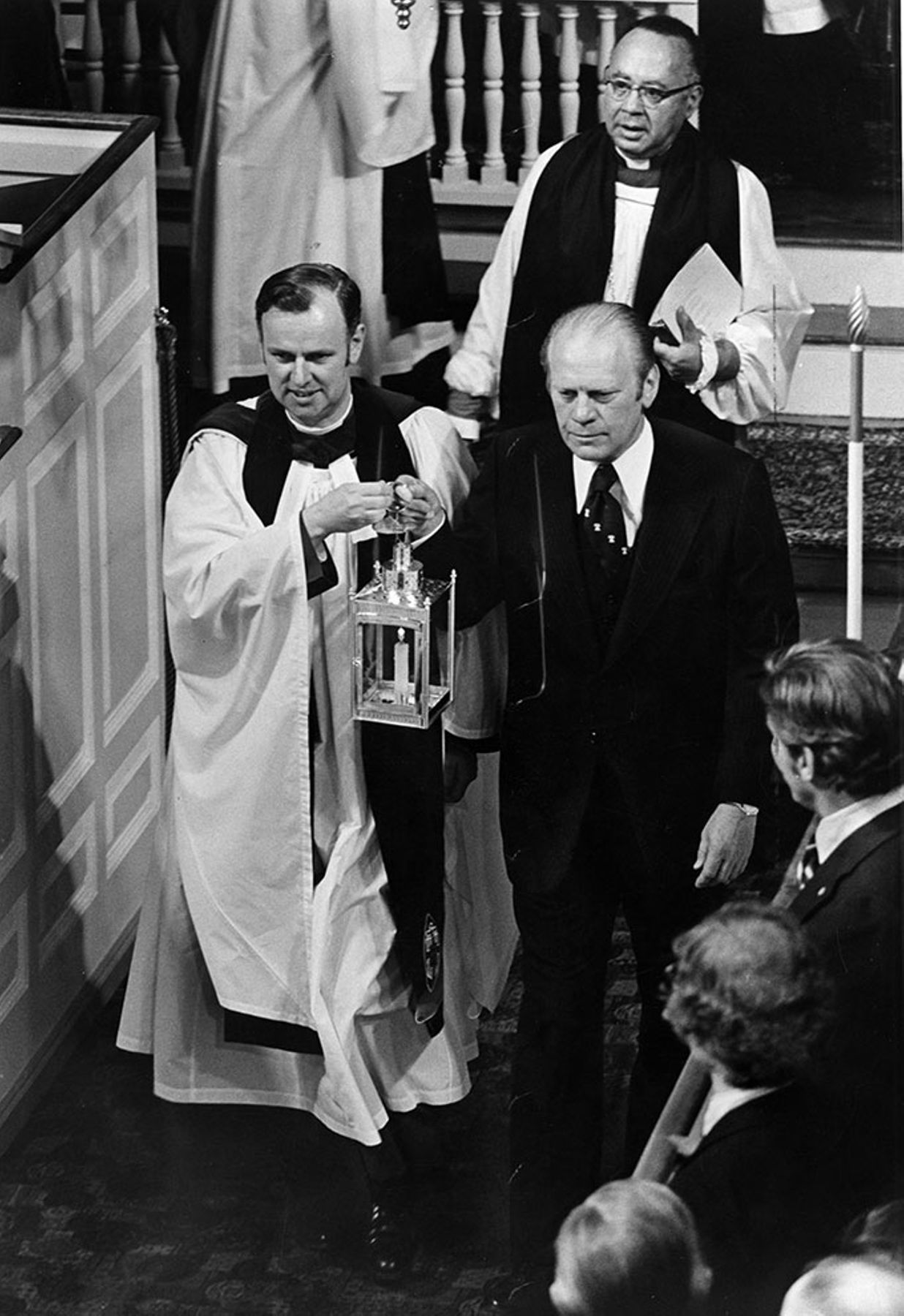
Ford engaged in a host of events to celebrate America’s big birthday, starting more than a year in advance. On April 18, 1975, Ford attended a ceremony at the Old North Church in Boston in which two lanterns were lit in the church steeple, recreating that signal sent to Paul Revere that the British were coming by sea. Ford then lit a third lantern meant to signify the beginning of America’s third century.
As America’s 200 birthday drew closer, the Ford administration tried to use bicentennial rhetoric to its advantage. Ford’s 1976 State of the Union address opened with a reference to the bicentennial year and stressed “how far we have come in 200 years.” And the president returned to the bicentennial theme at the end, saying, “So, all these magic memories which link eight generations of Americans are summed up in the inscription just above me. How many times have we seen it? ‘In God We Trust.’ Let us engrave it now in each of our hearts as we begin our Bicentennial.”
The rhetorical charge was led by Robert Hartmann, a hard-drinking former journalist who served as Ford’s chief speechwriter. Hartmann had known Ford before he became vice president and jealously guarded his personal ties to the president. He was often at war with other staff, which led to both comical and painful moments. Hartmann worked to bring in bicentennial ideas from outsiders like Irving Kristol and Daniel Boorstin, but not wanting to bias Ford against one source or another, didn’t let the president know who had authored each idea. Instead, he substituted a numeric code for their names. As Hartmann notes in his memoir, “In fooling Ford, I also fooled myself and history. I have lost my code key and cannot match all the names with the numerals.”
These confusions did not prevent Ford from stressing the bicentennial theme, which helped him in a tough primary challenge against former California Governor Ronald Reagan. Ford started off strong, beating Reagan in New Hampshire and launching a five-state winning streak. Going into the North Carolina primary on March 23, Reagan was out of money and seemingly on his way out of the race. The governor’s team bought some television time and aired a captivating, prerecorded Reagan speech on 15 stations across the state. Ford had had the upper hand up to that point, holding a bicentennial-themed rally on March 13 in Winston Salem. That drew 10,000—a big crowd, but a small fraction of the people who saw Reagan’s speech on TV in the days leading up to the primary. Reagan won North Carolina, salvaging his campaign and enabling him to continue the fight all the way to the GOP convention.
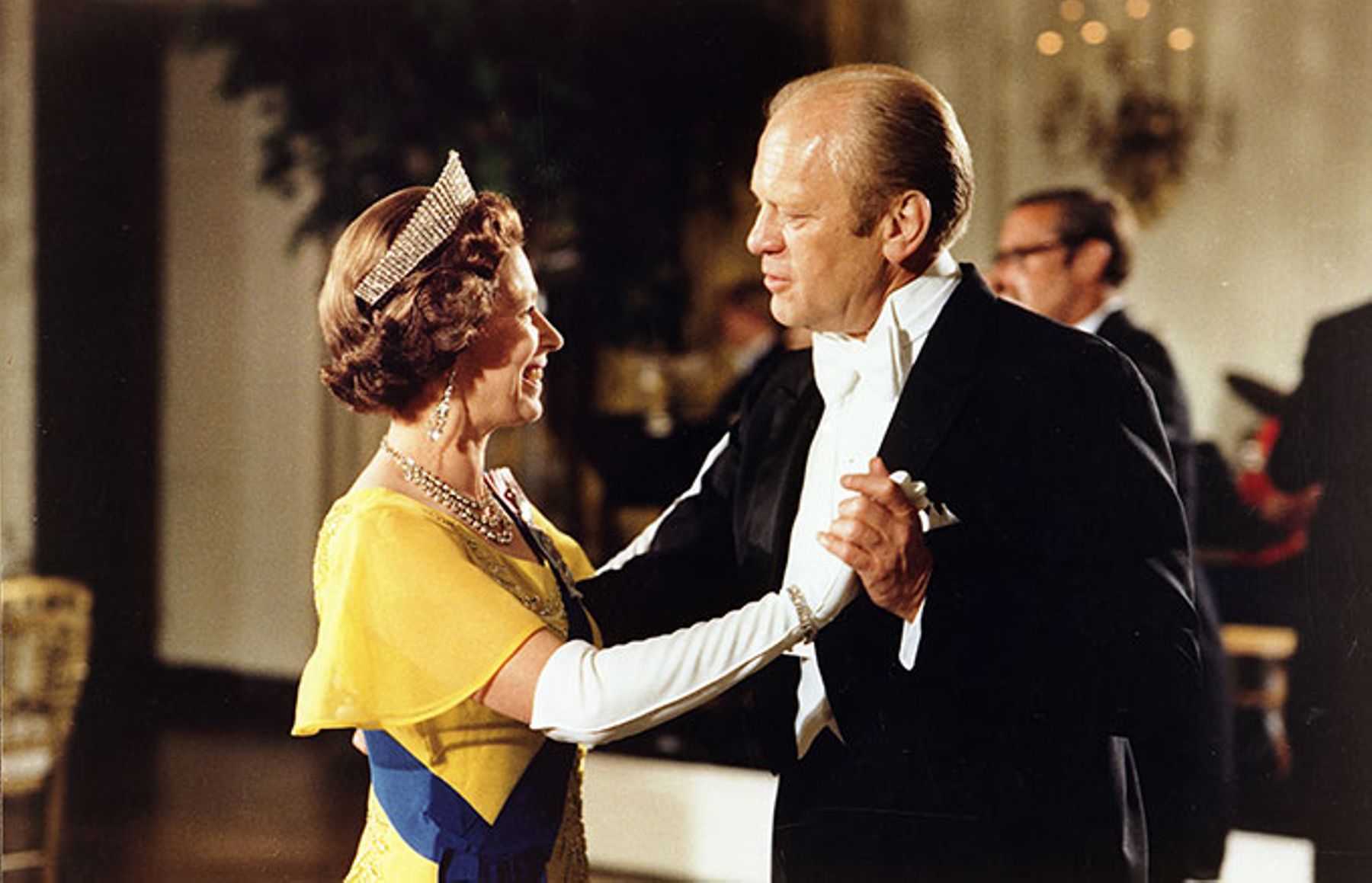
In the final phase of the primary campaign, with the delegate count razor close, Ford pressed the bicentennial to his advantage. Both the Reagan and Ford teams needed delegates going into the August convention, and Ford’s team strategically distributed access to bicentennial events to carefully targeted recipients. These gestures included seats on the USS Forrestal for the Fourth of July Tall Ships show in New York—Operation Sail—as well as joining Ford’s visits to key revolutionary sites, including a church at Valley Forge, Philadelphia’s Independence Hall, and Thomas Jefferson’s home at Monticello. Ford invited the chairman of the Mississippi delegation—Reagan and Ford were battling for its support—to the bicentennial state dinner for Queen Elizabeth at the White House. According to historian Michael Auslin’s new book National Treasure, Ford also kicked off a well-attended, multiday showing of the Constitution and the Declaration of Independence at the Rotunda of the National Archives.
Every bicentennial event the president attended offered sweeteners like tickets, photo opportunities, and Air Force One arrivals. According to Ford campaign strategist Stuart Spencer, “We’d arrive in Air Force One, they’d arrive in charter. We’d have Secret Service, we’d have the trappings. All of those things we milked as much as we could.” As the New York Times described Ford’s strategy in this period: “The Ford campaign threw all the perks of the presidency it could at delegates.”
With the primaries over in early June, Ford had almost two months to dispense bicentennial-related presidential favors, while Reagan had few tools at his disposal in the pre-convention delegate hunt. This disadvantage led the Reagan team to make a major strategic mistake. Campaign manager John Sears, desperate to shake up the race and to squelch news stories suggesting the campaign’s imminent demise, urged Reagan to pick a vice presidential candidate before the convention—a highly unusual strategy.
“You think it’ll work?” Reagan asked.
Sears’s less than encouraging reply: “It’s as good a shot as we’ll get.”
The move backfired badly. Reagan’s selection of liberal Republican Senator Richard Schweiker of Pennsylvania infuriated conservatives, Reagan’s base. The Ford team was thrilled. “We just got the best news we’ve had in months,” Chief of Staff Dick Cheney told Ford. Ford went on to win the nomination at the convention in a close and bitter contest.
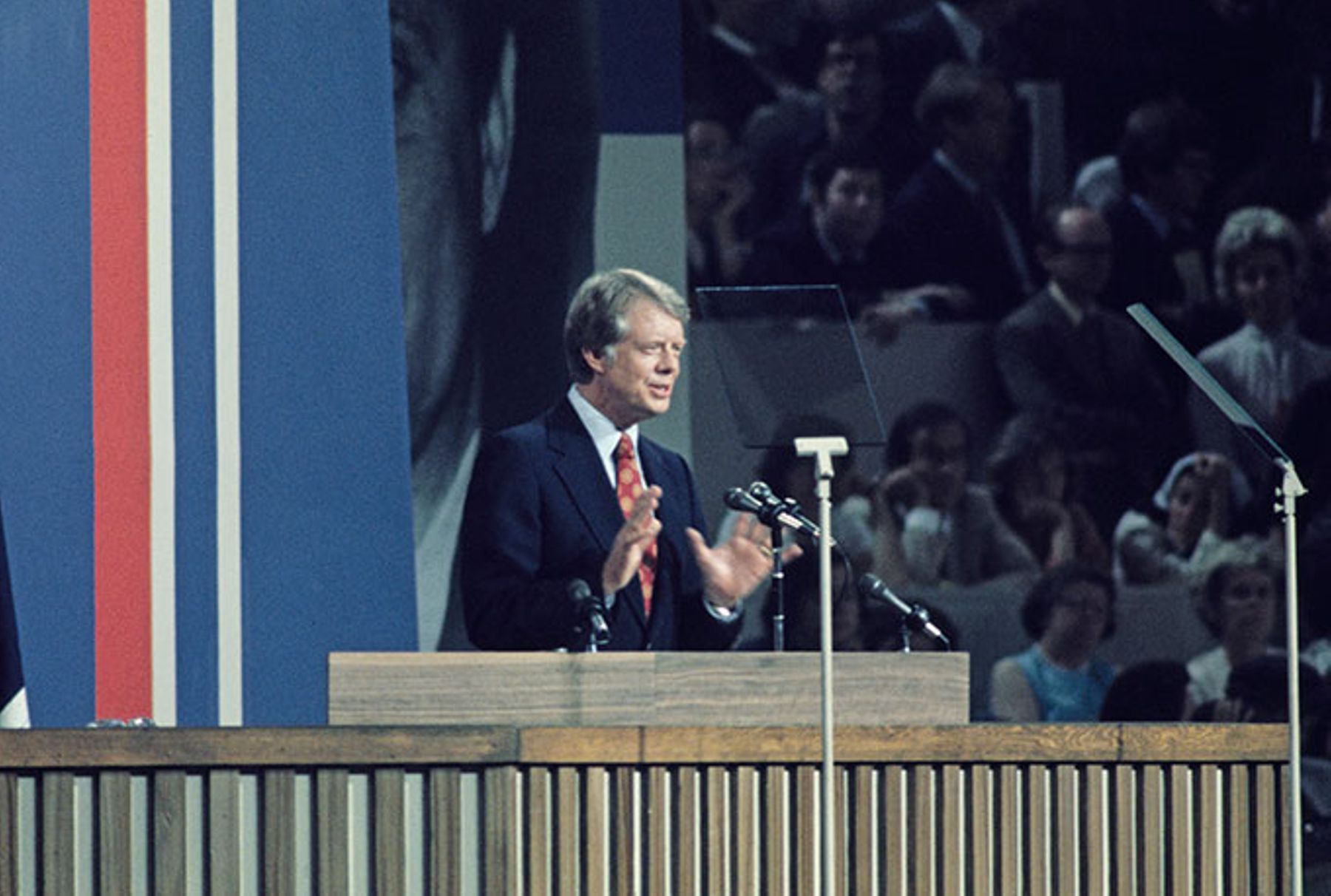
Of course, winning the GOP nomination was only half the battle. Georgia Governor Jimmy Carter was Ford’s general election opponent, and he had invoked the bicentennial as well. Carter’s team carefully planned a convention in New York that took advantage of that city’s bicentennial celebrations. The candidate’s speech accepting the Democratic nomination was filled with the bicentennial spirit. He noted that “America’s birth opened a new chapter in mankind’s history. Ours was the first nation to dedicate itself clearly to basic moral and philosophical principles: that all people are created equal and endowed with inalienable rights to life, liberty, and the pursuit of happiness, and that the power of government is derived from the consent of the governed.”
Carter continued with the patriotic sentiments into the fall. In September, Carter gave a bicentennial-themed address to a group of Italian Americans, recognizing the importance of white urban “ethnics,” whose support he needed in the fall election.
Carter narrowly defeated Ford in November, but the bicentennial story was not quite over. Ford referred to the bicentennial in his final address to Congress, January 12, 1977, saying, “As a people we discovered that our Bicentennial was much more than a celebration of the past; it became a joyous reaffirmation of all that it means to be Americans, a confirmation before all the world of the vitality and durability of our free institutions.”
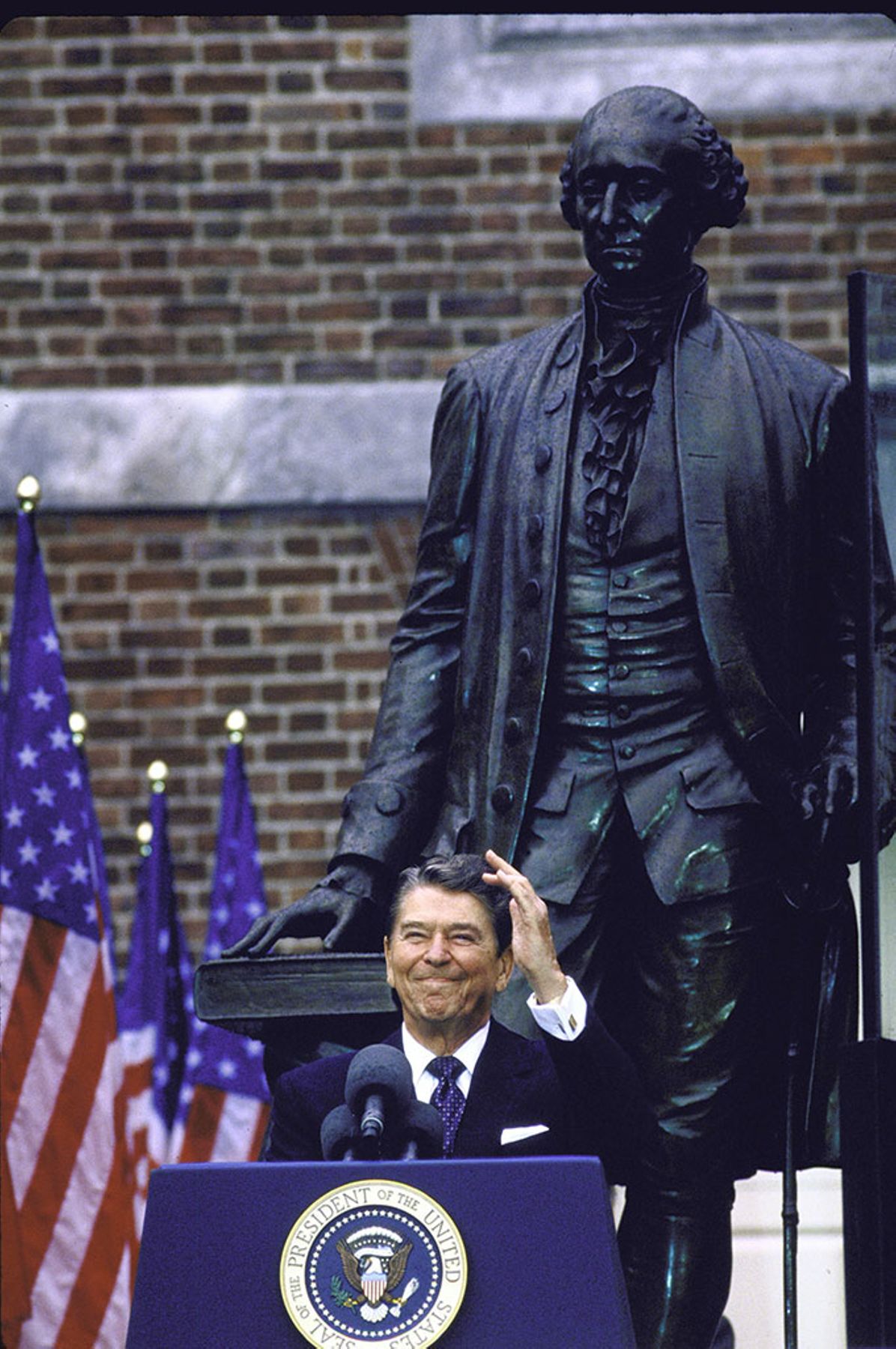
As for Reagan, he got his own version of a bicentennial celebration 11 years later, when, as president, he led celebrations of the 200th anniversary of the U.S. Constitution.
Fifty years after the bicentennial spectacle, America’s semiquincentennial year has been much quieter—and there won’t be a presidential election to anchor it. Even so, the 250th anniversary has seen the involvement of at least two presidents. Joe Biden appointed former Treasurer of the United States Rosie Rios to head a bipartisan, 16-member U.S. Semiquincentennial Commission, and, like Nixon, fully expected to preside over the celebrations. Donald Trump, who defeated Biden in 2024, established his own White House task force for semiquincentennial festivities. Trump is echoing Ford in his planning and headlining of numerous 250th events, though he is typically taking a much more flamboyant approach, as with his UFC Freedom 250 mixed martial arts Flag Day event, held on June 14 (also the president’s 80th birthday).
The next time we’ll see the confluence of a presidential election and a big national anniversary will be America’s tricentennial—the 300th anniversary celebration, in 2076. How many presidents and future presidents take a hand in that occasion remains to be seen. However things play out, though, it will be hard to match the four-president extravaganza that was our bicentennial in 1976.