I spent my twenties and early thirties immersed in the world of “Red Pill” content, an online, male-centric subculture. I began as an observer and later became a recognizable voice within it. I spoke at Red Pill–themed conferences like the 21 Convention and the Conference of Masculine Excellence, appeared on shows such as Fresh and Fit and Rich Cooper Unplugged, and met many of the movement’s most influential figures, including Rollo Tomassi and the Tate brothers, Andrew and Tristan.
The Red Pill (TRP) comes from The Matrix, in which Neo swallows the red pill and sees reality as it is. Applied to relationships, it means believing that you have pierced illusion and uncovered the hidden rules governing attraction, hierarchy, and power.
Finally, a reason to check your email.
Sign up for our free newsletter today.
TRP is not a single organization but a loose constellation—pickup artists, MGTOW (Men Going Their Own Way) purists, incels, entrepreneurial “alpha” influencers—offering explanations for men’s frustrations with women and modern culture. It sounds clarifying. In practice, it operates as a closed system that dismisses counterevidence and turns contradiction into confirmation.
Its message is simple: You are the victim of a culture that favors women and discards men. To deal with women safely, treat them as adversaries. And now that you see the truth, the path forward runs through my book, my course, my subscription.
TRP is not a criminal enterprise. But having grown up in public housing projects, I recognize its psychological resemblance to gang recruitment. Gangs promise power, recognition, and protection to boys who feel shut out of legitimate paths to status. In return, gangs demand loyalty and offer refuge from a hostile world.
Both gangs and TRP promise masculine empowerment. Both cultivate grievance and reward anger. And both depend on insecurity that leaders can expand—and monetize.
Like many men who enter TRP, I arrived after a devastating romantic experience. When I was 22, a woman I had been dating told me she was pregnant—and that I might not be the father. A paternity test confirmed that I wasn’t.
When my mother learned of the pregnancy, she was ecstatic, and her enthusiasm was undimmed after the test results. She invited my now-ex and the child to move in and treated the boy as her grandson, hanging “family” photos that made my humiliation visible. In embracing them both, she signaled, intentionally or not, that my dignity was secondary to her desire for a grandchild. When I stopped visiting, she seemed surprised that I was hurt.
I thus felt rejected by two women in my life—one of whom had raised me—and I wanted an explanation. The Red Pill gave me one. A 2024 Journal of Gender Studies article, “Swallowing and Spitting Out the Red Pill,” by Matteo Botto and Lucas Gottzén, found that entry into TRP often follows romantic rejection, humiliation, loneliness, or feelings of inadequacy. Many who arrive are nursing private wounds.
TRP teaches that you were hurt because you don’t understand the true nature of women. That ignorance, it says, led you to choose the wrong woman or to lose her because of your “blue-pilled, beta” behavior. In TRP’s taxonomy, you are either an alpha—the man every woman desires and other men seek to emulate—or a beta, ignored by women and disrespected by men.
These false dichotomies prime men to see the world as adversarial. Yet TRP packages this worldview with just enough sensible self-improvement advice to make it seem plausible: get in shape, earn more money, develop real hobbies beyond video games and Netflix, and you will attract more women. If TRP did nothing more than offer that counsel, I would not compare it with street gangs. But the advice functions as a Trojan horse. Personal grievance binds the system together; outrage keeps it alive.
TRP appeals to men who feel lost, doubt their value to women, and are searching for direction. Street gangs recruit from a similar population. Even in violent, low-income neighborhoods, most boys do not join gangs. Those who do typically enter between the ages 12 and 15, when status anxiety and the need for belonging intensify. Longitudinal research—including the Rochester Youth Development Study and the Seattle Social Development Project—links gang membership to weak school attachment, delinquent peers, exposure to violence, and family instability. Poverty alone is not enough.
Gangs flourish where identity is fragile and recognition scarce. They offer a ready-made script precisely when one is most needed.
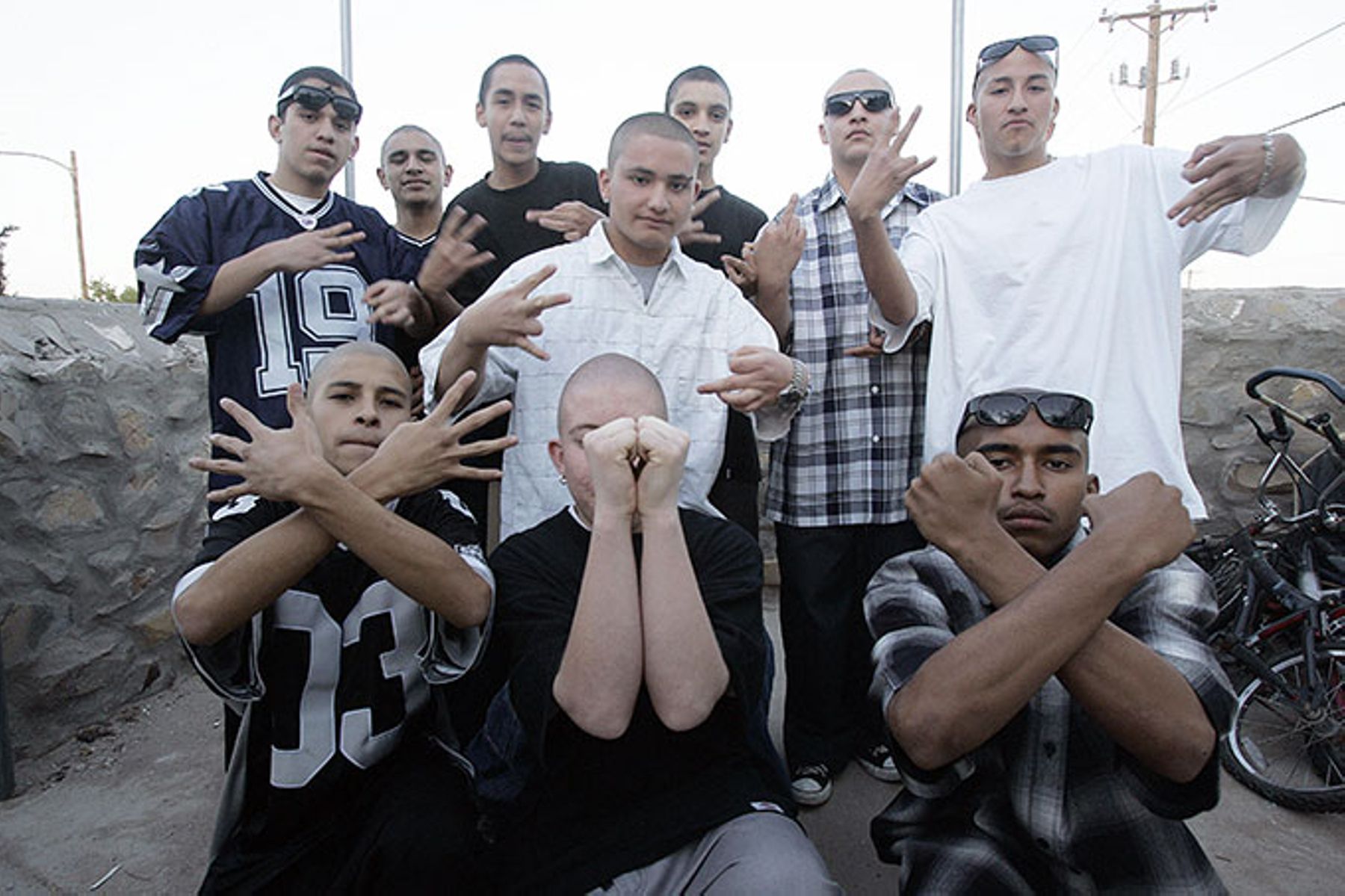
Movements cohere around enemies. As Eric Hoffer observed, “mass movements can rise and spread without belief in a God, but never without belief in a devil.” Whether that devil is real or exaggerated matters less than whether it is clearly named. A defined enemy converts diffuse anxiety into a concrete target.
Street gangs promise protection in a world of rivals. Retaliation confirms the threat. Police intervention becomes proof that the world is aligned against you. Each confrontation reinforces the premise: you are under attack, and only we can shield you.
TRP operates in a similar psychological register. Masculinity is portrayed as besieged by cultural institutions, family courts, and modern dating norms. Romantic disappointment becomes proof of systemic betrayal.
The Red Pill teaches that women are “hypergamous,” a term borrowed from evolutionary psychology and recast as a fixed law of female nature: women are said to be perpetually “trading up,” ready to leave when a higher-status man appears. The sentiment is captured in a common refrain: “She’s not yours. It’s just your turn.” Men are reduced to those two types: alpha and beta, the former dominant and desired; the latter compliant and tolerated. Masculinity becomes a hierarchy to climb rather than a character to cultivate. Men are told to “maintain frame”—never concede emotional ground, never empathize too deeply. Support becomes “simping.” Every interaction becomes a contest.
This mentality conditions men to approach women with distrust and see other males as competitors. As one former TRP adherent admitted to Botto and Gottzén, “I couldn’t create natural human connections anymore because I was so focused on how to look like an alpha male. In a new group, I measured everyone.”
TRP selectively highlights certain data points—divorce rates, custody outcomes, sentencing disparities—to amplify a sense of hostility. Some of these grievances are real: men face documented sentencing disparities, for example. Custody outcomes vary by jurisdiction and remain widely debated. Men underperform in education and die by suicide at higher rates. Many young men do struggle to find their footing in a rapidly changing culture. But real problems can be presented in ways that deepen distrust instead of encouraging careful analysis.
Over time, the framework reshapes behavior. If a relationship fails, it confirms the doctrine. The ideology hardens.
But what happens if the threat is neutralized? How does a movement sustain power if the problem that it organized itself around is resolved?
Movements built on grievance promise improvement through allegiance. But when men gain stability, the market for grievance shrinks. Leaders lose influence and revenue. Instability has economic value: on the street, through illicit markets; and online, through subscriptions and monetized outrage.
As Eva Bujalka, Ben Rich, and Stuart Bender argue in a 2022 study, TRP resembles an online protection racket, in which insecurity is amplified and monetized. And insecurity can pay handsomely. Whether through book and course sales, memberships, seminars, or YouTube ad revenue, top Red Pill influencers generate steady streams of income. Rollo Tomassi, a foundational TRP voice, has said that he doesn’t do it for the money. Yet his Rational Male series has found a wide readership, and his ideas now reach hundreds of thousands of YouTube subscribers. Even if income isn’t his primary motive, it is substantial.
Inflammatory, adversarial content reliably generates attention. Fresh and Fit, known for confrontational debates with young women, earned over $1.5 million in fan tips, in addition to ad revenue, before it was removed from YouTube’s Partner Program.
The Whatever Podcast, with 4.6 million subscribers, reportedly generates $106,000–$309,000 in ad revenue monthly, according to VidIQ. Its format—panels of young women debating dating and gender norms before a hostile audience—produces viral clips designed to provoke male outrage and backlash.
Online, territory is digital and measured in subscribers and impressions. On the street, it is physical and marked by presence and retaliation. In both realms, status depends on visible conflict, and income flows from environments kept unstable.
Why do boys leave gangs and men leave TRP? The similarities are striking.
Despite the mythology of “blood in, blood out,” most boys don’t leave gangs because of police crackdowns or harsher sentencing. The Justice Policy Institute’s report Gang Wars notes that the typical gang member is active for a year or less. The fantasy of power eventually collides with the reality of consequences.
In interviews with former gang members, the most common turning point was direct exposure to violence. One man put it bluntly: “I watched a dude die. . . . It’s still pretty traumatic.”
Others leave for quieter reasons. Former members describe “growing out of it,” taking on new responsibilities, or realizing that they are too old for adolescent posturing. On a Reddit forum where former gang members explained why they left, one poster wrote: “Eventually, you just get too old for that shit.”
Fear of punishment rarely appears as the decisive factor. Arrest and incarceration are often treated as rites of passage. Law enforcement can disrupt activity, but it does not reliably produce the internal shift that leads a young man to walk away. The turning point usually comes from within.
These patterns appear in the testimonies of former TRP adherents as well. In their 2024 study, Botto and Gottzén document accounts of men who initially embraced the ideology and later rejected it. One participant described internalizing the alpha hierarchy so completely that a physical injury felt like emasculation: “TRP always clowns ‘betas’ and insinuates that only affluent, muscular men are worth anything. After my injuries, I felt like less of a man. Any time a woman showed me attention, I assumed she wanted to exploit me as her ‘beta bux.’ ”
Another recalled the moment when the framework collapsed. After a breakup, he reassured himself that his ex was hypergamous and had left him for an “alpha Chad.” “Funny enough,” he wrote, “it was not. It was a girl. The Red Pill was utterly wrong.” Others described psychological fallout. “After all those hours listening to their theories, I felt like not me at all. Like my brain was melted. I couldn’t socialize. I just wanted the old me back.”
These men left when experience contradicted what TRP had promised. They saw successful relationships that didn’t fit the model. They encountered women who responded to vulnerability with care rather than contempt. Ironically, leaving TRP is how they began to see the world more clearly.
Many describe exhaustion. Treating every interaction—whether on a street corner or in a relationship—as a power contest takes a psychological toll. Eventually, the cost outweighs the benefit.
Others leave because they want different outcomes. An ideology built on cataloging women’s flaws makes intimacy difficult to sustain. As my relationship with my then-girlfriend—now my wife—deepened, I could no longer reconcile it with Red Pill doctrine. In the same way a young father may come to see gang life as incompatible with raising a child, a man who genuinely desires connection begins to recognize that TRP cannot provide it and, in fact, discourages it.
In both cases, departure requires tolerating uncertainty. Leaving a gang means relinquishing a ready-made identity; leaving TRP means surrendering a totalizing explanation. The world becomes less rigid, more probabilistic. Women are no longer caricatures, rivals no longer omnipresent enemies.
The transition is uncomfortable because it restores ambiguity—but also agency. The former gang member must find belonging without a uniform. The former TRP adherent must build relationships without a script that once protected his ego but guaranteed failure. Identity must be constructed instead of inherited.

Movements organized around grievance struggle when their members mature. Stability—through work, family, and competence—erodes the emotional conditions that made the ideology compelling. And maturity is difficult to monetize.
As my accomplishments in writing and as a professional boxer accumulated, TRP began to feel childish. Gangs and TRP do not invent insecurity; they attract men already wrestling with it. But instead of resolving that insecurity, they weaponize it—offering belonging at the cost of autonomy and flexibility.
We don’t need to pretend naively that courts are perfect, dating is easy, or heartbreak painless. The alternative is building forms of masculinity that feel strong without requiring an enemy.
A man once told me that he avoided TRP because he found structure in sports and the military. Former gang members say the same about work, service, and fatherhood. Institutions that confer earned status meet the same psychological needs, without the same costs.
My strongest male friendships were built on shared discipline and effort. At the boxing gym, strength was measured in improvement, respect earned through consistency.
Intimacy works the same way. It requires risk—the willingness to be hurt again. The Red Pill promises insulation from that risk, but what’s necessary is the courage to face it. Men who leave eventually realize that adversarial thinking protects the ego but sabotages the life they actually want.
The best and worst things in life walk hand in hand. If all you try to do is avoid pain, you will forfeit your chance to experience joy.