We all live in constructed worlds. Because human ignorance is nearly infinite and the symbolic mind demands explanations, I tell myself stories that I cannot possibly verify. I believe in atoms, quarks, and black holes, though no one has ever seen such things directly. I believe that the twinkling stars are giant fireballs billions of light-years away, though I cannot prove that, either. I accept these claims largely on trust.
When it comes to the transcendental—the realm of higher meaning—the stories we tell ourselves are powerful enough to shape entire civilizations. Every religion, if truly believed, is a constructed world. Yet our materialist age tends to sneer at concepts like heaven and hell. Why, though, is an angel a more preposterous notion than a quark? Why should I believe that I’m merely a collection of synapses but not a soul?
Finally, a reason to check your email.
Sign up for our free newsletter today.
Every constructed world, taken as a set of settled truths, exists in constant tension with its environment, a source of change and doubt. When the gap between conventional truth and external reality gets too wide, the constructed world can adapt, collapse, or choose the pathological response: doubling down on its beliefs, regardless of the consequences. Faith then declares war on facts, reality becomes an enemy, and communal life begins to resemble a mass psychotic episode.
American politics has long exhibited signs of fragmentation. Broad-based coalitions have given way to factions that often inhabit separate information worlds. The structural forces behind this are relatively well understood. In brief, the shock of the digital age eroded trust in institutions and weakened the authority of elites who once helped sustain a common consensus. We’ve entered a moment with fewer shared points of reference, in which even reality itself is increasingly contested.
That condition shapes the political battlefield. Conflict today is less about programs or ideologies than imposing one constructed world on reality and discrediting rival ones. It is a clash of competing certainties, a rhetorical war of quasi-religious conviction, waged with unusual intensity by people whose identities are bound up with the outcome. In one world, a ring of pedophiles runs the federal government. In another, President Trump is a secret agent of Vladimir Putin. The implausibility of such claims can enhance their appeal. Credo quia absurdum, as the saying goes—I believe because it sounds absurd. Belief becomes as much a test of loyalty as a judgment about facts.
We should not suppose that the foot soldiers in these conceptual struggles are merely dupes of demagogues or victims of fake news and disinformation. As cognitive scientist Hugo Mercier explains it, propaganda is rarely effective unless it builds on opinions that people already hold. True believers willingly cross a threshold from the political to the mystical, into a world where everything is as it should be.
Once the conversion is complete, our chaotic environment, so full of bewildering noise, suddenly seems transparent. The constructed world functions like a powerful gravitational field, trapping new information within its orbit. If the despised Trump appears heroic after an assassination attempt, the event must have been staged. If the supposedly unbeatable Trump loses an election, the result must have been rigged. Within the psychology of the constructed world, contradictions cannot be allowed to stand; otherwise, the believer’s worldview begins to unravel.
Constructed worlds are prevalent on the Right and on the Left, indulged by MAGA ultras and progressive fanatics alike. But the reach and prestige of these rival faiths differ greatly, and so, I believe, does the damage they inflict on the democratic process. The ultras are surrounded by hostile institutions and largely excluded from the commanding heights of the established order. They can and do promote outlandish conspiracy theories, but largely from the margins of the information sphere, to an audience mostly composed of the cognitive underclass. Most Americans never encounter these fever dreams directly.
The Left, by contrast, owns the culture. From the New York Times to the National Institutes of Health, from the Ivy League to Hollywood, from the sprawling regulatory agencies to the vast world of NGOs, the Left and our cultural institutions are deeply intertwined. The result is a thick bubble of agreement around its own distempered theories. It can reach most Americans, assert a falsehood, and then summon a chorus of famous and influential voices to affirm its truth.
Let us look more closely at the divergence between these two constructed worlds. Those that seduce the MAGA-ultra mind tend to follow the QAnon model. This refers to the anonymous figure “Q,” who, between 2017 and 2020, delivered hundreds of political prophecies and warnings from the seedier corners of the web. In Q’s telling, the federal government was controlled by a shadowy cabal centered on Hillary Clinton, one that somehow found the time and energy to engage in child trafficking, satanic rituals, and financial corruption, while simultaneously plotting President Trump’s downfall. Q’s style was cryptic, full of catchphrases like “Spread the word” and “Follow the money.” Almost none of Q’s predictions—for example, that Clinton was about to be arrested—ever came true.
The chosen means of communication limited the size and character of Q’s audience. Mainstream media, for their part, treated him as a purveyor of bizarre conspiracy theories—dangerous or comical, depending on one’s perspective. Yet significant portions of the MAGA movement entered the world Q had built. According to one survey, 20 percent of Republicans were believers, and that percentage rose among Trump supporters. It was natural for antiestablishment insurgents to feel surrounded by powerful but invisible enemies. Q’s messianic promise that a “storm” was coming helped motivate many of the pro-Trump rioters on January 6, 2021.
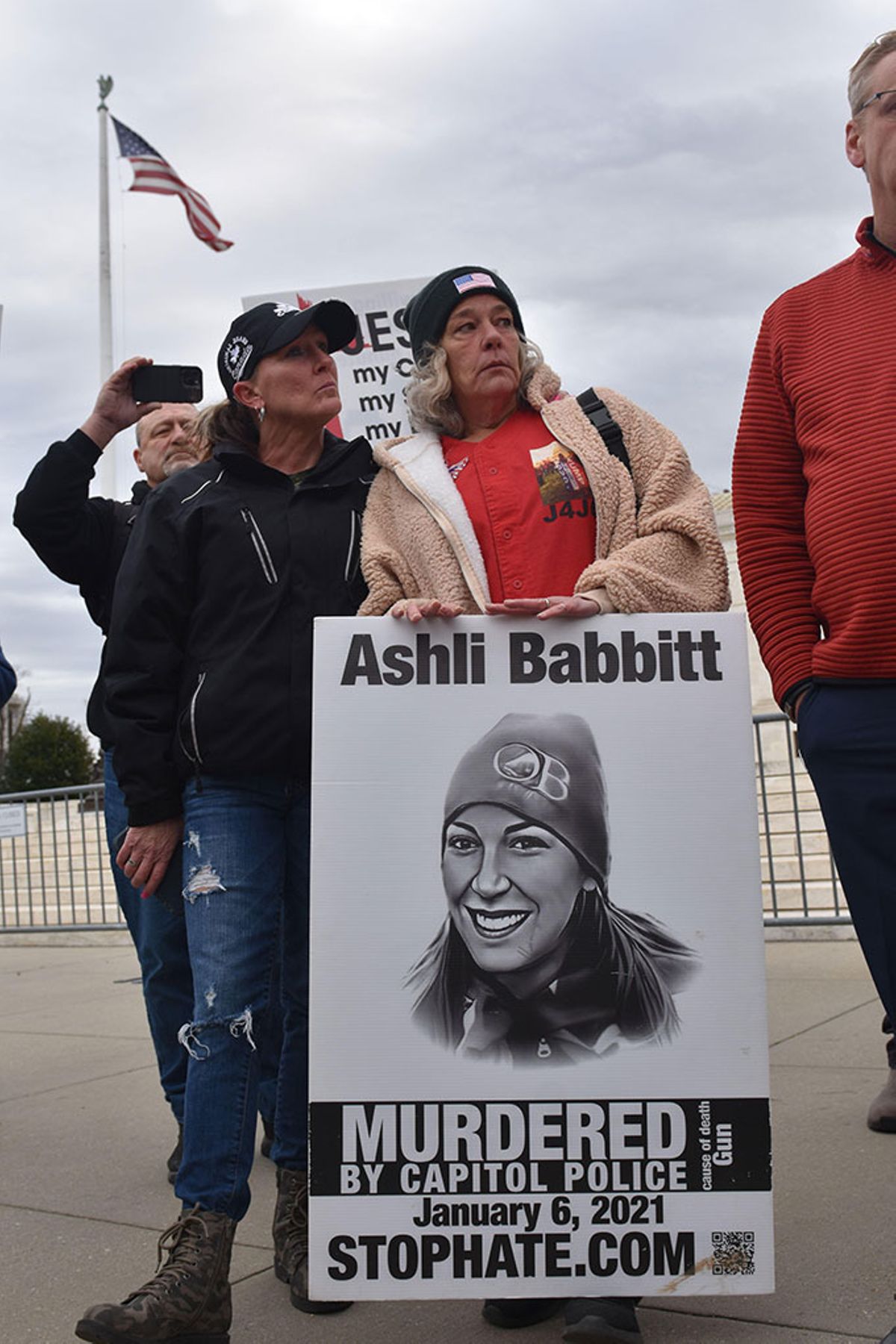
We can take Ashli Babbitt, the lone fatality of those events, as an example of the QAnon outlook. Babbitt had led a seemingly ordinary life. She enlisted in the military, served in Afghanistan and Iraq, and received an honorable discharge. She later ran a pool-supply business in San Diego. She had voted for Barack Obama and had no history of political violence. Yet her social-media posts suggest someone wholly trapped within Q’s constructed world. “Nothing can stop us,” she wrote on January 5: “the storm is here and it is descending upon DC in less than 24 hours . . .
dark to light!” Reality bent to faith; she could look on a crowd of thousands and exult, “Three million-plus people.”
Babbitt, 35, was fatally shot by a Capitol Police officer as she tried to enter the House chamber. Though she was unarmed, the officer was never charged. Babbitt believed that she was helping to save the country, but the event in which she participated was immediately cast as an insurrection—a form of treason. The Biden administration spent years tracking down and prosecuting roughly 1,500 January 6 participants; some received prison sentences of up to 18 years. Set aside the question of whether this treatment was just or unjust, and consider the consequences for the antiestablishment Right of indulging the pathologies of a constructed world: the establishment can strike back, and the costs can be severe.
That isn’t the case on the Left; recall the police chiefs across the country who literally knelt before Black Lives Matter protesters. Constructed worlds on the Left tend to follow some version of the Omnicause model. The term refers to the multitude of sins for which Western civilization stands accused—global warming, white supremacy, sexual oppression, inequality, colonialism, Donald Trump—and the moral imperative to repudiate every facet of this allegedly monstrous system.
Detachment from reality is ritualized in this model, as when placing litter in the correct bin is said to be “saving the planet.” Unlike the delusions of the Right, those of the Left often acquire the force of law. In that sense, we all kneel before the Omnicause.
Overall commitment matters more than any particular cause; one can move from anti-ICE activism to anticapitalism without missing a beat. A well-known example is Greta Thunberg, who evolved from climate activist to protesting the treatment of Palestinians in Gaza. Thunberg’s trajectory offers a revealing illustration of the logic of the constructed world. At 11, she stopped talking. “She cried at night when she should be sleeping,” her mother observed. “I had no energy, no friends and I didn’t speak to anyone,” Thunberg herself tweeted in 2019. “I just sat alone at home, with an eating disorder.” The Omnicause cured her: “I have found a meaning, in a world that sometimes seems shallow and meaningless to so many people.” This was less a political stance than a religious conversion.
Thunberg also illustrates the disparity in how the fantasies of the Left and the Right are judged. The broader culture remembers Ashli Babbitt, if it remembers her, as the dupe of a false prophet; her shooting is generally regarded as justified. Thunberg interrupted children’s education in the name of activism, embraced authoritarian regimes, and issued apocalyptic warnings about climate change and Gaza that have proved no more reliable than Q’s prophecies. Yet she became a role model for her generation—the Joan of Arc of the Omnicause.
The Left controls the designation of saints and sinners. Even its most destructive lunacies, such as child sexual mutilation, descend from the mountaintop with a voice like thunder, clothed in the language of legal and moral obligation. The resulting misery is rarely borne by those responsible for it.
Part of a constructed world’s appeal is that hidden forces can be blamed for how our lives turn out. The ancient archetype is anti-Semitism—and we should not be surprised that hostility toward Jews and “Zionists,” along with outrage at Israel as a uniquely evil nation, has spread through the culture like a debilitating virus.
By nearly every empirical measure, incidents of anti-Semitic violence in the United States have increased significantly. The war in Gaza between Israel and Hamas was the trigger, not the cause, of this surge. It tapped into a preexisting willingness among many Americans to succumb to the malady.
Anti-Semitism now permeates our politics. On the Right, media personalities once associated with MAGA, including Tucker Carlson and Candace Owens, have given a sympathetic hearing to Hitler admirers and Holocaust deniers, while promoting familiar stereotypes—for example, that “Jewish people control the media” and that every American Zionist is “employed” by the Israeli government. In Congress, Republicans Thomas Massie and Marjorie Taylor Greene have portrayed the pro-Israel lobby in conspiratorial terms consistent with the QAnon model.
Still, it’s important to note that all these political actors turned against Trump—and the president, in his inimitable style, has returned the favor, deriding Owens, for example, as “low IQ.” Taylor Greene resigned. Massie was defeated in a primary by a Trump-backed candidate. An appetite for anti-Semitic content exists on the Right; Owens’s audience numbers have grown dramatically. But for now, such voices remain on the fringes, sidelined by the standard-bearers of the MAGA movement.
On the Left, though, a ferocious anti-Zionism has emerged as one of the most energizing dogmas of the Omnicause. Since most Jews are perceived, accurately, as Israel supporters, the difference from true anti-Semitism is sometimes hard to discern. Left-wing activists have been prominent among the crowds that have harassed Jews on college campuses, outside synagogues, and elsewhere. A radical leftist murdered two employees of the Israel embassy outside the Capital Jewish Museum in Washington, D.C. According to one study, anti-Semitic incidents associated with the far Left rose globally by 324 percent between 2023 and 2024, “rendering the far left the dominant ideological camp” behind such incidents.
The Democratic Party, the political home of most American Jews, has also undergone a marked anti-Zionist shift. New York City Mayor Zohran Mamdani declined to attend the annual Israel Day Parade and has said that he would seek to have Benjamin Netanyahu arrested should he set foot in the city. Mamdani is a nominal Muslim and a committed socialist. New York Senator Charles Schumer, a Jew and mainstream Democrat, has asserted that Netanyahu has “lost his way” and that “Israel cannot survive if it becomes a pariah.” Less constrained, Congresswoman Rashida Tlaib has called Netanyahu a “genocidal maniac.”
The New York Times, the Omnicause’s house organ, published an opinion piece by Nicholas Kristof accusing Israel of systemic torture of Palestinian captives, including, notoriously, training dogs to rape male prisoners. Only someone buried deep in a constructed world could swallow such a story.
Aggressive anti-Zionism, we have seen, often curdles into fears of Jewish conspiracies and, from there, into outright anti-Semitism. The extent to which the Democratic Party has traveled this well-worn path remains unclear. Certainly, much of the party’s activist base already has. No parallel voter swing has taken place, however: most Americans still hold an overwhelmingly positive opinion of Jews. But constructed worlds follow their own logic, and the pressure to conform within a transparent information environment is immense. The Democrats have been busy erecting barriers; nowadays, I doubt they would tolerate a Jewish presidential candidate.
How did we get here? It will not do merely to blame the web or social media. These technologies make the pathology possible, not inevitable. They open the door, but we need not walk through it. If we put away our smartphones, we will find reality, with all its riddles, staring us in the face. What we make of it is up to us.
The same holds true of turning Trump into the prime mover. Without question, he is the most polarizing political figure of the century, but that should not drive us to unreason. His peculiar gift is the ability to do exactly that—to present himself as a cosmic force deserving universal attention, generating a perpetual uproar among supporters and antagonists alike. But that, too, we can refuse.
So let us suppose that constructed worlds deliver not a political but a semireligious experience, arising out of a basic human need that William James labeled “the will to believe.” Traditional culture once fed that hunger; contemporary culture does not. That traumatic loss has contributed to the break with reality. Democratic politics, a dry and transactional process, offers insufficient compensation—hence the constant irritability that so often crests into rage. We search within the domain of power relations for what can only be found in the spirit.
Constructed worlds flourish where genuine sources of meaning have collapsed.