Early last December, homeowners in Cook County, Illinois, home to Chicago, received an unwelcome pre-Christmas jolt. In neighborhoods on the city’s South and West Sides, property-tax bills arrived just days before the first installment was due. In some areas, the average bill had nearly doubled.
The backlash was swift. Some residents organized a property-tax bill burning, with one protester likening the bonfire to the Boston Tea Party—citizens, he explained, were objecting to taxation without representation. The analogy wasn’t far off. Illinois law is supposed to cap year-to-year growth in property levies, but exemptions—especially for underfunded school pensions—have caused bills to soar. “This system is rigged,” a pastor at a local church said. “It can’t be fair.”
Finally, a reason to check your email.
Sign up for our free newsletter today.
The Chicago bonfire was far from the only property-tax protest in recent years. In Colorado, when homeowners challenge their tax assessments, the filings are officially labeled “protests.” After property charges surged in Denver in 2023, following misguided reform legislation that was meant to make the system fairer but that instead drove up tax bills, such protests jumped 600 percent. The year before, appraisal challenges hit record levels in many Texas counties as rising home values pushed taxes higher. In the Lone Star State, lawmakers have spent the past four years debating possible solutions.
Across the country, property taxes have been climbing sharply, driven by rising home values and weak limits on assessments. At the same time, falling commercial property values and growing local government spending have shifted more of the burden onto homeowners. Though tax experts often regard property taxes as among the most efficient and equitable of levies, homeowners consistently rank them among the most hated. That sentiment is now evident in a growing wave of tax revolts, with more than a dozen states debating new or expanded reforms.
Property taxes are among the oldest levies in America, dating to the British colonial era. Initially applied to a person’s total wealth, they gradually evolved into a tax primarily on land. Over time, governments introduced other revenue sources, such as tariffs on imports and taxes on income, to supplement them. Even so, property taxes remain the principal means of financing local government—towns, cities, counties, and school districts—accounting for roughly 70 percent of local revenue and about 25 percent of state spending. Much of that money funds public safety, roads, and education. Hence the reason that tax experts often view property taxes favorably: the benefits are, at least in theory, visible to those who pay them.
Taxpayers, though, have never felt the same way. Periodic property-tax revolts have erupted, most notably in the late 1970s, with the passage of Proposition 13 in California, and again in the early 1990s, when states such as Colorado, Oregon, and Michigan adopted caps on increases. Today, property taxes are among the least popular of all charges. In a 2024 Harris School of Public Policy poll, nearly six out of ten respondents rated them as unfair. They scored worse on fairness than the Social Security (FICA) tax, as well as state income and sales taxes.
Relentless increases, coupled with rising local spending, have fed that disdain. In 2024, states and municipalities collected nearly $800 billion in property taxes, up from about $460 billion a decade ago, an increase of roughly one-third in real terms, after accounting for inflation. By contrast, the nation’s population grew by just over 7 percent during that period. Property taxes exploded during the pandemic, with the median bill increasing by 23 percent from 2019 through 2023, and then rising another 8 percent in 2024, according to the National Association of Home Builders.
Those increases coincided with a sharp expansion in government spending, with state and local expenditures going up by nearly a third. Some of the largest gains came in school districts, where spending inflated by 30 percent between 2019 and 2024, an increase of roughly $230 billion. Public school enrollment declined by nearly 1.3 million students over that same period. Some of that spending responded to Covid, with much of the pandemic-era remediation financed with federal grants. While that funding has since disappeared, spending has kept climbing.
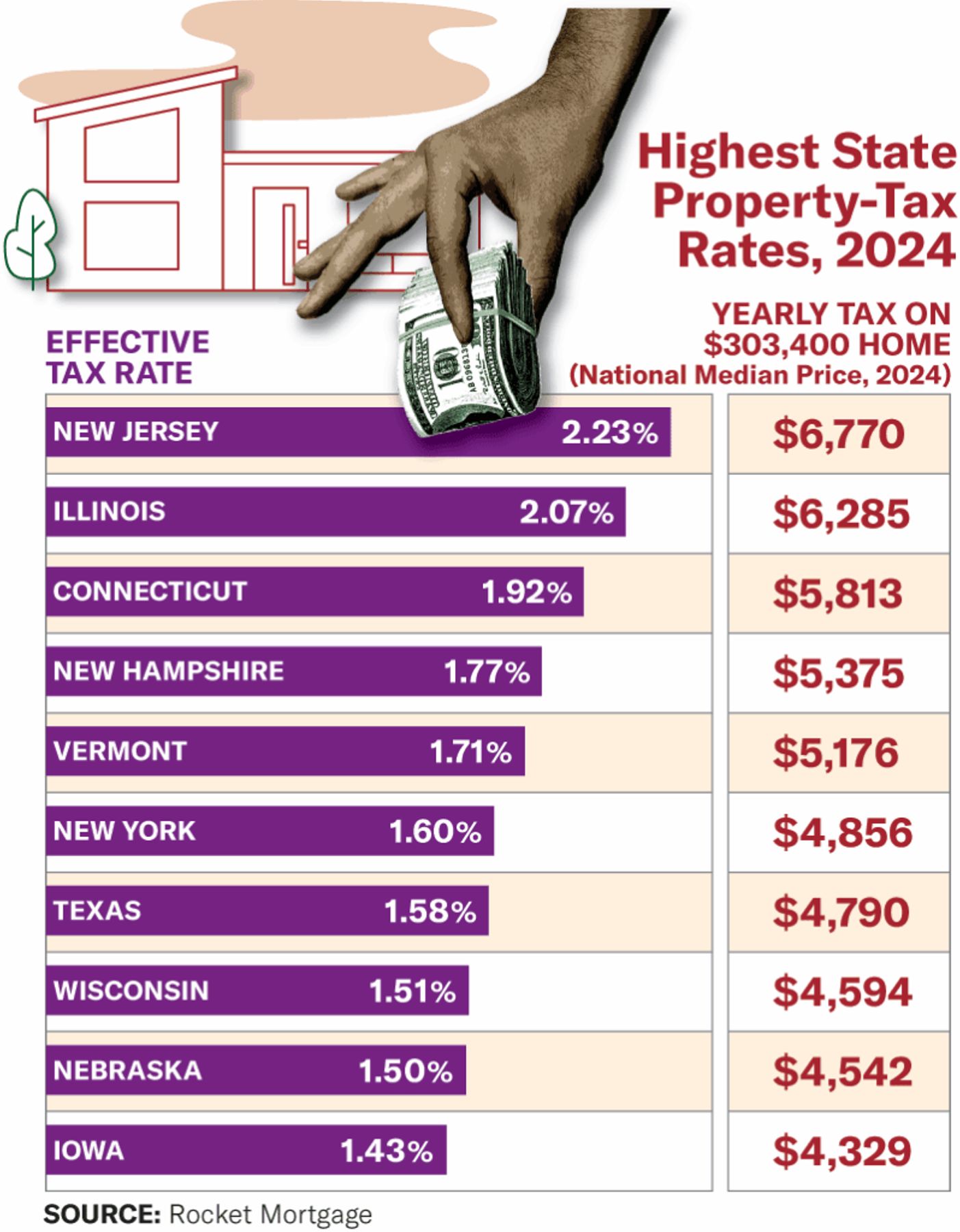
The property-tax problem afflicts both Democratic-leaning states with spendthrift reputations and Republican jurisdictions considered more fiscally austere. States with the highest average property taxes include blue New Jersey, Illinois, Connecticut, and New York, ranked first, second, third, and sixth nationally. But red states like Texas and Nebraska also rank high, with the seventh- and ninth-highest homestead taxes. (See chart on page 57.) In some places, advocates defend these steep rates by arguing that they fund better services, including stronger schools. But it’s also clear that mismanagement and the politicization of local services sometimes drive a significant share of spending—and the higher property taxes that follow.
Chicago epitomizes the government malpractice factor. In 1991, Illinois enacted a law intended to limit property-tax hikes to the lesser of inflation or 5 percent annually. But the cap exempted certain funds, including those used to repay bonds or support pension obligations. Chicago has especially mismanaged its city government and its school pensions, accumulating roughly $40 billion in unfunded liabilities, about $14 billion of it tied to school pensions alone. In response, legislators carved out an exemption for schools from Illinois law, allowing the system to take increasingly larger property-tax bites from homeowners. The additional revenue claimed by Chicago Public Schools blasted from $11.8 million in 2007 to a staggering $698 million in 2023. Since 2007, the total extra burden on taxpayers above the rate of inflation has been $4 billion.
Chicago also has faced recurring budget crises as pervasive social disorder and an increasingly unfriendly city and state business climate—Illinois now ranks among the worst states for doing business, according to CEOs—have hurt commercial activity. Last year, the number of firms in the Windy City fell to a ten-year low, with the famous Magnificent Mile along North Michigan Avenue recording a stunning 50 percent drop in occupancy. As commercial property values and associated tax revenues have plunged, homeowners have had to take on a greater portion of the tax load.
Homeowners in other cities have suffered similar fates. Once one of America’s most vibrant business districts, downtown Seattle has been battered by rising homelessness, the breakdown of order following police abandonment of a precinct during the 2020 Capitol Hill Organized Zone protests, and swelling municipal and state business taxes that pushed jobs elsewhere. Seattle now has one of the nation’s highest office vacancy rates. Payroll-tax revenues shrank by $47 million in 2025, and real-estate excise-tax receipts have also declined. As the city confronts a budget squeeze, residential property-tax bills have climbed, leaving the Seattle metro area with the tenth-highest levies nationally.
Government failures have contributed to shrinkage of New York’s commercial property-tax base, too; it’s down 20 percent since Covid. And San Francisco’s budget has felt the pinch as some 9,000 businesses in recent years have appealed their commercial property-tax assessments. In Boston, officials are trying to persuade property owners to convert their devalued office towers into residences.
Shifting tax burdens have also proved troublesome in Colorado, where a reform effort backfired. In 2020, voters repealed a provision of the state constitution that had capped homeowners’ share of total property taxes at 45 percent, with the remainder falling on commercial properties. Reformers argued that rapidly rising home values had reduced effective tax rates on residences, making it harder to finance local government, especially in suburban areas with relatively few businesses. The state, they contended, needed a more stable system.
The problem is that the repeal that reformers championed—lifting the 45 percent cap—left the system exposed to a sudden drop in business activity, which arrived with Covid and hurt commercial property values. Since 2020, residential property-tax bills in the state have gone up 55 percent, or about $5.4 billion. In 2024 alone, collections from homeowners leaped 19 percent, the largest rise in five decades. While a windfall for local governments, including school districts, those gains have come at the expense of homeowner affordability. In the Denver area, tax hikes have far outpaced growth in household income, raising the cost burden of homeownership. Lawmakers have struggled to find an acceptable fix.
Republican-leaning states have seen comparable spikes. Florida’s property-tax bills have swelled by an average of over 9 percent annually since 2020—a nearly 50 percent compounded increase. The surge reflects the state’s booming economy, including strong domestic migration, which has boosted home values.
Florida law caps annual increases in home assessments at 3 percent, but the limit resets when a property gets sold. In a red-hot housing market, that has led to a doubling in property-tax collections over the past decade—far outpacing even the state’s swift population growth. The accompanying rise in local spending has sparked clashes between state and local officials. Governor Ron DeSantis has derided the system as “a piggy bank for local governments,” and Chief Financial Officer Blaise Ingoglia has advocated for lowering tax rates rather than expanding spending.
In Texas, property taxes have grown over the past 25 years at more than twice the rate of inflation plus population growth. The primary driver: school districts, whose tax revenues climbed to $41.7 billion in 2024, up from $26.6 billion a decade earlier, an annual growth rate of approximately 4.6 percent. As in Florida, homeowners have found themselves squeezed by a combination of mounting assessments in a hot property market and a state law allowing local governments to increase tax collections by up to 3.5 percent annually without voter approval. Governor Greg Abbott has warned that it’s time for local governments to “live within their means.”
Recent reforms underscore how tough it is to balance competing interests in a tax system tied to homeownership. Montana, often ranked among the nation’s most tax-friendly states, offers a telling case. Its sizzling real-estate market has sent home appraisals skyward. As revenues rose, local officials complained that the state captured too much of the windfall through its own property tax.
Facing political pressure, lawmakers enacted changes that cut taxes for about 80 percent of homeowners but shifted the weight onto higher-value properties and businesses. The result is less a true reform than a redistribution. By imposing higher rates on certain properties, the system effectively makes the property tax more progressive, enabling the state to raise similar revenues in a less visible way. “Unfortunately, Montana lawmakers have opted for a tax shift, not a tax reform, and it is unlikely to prove a long-term solution,” the Tax Foundation’s Joseph Johns observed.
Another politically popular, though ultimately ineffective, response to rising property taxes is the short-term rebate program. These schemes use revenue from other sources, such as state income or corporate taxes, to send checks to homeowners. In lieu of structural reform, states such as Pennsylvania, New York, and New Jersey now provide such payments to selected taxpayers.
The approach helps defuse public anger and enables political leaders to target relief to favored groups, such as seniors. It also makes the system more progressive by excluding higher-income homeowners. But without constraints on spending, these programs do nothing to address the underlying mismatch between revenues and expenditures that drives property-tax rates higher.
The depth of discontent over property taxes is evident in the 2026 legislative season, with more than a dozen states debating new or expanded reforms. Most striking is the growing push to eliminate a significant share of property taxes—a daunting prospect, given how heavily local governments rely on them. The rhetoric reflects broad political awareness of how unpopular the charge has become. Florida’s DeSantis, for example, argues that homeowners paying annual property taxes don’t truly own their homes: “You have to continue writing a check to the government, every year, just for the privilege of being able to use property that you supposedly already own.”
He has also likened rising tax bills from higher home values to taxes on unrealized capital gains, claiming that they leave owners property-rich but cash-poor. After extensive negotiations with legislators, DeSantis is backing an amendment to Florida’s constitution, to be voted on in November, that would raise the amount of a home’s value exempt from property taxes from its current $50,000 to $250,000 by 2028. The tax cut will apply only to property taxes used to fund municipal government—not schools. DeSantis says that the state will create a special emergency fund as a backstop in cases where property-tax revenues might suddenly and unexpectedly decline. But critics argue that, given the size of the property-tax cut, the state might have to raise other taxes to meet its obligations.
Texas Governor Abbott has proposed the opposite approach: eliminating property taxes tied to schools, while retaining those that fund other local services. He would use state surpluses to finance education, as part of a broader plan that imposes tighter limits on local spending growth and reduces the frequency of property reappraisals. “Your home should not be the piggy bank that is raided to pay for public schools,” Abbott said, echoing DeSantis’s rhetoric.
The sentiment behind such reforms is giving rise to similar proposals in other states to eliminate or sharply reduce property taxes, though many lack support from key political leaders. In Indiana, a bill cosponsored by four assembly members would abolish property taxes by 2028 and replace them with school fees and a revenue-sharing fund based on sales and use taxes. Georgia Republican legislators have advanced a sweeping plan to sunset the tax by exempting the first $150,000 of a home’s value, with full elimination by 2032 and replacement revenue drawn from other taxes and service fees. Organizers in Oklahoma are gathering signatures for a ballot measure that would phase out property taxes by 2029.
Even when such far-reaching efforts fail, politicians have heard the message from taxpayers. After North Dakota voters rejected a 2024 effort to abolish property taxes, the state legislature passed a law that raises the exemption, effectively freeing about one-third of homeowners from the charge by using money from the state’s Legacy Fund, built on oil and gas revenues. Ohio, meantime, has expanded its residential tax credit as part of a reform that caps reappraisals and limits tax increases.
Because property taxes are levied locally and differ widely across states, no single reform will work everywhere. But states and municipalities can make their systems fairer and reduce sudden tax increases while still retaining the property tax. The most important step is controlling local spending, so that municipalities can meet their obligations without imposing excessive burdens on homeowners.
One tool is the levy limit, which restricts how quickly property-tax revenues can grow. Massachusetts adopted such a limit with Proposition 2½ in 1980, capping annual growth in collections to 2.5 percent on existing property. Alaska uses a per-capita limit equal to $1,500 per resident. Michigan, for its part, requires localities to roll back tax rates when rising property values would otherwise push collections above inflation.
Though many states impose some form of levy limit, their design and effectiveness vary widely. Some allow exemptions or overrides for emergencies or new construction, so spending can rise despite the cap. In other cases, exceptions are imposed from above, as in Illinois, where certain school districts are exempt—helping drive large increases in Chicago property taxes.
In other cases, where residents must approve spending above the cap, the system is riddled with loopholes. Votes are often held in off-year elections, when turnout is low and organized interests, such as public-sector unions, can dominate. Nor is it always clear to voters how much new spending will raise their property taxes, or even that such a measure is on the ballot. In South Dakota, for instance, dozens of school districts and municipalities in recent years have opted out of property-tax caps without a public vote. State law says that that is okay, as long as the governing body announces its intent in a notice to taxpayers and no organized opposition emerges from the community.
A significant strand of the current reform movement would give voters more control over these overrides. A proposal from South Dakota legislators would require a public vote on any effort by school districts to exceed spending limits. In Texas, Abbott has backed raising the threshold to approve new spending to a two-thirds vote. New Hampshire lawmakers have similarly considered requiring a 60 percent supermajority to spend beyond the caps. In Kansas, reformers want to lower the number of signatures needed to block local efforts to surpass tax limits—a move that followed a county’s decision to boost levies 41 percent in a single year.
Most property-tax systems pile on fixes—assessment caps, circuit breakers—to soften sudden spikes. Their results are uneven, especially where levy limits are weak. Other devices, like targeted rebates, often make matters worse by inviting political favoritism.
One feature that complements tax limits while avoiding that problem is the statewide homestead exemption. It works like a standard deduction, shaving a fixed amount off a home’s taxable value. Applied uniformly, it delivers the greatest proportional relief to owners of modest homes, without carving the electorate into winners and losers.
If the age of Donald Trump has taught anything, it’s this: when the views of experts and politicians drift too far from those of ordinary voters, public anger becomes a political force. Property taxes may satisfy economists’ tests of fairness and efficiency, but homeowners increasingly detest them. Politicians who wave that away court a predictable revolt.