
A multicity campaign led by far-left activists is targeting the American technology firm Palantir, portraying it as central to U.S. immigration enforcement, military operations, and Israel’s war in Gaza. Activists in Denver, Minneapolis, and South Florida see the company as a vulnerable target.
As with these activists’ past efforts against Lockheed Martin, the campaign against Palantir raises national security concerns—especially if sustained pressure begins to disrupt the operations of a key provider of defense, counterterrorism, and law enforcement tools and services for government.
Finally, a reason to check your email.
Sign up for our free newsletter today.
The activists secured an early win against Palantir in Denver, where their efforts forced the company to relocate its executive offices to the Miami area. Now they’re mobilizing allies in Florida to extend the campaign, while intensifying activity in communities where Palantir operates or maintains ties.
During a recent webinar, activists from the Anti-War Action Network outlined the Denver campaign and described how similar strategies might succeed elsewhere. They emphasized as core tactics coalition building, sustained disruption, and economic pressure. Antiwar, anti-Israel, and anti-deportation activists, they argued, must work together to build political leverage against the company.
Brandon Gehrke Quintanilla and Hatem Teirelbar represented the Denver coalition. Gehrke Quintanilla is co-founder of the immigrant rights group Aurora Unidos CSO and serves as co-chair of the Legalization for All Network, a key national umbrella organization in the anti-ICE mobilization. He argued that Palantir has streamlined ICE’s operations to such an extent that what previously “would have taken days, now in certain cases, it can take hours.”
Teirelbar, representing Denver Anti-War Action (DAWA), explained that, in early 2025, DAWA focused on targeting Lockheed Martin. But members soon realized that the factors that made Lockheed Martin hard to operate against—its location outside the city, its presence on federal land, and the fact that its Denver-area presence was just “one of many Lockheed locations”—did not exist with Palantir. Palantir’s sited its global headquarters in rented office space in a dense, highly populated area of Denver, offering what Teirelbar described as “favorable local conditions.”
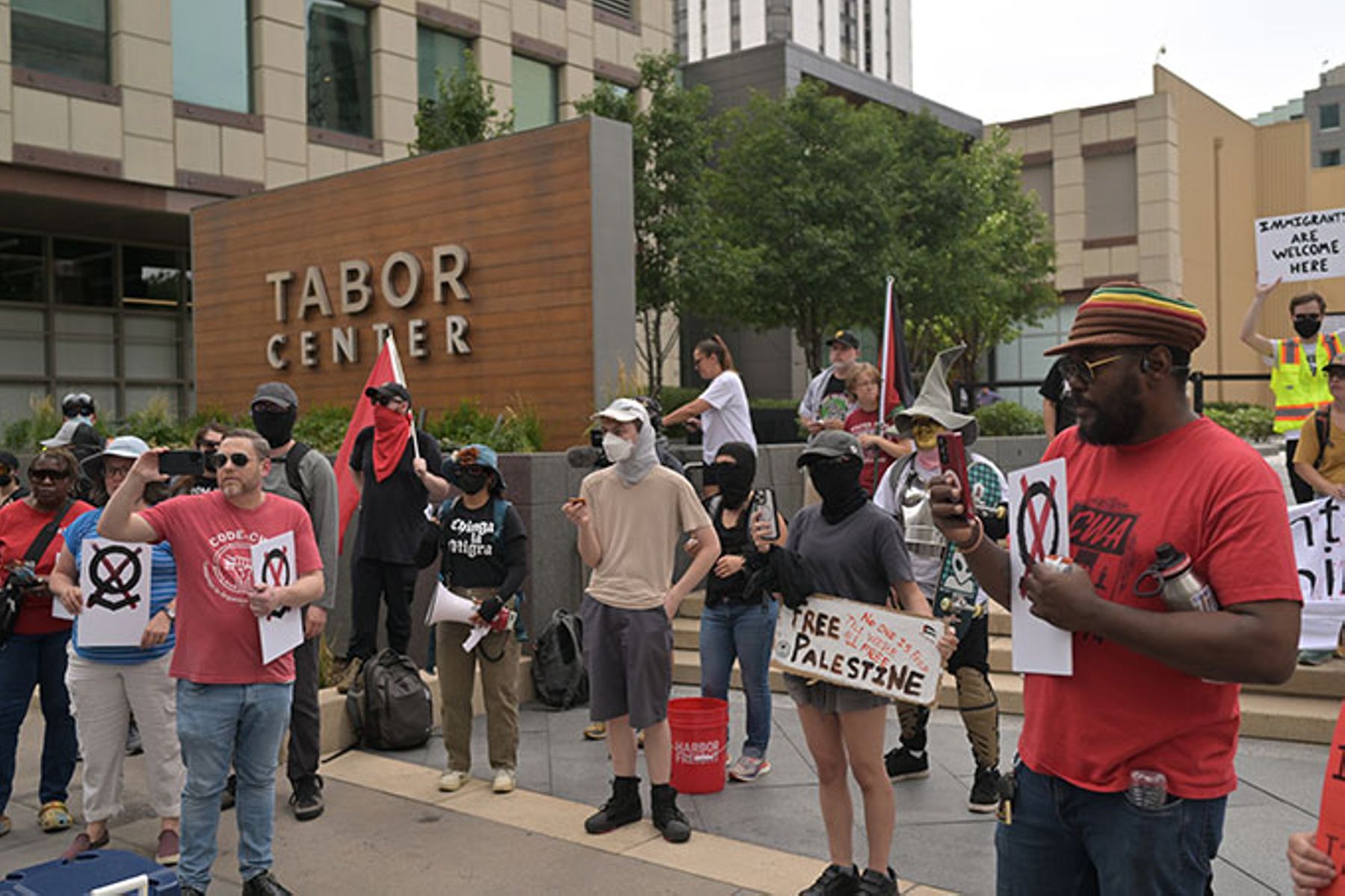
The campaign kicked off in April 2025 and went on to include “at least 28 rallies, marches, pickets, car rallies, and internal disruptions” over 44 weeks. Teirelbar bragged that “not a week went by without some action being taken against Palantir.” He noted that DAWA acted during business hours but at unpredictable times to “maximize disruptions,” and it coordinated with other organizations to extend efforts beyond the company itself, targeting its landlord and attempting to “put pressure on Palantir’s neighbors, hoping they would complain to the landlords and add to that pressure.”
In the same webinar, Maeve Aickin, representing the Minnesota Anti-War Committee, described how activists in her state are targeting the Minnesota State Board of Investment to demand divestment from Palantir. She explained that Palantir has been a particularly effective organizing focus, as public anger has grown over immigration-enforcement activity in Minnesota.
Aickin’s organization has been involved in seemingly successful divestment campaigns before, such as the sit-in targeting the State Board of Investment, at which Aickin and several others were arrested. She noted that a public-records request revealed the State Board of Investment had “quietly” divested $13.3 million worth of holdings in Israeli bonds, though the board has denied these moves were a “divestment.”
“A similar victory of complete divestment from Palantir would open a door that can’t be closed and increase the size of the crowd trying to knock the whole thing down,” Aickin said.
The final presenter, Hannah Collantes of the South Florida Anti-War Committee, acknowledged that her group’s campaign against Palantir is in its early stages. But the organization has already organized an “unwelcome party” at Aventura Mall, site of the company’s new headquarters, alongside coalition partners Mijente and Jewish Voice for Peace. Collantes claimed that protesters were not allowed inside the mall “due to law enforcement,” preventing them from being “as close and as disruptive . . . as we would want to be,” but she described the action as “very visible.”
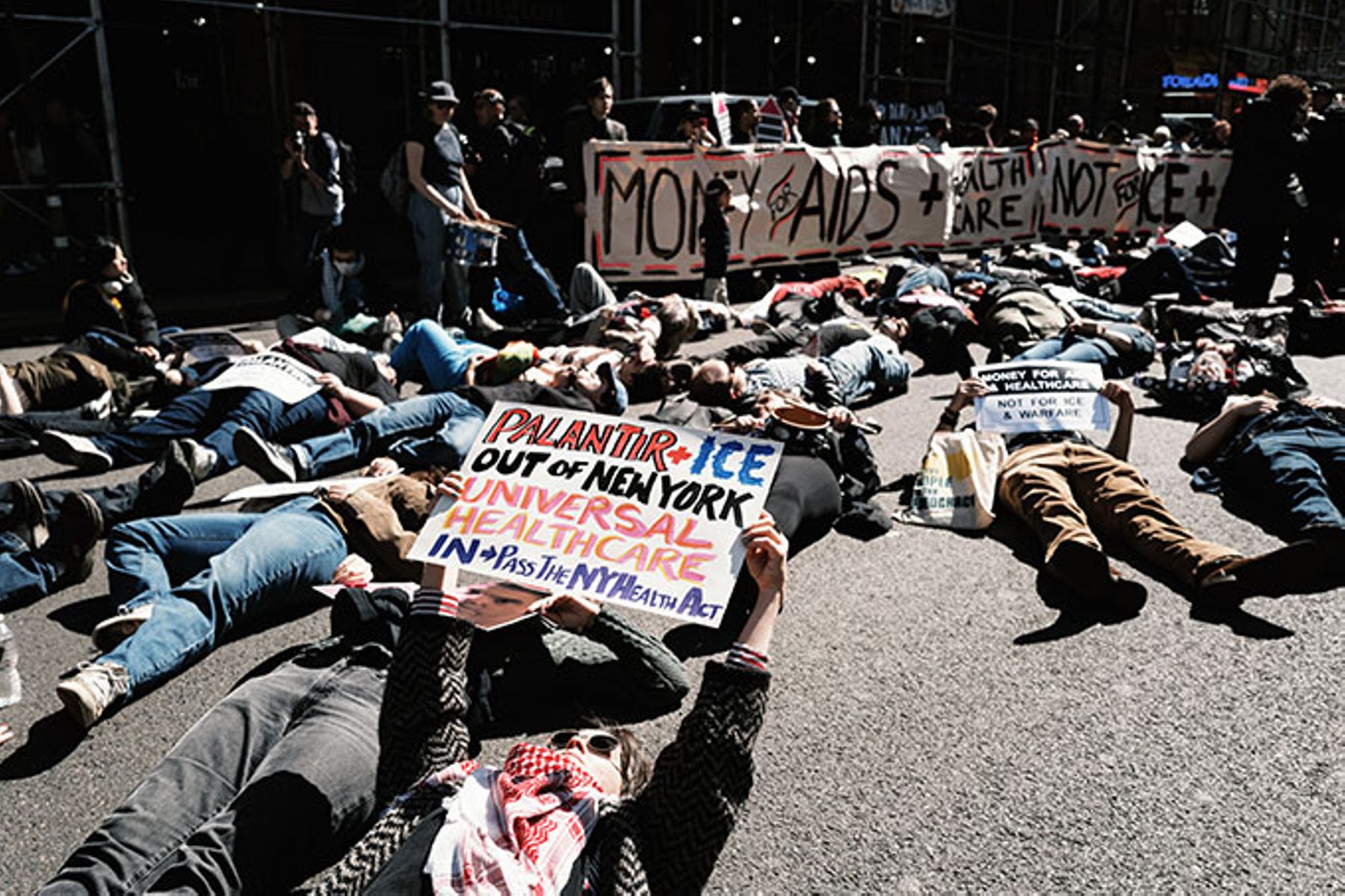
Clearly, the word is spreading: Palantir is the new bête noire of far-left activists. Jewish Voice for Peace recently mobilized in the lobby of Palantir’s New York City office alongside the Sunrise Movement and Jews for Racial and Economic Justice, as part of the latter’s annual Seder in the Streets direct action. The militant AIDS activist group ACT UP New York even staged a “die-in” outside Palantir’s office in the city, arguing that funding the war with Iran diverts resources away from HIV programs.
So who, exactly, is leading the charge against Palantir? While the Anti-War Action Network presents itself as a broad, generic coalition, it operates as an umbrella organization that overlaps significantly with the Freedom Road Socialist Organization (FRSO) ecosystem. Many of its affiliated groups, often branded as local “antiwar committees,” have been linked to more confrontational forms of activism.
Organizers connected to these networks include Rick Toledo, who was involved in the occupation of Cal Poly Humboldt and faced charges of false imprisonment, assault, and battery against the associate director of the student activities center. Another figure, Conor Cauley, allegedly disrupted a Jacksonville City Council meeting and was charged with carrying a concealed weapon. In 2010, the FBI investigated many individuals linked to the Freedom Road Socialist Organization for their work with antiwar committees, citing alleged material support for terrorism—though those charges were ultimately dropped or never filed. Some of these individuals have since become movement elders in these circles and even cohosted a webinar last year with the Anti-War Action Network on how they organized in response to the charges.
One of FRSO’s strategies has been to revive defunct activist groups and create broadly framed organizations with ideologically neutral-sounding names that serve as vehicles for its activism, often with FRSO members in leadership roles. Its network of “antiwar committees,” its involvement in the revived Students for a Democratic Society chapters, and its participation in city-based anti-Trump coalitions all reflect this approach.
This approach often obscures FRSO’s role, leading mainstream progressive organizations to partner with groups that are part of its broader network without recognizing the connection. Considering recent sexual misconduct and cover-up allegations against FRSO members and leadership—and subsequent public statements from prominent far-left groups distancing themselves from FRSO—the organization is likely to rely even more heavily on this strategy, forming new affiliated groups or rebranding under different names.
The campaign against Palantir Technologies is not a spontaneous surge of grassroots activism but part of a long-term strategy of the far Left. Coalitions like the Anti-War Action Network and FRSO have repeatedly rebranded, regrouped, and shifted efforts to new targets with striking effectiveness. Palantir is just the latest, chosen for its perceived vulnerabilities.
These activist offensives can and will have serious national security consequences. America’s military and law enforcement apparatus depend on Palantir’s technology to be more effective and more humane. The activists seem intent on crippling these capabilities. For President Trump’s revamped Justice Department, the question is whether to continue to treat these actions as routine protests—or as part of a pattern that demands closer scrutiny and a coordinated response.