
Deichman Bjørvika, the main library in Oslo, occupies a prominent site next to the opera house and the Munch Museum. Whereas many American downtown libraries favor classical design, Oslo’s is strikingly postmodern, its asymmetrical layout featuring almost no right angles. Inside, the building blends Brutalist monumentality—massive, exposed concrete slabs—with an airiness created by natural light and a soaring central atrium. The collection of more than 450,000 volumes is excellent by my preferred standard: a wealth of older, rebound books that likely haven’t circulated in years. It’s ideal for browsing. The library organizes most of its books and private study spaces around three multistory columns rising through its center, ensuring functionality while preserving unobstructed views of the Oslo Fjord.
Design and collection quality aside, Deichman Bjørvika differs from downtown libraries in America by its near-total absence of homelessness. I’ve visited a few dozen downtown libraries in midsize and major American cities and have yet to encounter one that did not serve additionally as a daytime homeless shelter. Shelters require clients to vacate dorm space in daytime hours. Clients must find somewhere to go, but most don’t work. So they head to the library.
Finally, a reason to check your email.
Sign up for our free newsletter today.
Any American who questions whether libraries should function as daytime homeless shelters is quickly accused of opposing “inclusivity.” Yet the Oslo public library is more inclusive than any American downtown library I know. From its 8 a.m. opening to its 10 p.m. closing, everyone uses it—college students (both native Norwegians and headscarf-clad young women), groups of schoolkids, parents with small children, chess players, retirees, professionals. By contrast, the patron population of a typical American downtown library scarcely reflects its host community. When homeless people take over the space, community members tend to stay away.
Deichman Bjørvika’s lack of vagrancy reflects conditions generally in Oslo. Oslo does host a safe drug-consumption site. Though located in the scuzziest part of Oslo’s city center, its attendant disorder does not reach the library, about a 15-minute walk away.
European cities’ lack of street homelessness doesn’t track with typical preoccupations among critics in the United States. Those who dispute the homelessness-as-a-housing-problem thesis might note that European cities facing housing crises don’t resemble San Francisco. Those who believe robust social spending prevents homelessness could point to social democracy, though New York City’s experience suggests that that model can’t be exported any more reliably than political democracy can be exported to the Middle East. And levels of social spending in America are more robust than commonly appreciated. Those who believe American homelessness demonstrates a failure of the mental-health system might cite Europe’s higher psych bed counts. But disability rights advocates—who accept the idea that mental illness drives homelessness but dislike institutional care—could counter that community mental health is better organized in Europe, too.
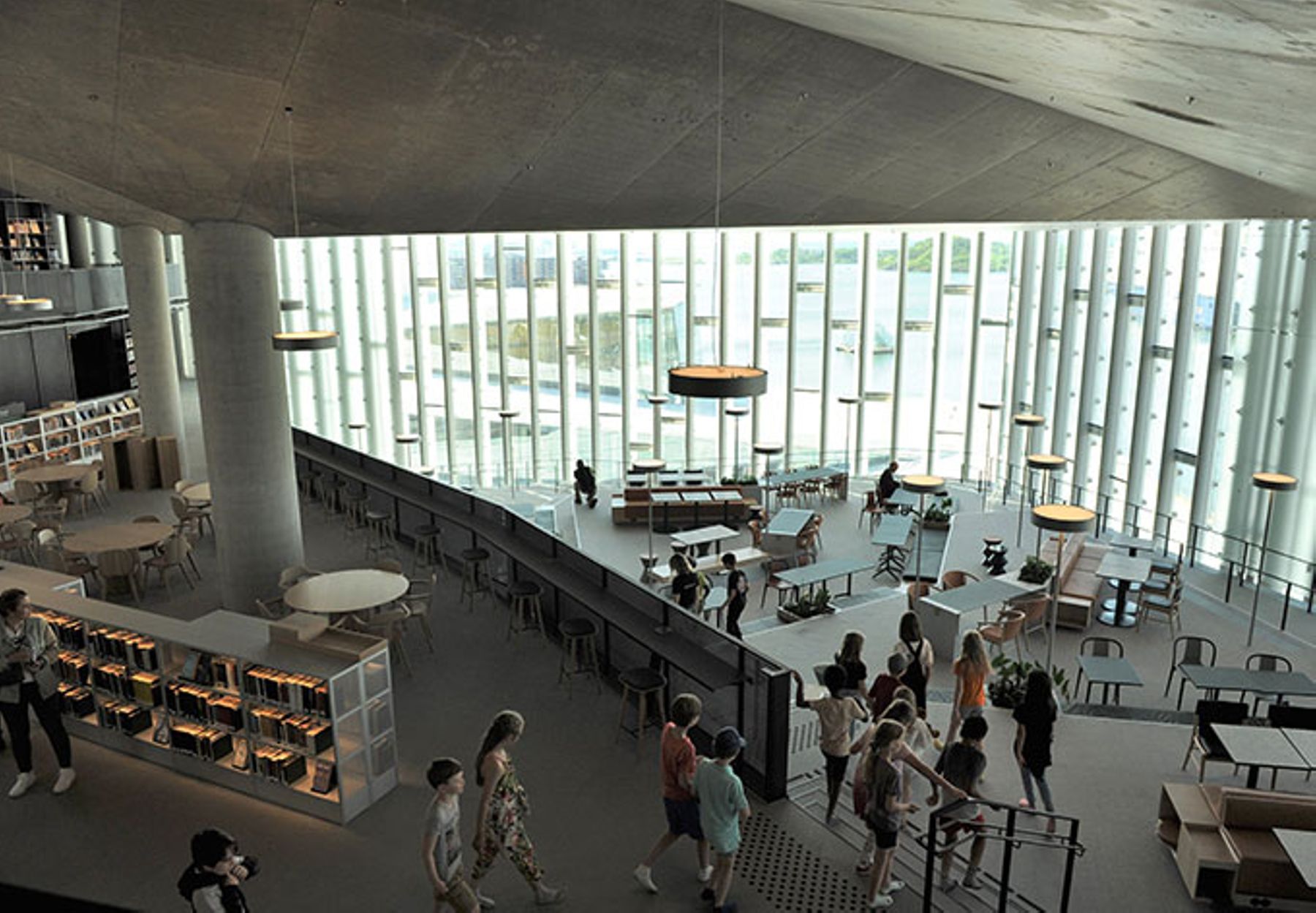
Americans pair extensive library-management failures with equally extensive theorizing about how libraries should function. Some say it’s perfectly acceptable for libraries to double as homeless shelters. Others praise them as “third places” or “social infrastructure,” terms usually invoked to lament America’s supposed under-investment in public goods. Oil-rich Norway does show what generous investment in libraries looks like, not only at Deichman Bjørvika but also other branches. Yet spending alone can’t guarantee a healthy library culture. New York’s Stavros Niarchos Foundation Library and Washington, D.C.’s Martin Luther King Jr. Memorial Library have both recently benefited from new investment, but both struggle with homelessness. The history of public housing makes the lesson clear: pouring concrete is no substitute for enforcing behavioral norms.
Inclusiveness aside, Norway hasn’t found a solution to the decline of immersive reading. Deichman Bjørvika hosts a young crowd, but most are working on their laptops. This institution’s accomplishments are not so much cultural as civic and urbanist. Jane Jacobs would have marveled at the sight of dozens of strangers packed all day long into cheek-by-jowl circumstances, where they labor civilly in relative, if not absolute, quiet. The library in Oslo has a beehive-like feeling that contrasts sharply with the oppressive listlessness characterizing America’s homeless-shelter libraries. The only American library space that exhibits a similarly charming mise en scène to Oslo’s is the New York Public Library’s Rose Main Reading Room. That space has largely been kept free from homelessness by tactics that, for reasons known only to itself, the NYPL declines to employ at its other locations.
Library use, even more than transit conditions, offers a meaningful measure of urban health. People must use transit, but usually only in short bursts. A library user, by contrast—someone who could study at home but instead chooses to spend an entire afternoon working in a public space alongside others—casts a strong vote of civic confidence in his city. That such experiences have become so rare in America speaks to our diminished ability to have agreeable things and share them with one another.
This century will be the first in modern times in which Europe does not play a leading role in world affairs. Still, we err when we dismiss the Continent as “a museum.” We will stay interested in Europe as long as we remain interested in how to run cities.
Top Photo by Sigrid Harms/picture alliance via Getty Images