
An increasingly obsessive focus on progressive politics has caused New York’s powerful teachers’ unions to lose sight of their basic job: representing teachers. Interviews with union members, teachers, and former educators reveal growing discontent over the scope of the unions’ political activism, with some saying the unions have gone too far and should concentrate on their traditional mission of negotiating better contracts for the workers they represent.
The divide is partially driven by a rising number of members aligned with the Democratic Socialists of America (DSA) and other radical left-wing organizations in New York. Also pivotal are members in noneducational roles, like school nurses and teachers’ aides, whose material disagreements with teachers can be papered over with social-justice rhetoric.
Finally, a reason to check your email.
Sign up for our free newsletter today.
This growing conflict mirrors that seen in other unions. It could have existential consequences for one of the most powerful forces in New York politics, and for organized labor more generally.
In New York City, the United Federation of Teachers (UFT) is the sole representative of teachers. It operates under a unified dues system, meaning that member dues flow not just to UFT but also to its state counterpart, the New York State United Teachers (NYSUT), and its national parent, the American Federation of Teachers (AFT).
The NYSUT is a statewide federation of more than 1,200 local unions. Since 2023, it has been led by Melinda Person. It’s debatable whether Person could be characterized as a “teacher.” She was a student teacher in Boston public schools, then joined NYSUT in 2006 after working in the governor’s budget office and the New York State Assembly.
A NYSUT representative confirmed that Person is a New York-certified teacher. But she obtained her certification only a week prior to her election as NYSUT president. Analysis of pay data reported to the state Teachers’ Retirement System also suggests that she compiled the 40 required days of practical training only in the years immediately preceding this period, with little teaching since. A FOIL request revealed that some of the hours likely used to satisfy the practicum requirement were in non-union positions. Person’s teacher certification creates the superficial impression that she is an educator, but the larger part of her work history suggests that political savvy, not educational experience, is what now drives unions like NYSUT, which are increasingly focused on issues other than education, especially social-justice goals.
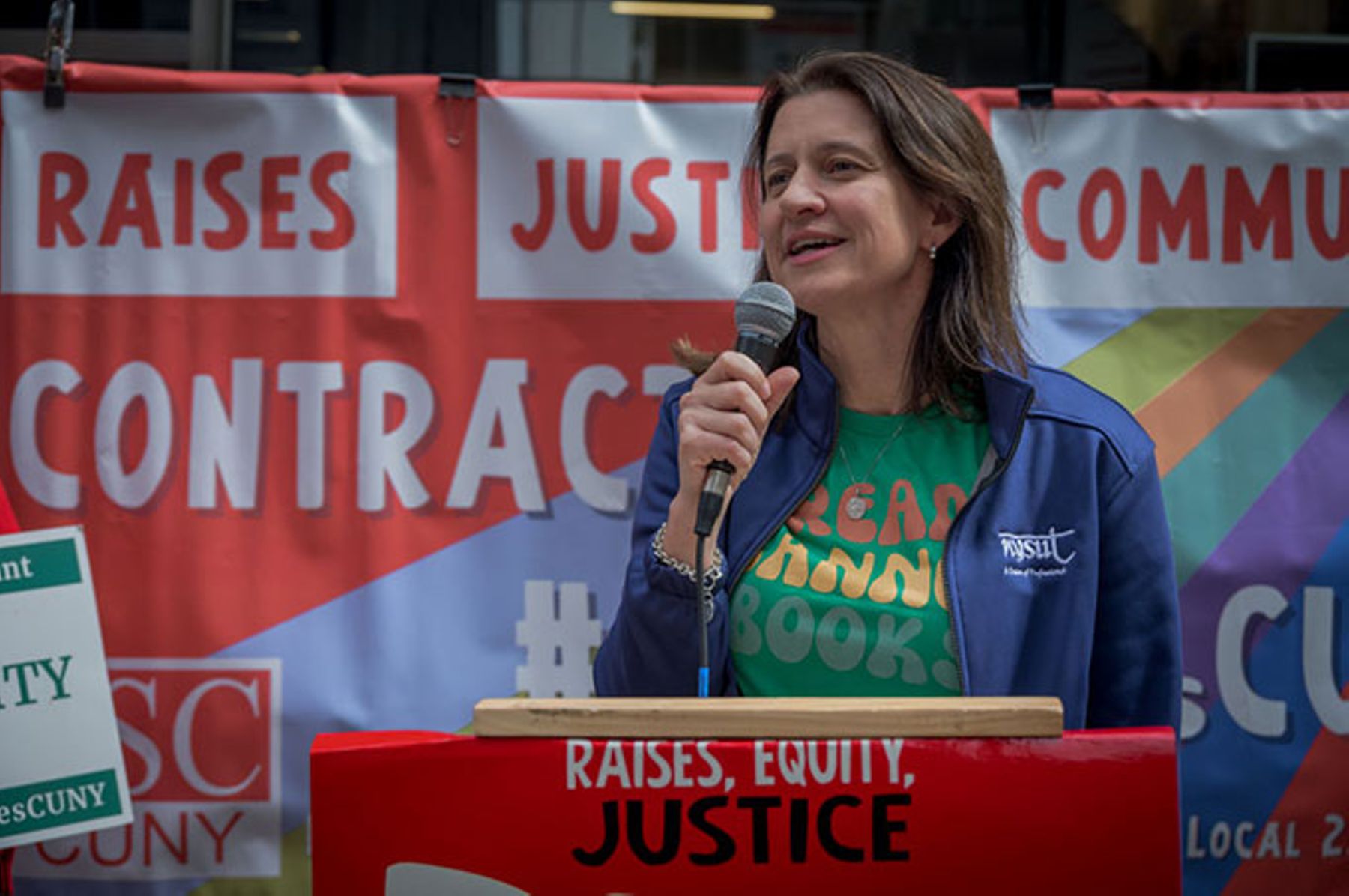
Some of the union’s work is obviously related to its employees’ interests, if not the public’s. Its most visible effort has been lobbying to sweeten public-sector pensions. The move would be crippling for state finances, costing taxpayers an extra $100 billion over the next three decades. NYSUT also opposes school choice and is pushing for greater funding for New York’s already aggressively funded district schools.
But according to the NYSUT, “social justice is not separate from union work—it’s at the heart of it.” That commitment is reflected in the organization’s annual “Social Justice Academy,” in its demand for higher taxes, and in its fight against “anti-DEI policies.”
Resources are finite, meaning time and money spent on broader social issues necessarily come at the expense of advocacy on direct contractual terms. When City Journal asked Person what she views as the right balance between the two, a NYSUT representative responded that the union’s focus is on “state-level issues that directly impact our members, their students, and the public school communities they serve. Issues like child poverty and hunger are squarely within that mission.”
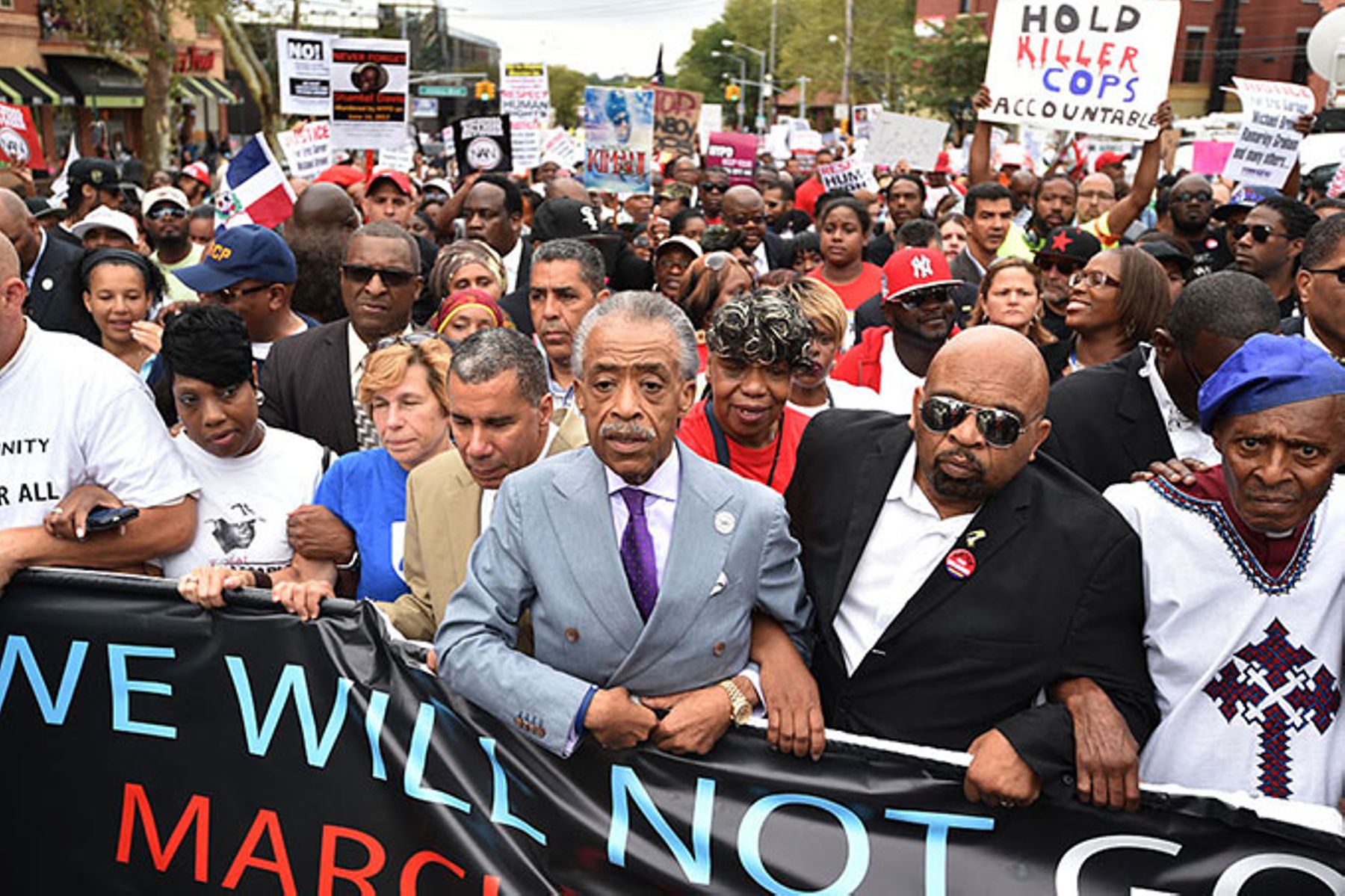
Not all teachers, however, are so enthusiastic about unions’ increasing focus on social justice. In New York City, concerns emerged as early as 2014, when the UFT sponsored a rally led by Rev. Al Sharpton. The event prompted a major backlash from members, who saw it as divisive and disrespectful toward the NYPD.
Several teachers I interviewed for this investigation attributed the UFT’s recent shift toward more radical positions to the influence of the Movement of Rank and File Educators (MORE) caucus, which emerged in 2012. The implication of MORE’s radical agenda is that public education and unions would become mere vehicles in the pursuit of a state conforming to its leadership’s vision of social justice.
One New York City public school teacher—speaking on condition of anonymity—told me that MORE sought to intensify militancy and strike activity. He linked the increasing strike action in Chicago and Los Angeles to a progressive branch takeover within the union. “MORE wants to align the UFT to that style of activism,” he said. Others confirmed overlap between MORE’s leadership and the DSA. MORE did not respond to City Journal’s request for comment.
Karen Feldman, who spent 26 years as a New York City public school teacher and was a long-time union member, said “people weren’t paying attention” when the MORE caucus was founded. By 2015, MORE was growing, combining sensible policies like “better air conditioning” with more extreme proposals. A decade later, MORE-affiliated Olivia Swisher mounted a leadership contest against incumbent UFT President Michael Mulgrew, who managed to secure reelection with 54 percent of the vote, the “narrowest victory to date.”
MORE is closely connected to the city’s radical-left infrastructure. That includes links to the Neville Roy Singham-backed People’s Forum, which, according to the New York Times, used a “web of charities and shell companies” to fund anti-Western propaganda. After the October 7 attacks, MORE and the DSA co-sponsored an anti-Israel protest and provided teachers with resources published by Rethinking Schools, which seeks to “promote equity and racial justice in the classroom.”
Feldman warns that politicization is not confined to MORE. Shortly after Mulgrew’s reelection, she said Swisher was invited to the UFT’s headquarters to lead a workshop on how to teach “civil activism.”
Another factor pushing teachers’ unions away from a focus on education is their representation of nonteachers—classroom aides, bus drivers, security staff, school nurses, and the like. These workers often earn significantly less than certified teachers, a disparity that became salient in the United Federation of Teachers’ 2025 leadership contest. Mulgrew’s challengers unsuccessfully tried to rally these members to unseat the incumbent.
The basic tension is simple: higher pay for paraprofessionals from school-district budgets would come at the expense of certified teachers. Representing these divergent interests is inherently difficult. That gives union leadership an incentive to focus on other topics. As a result, social justice gets prioritized over issues more directly related to work conditions, such as the negotiation of benefits and oversight of organizational rules.
This leaves teachers feeling underserved. The previously quoted New York public school teacher informed City Journal that he had “not felt a positive impact of the teachers’ union at work.” When he tried to discipline a student for cheating on a test and the principal deemed the penalty “inequitable,” the union did not defend him. “The kids joke that [the union representative] is never in the building,” he said.
Feldman ceased teaching in 2024, leaving the UFT. She highlighted several ways in which union activism conflicts with teachers’ interests, including the growing number of politically driven resolutions in recent years that filter into the classroom. “I was a proud UFT member for many years, until the UFT started to represent something different,” she said.
Feldman isn’t the only one to opt out. In the years since the Supreme Court’s 2018 decision in Janus v. AFSCME, the number of NYSUT’s active (nonretired) dues-paying members has declined by 2 percent, even as the total number of full-time equivalent teachers and paraprofessionals in New York State grew by 6.7 percent. The trend suggests many have concluded that paying dues isn’t worth the hassle.
Nonetheless, the money keeps flowing to the unions’ political campaigns. Under New York State law, union dues can be automatically deducted from teachers’ wages and are deductible from state taxes.
“Sometimes, [workers] don’t even realize their money is being taken away” to pay for union dues, said Chip Rogers, CEO of Americans for Fair Treatment (AFFT), a nonprofit focused on informing public-sector employees of their rights surrounding union membership. Following the Janus decision, then-New York Governor Andrew Cuomo enacted measures preventing groups like AFFT from contacting public employees about their right to opt out of these unions.
The way New York’s teachers’ unions are going, outside pressure from groups like AFFT might not even be needed. Growth in active membership has already declined, and unless the unions refocus on core issues, it’s likely to shrink further. The direction leadership chooses may ultimately prove consequential to the unions’ long-term viability.