
The net outflow of New Yorkers to other states has topped the 1 million mark since 2020, while the flow of migrants into the Empire State from other countries was even larger than originally estimated during that same period, according to the latest U.S. Census Bureau estimates.
But New York was also hit hard by what the Census Bureau calls a “historic decline in net international migration”—meaning far fewer immigrants arriving from abroad—over the 12 months from July 2024 through June 2025. With New Yorkers continuing to leave the state at a steady pace, a modest two-year rebound in the Empire State’s population came to a halt—with all signs pointing to renewed decline in the second half of this decade.
Finally, a reason to check your email.
Sign up for our free newsletter today.
New York’s total population hit a record 20,203,696 in the April 2020 census count—but then dropped by about 368,000 in the two years following the Covid-19 outbreak. Subsequent estimates showed a surge of foreign migrants made up for some of that decline during the next two years. However, the latest change in the state’s population was virtually no change at all—an estimated gain of just over 1,076 people during the 12-month period ending last July 1.
For the U.S. as a whole (including the District of Columbia and Puerto Rico), the mid-2025 population count came to 341,784,857, a modest increase of 1 percent, or 1.778 million, over the mid-2024 estimate. Measuring from April 2020, the national total was up 10 million, or roughly 3.1 percent.
By contrast, New York’s population is still down a net 201,269 from the 2020 Census count—the biggest population decline of any state.
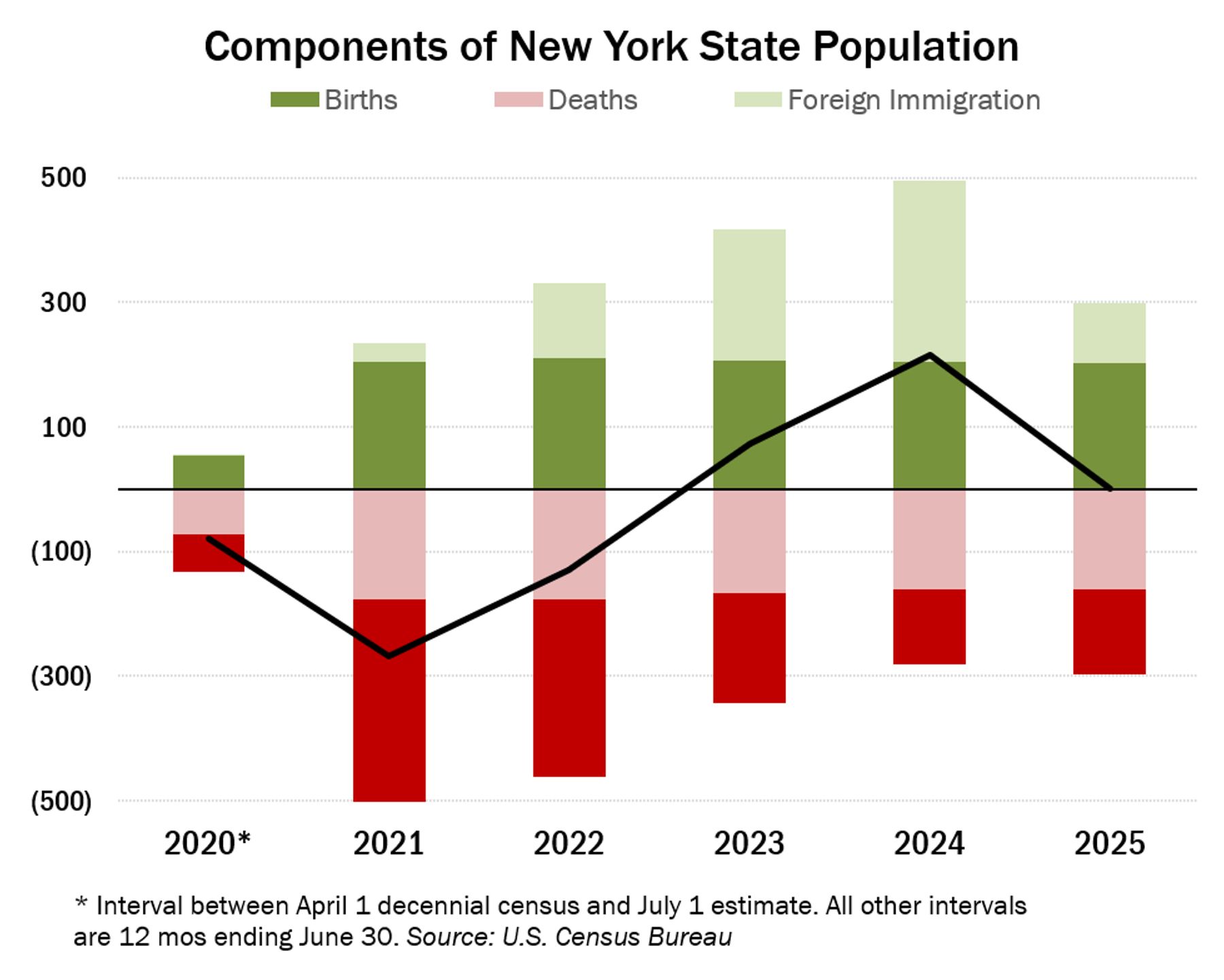
Continuing a long-term trend, the negative drag on the Empire State’s headcount continued to be net domestic migration—the difference between the number moving into New York and the number moving out. The 2024–25 net outflow of 137,586 New York residents brought the state’s total five-year domestic migration loss to just over 1 million. Only California has lost more people to the rest of the country during the same period. However, relative to its base population as of the last Census, New York’s rate of decline in the 2020s has remained the largest of any state’s.
Including a significant upward adjustment in the previous Census Bureau estimate, the latest data indicate the Empire State took in more than 290,637 foreign migrants in 2023–24—the highest single-year total for that category in at least a century. But New York State’s influx of residents from overseas—including roughly a quarter-million border-crossers housed and fed by New York City at an estimated taxpayer cost of $12 billion—had dwindled by mid-2025. Reflecting a border-crossing slowdown dating back to the final months of the Biden administration, international migration to the Empire State in the latest 12-month period fell by a full two-thirds, to 95,634.
New York is one of only seven states to have experienced a net drop in total population since 2020, according to the estimates. Three of them—West Virginia, Mississippi, and Louisiana—are chronically poor and economically sluggish. A fourth, Hawaii, has struggled to recover from the pandemic’s impact on tourism.
Among the biggest post-2020 demographic losers—Illinois, California, and New York—the common denominator has been politics. All three states are dominated by progressive Democrats. On a proportional basis, New York’s 1 percent population decline since 2020 exceeded the 0.8 percent and 0.5 percent declines experienced by Illinois and California, respectively. Only West Virginia and Hawaii, both down 1.5 percent, have lost a bigger share of their latest Census base.
On the opposite extreme, the states with the biggest population gains were Texas and Florida, which have grown by about 2.6 million and 1.9 million residents, respectively, since 2020, the Census Bureau estimates. In the latest year alone, Texas added 391,243 and Florida added 196,680 residents.
The 2024–25 state estimates do not include county-level counts (they are scheduled for release in a few months), nor do they indicate the destinations of interstate movers. Based on previous trends, New York’s foreign and domestic migration shifts most likely have remained concentrated in New York City and its suburbs, while the decline in total population has been felt disproportionately in aging rural counties of Upstate New York.
The latest Census Bureau estimates put New York’s 2024–25 components of population change in near-perfect equilibrium, with the “natural increase” of births minus deaths balancing out the net loss to migration. It’s unlikely to remain this stable, however.
With the U.S. border now shut tight and deportations ongoing, international migration is likely to decline further. Meantime, the housing market has begun to thaw elsewhere in the country—especially in growing Southern states, which have been attractive destinations for a good share of New York’s outmigrants. Given these trends, New York is most likely headed for a further population decline in the second half of the 2020s.
Photo by Spencer Platt/Getty Images