
One might expect researchers to have settled the question long ago of whether poverty causes crime. On the surface, the answer seems obvious. A correlation certainly exists: anyone working in the criminal-justice system—or simply walking through a low-income neighborhood—could observe that the poor are more prone to crime. But is the relationship causal? As the old Gershwin tune reminds us, it ain’t necessarily so.
If we limit the analysis to major violent crimes—defined by the FBI as murder, manslaughter, rape, robbery, and assault—we do find that the poor are, on average, more dangerous. But as I’ll show, some poor populations are more dangerous than others. Most notably, the relationship between poverty and crime is inconsistent. If poverty causes crime, why don’t all similarly impoverished groups—by race, religion, ethnicity, age, gender, and so on—commit violent crimes at the same rate? The fact that they don’t suggests that other factors are at play.
Finally, a reason to check your email.
Sign up for our free newsletter today.
Consider some striking facts that illustrate the inconsistency between poverty and violent crime. Some cities and countries with high poverty rates have low murder rates, and vice versa. Calcutta, for example, one of the poorest cities in India—and, indeed, the world—recorded a murder rate of just 0.3 per 100,000 people in 2008. The rate in Delhi, by contrast, was 2.9 per 100,000. That same year, the rate in far wealthier New York City was 7 per 100,000—more than 23 times higher than Calcutta’s.
Zimbabwe, among the poorest African countries, had a remarkably low murder rate of 0.5 per 100,000 in 2023. By contrast, Jamaica, with a relatively modest 16.7 percent of the population in poverty, had the world’s highest murder rate: 49.3 per 100,000. What explains the relative nonviolence of impoverished Zimbabweans? And why are Jamaicans so homicidal, despite their relative affluence? Clearly, poverty can’t be the answer to both questions.
Turning to macro trends in the United States, we find similar anomalies. In the late 1930s, as the Great Depression worsened, homicide rates declined, as I note in my book The Rise and Fall of Violent Crime in America. Likewise, during the so-called Great Recession of 2007–09, murder rates, which had begun to sink in the early 1990s, kept falling. And in the late 1960s, when the American economy was booming, the great crime wave (more like a crime tsunami) was beginning its deadly multi-decadal surge—a pattern that I discuss in The Rise and Fall of Violent Crime in America.
Criminological research has revealed similar surprises, with no consensus on the explanation. Over 40 years ago, criminologist Steven F. Messner, studying more than 200 metropolitan areas, was astonished to find that, after controlling for various demographic variables, poverty was inversely related to homicide. In other words, the more poor people there were in a metro area, the lower the murder rate was. As a follow-up, the same researcher studied Manhattan neighborhoods, this time finding that, while poverty was associated with homicide, economic inequality—the concentration of wealth in fewer hands—bore no connection to killing.
In a 1996 study of extremely disadvantaged neighborhoods in Columbus, Ohio, which included poverty as part of its definition of disadvantage, Lauren J. Krivo and Ruth D. Peterson found that, even at comparable levels of hardship, black communities had higher rates of violent crime than white ones. In 2009, Krivo and Peterson and a third coauthor identified significant differences in violent crime levels between black and Latino neighborhoods, despite similar levels of disadvantage and segregation.
Note the common thread: if poverty causes crime, then equally impoverished groups should exhibit similarly high levels of criminal behavior, even after controlling for other relevant factors. But they don’t—and that remains a mystery. I’ll attempt to unravel it, starting with a surprising analysis from the Big Apple.
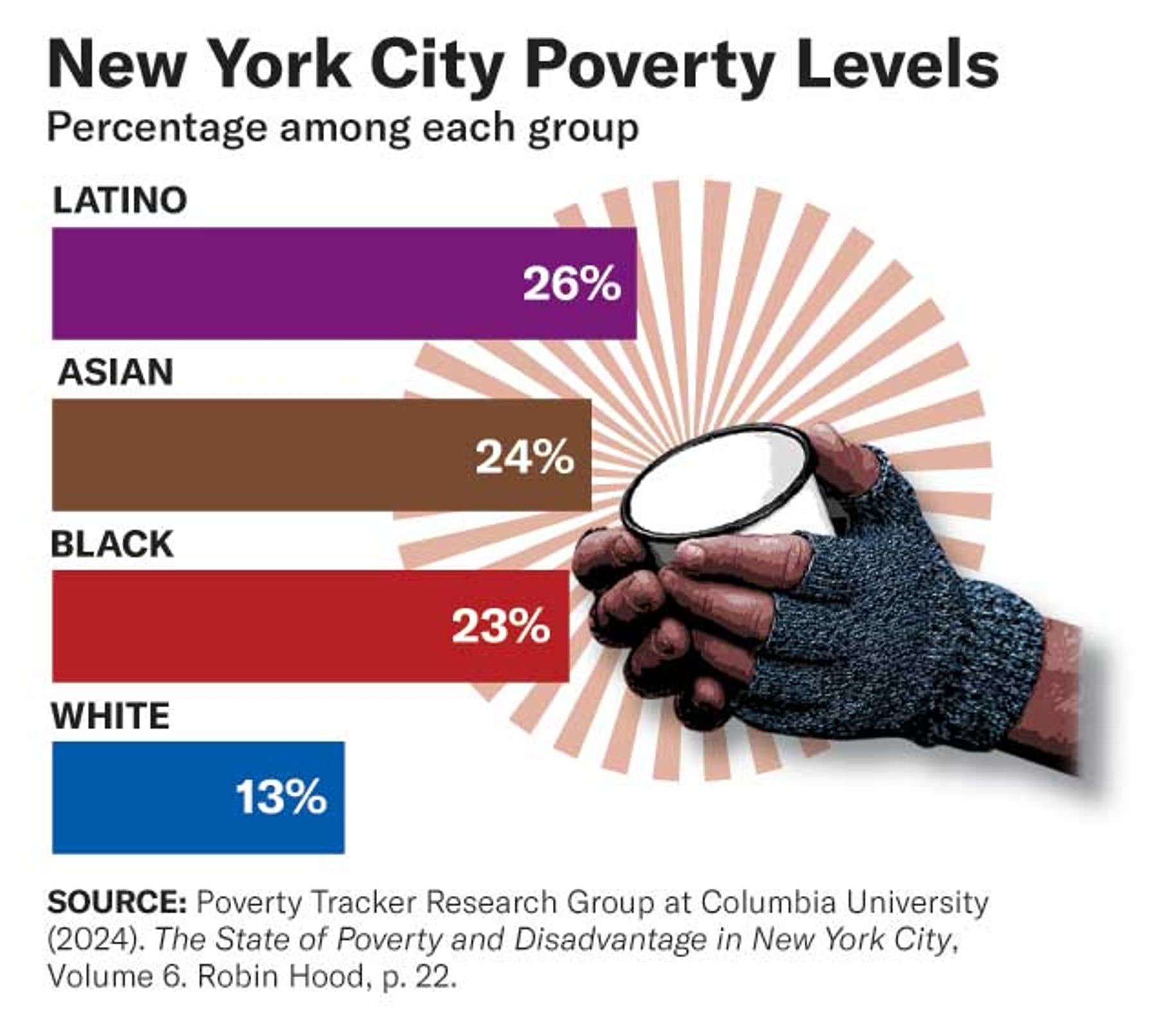
Three years ago, I wrote for City Journal about a new study on Asian poverty in New York City. Columbia University researchers found that more Asians than African Americans were living below the poverty line, a surprising result. Curious about how this affected crime, I examined violent crime arrests. The data showed far more arrests of blacks than Asians.
How could that be? Was it a one-off, or part of a recurring pattern? To find out, I gathered New York City data for 2024. Here’s what I found.
As the chart above shows, in 2024, Latinos, Asians, and blacks were closely matched in poverty levels. Latinos had the highest levels, at 26 percent; Asians were next, with 24 percent below the poverty line; and blacks were third, with 23 percent.
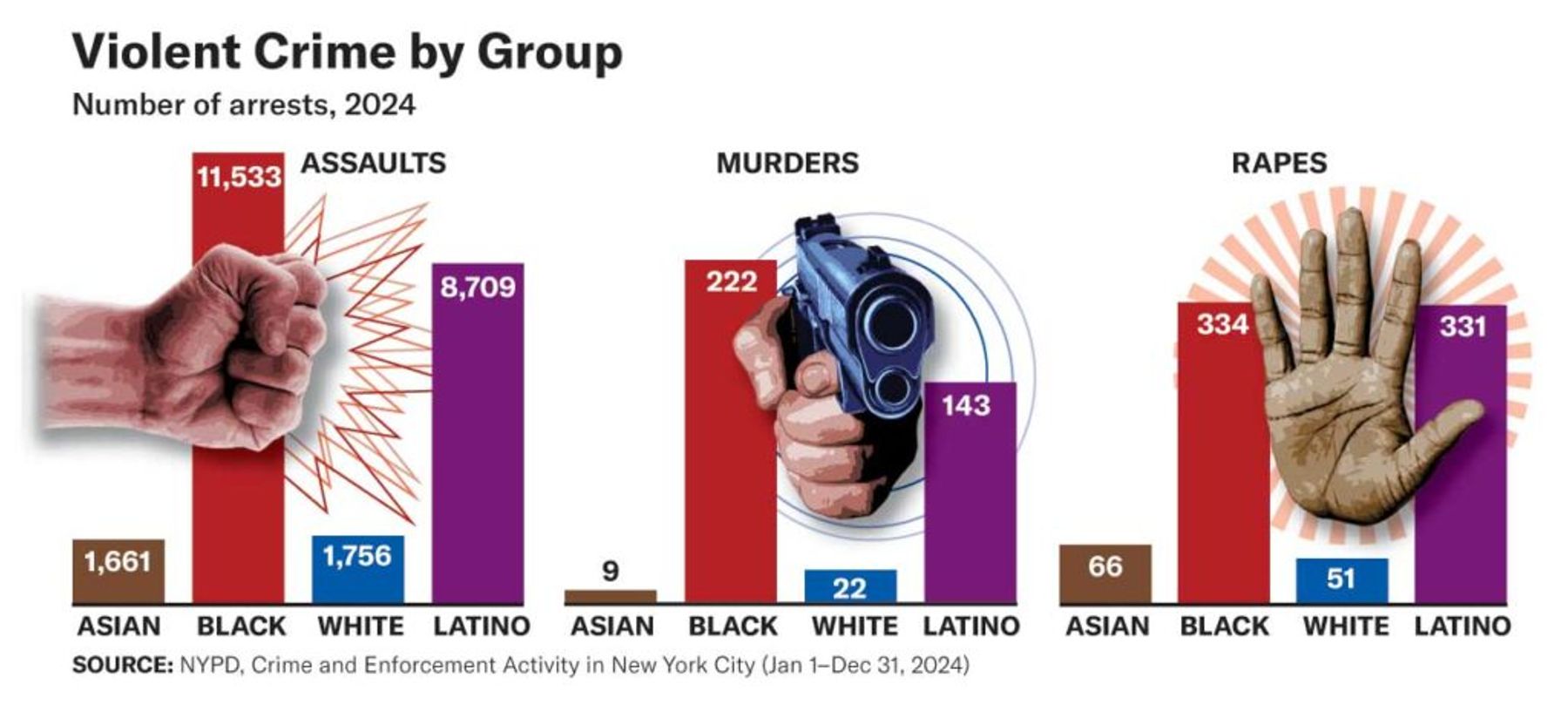
When I examined arrests for violent crimes, the order was significantly different. As the chart on the next page shows, blacks had by far the most violent crime suspects per capita, Latinos were next, and Asians were the least likely to have been arrested.
Consider murder arrests—likely the most reliable crime statistic, since underreporting by victims is not an issue, and police devote the most resources to solving this most serious offense. The black murder-arrest rate, adjusted for population size, is 11.5 per 100,000, almost twice the Latino rate and nearly 16 times the Asian rate. So while more Asians live in poverty than blacks, African Americans are 16 times more likely to be arrested for murder.
The disparities extend to other violent crimes. The black arrest rate is 4.5 times higher than the Asian rate for felony assault, 3.3 times higher for rape, and 11.4 times higher for robbery. Latino arrest rates are also higher than Asian rates, though generally lower than black rates.
Clearly, poverty alone does not explain these disparities. But what does? Given that black violent crime rates have been elevated relative to other social groups since the late nineteenth century, it appears that something in the culture of poor blacks, especially young males, predisposes them to violence.
The phenomenon is often described as a “subculture of violence,” marked by a heightened sensitivity to perceived slights and threats, along with a readiness to use violence in response. Yale sociologist Elijah Anderson, who spent four years immersed in Philadelphia’s inner cities, identified a “code of the street”—a set of unofficial rules for poor black neighborhoods. The essence of this code is to display violence, or a predisposition to violence, to ward off the all-too-common attacks and assaults in these communities. Does this code operate in New York City, too?
Cultural attitudes toward violence—or, in the case of many Asians, toward nonviolence—help explain why poverty alone doesn’t account for violent crime. Poverty is certainly associated with violence, but not in the way that gravity causes objects to fall to earth.
A similar correlation exists between affluence and lower rates of violence. Wealthier individuals have more to lose—jobs, families, reputations, and freedom—so they’re more inclined to hire lawyers and file lawsuits than to resort to physical force. Lifting the poor into the middle class does reduce violent crime, as we saw with Irish immigrants in the nineteenth century and Italian immigrants in the early twentieth. But there is little agreement on how best to achieve this through government policy.
Is there a cultural explanation for the relatively modest crime rates among some low-income groups? For example, could the recent immigrant experience of many Asians and Latinos help moderate their crime rates? In New York City, more than two-thirds of the Asian population is foreign-born, which may foster a strong desire to blend in and avoid trouble. Similarly, Latinos—especially those who entered the country illegally—may be more likely to fear deportation if arrested, which could deter criminal behavior.
On the other hand, this concern might be mitigated over time, and New York City Latinos have lived in the U.S. an average of 21 years. Moreover, the immigration hypothesis doesn’t account for the very low crime rates among whites, many of whom have ancestral roots in the U.S. stretching back more than a century. In this case, white affluence may help explain the difference.
One thing is clear: simplistic explanations of violent crime based solely on poverty fall short. They overlook the cultural dimension, which is essential to any full understanding of criminal behavior.
Top Photo: kali9/Getty Images
