Site of the Waldorf Astoria and the Seagram Building, domicile of the mighty, both real and imagined—from J. P. Morgan to Tom Wolfe’s fictional Sherman McCoy—Park Avenue boasts some of the steepest urban land values in the world. Soon the avenue will welcome another high-profile addition: New York’s flagship government-owned grocery, the first step in fulfilling one of Zohran Mamdani’s most prominent campaign pledges.
Mayor Mamdani has touted the $30 million store—funded at taxpayer expense, it will pay no rent—as a remedy to rising food prices. A private operator will handle day-to-day management and be required to pass savings on to customers. But New Yorkers will still end up paying in other ways, including by being deprived of the better uses of land that could have supported apartments, offices, or other stores and that might have employed thousands.
Finally, a reason to check your email.
Sign up for our free newsletter today.
A politics that sees land use decoupled from potential value imposes harsh costs—not only on the majority of renters, now paying over 30 percent of their income for housing, but also on small businesses. Mamdani isn’t alone in New York government in this misguided approach, however. New York State lawmakers, such as Julia Salazar, want to reintroduce a bill that would enact commercial rent stabilization across the city. Cea Weaver, whom Mamdani appointed to head the Mayor’s Office to Protect Tenants, previously led an organization that seeks to preclude housing from market forces entirely.
Whether applied to rents or food prices, these policies work the same way: they transfer resources to favored constituencies while ignoring the conditions that made those goods expensive in the first place. Worse, they suppress the price signals that would draw land, capital, and labor toward more productive uses. Mamdani actually has the diagnosis backward: New York’s problem is not too much capitalism, but too little.
New York City’s success has always depended on growth. Its density fosters commerce, helps workers find jobs and employers find talent, and spurs both cooperation and competition. But agglomeration requires room to expand. Throughout its history, the city has grown beyond the bounds of New Amsterdam—into Brooklyn, Queens, the Bronx, and Staten Island—and reinvented itself along the way, turning Manhattan’s sweatshops into skyscrapers and Fifth Avenue’s mansions into museums.
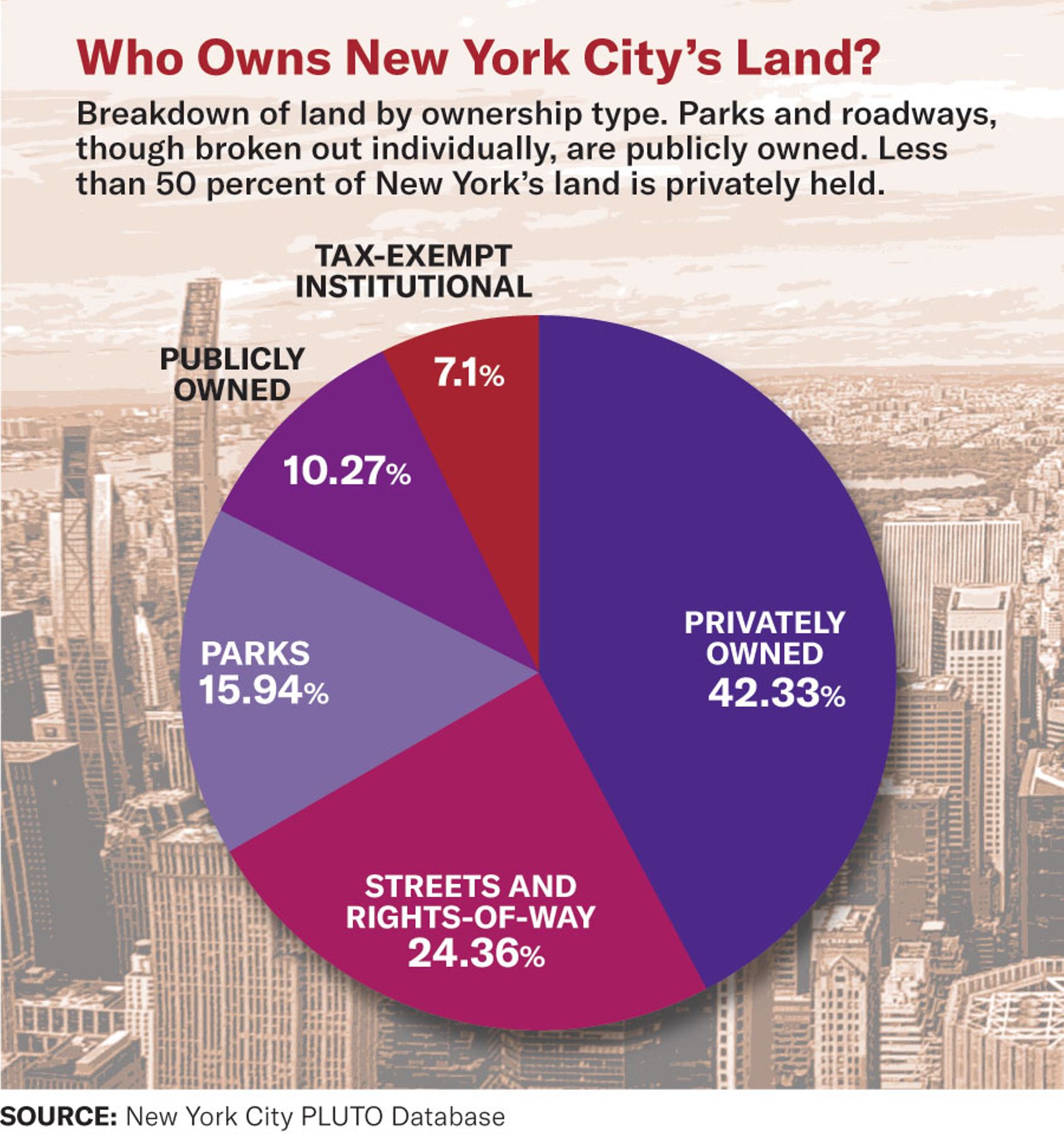
Political realities have made this process harder to sustain. Just 42 percent of New York City sits on privately owned land subject to market forces, according to my analysis of the city’s Primary Land Use Tax Lot Output (PLUTO) database, which details lot sizes and land-use categories. Another 24 percent is allocated to streets and rights-of-way, and 16 percent is devoted to parks, uses that contribute heavily to the city’s desirability and functionality. Seven percent is held by tax-exempt institutions such as hospitals and universities, and another 10 percent comprises other public property, including housing operated by the New York City Housing Authority (NYCHA) and facilities occupied by state and federal agencies. These figures reflect a two-dimensional view of the city—mapping ownership at the level of whole buildings.
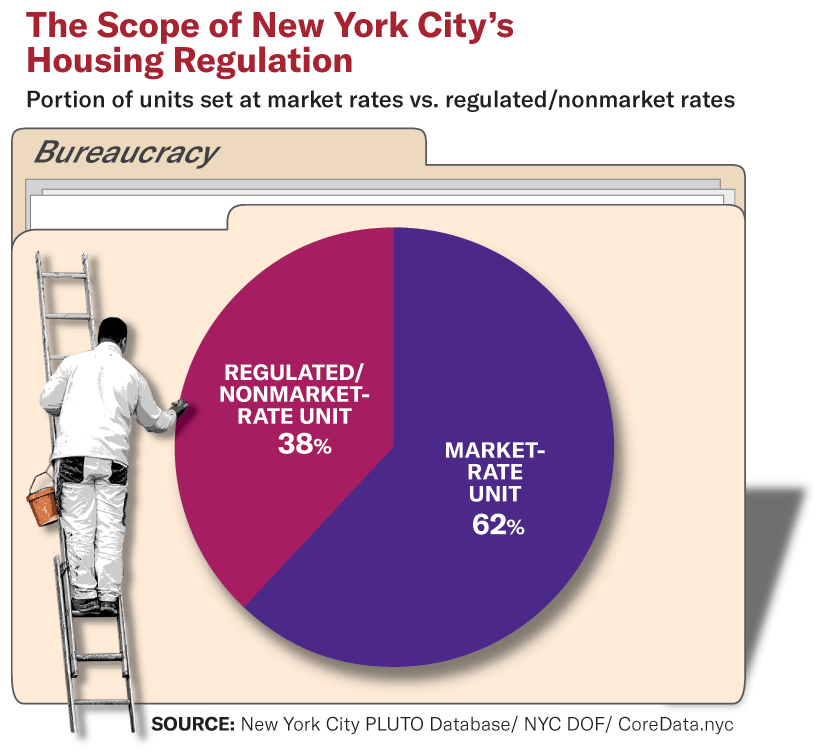
A three-dimensional view, assessing the status of every unit on a given lot, provides a fuller picture: 38 percent of New York’s total housing stock is shielded from market exposure (See page 90, bottom chart). Analysis of PLUTO and of records from New York City’s Department of Finance and NYU’s Furman Center reveals 1,430,374 units subject to some form of rent stabilization, receiving taxpayer subsidies, or designated as public housing. In other words, New York lacks a free market for a significant minority of its housing stock; nonmarket mechanisms determine its allocation.
When people can trade freely, land uses are continually put to a competitive test. Guided by price signals, those who can put a parcel to better use will usually outbid lower-value uses, directing resources to their most productive ends. The baker outbids the shoemaker, seeing greater demand for bread and his own advantage in supplying it; the developer buys out a single-family owner, judging that apartments would deliver more value to more residents than a single home.
More than half of New York’s land is now effectively removed from this beneficial calculus. Regulations make transfers difficult or impossible; even when they occur, strictures prevent prices from adjusting to new uses. Without a mechanism to discover and allocate land to higher-value purposes, a city ceases to function.
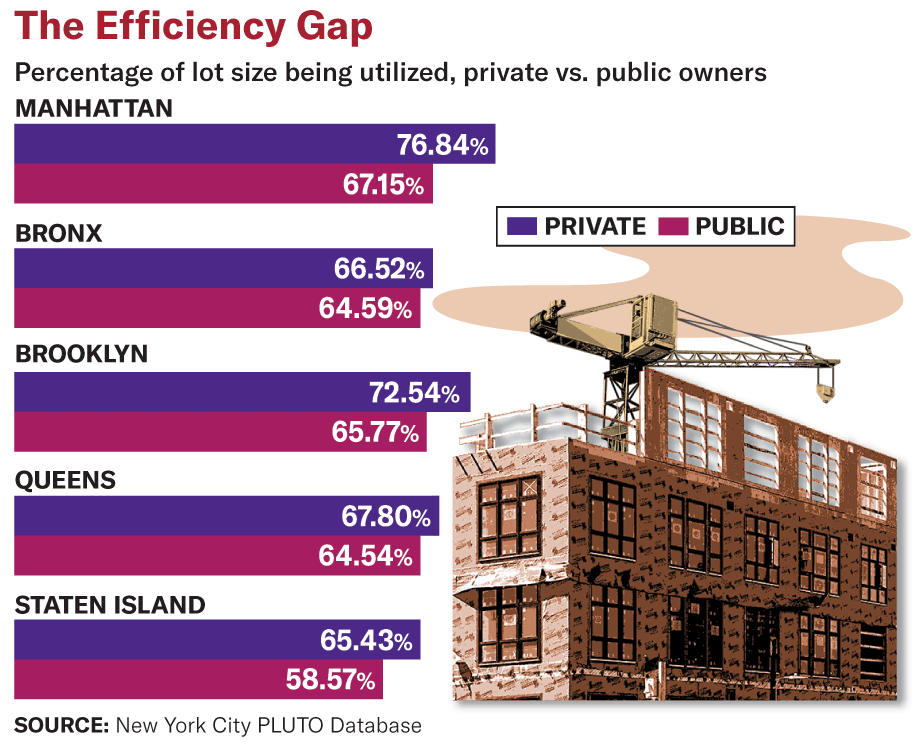
Land markets perform well because they reward the most effective deployment of a scarce resource within legal limits like zoning. In New York City, private owners use permitted capacity more fully: my analysis of PLUTO data finds them about 6 percent more likely to build to the maximum allowed. In other words, if the law permits six stories, private developers are more likely to build all six.
From this perspective, trying to curb high rents and food prices by removing ever more land from market forces is counterproductive. The alternative to using taxpayer funds to acquire land is to tackle the underlying cost drivers directly.
Consider food. Over the last decade, food prices in New York have risen 34 percent. Nationwide, they have gone up 32.5 percent, suggesting that many cost factors—such as tariffs and higher gas prices—lie beyond local control. Other factors, however, do not lie beyond local control: land policy is one. In manufacturing districts, where large supermarket sites are typically located, the city requires a special permit for stores of over 10,000 square feet, a costly proposition that invites politicians to extract concessions from developers. If the city instead allowed larger retail spaces across more districts, land would be cheaper to acquire. Greater competition and economies of scale would follow, and prices could fall.
Other factors also need attention. Union opposition and political pressure forced Walmart to abandon plans to open stores in the city in 2012, depriving consumers of a less expensive grocery alternative. Retail theft, meanwhile, remains above pre-pandemic levels, despite a decline in the first quarter of 2026—increasing security costs and deterring new entrants. Addressing these underlying drivers, too, would help make food cheaper. Mamdani’s approach merely shifts who pays and how, pushing costs elsewhere.
This reality is even more evident in housing, where so much of the city’s stock is fully or partially exempt from market pressures. At its most extreme, de-commodification would look something like what New York State Assembly member Claire Valdez, who is running for Congress, has called for: universal rent stabilization—an entire rental market effectively under public control.
That policy might superficially “improve” affordability but does so by making New York a less desirable place in which to live. It’s like taking aspirin for a wound: the pain might dull, but the injury will worsen until it’s treated. Who is best placed to make the most of a unit? In market-rate housing, landlords tend to rent to the highest bidder, and those tenants often put units to the most productive use. Prices are not arbitrary: workers pay more to live near their jobs; businesses pay more for locations that enhance what they offer—hence, for example, Cartier outbidding an Amazon data center on Fifth Avenue.
Rent stabilization shuts this process down: housing goes to whoever arrived first, and that tenant keeps it at a price increasingly detached from demand. In a typical market, an owner getting an offer well above a property’s value would likely sell, benefiting both parties; in New York, tenants often cannot be outbid, preventing owners and would-be occupants who value the unit more from transacting. The result is to lock in incumbent tenants on land that they do not own while pushing costs onto everyone else. The city’s most recent Housing and Vacancy Survey, conducted in 2023, found that where the median stabilized rent was $1,500, a market renter paid $2,000—meaning that the 62 percent in market units effectively subsidize the 38 percent in regulated units.
If operating costs don’t match revenue, landlords will either remove units from the market when they go vacant or declare bankruptcy. Even if the city acquired these buildings, moreover, the mathematical problem remains: rents would need to rise at least enough to match operating expenses if the building is to break even without subsidy. That has not been the reality in New York: the city has seen a decade of below-CPI rent increases, likely to continue this year. No surprise, then, that the city now counts some 50,000 vacant apartments, a growing number of rent-stabilized buildings are financially distressed, and maintenance is increasingly deferred.
Nowhere is this dynamic more evident than in the New York City Housing Authority’s portfolio. Here, rents are detached from market pressures, set at 30 percent of tenants’ income. NYCHA faces even weaker market discipline than other forms of regulated housing, producing striking inefficiencies. On some of the most valuable land in America, some 30 percent of NYCHA residents inhabit units with spare bedrooms; and only 63 percent of tenants pay on time, contributing to further shortfalls.
The agency thus struggles to keep up with maintenance and performs worse than any private landlord on would-be violations. Some $80 billion is now needed to maintain and restore the agency’s existing units, a figure likely inflated by lack of accountability to tenants and shareholders (NYCHA executives are accountable only indirectly, through political considerations), as well as corruption.
The same land dynamics apply here. Along with capital costs, subsidized at public expense, taxpayers bear the cost of land that could be developed more densely standing idle. The property, as City Journal contributing editor Howard Husock has long argued, is effectively “frozen”; time has stopped there. Things might be starting to change, however. At NYCHA’s Fulton & Elliott-Chelsea Houses, sitting on land worth $245 million, efforts are under way to redevelop the site more densely and add private units. Progress has been slow and impeded by legal battles, but recent trends suggest some recognition of the importance of markets and price signals.
The agency could go further—by expanding such developments or adopting a “right to buy” policy, as the United Kingdom did in 1980. That reform allowed residents to purchase their homes from local councils, restoring market allocation while attracting private investment for upkeep. Residents benefited, too, as they could realize gains when their homes appreciated.
Beyond NYCHA, a new paradigm has taken hold among young voters, political staffers, and even elected officials, who nominally support new housing. Last November, voters approved measures to ease the construction of new affordable housing across the city. Affordable housing is, of course, better than no housing, if one considers only aggregate units. But a more effective approach would be to develop land to its highest-value use and allocate it accordingly. Affordable housing, which depends on subsidies, is not truly “affordable”; its costs are simply shifted onto others.
New York City neither needs nor can sustain more socialism. Already, large swaths of its land are exempt from market forces. Policies such as commercial rent stabilization, rent freezes, universal rent control, and government-run grocery stores may carry electoral appeal, especially among younger voters, but they are counterproductive, worsening the very problems they aim to solve. By embracing market forces, especially in land use, New York can ensure a thriving future.