In unveiling the second draft of his $125.6 billion budget in May, New York City Mayor Zohran K. Mamdani presented the document, the usual technocratic outline of the city’s projected revenues and outlays for the fiscal year that starts July, as a radical departure from normal practice. “For too long, working New Yorkers have been told that ambition must give way to austerity,” the mayor said. But in a “new era,” he suggested, such austerity would not be “the only answer to adversity.” A week later, in his inaugural “talk with the people” streaming series, the mayor repeated that singular word: “when you inherit a deficit”—initially projected at $12 billion—“people will say, ‘Just go to austerity. Just start cutting.’ ”
Mamdani’s emphasis on austerity—a term common in fiscal policy circles but less so in everyday speech—is no accident. As leader of America’s largest city, he is the most prominent advocate of a message the Democratic Socialists of America (DSA) have developed since the 2008 financial crisis: that the country’s problems result not from excessive spending but from governments unwilling to tax and spend more aggressively. In this view, elected officials remain too constrained by the assumptions of Reagan-era neoliberalism to fund the level of public investment that progressives believe the nation requires.
Finally, a reason to check your email.
Sign up for our free newsletter today.
This premise extends further, holding that before it became the bipartisan Washington consensus, “austerity” originated in New York City during the fiscal crisis of the mid-1970s. New York’s sin—cutting spending to avoid municipal bankruptcy, rather than raising taxes—became America’s sin. If New York was where austerity began, the reasoning goes, it can also be where it ends. Prove that anti-austerity works here, and four decades of neoliberal economics can finally be swept aside.
But fiscal reality may prove harder to overcome than ideological conviction. By treating budget constraints as a political choice rather than an economic fact, Mamdani risks setting New York on a course that could force the spending cuts he hopes to banish.
To those who pay attention to the mayor’s rhetoric, the word “austerity” has long since become familiar. A deft communicator, Mamdani understands that repetition in an age of fractured attention can make almost anything seem true. Last year, at a rally on the eve of his November election, he boasted at having “put Andrew Cuomo’s vision of austerity and smallness firmly where it belongs.” On his first day in office in January, standing on the steps of City Hall, he declared that “every moment of fiscal challenge, we [will] overcome with ambition, not austerity.” He returned to the theme later that month when explaining his push for expanded state aid, including $9 billion in new annual income-based taxes on which he had campaigned, and again, during a February trip to Albany to lobby for those funds. His mantra: “We reject austerity politics.”
The obvious problem with this stance is that New York is hardly austere. Where, then, does the austerity narrative come from? It originates from a revisionist account of the city’s recovery from its near-default on municipal debt in 1975.
From 1975 through the early 2000s, New York’s political class and electorate almost universally viewed the city’s recovery from that twentieth-century debacle as a success story. The conventional account, featuring figures such as investment banker Felix Rohatyn of Lazard Frères and Victor Gotbaum of the city unions’ Municipal Labor Committee, runs as follows: during the 1960s and 1970s, New York City dramatically expanded spending. Its annual budget crossed the $2 billion mark in 1958 ($23.4 billion in today’s dollars) and had reached $10.3 billion ($81 billion today) by 1973 and $13 billion by 1975. In the first phase, Mayor Robert Wagner, a traditional machine Democrat, increased spending largely on union pay and benefits; in the second phase, Mayor John Lindsay, a liberal Republican, expanded social-welfare programs.
To finance some of this new spending, Wagner relied on a mix of tax increases, borrowing, and budgetary gimmicks. By the late 1950s, he had successfully pushed for a state law allowing the city to defer certain pension payments for municipal workers. By Wagner’s final year in office, 1965, the budget approached $4 billion, and he had implemented what he called a “borrow now, pay later” plan, taking out hundreds of millions of dollars in short-term bank loans and bond borrowing to cover growing deficits. Under Lindsay, the state let New York City levy its first income tax, in 1966.
But even higher taxes and continual borrowing for operating expenses proved insufficient. By 1975, two years after Lindsay had left office, Gotham was in such severe fiscal distress that banks and bondholders would no longer lend it money. The city required rescue from both the state and federal governments—though not before the famous headline ford to city: drop dead entered New York lore.
As the price of that bailout, the state appointed a board, soon led by Rohatyn, to ensure that New York began living within its means. Everyone contributed to the effort, even if the term “austerity” was sometimes applied absurdly, as when the New York Times characterized a 1975 move to sell 79 city cars as an “austerity measure.” Unions, under Gotbaum’s leadership, bought some of the city’s new bonds for their pension funds, as a show of confidence, and gave up raises; new public-sector employees accepted reduced future pension benefits; and the public endured cuts to basic services, including layoffs of newly hired cops and sanitation workers.
Though the cost of rescue was high, the traditional story goes, the reward was a more efficient city, a growing population, and a larger tax base capable of supporting the public-safety gains that began in the 1990s. As Ed Koch, mayor from 1978 through 1989, put it, by the early 1980s, “the city was able to begin improving services after years of cuts. Efforts to make services more efficient had helped moderate the impact of many of the cuts, but the combination of better management and more resources finally allowed certain things to improve for the first time in years. Streets became cleaner, response times for police cars and ambulances were reduced, and students’ reading and math scores on standard tests improved.”
This story was always partly myth. For one thing, the principal mechanism of the bailout was more borrowing—eventually $9.5 billion—to repay stranded lenders. Unlike the old debt, the new debt was long-term and backed specifically by the city’s 4 percent sales tax as well as a federal guarantee. The old debt matured regularly, requiring constant refinancing, and was backed only by the city’s general “full faith and credit.”
What wasn’t a myth, however, was that austerity was temporary. As Koch acknowledged, New York’s austere era gradually came to an end, partly because the city got lucky: Wall Street and the real-estate sector, both powered by an influx of professional workers, boomed in the early 1980s, generating fresh tax revenue. By the mid-1980s, the city government was fully staffed again, public employees were getting raises, and the state had reversed some of its cuts to pension benefits for new municipal workers.
In theory, New York was still living within its means, but those means had swelled dramatically. In 1990, Mayor David Dinkins persuaded the state legislature to approve an income-tax surcharge to fund more policing. By the early Michael Bloomberg years, New York was spending as much as it ever had, adjusted for inflation.
Mamdani’s first budget, though only modestly larger than Eric Adams’s final budget, is roughly 12 times the size of Lindsay’s last budget, enacted before the supposedly austere decades that followed. That increase far outpaces inflation’s nearly eightfold growth over the same half-century. The city’s total tax revenues in the current fiscal year are $84.4 billion, compared with a 1975 total of about $5 billion—nearly 17-fold growth. (The rest of the city’s funding comes from federal and state grants.)
But the myth of permanent austerity has persisted, partly because it made everyone look like heroes, from Rohatyn to Gotbaum and a generation of elected officials, and partly because it gave those officials a handy reason to slow spending growth when it served their interests. Well into the Bloomberg era, city government used the term “austerity” positively: it denoted basic discipline (albeit inconsistent) over spending growth.
After the 2008 financial crisis, a resurgent Left gradually embraced the myth of permanent austerity, but in this telling, “austerity” was a dirty word. Occupy Wall Street emerged as a national movement in the fall of 2011, protesting bipartisan bailouts of financial firms and calling for higher taxes on the wealthy. The protest had begun months earlier, near City Hall, with activists erecting a performance-art encampment dubbed “Bloombergville” to protest alleged “austerity measures” by then-Mayor Bloomberg.
Calling Bloomberg “austere” was laughable. One of his first acts as mayor, in 2002, was to secure state approval for increases in the city’s income and sales taxes—the former falling disproportionately on the wealthy—to close post-9/11 and post-dot-com budget gaps. He also raised property taxes and awarded teachers a pay boost of more than 40 percent. Between fiscal years 2002 and 2014, spanning Bloomberg’s three terms, city spending rose 78.3 percent, compared with inflation of 34.3 percent.
Bloomberg flirted with austerity only in his third term, after the financial crisis. He unsuccessfully sought productivity concessions from unions in exchange for raises, but the unions simply waited him out. He had more success supporting pension reforms enacted by Governor Andrew M. Cuomo, which hiked the retirement age and reduced benefits for newly hired public-sector workers.
Nevertheless, the “billionaire mayor” made an irresistible symbol, and local, national, and even global austerity themes were expertly welded together in Fear City: New York’s Fiscal Crisis and the Rise of Austerity Politics, the 2017 Pulitzer-finalist book by Columbia history professor Kim Phillips-Fein. Her thesis was that New York’s 1975 “belt-tightening” ushered in “forty years of anti-government politics” nationwide, during which “austerity remains a political choice. The forces that make it seem the only option obscure the underlying reasons why . . . wealthy metropolises come to have governments starved for funds,” Phillips-Fein wrote. That same year, meantime, the DSA noted that “if the financial crisis has demonstrated anything, it’s the intellectual bankruptcy of neoliberal economics, embodied in the austerity response that shifts the burden onto people suffering the most.”
By 2020, “austerity” had become a common epithet in local politics. “We need to work on raising revenue, not austerity,” said Harvey Epstein, then a progressive state assemblyman and now a Lower Manhattan city councilman and key Mamdani ally. Five years later, on the campaign trail, Mamdani denounced former Governor Cuomo as an austerity merchant, even though Cuomo had largely abandoned the spending discipline of his early years in office, significantly raising taxes on high earners in 2021 during his third term.
Mamdani brought the DSA’s sustained attack on “austerity politics” all the way to city hall and to the national stage. Coming full circle, on the day of Mamdani’s inauguration, Phillips-Fein maintained in a New York Times op-ed that the new mayor was “seeking to reclaim the democratic community of the city from wealth, power and greed.” She described how “the obvious weight that the wealthy carry in the city’s political and fiscal life has also led to the perception that they are able to demand favors from city government and to receive special treatment.” But perception isn’t reality, and Phillips-Fein offered no numbers to support her claims about city spending—and she couldn’t have done so, as spending by the current fiscal year had climbed to nearly ten times the 1975 figure of about $13 billion (inflation over the same period drove up prices nearly six-and-a-half-fold).
Nor has spending on DSA priorities declined as spending on DSA anti-priorities, such as policing, increased. Between 1980 and 2025, according to my analysis of Independent Budget Office (IBO) data, the share of the city budget devoted to programs broadly aligned with DSA goals—including education from pre-K through college, housing, health care, social and homeless services, and youth and aging programs—rose from 49.8 percent to 54.5 percent. Swelling education spending accounts for more than half of that total.
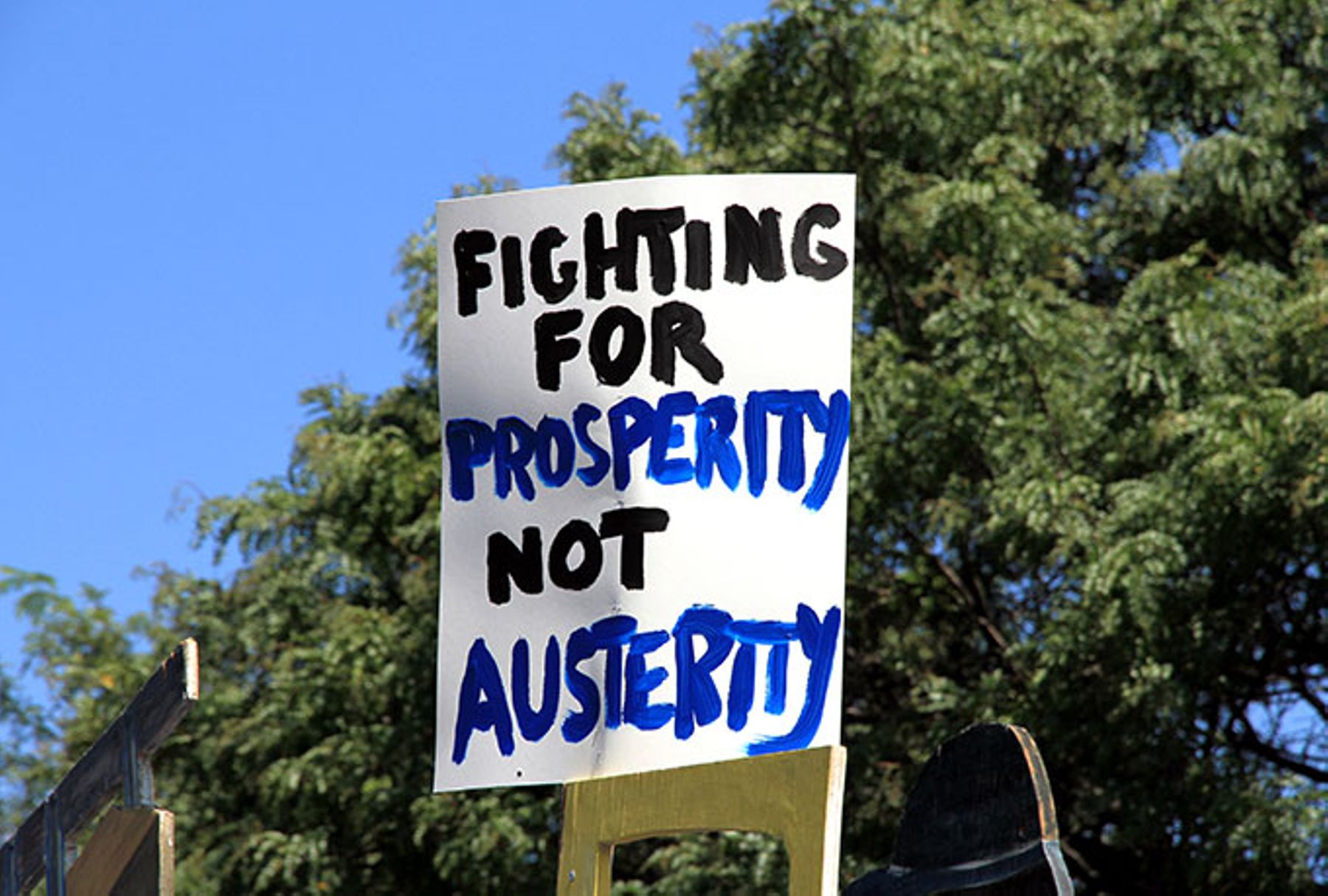
Though politically useful, Mamdani’s attacks on austerity may only hasten its return. In his first budget, he kept growth in state- and local-tax-funded spending below 1 percent, but only through gimmicks. Just as Wagner postponed some payments for worker retirement in the 1950s, Mamdani persuaded the state legislature to approve a plan to “restructur[e] city pension liabilities” by $1.6 billion annually over the next four years. His own version of this Wagnerian “borrow now, pay later” strategy amounts to another form of debt—this time from the pension funds—and is unlikely to work out any better than Wagner’s did. If the city cannot afford these costs now—when they are theoretically due and when the economy is doing well—how will it afford them later?
Further, Mamdani’s budget assumes that public-employee wages and salaries will rise by $3.2 billion annually by 2030, suggesting that he has no intention of asking workers to finance future raises through productivity gains. Worse, he has agreed to pay teachers special bonuses—$8,500 in the first year and $9,500 in the second—for teaching classes that exceed a state-mandated size limit. The teachers’ union demanded the concession in exchange for delaying implementation of the smaller-class requirement, a deal that will cost about $21 million in its first year, calculates the city’s Independent Budget Office. (And once union members grow accustomed to these bonuses, they are unlikely to surrender them.)
Meanwhile, Albany is rolling back Cuomo-era reforms, including a higher retirement age for civilian workers. The result will be extra pension costs of roughly $150 million annually, rising to nearly $200 million by 2030. On the social-spending side, Mamdani is maintaining the above-inflation increases in homelessness services and welfare benefits that began under Bill de Blasio and Eric Adams, respectively.
So the city will face a $7.6 billion deficit next year, and a budget gap nearing $10 billion by 2030—and that’s before Mamdani even tries to make good on his priciest campaign promises. Free buses would cost $1.1 billion annually, the IBO reports, and the mayor’s still-imaginary “department of community safety” would cost several hundred million dollars each year, too. City-run grocery stores in each borough eventually would carry an operating cost in the tens of millions of dollars.
Mamdani might respond that he need not make hard choices because Albany declined to enact the $9 billion in annual income-based taxes that he requested. Instead, he received only a consolation prize: a tax on expensive second homes, optimistically expected to raise about $500 million annually. The solution, he could argue, is simply to win approval for the tax increases on which he campaigned.
But if Mamdani could not persuade Governor Kathy Hochul and a progressive-controlled legislature to approve those taxes this year, at the height of his political influence, his prospects next year are dim. Hochul would likely raise taxes only in a recession, to avoid deep cuts to existing programs and services rather than to fund new ones. Even then, the increases might not eliminate budget gaps, forcing Mamdani to restrain spending anyway.
Mamdani’s ideological aversion to “austerity,” then, may wind up creating the conditions for the very austerity that he disavows. It’s unlikely that the mayor will face any pressure from the city council or state lawmakers to cut or constrain spending. Instead, an external event, like a deep recession, would force the change.
And what might precipitate such a recession? The DSA is not wrong about one thing: New York’s 1975 crisis did foreshadow a new national economic philosophy. But that philosophy was not neoliberal austerity. It was the broad financialization of the American economy, including a growing reliance on debt by both governments and households. Though Washington, a half century ago, barred New York from borrowing for operating expenses as a condition of its bailout, it imposed no comparable restraint on itself. Outstanding federal debt has risen from less than one-third of gross national product to more than 120 percent. New York escaped austerity partly because of that financialization: Wall Street reaped enormous profits from the explosion of lending, easing pressure for fiscal restraint.
Regardless, then, of how New York’s mayor or other political leaders talk about austerity, the real question is how long governments can keep avoiding it. After decades of rising debt and expanding budgets—and financial markets willing to absorb both—fiscal restraint has been the exception rather than the rule. The uncertainty is not whether austerity will return—but when.