
New York City Mayor Zohran Mamdani has announced the first location for one of the five promised city-owned grocery stores. The 9,000 square-foot store will be built on a city-owned vacant site under the Metro-North railroad viaduct at La Marqueta, near Park Avenue and East 116th Street, in Manhattan’s East Harlem neighborhood.
The city will finance the store’s construction with $30 million from the capital budget. The store will have no debt service. Though privately operated, it will pay no rent or property tax.
Finally, a reason to check your email.
Sign up for our free newsletter today.
Mamdani’s plan proposes, in essence, that the city will compete with local grocery stores—using public subsidies to lower the cost of staple foods—and that it will do so while paying store employees union wages.
It is by no means clear that both objectives are possible without additional subsidies. Nor is this extravagant expenditure at a time of budget stringency the most effective way to achieve Mamdani’s food-affordability goals for East Harlem residents.
The mayor’s rationale for his public grocery-store venture, as stated in a recent press release, is that “[g]rocery prices in New York City have risen nearly 66% over the past decade—significantly outpacing the national average.” That’s a bogus statistic, and we can trace how the mayor’s staff made that error. The press release links to a report from New York State Comptroller Thomas DiNapoli, who indeed finds that something increased by 66 percent: New York metropolitan-area consumers’ spending on food eaten at home, from 2012–2013 to 2022–23. That statistic, which includes spending by affluent people in the suburbs who shop at premium stores, says nothing about prices.
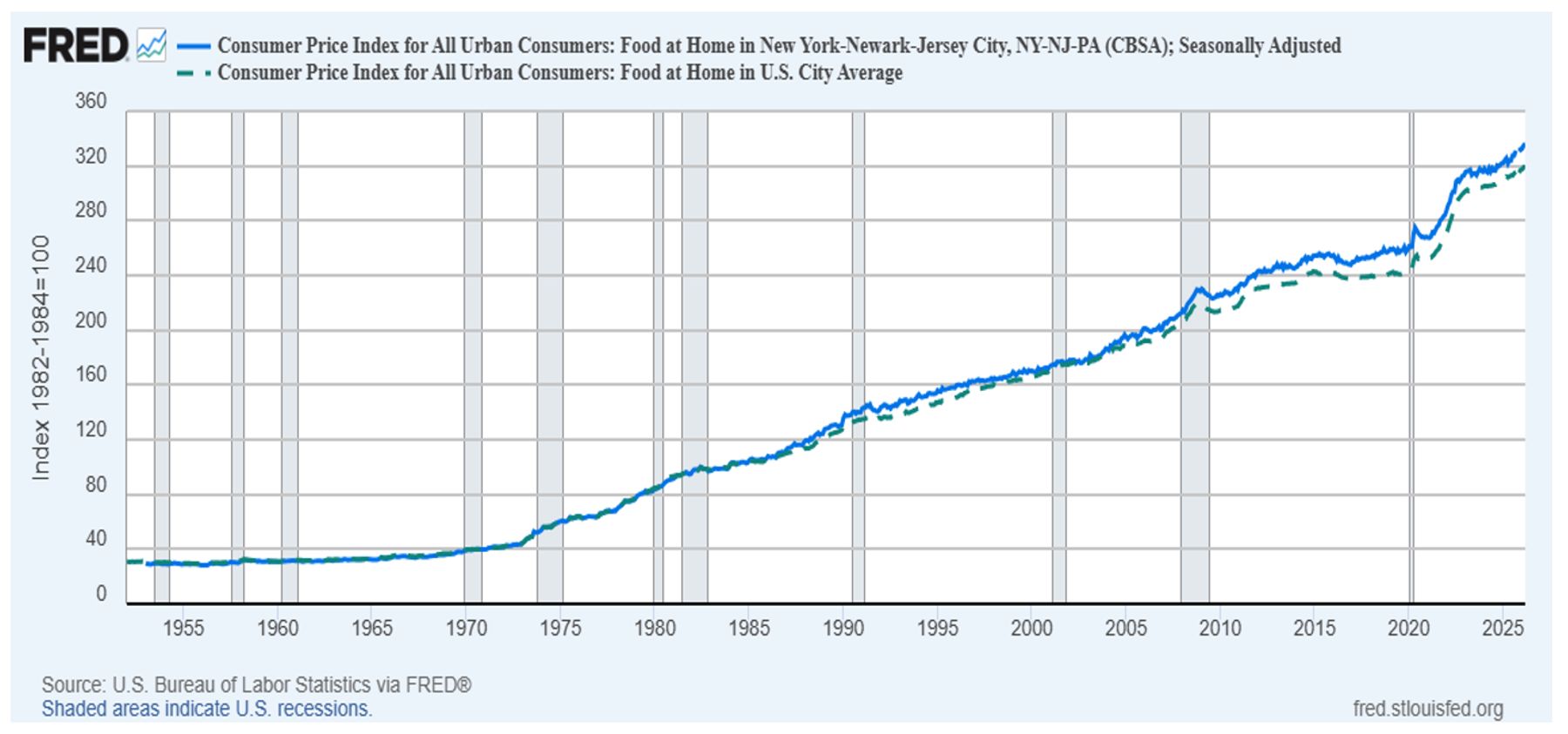
The Bureau of Labor Statistics publishes a separate price index for the cost of food consumed at home for the New York metropolitan area. Not surprisingly, the local index tracks the national index closely (see chart below). Over the ten-year period from March 2016 to March 2026, the food-at-home price index for the New York City metro area increased by 34 percent, versus 32.5 percent for the national index.
New Yorkers live in an expensive region. Moreover, East Harlem has long struggled to bring affordable food to its residents. Historically, the neighborhood depended on small supermarkets run by individual entrepreneurs and was shunned by big regional and national retailers. The small stores often fell short of the standards set by large grocers, with high prices and limited access to fresh fruits and vegetables.
In the 1990s, a huge political battle erupted over a proposal to construct a Pathmark supermarket on a city-owned site at East 125th Street and Third Avenue. Leading the opposition were entrepreneurs who operated small supermarkets in the neighborhood. They feared the big new store would drive them out of business.
The Pathmark opened in 1999 and became hugely popular. But it lasted only 16 years, closing in 2015 with the bankruptcy of its parent company, A&P. Today, the site is a vacant lot, and the grocers left standing are mostly the same small operators. They have benefited from the population growth of the East Harlem community district, Manhattan 11, from 117,743 in 2000 to 133,493 in 2020.
The small grocers provide walk-in convenience for East Harlem’s low-income population, but they cannot achieve the purchasing and operating economies of scale enjoyed by Pathmark in its heyday. Fortunately, East Harlem residents also have access to an Aldi supermarket in the East River Plaza shopping mall at the east end of 117th Street. Part of a larger national chain, the East Harlem Aldi offers a large selection of private-label items and advertises its low prices.
Aldi may operate successfully in East Harlem because the shopping mall’s parking garage attracts a more affluent clientele from a broader area of the city. Nonetheless, its operating model (and that of its rival, Lidl) likely provide a better answer to Mamdani’s concerns about food affordability, and at no extra cost to the city.
The city council will need to approve the proposed La Marqueta grocery lease. Council Speaker Julie Menin was noncommittal and expressed concern about the impact on local businesses. Local grocers figure to be strongly opposed, as they should be. The city should not be using taxpayer resources to undercut businesses that pay taxes and comply with other applicable laws, all to benefit one favored operator.
What should Mamdani do instead? The city could take the same $30 million and use it to help local entrepreneurs upgrade their stores—for example, with energy-efficient equipment. Such aid could be conditioned on competitive pricing of staples, though the city may lack the capacity to monitor these agreements effectively. The city could also upgrade bus service along East 116th Street, making it easier for residents without cars to reach stores like Aldi.
More broadly, the city should reconsider the land-use patterns of East Harlem, which limit access to services widely available elsewhere in Manhattan. A band of aging New York City Housing Authority (NYCHA) buildings stretches across Harlem and East Harlem between East 112th and East 115th Streets, with additional large NYCHA projects extending for blocks to the north and south in Community District 11. The result is a vast, government-engineered concentration of poverty.
In keeping with the benighted planning theories of the time, those NYCHA projects have no retail stores within them. They do have large open spaces suitable for new construction and the potential for selective demolition and tenant relocation within the developments. By allowing new, higher-income housing within NYCHA developments while retaining existing tenants, the city could attract new supermarkets that will not only upgrade the local retail environment for all residents but also yield rent-paying revenue in ground-floor spaces that helps underwrite the costs of new housing.
True to his socialist principles, Mamdani has chosen one of the worst possible options to achieve his goals. He should be more pragmatic, and the city council should help him get there.