
The 2026 Winter Olympics have arrived in Milano-Cortina with the usual pomp: flags, anthems, flashy choreography, and the insistence that, for two weeks, humanity has agreed to behave itself. This is the Olympics’ oldest and most profitable illusion: the idea that sports are a kind of international diplomacy, and that the International Olympic Committee is the custodian of peace.
But if the Games are supposed to be a festival of global harmony—armonia, the Italian word pervading the opening ceremonies—someone forgot to tell the world.
Finally, a reason to check your email.
Sign up for our free newsletter today.
Every Olympiad begins with the Parade of Nations, a carefully staged procession of sovereign states reduced to marching athletes in matching warm-ups. Every Olympiad invites the same sentimental interpretations. Iran and Israel are only a few letters apart: See? They can coexist. The United States and China share the same stadium: Isn’t that something?
It’s not.
Alphabetical proximity isn’t cosmic foreshadowing, and the notion that we can put geopolitical rivalries on ice by forcing them into adjacent lanes on a racetrack is the kind of idea that could be loved only by an Olympic grandee—one of those globetrotting administrators whose ego is matched only by his expense account.
Of course, the Olympic “movement” has always wrapped itself in lofty language. Pierre de Coubertin, founder of the modern Games, was a romantic aristocrat who wanted to revive ancient ideals and build character through sport. He spoke in the register of virtue, honor, and civilization. Today’s Olympic establishment still borrows that language, updating it for the era of TED Talks: “unity,” “dialogue,” “inclusion,” “shared humanity.”
But the Olympics are at their best when they embody something much simpler and much more American: tradition meeting meritocracy, Coubertin meeting Milton Friedman (and Vince Lombardi). The Games work when they’re a global presentation of excellence, governed by rules that are at least aspirationally fair and awarding medals that can’t be purchased, inherited, or negotiated. That’s the real moral appeal here: not that nations become friends, but that individuals earn glory by competing against, and beating, the best in the world.
The problem is that the IOC keeps trying to sell something it can’t deliver. The Olympics aren’t a peace conference. Athletes aren’t diplomats. A skier from Oregon isn’t an emissary of American government policy—particularly if he publicly confesses to having mixed emotions about representing his country—and a speed skater from The Hague isn’t a delegate from the European parliament. They’re competitors, not ambassadors, no matter how many commentators insist that their mere presence in the same venue constitutes “dialogue.”
The idea of the “Olympic truce” is also more myth than reality. The IOC loves to invoke it, and journalists dutifully repeat it, as though the world has ever taken a two-week timeout because the biathlon is on. But even the ancient Greek precedent was less inspiring than is now advertised. The sanctuary at Olympia was not some politics-free Eden. Greek city-states fought constantly, and the Games were embedded in that world of rivalry, alliances, and power. There were disputes, armed confrontations, and violations of sacred norms. The truce was never a magical force field but, at best, a limited agreement about travel and access.
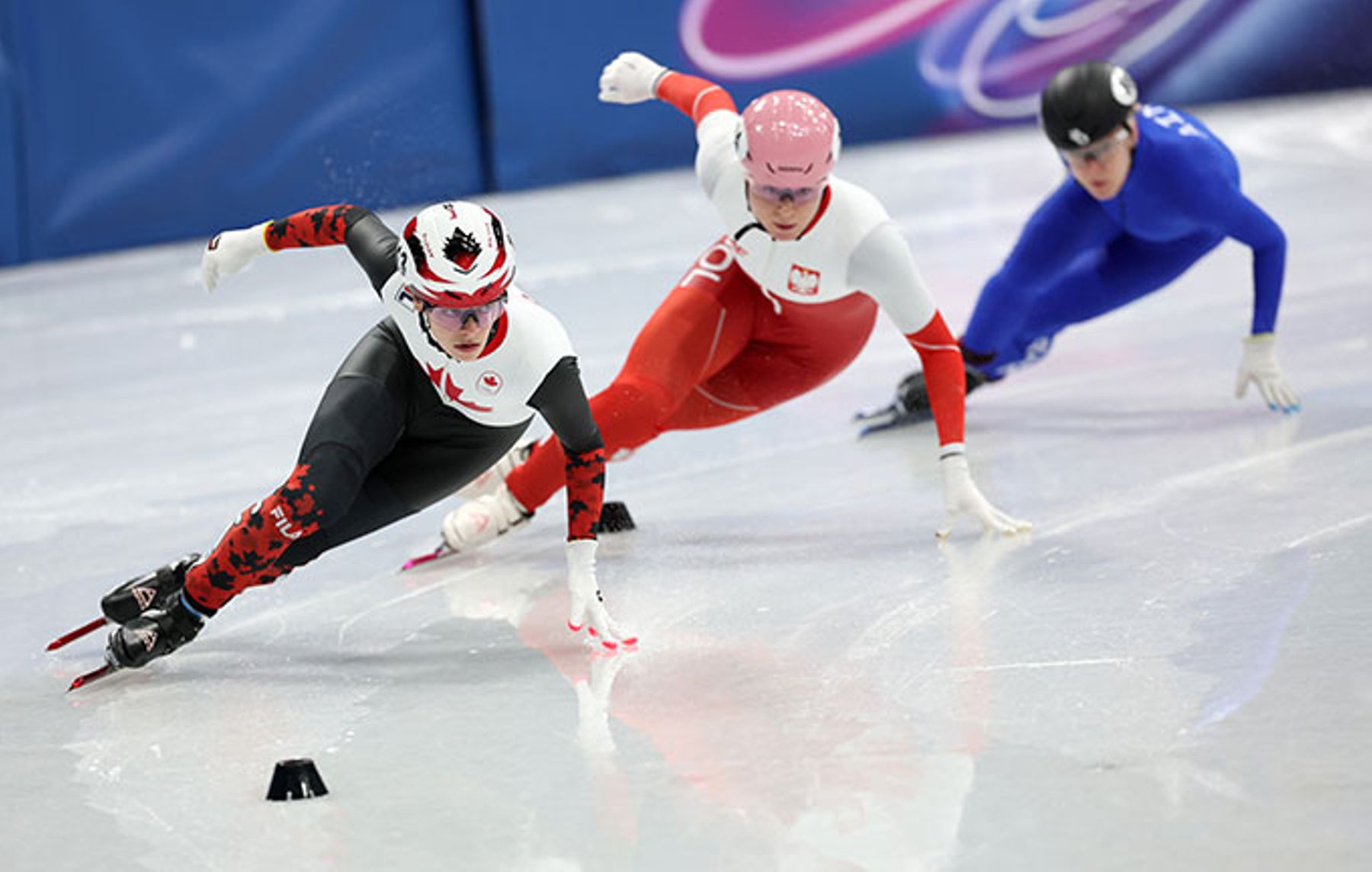
In the modern era, the truce has been more PR slogan than governing principle. Wars have started during Olympic seasons, continued during Olympic seasons, and been cynically exploited through Olympic seasons. The Games don’t tame human conflict. If anything, they provide an irresistible stage on which to dramatize it.
That’s why the “harmony” narrative is so grating. It asks viewers to pretend that multicolored rings can dissolve realities that diplomacy struggles to manage. It also asks us to ignore the more obvious truth: that the Olympics aren’t an antidote to politics but a magnet for it.
And yet, despite it all, the Olympics remain compelling—because sports are compelling. Even the most cynical observer can’t help but watch a downhill run that flirts with catastrophe at 80 miles per hour, or a hockey game where national pride is compressed into 60 minutes of controlled violence. There’s something timeless about it: the pursuit of excellence, the confrontation with fear, the now-clichéd thrill of victory and agony of defeat.
Milano-Cortina has the ingredients for a great Winter Games: iconic scenery, serious sporting tradition, and a setting that seems designed for spectacle. Italy knows how to stage drama, and the Games are, above all, a form of drama.
That’s why the IOC should stop pretending that the Olympics are something they’re not and stop apologizing for what they really are. The Games don’t need to justify themselves as a peace project, a “global conversation,” or a sermon about the brotherhood of man. They need to embody world-class athletic competition with maximum entertainment value.
Ironically, the most honest voices around the Olympics are often the commercial ones. The sponsors aren’t selling global harmony; they’re selling excellence, grit, and national pride as a proxy for consumer goods. As a recent commentary noted, it’s the commercials that remind viewers that America remains the greatest show on earth.
The Olympics endure not because they make the world peaceful but because they reveal something about human striving. With apologies to Clausewitz, they’re not politics by other means. They’re sports—glorious, messy, thrilling sports—at the highest level.
If Milano-Cortina succeeds, it won’t be because an entire soccer stadium cheered the beleaguered Ukrainian delegation (a touching moment, to be sure). It’ll be because someone ski-jumped farther, luged faster, or skated harder than anyone thought possible.
That’s not John Lennon’s “Imagine.” It’s something better: a showcase of human achievement.
Top Photo by Millo Moravski/Agence Zoom/Getty Images