In late 2025, Harvard Kennedy School professor Sandra Susan Smith expressed skepticism about the Trump administration’s decision to target a dozen American cities—including Oakland, Chicago, New Orleans, Los Angeles, New York, Portland, and Washington, D.C.—for temporary federal law-enforcement and National Guard deployments aimed at reducing crime and restoring order. Smith wondered “about what the consequences for deploying federalized forces are, especially for black and brown people in the cities that have been targeted for intervention.” She continued: “What seems clear to me is that the costs that are associated with this federal intervention will far outweigh the meager and very short-term benefits.”
One of the targeted cities was Memphis.
Finally, a reason to check your email.
Sign up for our free newsletter today.
With a population just over 610,000—two-thirds of it black—Tennessee’s second-largest metropolis has consistently ranked among the country’s most dangerous places. The Bluff City faces steep challenges. Along with its persistent crime problem, it has struggled with a police recruitment and retention crisis that has left the Memphis Police Department (MPD) roughly 600 officers short of full strength. Compounding those difficulties was the 2023 police encounter that claimed the life of Tyre Nichols, further straining relations between law enforcement and the community. As if this weren’t enough, Shelby County District Attorney Steven Mulroy added further obstacles—pushing various misguided reforms like “restorative justice” and the expansion of juvenile courts to include older defendants up to age 25.
Many would not have expected President Trump to expend much effort helping Memphis, a city with a Democratic mayor, a “progressive” district attorney, and an electorate that gave him only 36 percent of its vote in the 2024 election. But Trump has acted.
In September 2025, a presidential memorandum established the Memphis Safe Task Force (MSTF), now led by the U.S. Marshals Service (USMS), advancing a clear objective: “to end street and violent crime in Memphis to the greatest possible extent through the promotion and facilitation of hypervigilant policing, aggressive prosecution, complex investigations, financial enforcement, and large-scale saturation of besieged neighborhoods with law-enforcement personnel, and which shall coordinate closely with State officials in Tennessee and local officials in Memphis to share information, develop joint priorities, and maximize resources to make Memphis safe and restore public order.”
The data suggest success—so far. Between 2020 and 2024, Memphis averaged 288 murders annually, a homicide rate of 47.2 per 100,000; but the city ended 2025 (with the task force operational for the last three months) with 184 murders (30.2 per 100,000—a decline of 36 percent). Through the first quarter of 2026—marking nearly seven months since the task force’s formation—crime in Memphis continued to decline sharply. According to a joint media release issued by the local crime commission and the University of Memphis’s Public Safety Institute, murders over that period were down 29 percent. Rapes fell 33 percent. Robbery was down 49 percent, while aggravated assaults dropped 27 percent. The declines were just as pronounced for major property crimes, including burglary (33 percent) and vehicle theft (66 percent).
This is no small thing. To an unusual degree for U.S. presidents, Trump has prioritized crime throughout his second term with everything from executive orders on policing and bail reform to immigration-enforcement surges and changes to how the Department of Justice approaches police oversight. Trump highlighted the 2025 year-end declines in serious crime in his February State of the Union address, during which he nodded to the MSTF: “Starting last summer, I deployed our National Guard and federal law enforcement to restore law and order to our most dangerous cities, including Memphis, Tennessee—big success.”
The primary beneficiaries of that success are the city’s black residents.
On March 23, Trump visited Memphis to highlight the MSTF’s work. Two weeks before the president’s trip, I flew down to Memphis for an inside look at the task force and the work its members are doing to turn the city around. Both the U.S. Attorney and the U.S. Marshal for the Western District of Tennessee, D. Michael Dunavant and Tyreece L. Miller, sat for exclusive interviews and arranged a nighttime ride-along with one of the task force’s “flex” teams, roving enforcement units deployed to crime hot spots as needed. I witnessed one night’s work in what may become one of the greatest urban turnarounds in decades.

The first thing to know about the MSTF is that those running it are expected to produce results. It is a genuine crime-fighting operation, not political theater.
On a warm, overcast morning in his office on the eighth floor of the Odell Horton Federal Building, U.S. Attorney Dunavant explained how the MSTF differs from previous efforts. “We’ve done operations in Memphis before . . . 30-day, 60-day, 90-day operations that have had some short-term impact.” “But,” he continued, “[the president] has made it clear that this is a long-term operation that will continue until violent crime is reduced in a meaningful way, once and for all.” Dunavant lamented that punishment has become a “dirty word” for critics of the American criminal-justice system. Regardless, aggressively targeting criminals—and doing so at scale—is precisely what the MSTF is designed to do.
Thirty-three federal and state agencies contribute personnel to the MSTF. When I visited in March, it comprised more than 2,600 operational personnel. The task force deploys 42 interagency teams across the city’s nine precincts, carrying out missions that range from hot-spot policing and follow-ups on service calls to executing search warrants and—unsurprisingly, given that the MSTF is led by the United States Marshals Service—tracking down and apprehending fugitives. As Marshal Miller put it, “This operation is the Marshals Service doing what we do on steroids.”
Deploying that many agents means pulling personnel from around the country away from their families and normal duties at their home agencies—including ICE, CBP, ATF, FBI, HSI, DEA, the USMS, and even the IRS. Agents are flown in and housed in local hotels for the duration of their two-week tours. Some of the agents I spoke with were visiting Memphis for the first time on MSTF assignments; others were on their third tour in the city. Many rent cars for their work because doing so is cheaper than transporting agency vehicles from around the country. The entire operation is a major logistical undertaking.
Outsiders though they may be, the agents adapt quickly. While police work is broadly similar across jurisdictions, it helps to have a native’s sense of the local context, and that’s where the visiting agents’ local counterparts come in. Each of the task force’s 42 teams includes at least one member from either the MPD or the Tennessee Highway Patrol (THP). I was told that what local authorities bring to the operation is invaluable. On the street, they play critical roles, including conducting traffic stops—federal agents lack jurisdiction to enforce local traffic laws—during which teams often uncover contraband such as guns and drugs, as well as outstanding warrants.
The MPD and the Tennessee Bureau of Investigation share intelligence with task-force leaders, helping identify crime hot spots and prioritizing high-risk offenders and criminal organizations. At the MSTF’s temporary headquarters, I was ushered into a large room buzzing with activity. Liaisons from participating agencies fielded calls from agents in the field, either reporting arrests or receiving critical information in real time. One wall was lined with oversize screens displaying mug shots and criminal histories of targets identified for warrant-service teams, evidence photos from recent busts, and live maps tracking patterns of criminal activity across the city.
The visiting agents were appreciative of—and, in some cases, surprised by—the warm welcome they received from state and city authorities. Out in the field, the relationship between the federal and local members of the task force could fairly be described as brotherly and cooperative. That degree of coordination is notable, given the long-standing turf battles and institutional tensions that often characterize relationships between federal and local law-enforcement agencies. Agents regularly sought local officers’ input and offered assistance wherever they could.
During one “knock-and-talk”—visiting an address associated with a wanted offender to see whether he was there or to ask where he might be found—an MPD officer got a hit on his license-plate reader from a U-Haul trailer parked in a driveway near the house our team was targeting. The trailer had been reported stolen. The task-force members were there to apprehend a violent felon, but, recognizing that the MPD still had its own job to do, they offered to leave an agent behind with the officer before moving on to the next target so that he would not have to wait alone for backup. There was not even a hint of condescension or tension between the federal agents and the local officers.
Even more important, the local officers’ appreciation for their federal counterparts is shared by the community. Unlike the videos that so many Americans saw coming out of cities like Minneapolis, where federal agents were regularly heckled, taunted, and attacked, the response from Memphians has been overwhelmingly positive. Many of the agents I spoke with—some of whom did immigration-enforcement tours in Minneapolis—recounted being thanked by strangers in the street. For them, Memphis was a breath of fresh air.
The teamwork extends beyond local law enforcement. Memphis Mayor Paul Young, a Democrat, “has been good to work with,” Miller says. He describes a collaborative relationship that enables the task force to operate without the official hostility that other federal operations have encountered in places like Minneapolis, Chicago, and New York City. Less surprising, but equally important, has been the support of Governor Bill Lee, who approved the deployment of the Tennessee National Guard to play a key role in the MSTF.
The task-force members may owe their warm reception from both residents and local officers to the fact that Memphians understand the dangers of the work they are doing. Those dangers cannot be understated. The night before I arrived in Memphis, members of the same flex team with whom I went on the ride-along were shot at while responding to a separate call for shots fired. No one was hit, luckily. A few days earlier, though, an MPD officer was shot at point-blank range during a traffic stop. Thankfully, he survived.
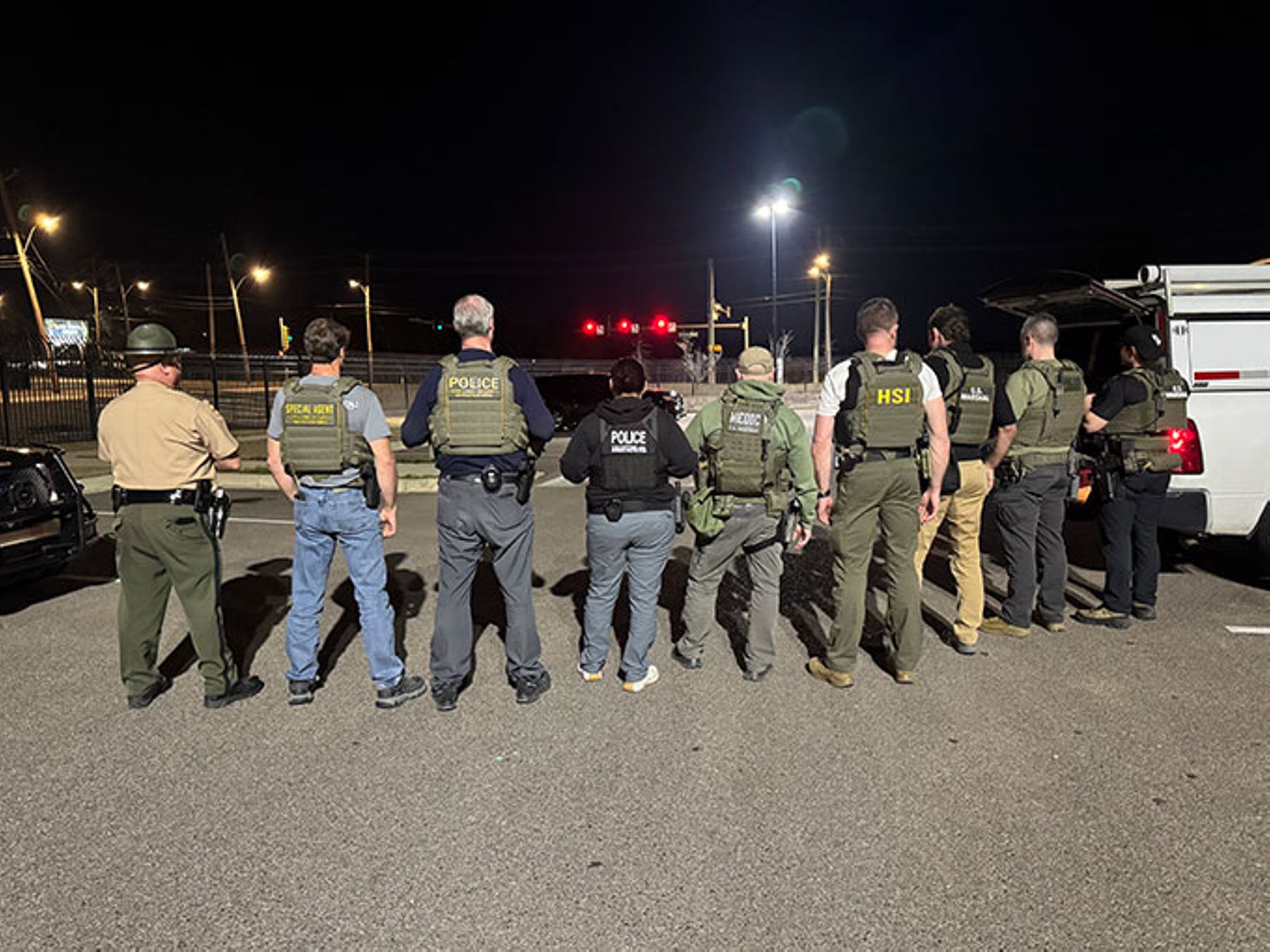
Undeterred by these recent close calls, the team I rode with gathered in the parking lot of an abandoned strip mall to plan its next operation. The target: an active Vice Lords gang member with an outstanding warrant—and not just any Vice Lord but one with a prior murder-for-hire conviction. Casual conversation in the parking lot stopped when the lead agent called everyone to attention. Once it was time to work, the smiles disappeared, and you could feel the shift in the agents’ focus.
The team was briefed on the target, warned about the risk of violent resistance, and walked through every step of the operation—from the direction of approach and where vehicles would park to the precise role of each agent: who would take the front door, who would monitor the back of the house, who would cover the windows, and what supplies the medic should have on hand. The THP officer’s vehicle was designated the operation’s “ambulance,” meaning that if an agent were shot, it would be used to transport him to the nearest trauma center, identified in advance. Why the THP vehicle? Because the trooper knew the city best, and a marked patrol car with lights and sirens could cut through traffic more easily in an emergency.
While all of that was unfolding, 41 other teams were spread across Memphis carrying out their own missions. Over time, those efforts have begun to pay off. Every morning at 7 am, MSTF leaders receive a situation report (“SitRep”) containing the latest enforcement statistics and highlighting some of the operation’s most significant arrests. Through April 20, the task force had made 8,366 arrests. Roughly half involved warrants that federal law allows the USMS to adopt. Resource constraints within the MPD had produced a five-figure warrant backlog, and USMS agents were uniquely well positioned to help address it—executing warrants and tracking down wanted felons is precisely what they are trained to do.
Also included in those arrest figures: the recovery of more than 1,300 illegal firearms and the apprehension of 875 known gang members, which, in a city of just over 610,000, can make a meaningful difference on violent crime measures.
The influx of additional resources has allowed the MSTF to address other important problems as well. FBI investigators, for example, have assisted the MPD with cold cases, including through forensic analysis. The task force has also emphasized public-order and quality-of-life policing through stepped-up traffic enforcement and the deployment of more than 1,400 Tennessee National Guard troops, who serve as visible deterrents in high-traffic, sensitive areas such as Beale Street in downtown Memphis. Through its first six months, the MSTF issued more than 20,000 traffic citations.
The task force has also enlisted help from the United States Department of Labor, the Social Security Administration, and the Small Business Administration to identify fraud involving social benefits and Paycheck Protection Program loans. “This is a whole-of-government approach,” Miller told me—a multilayered law-enforcement operation.
Still, the bulk of what the task force does (and what the officials running it tend to highlight) remains street-level anticrime operations. To make the most of that effort requires following up task-force arrests in court—not always a given in District Attorney Mulroy’s Shelby County. But when federal authorities have concurrent jurisdiction over the underlying offenses—such as those involving prohibited possessors of firearms and drug traffickers—the prosecutors for the Western District’s U.S. Attorney’s Office try to take on as many cases as possible. U.S. Attorney Dunavant went over some of the numbers in March. “So in five months, we’ve charged 251 people,” he told me, noting that this figure is “about 300 percent greater than what we would normally be doing. We have tripled our caseloads.” To help manage the workload, his office has brought in prosecutors from various branches of the U.S. military’s Judge Advocate General’s Corps to work as special assistant U.S. attorneys.
The benefits of taking cases federal primarily have to do with the higher likelihood of detention for dangerous defendants. Dunavant put the detention rate at approximately 66 percent as of March, which, when compared with the state system, he said, “is a stark contrast.”
It’s well-known that warm summer weather usually brings an increase in violent crime. This summer—Memphis’s first since the task force launched—will be the MSTF’s final test. “[I]f there is a ‘spike,’ ” Marshal Miller told me, “we are prepared to adjust scheduling, deploy resources, and supplement MPD wherever we’re needed.” If the task force maintains its success through the summer, the doubters and critics will have little left to argue about.
The MSTF represents a major federal investment of resources—one whose benefits have accrued overwhelmingly to the black residents of Memphis. The city’s predominantly black population has long been desperate for relief from the crime plaguing its neighborhoods. Miller is keenly aware of what success means. “Parents are seeing that they can allow their kids to go out and play now, because they don’t hear gunfire all night every night,” he said.
I witnessed what he means firsthand in a small housing development during my ride-along. When the flex team’s cars pulled in, some of the older boys and young men quickly retreated indoors while agents questioned the occupants of an address associated with a wanted person. Minutes later, the common areas outside the single-story apartments were occupied by children—some on bikes, others who decided on a game of tag. I couldn’t help but wonder, after we pulled away, how long it had been since those kids were free to play outside their own homes.
One of those parents to whom Miller referred—a retiree and part-time Uber driver—told me that he had initially been uneasy about the MSTF. What, he wondered, would the city be like for law-abiding residents with thousands of federal agents roaming the streets, authorized to make as many arrests as possible? When I asked how he felt now that the task force had been operating for six months, his reply sounded almost as though he regretted his earlier hesitation. “The small liberties that we may give up,” he said—referring to increased car stops—“ain’t nothing compared to what we gained.”
How to sustain those gains is something those leading the task force’s efforts think about every day—and it’s a question critics often ask. “The fear,” Dunavant told me, “is that when we pull out, the criminals will notice it, and the ones who’ve been lying low will come back out with their guns and their drugs.” But embedded in such fears is an acknowledgment that the current approach is yielding fruit. Dunavant remains optimistic that the task force’s efforts will leave a lasting impression in the minds of Memphians. “They’ll understand that this is what’s needed—that this is the type of personnel on the street that really makes a difference,” he said, hopefully. The goal is to give the city and state a blueprint they can follow after federal resources dry up.
That may not happen for a while, however. In June, President Trump announced the next phase of his administration’s war on crime and disorder: the Model Cities Initiative, which will make approximately $300 million in funding available to municipal applicants seeking to hire more police and augment their public-safety efforts through the acquisition of technologies like drones, facial recognition, and gunshot detection. That commitment aside, the federal resources that have recently flooded Memphis will eventually get pulled back, and the MSTF disbanded. When that time comes, Memphians would do well to build on what the task force leaves behind: the enduring lesson, demonstrated by New York a generation ago, that a city can arrest and prosecute its way out of a crime crisis. The question for Memphis will be how to keep the momentum going. If it can count on continued support from state leadership in Nashville, the city’s prospects are bright.