For years, pundits have lamented that America no longer builds things. Bridges and roads take decades to complete, and housing construction in many places has slowed to a crawl. Governments at all levels keep layering on new regulations and stifling growth.
Yet under our noses, one of the great building booms in American history has unfolded. In 2025, the U.S. spent about $425 billion building data centers—those often-unlovely hulks of concrete, cables, and chips that house and power the internet and artificial intelligence. That amounts to nearly 1.5 percent of the entire economy and approaches America’s spending on highways during the interstate build-out of the late 1960s and early 1970s.
Finally, a reason to check your email.
Sign up for our free newsletter today.
The heart of the data-center boom, in America and globally, is an otherwise quiet and affluent bedroom community in Northern Virginia: Loudoun County. Communities like Loudoun are supposed to be bastions of Not In My Backyard opposition to development, not the front line of a new industrial revolution.
Yet data centers have proved an extraordinary boon for Loudoun residents; they now generate nearly half the county’s tax revenue. Thanks to them, Loudoun enjoys smooth roads, lavish schools, and low tax rates for homeowners. Even as opposition to data centers grows, Loudoun’s experience shows what can happen when governments embrace growth. For residents and businesses alike, Loudoun offers a model that the rest of America would do well to study.
Loudoun County was, until recently, a rural outpost of Washington, D.C. Even today, most of its land remains rural, with many farms and ranches set against the Blue Ridge Mountains to the west or the Potomac River to the north. Nearly all the population, however, lives in the eastern part of the county, near Dulles Airport and major arteries like the Loudoun County Parkway and the privately owned Dulles Greenway. The county’s population has nearly octupled since 1980 and now stands at about 440,000 residents, most living on comfortable suburban lots. That makes Loudoun larger than many well-known American cities, including Cleveland and New Orleans. By one measure, Loudoun is America’s richest county, with a median household income of over $170,000.
Loudoun has benefited from its proximity to Northern Virginia’s often-underappreciated technology boom. As Paul Ceruzzi shows in Internet Alley, the Defense Department recognized early in the Cold War that it needed to rely on the private sector for everything from cutting-edge mathematical research to frontier telecommunications. The area around the Pentagon thus became a hub for experimental technology. Contracts from the Defense Advanced Research Projects Agency helped give birth to the internet and laced the region with communications infrastructure.
Soon, Northern Virginia technology firms began working outside the government’s purview. One night in 1992, some early internet network executives got together over beer to plan what became the first private Internet Exchange Point, based in Fairfax County, Virginia, next to Loudoun, where networks could connect and share data. It became known as Metropolitan Area Exchange-East. By some estimates, about half the world’s internet data passed through MAE-East at one point.
America Online, an early dial-up internet company, used these personal and physical networks to become Northern Virginia’s first consumer-technology breakout firm. AOL’s move to Loudoun County in 1996 helped cement the growth of what was still seen as an exurban landscape. One early AOL employee recalled breaking into tears after seeing the new headquarters, convinced that he would be commuting to the middle of nowhere. Around the same time, MCI WorldCom, then one of the world’s biggest telecommunication companies, moved to Loudoun. MAE-East relocated there to be closer to the action.
Data centers emerged as a distinct industry to connect and support these companies. In 1998, a new firm called Equinix built its first data center near MAE-East in Loudoun after local internet companies realized that the exchange point couldn’t handle the growing traffic.
AOL and MCI WorldCom foundered and collapsed, but they and other firms left a legacy in the county, including vast amounts of underused “dark fiber,” which other companies snapped up. The presence of MAE-East and the early data centers provided a springboard for future growth. Equinix went on to become one of the world’s largest data-center builders. In an almost too-perfect symbol of the transition, AOL’s former Loudoun headquarters was eventually converted into a data-center campus.
Loudoun County’s government, led by a nine-member Board of Supervisors, supported the technology boom early on. In 2000, in a little-noticed move, the zoning administrator ruled that data centers were equivalent to office buildings, not industrial facilities. As a result, they could be built “by right”—without further political approval—in commercially zoned parts of the county. Amazon Web Services took advantage of the county’s openness when it constructed its first data facilities in Loudoun in 2006.
One individual made a crucial difference to Loudoun. When I asked current vice chair of the Board of Supervisors Mike Turner what helped the county build on its early data-center lead, he answered: “The biggest thing we did right was hire Buddy Rizer,” the man who, Turner added, “built the data-center industry single-handedly.”
Rizer is the county’s chief of economic development and has been with the department since 2007. A former disc jockey with an economics background, he saw the opportunity for Loudoun to exploit its technological legacy. “We had a lot of assets and empty buildings,” he told me. “We had the fiber, we had the power.” They just needed to get the word out to more companies.
The reason Loudoun, and now other places, wanted data centers is clear. Rizer noted that the centers “provide tax revenue, and they don’t put a drain on services. It’s really a perfect industry for a fast-growing community like ours.”
Around 2008, buffeted by the first waves of the financial crisis, Loudoun and Rizer launched a marketing campaign, which branded the area “Data Center Alley.” In 2014, the county created a special data-center zoning ordinance, which made building the centers even easier in specific places. Rizer says that the key advantage Loudoun offered data-center companies was speed and certainty. “Nobody could get to market faster than us,” he recalls. “We had a single point of contact—and that was me.”
State government helped, too. In 2010, Virginia initiated a data-center tax-abatement program after losing a project to lower-tax North Carolina. A recent Virginia state study found that, in some years, data centers have received as much as 80 percent of the state’s economic-development tax incentives—largely through sales-tax exemptions on the servers they purchase. Some critics decry this as corporate welfare, but the reductions more closely align the sales tax with its intended purpose: taxing final consumption, rather than business-to-business transactions. On net, the facilities remain a major fiscal boon to state residents. From 2022 to 2024, over 80 percent of all new corporate investment in Virginia was tied to data centers.
A key requirement for data centers is access to large, stable electricity supplies, and Rizer says that the local utility, Dominion Energy, has been a crucial partner. Dominion also won customers primarily by moving quickly. The company assigned employees to work full-time with data centers, and, as Stan Blackwell of Dominion told one source, they “became half real-estate agents,” advising investors which sites could receive power fastest, so that they could buy land accordingly. “It used to be that a utility built two substations a year,” Blackwell noted. “We have roughly a hundred in the pipeline now. It’s an earnings driver.” Dominion would even prequalify power connections before all permits were finalized and ensure that the infrastructure was ready when the centers came online.
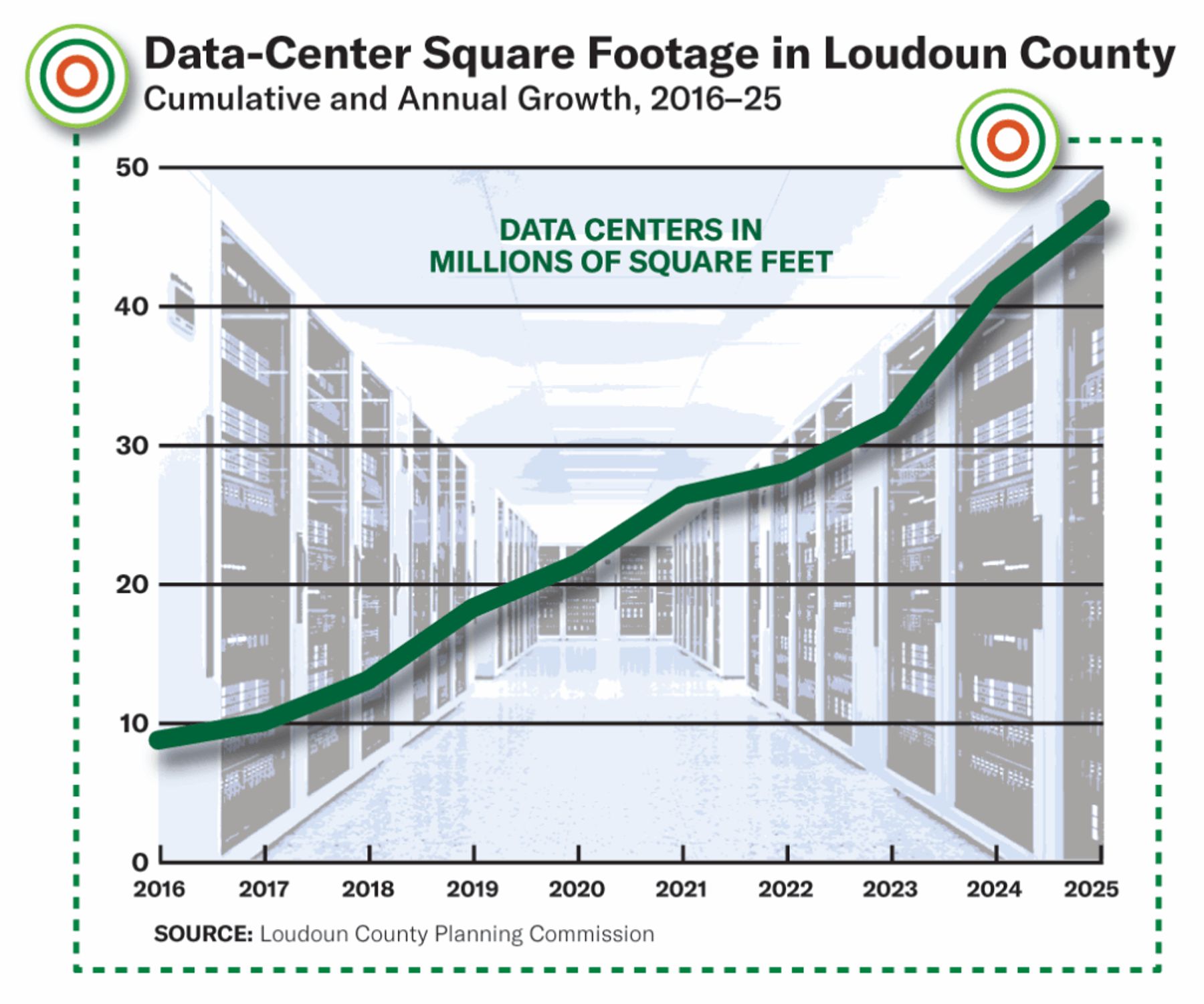
In 2019, Loudoun had roughly 20 million square feet of data centers, making the county the largest player in the still-budding industry. But after ChatGPT arrived in 2022, demand for data-center space exploded. Currently, the county’s 200 data facilities take up almost 50 million square feet, with tens of millions more square feet planned. By another measure of size, Northern Virginia, with Loudoun at its heart, has nearly 5,000 megawatts of data-center capacity—more than twice as much as Beijing, the closest competitor. Nowhere else in America comes close. As these facilities spread across the U.S. and the globe, Loudoun has held on to its early lead.
Data centers occupy only about 3 percent of the land in Loudoun, but they’re concentrated around an old farming village, Ashburn. As Andrew Blum writes in his book Tubes, “The Internet works because every network is connected, somehow, to every other. Where do those connections physically happen? More than anywhere else in America, the answer is ‘Ashburn.’ This is the bullseye of America’s Internet.”
Drive north up the Loudoun County Parkway on the edge of Ashburn today, with Dulles International Airport behind you, and you encounter a striking sight. Against the backdrop of empty lots and rolling hills, the parkway is lined with miles of towering concrete blocks—some nearly 100 feet tall—without a window or balcony. Many have massive electrical substations beside them, linking the buildings to nearby high-voltage lines. The concentration of these behemoths, standing shoulder to shoulder, can make the landscape feel almost purely mechanical.
Urban economists call the advantages that industries gain from clustering together “agglomeration effects.” The concentration of workers, ideas, and inputs in one place tends to make firms more productive. Data centers, though, are unusual candidates for such clustering: they consist largely of non-sentient (at least for now) servers and silicon chips that run mostly autonomously, once installed.
Yet real advantages come from locating the centers close together in Loudoun. One is low latency—the time servers spend communicating with one another and with human users. Just as garment workers once benefited from being within walking distance of one another in New York, data centers in Loudoun gain precious nanoseconds by communicating with nearby facilities.
Loudoun also benefits from its concentration of high-tech, high-demand workers. A Harvard Business School study found that data centers tend to cluster near areas with large numbers of tech and finance jobs, partly because those workers value faster connections. Proximity to Washington’s defense and technology sectors and reasonable access to the Acela Corridor make Loudoun a convenient place to locate servers.
Other advantages of locating data facilities in Loudoun are subtler. Executives cite the region’s relative freedom from natural disasters—there is little threat from earthquakes, floods, tornadoes, or hurricanes—a vital consideration when a single event could disrupt a large portion of the global internet. Though data centers require relatively few employees to operate, building them requires many more, and the region has developed a skilled construction workforce. Vice Chair Turner, who represents Ashburn, told me,“We have an entire workforce that understands data centers in Loudoun County.” It helps that “all the trade unions are familiar with data centers and what they require.” Amazon Web Services has helped launch a cloud-computing associate’s degree at Northern Virginia Community College and partnered with nearby George Mason University on a four-year program. Agglomeration effects appear to apply to data centers, too.
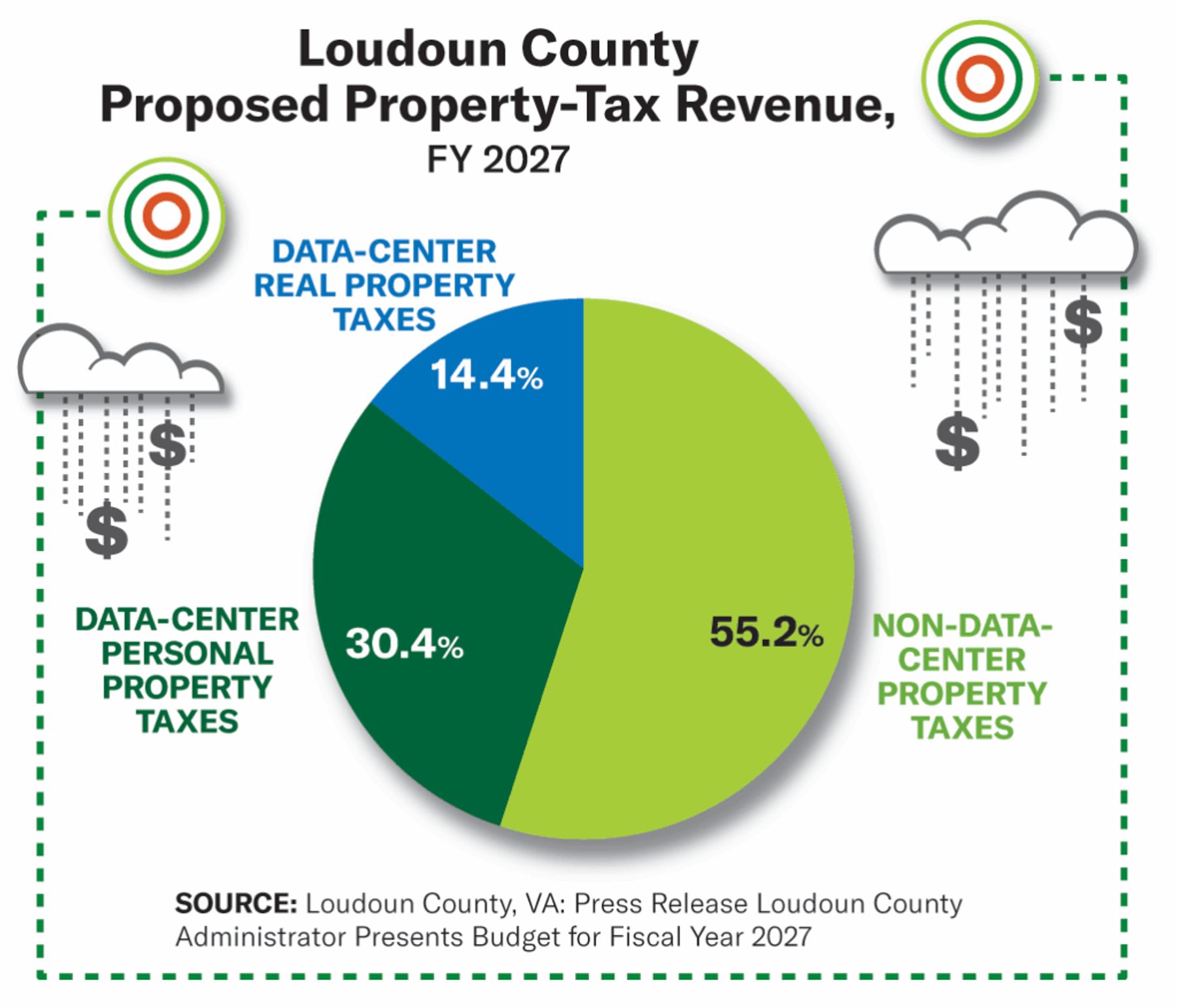
Loudoun County’s government has been so accommodating because data centers deliver enormous financial benefits to locals. As supervisor Kristen Umstattd told me, the facilities “bring $1 billion a year into Loudoun County,” and the total continues to rise. In the fiscal year 2027 budget, data centers are expected to generate $417 million in real property taxes (on the buildings themselves) and another $879 million in personal property taxes (on the servers and equipment inside them), for nearly $1.3 billion in total.
The data centers will thus provide 45 percent of the nearly $2.9 billion in county tax revenue. For perspective, that means that the money they generate exceeds what Loudoun spends on every county function outside the school system. In effect, local police, courts, jails, fire and rescue, libraries, parks, animal control, and social services are funded without burdening residents.
Nor are these services bare-bones. Supervisor Umstattd notes that data-center revenue has allowed the county to raise staff wages, purchase body cameras for law enforcement, and expand parkland and other public projects. The roads are wide and well paved; the schools are gorgeous.
Even as data centers have funded an expansive local government, they have also lowered the tax burden on residents. While other areas in the U.S. face periodic revolts due to rising property taxes, Loudoun reduced its homeowner property-tax rate every year for a decade, in total cutting it by about 40 percent since the early 2010s. At 80.5 cents per $100 of assessed value, the rate is around 30 percent lower than in nearby Fairfax and Alexandria. The board has also reduced the local “car tax”: at $3.09 per $100 of value, it is about a third lower than in those neighboring jurisdictions.
Even more important than the tax revenue is the fact that data centers require almost no services in return. As Vice Chair Turner explained, the facilities “don’t put kids in our schools. They don’t put cars on our roads.” The county estimates only about 4 cents of every dollar raised by the centers goes back into services to support the centers themselves. Typical commercial property requires about 25 cents in support for each dollar raised.
Another fiscal advantage for Loudoun is that most taxes on data centers fall not on the buildings themselves but on the “personal property” inside them. As centers upgrade to ever more expensive NVIDIA and AMD chips and Dell servers, Loudoun’s revenue from existing facilities keeps rising.
Data centers both benefited from and provided extra benefits for a particular legal district in the county. Back in 1987, Loudoun and next-door Fairfax County created the Route 28 Tax District to fund improvements on the main road going north from Dulles Airport, which was then just a two-lane highway. The district required commercial and industrial property owners to pay a tiny tax, no more than a small fraction of a penny per dollar, on top of regular property taxes. In exchange, the owners got a guarantee against any downzoning that would limit their right to develop. The Board of Supervisors later sweetened the deal by creating optional zoning districts that owners themselves could opt into in the district. Despite the increased taxes, data-center builders appreciated the certainty and options that the law provided. Much of Data Center Alley lies in this little-understood district, which still provides millions in funding for transportation in the area.
At a County Board of Supervisors meeting in January, Supervisor Juli Briskman noted a problem that most jurisdictions would envy: the county faced “excess revenue” for years to come and needed ways to use it without permanently expanding the operating budget. Loudoun has directed tens of millions into a housing trust fund—what Briskman called “a great use of data-center revenue”—and since 2023 has contributed tens of millions annually to a revenue-stabilization fund to cushion fluctuations in data-center taxes. In effect, the centers function like an oil field for a country such as Norway, generating so much income that some of it can be set aside for the future.
Local governments are often accused of “smokestack chasing”—luring industrial and commercial firms in hopes of creating jobs. Data centers don’t seem to fit that model at first. One estimate suggests that the average completed facility has only about 50 employees. Yet the ongoing boom in data-center construction has generated a steady stream of construction jobs that local government officials cultivate. “This industry has collaborated with their workforce better than any in my 40 years as a union organizer,” says Don Slaiman, an official at an International Brotherhood of Electrical Workers local. He noted that data centers are creating “six-figure blue-collar jobs right in the center of Northern Virginia. That is unheard of.” As Vice Chair Turner says of the facilities, “IBEW loves them.”
Many Loudoun residents have gotten rich by selling land to the centers. Last November, a local businessman sold 97 acres of land north of the main Data Center Alley for $615 million, or more than $6 million an acre—and more than ten times what the parcel sold for just four years earlier. The transfer taxes alone brought in $4 million for the county. One group of Loudoun homeowners, already surrounded by data centers, has petitioned to rezone their land—not to prevent more facilities but to allow the residents collectively to sell their plots for a bigger price tag.
Amazing local services, low taxes, strong blue-collar jobs, and windfalls for local landowners, all while requiring almost no taxpayer money in return: for years, data centers seemed like not just a free lunch but a free buffet, one that never stopped.
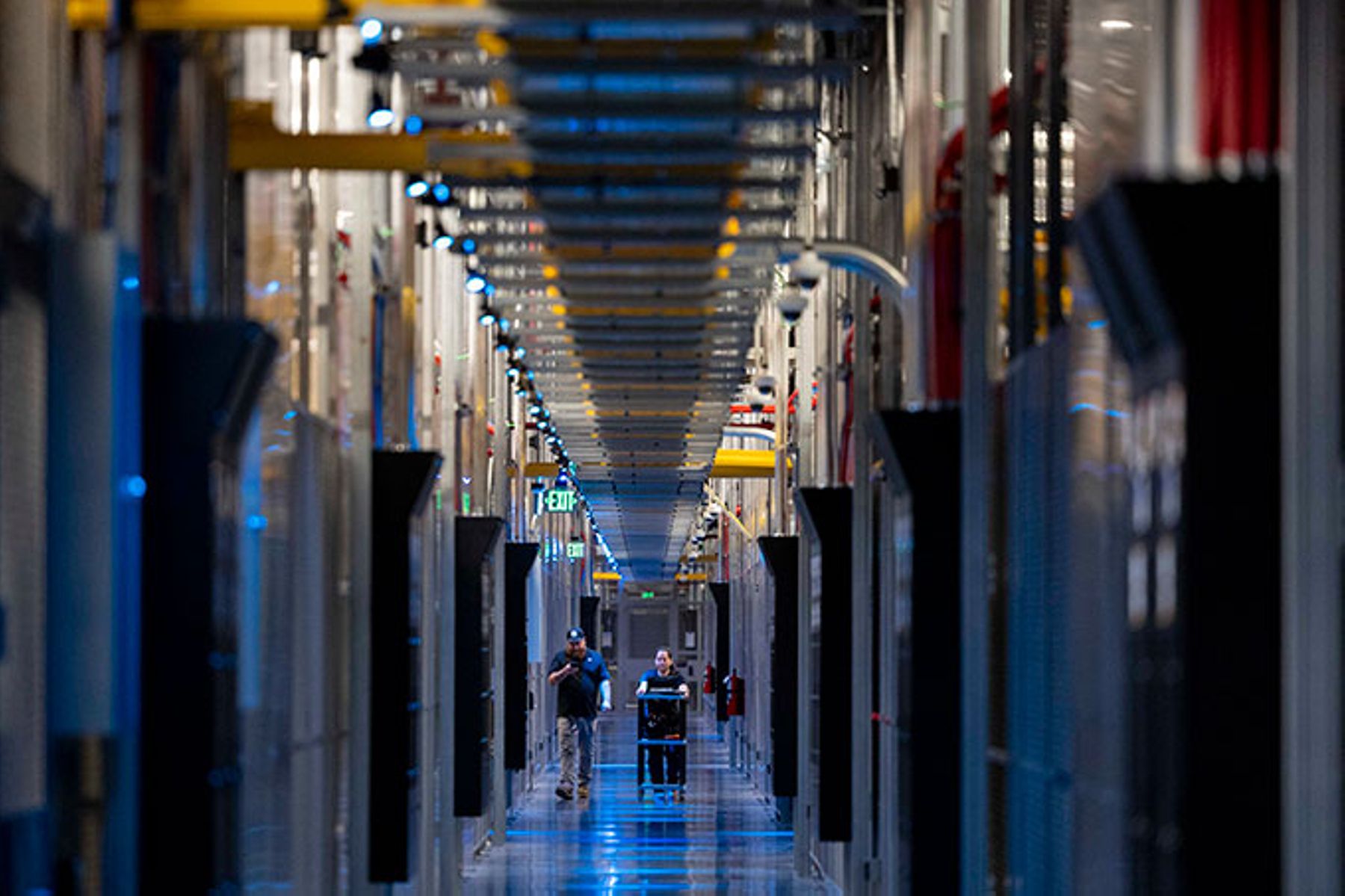
The boom in artificial intelligence since the release of ChatGPT has sparked another surge in data-center construction, both in Loudoun and nationwide. But the growth has also brought rising complaints—some legitimate—from politicians and residents.
Since Loudoun and Virginia have become centers of the boom, they have also become centers of opposition to it. According to one study, Virginia has about a third of all the activist groups trying to stall data facilities nationwide. In 2023, they organized into the Data Center Reform Coalition. They’ve notched some recent successes in Loudoun and elsewhere.
Phyllis Randall, chair of the Loudoun Board of Supervisors, won recent campaigns largely on promises to curb unchecked data-center development. In March 2025, the board, led by Randall, ended the county’s decades-old “by-right” zoning for data centers, requiring all new projects to undergo public review.
But local opposition to data centers is often tinged with admiration for what they’ve achieved. The Piedmont Environmental Council has been perhaps the most consistent political opponent of the facilities in Loudoun, but its head recently admitted that “Loudoun County has benefited dramatically, no question. What they’ve been able to do is pay for a lot of schools, a lot of public services.” One resident, while critical of data centers, conceded that Loudoun has “reaped a lot of benefits if you look at their schools and their libraries. They’re beautiful.” Even Randall admitted that two of the biggest data-center firms, Equinix and QTS, had been “excellent community partners.”
Opposition to data centers has focused less on stopping them completely than on controlling their downsides. The most common complaint is noise. The centers’ cooling systems, especially the equipment on their roofs, emit a constant low-frequency hum. A few hours each month, that hum can be joined by a sharper crack and pounding when backup diesel generators kick on.
When standing next to these facilities, I often struggled to distinguish their low hum from the sound of light nearby traffic. But an unending bass note, one that can penetrate walls, is not something any homeowner wants, however subtle. As part of the data-center approval process, Loudoun and other local governments are pushing for quieter centers. One way to achieve that is to switch to liquid cooling, which raises the costs of data centers about 10 percent but is much quieter and more energy-efficient. Politicians are also demanding more noise barriers and greater setbacks from neighborhoods.
The visual impact of data centers has also raised concerns. “They are big and they are a bit mysterious,” as Supervisor Umstattd puts it. Early facilities “weren’t very attractive,” she says, but newer ones look better. The county now pushes developers to break up the concrete facades with color, decorative elements, and even some “fenestration”—windows that may not look onto anything—along with other design changes.
Residents’ most consistent demand is that data centers be built farther from homes. Around Ashburn, most facilities sit beside other data centers or the occasional strip mall, though, in some cases, only a street separates them from dense neighborhoods. Under public pressure, newer projects are more likely to locate farther from residential areas.
Even in this newly critical environment, Loudoun has not ended the boom entirely. “We learned some painful lessons,” Vice Chair Turner concedes, particularly about noise or placement, but he also emphasizes the industry’s enormous fiscal benefits for the county. Buddy Rizer likewise admits that a few projects probably should not have been approved—but, he says, “you can’t deny the benefits.” Big new data-center approvals are unlikely in this political environment; but under last year’s law ending by-right zoning, projects already in the pipeline are grandfathered in, even if construction has not yet begun—potentially adding tens of millions more square feet, on some estimates. Around Loudoun, one sees innumerable lots under construction, with Brobdingnagian concrete walls supported by an array of steel struts that will soon be the home of blinking computer servers throwing off millions in new property taxes each year.
If you had asked many commentators a few years ago whether a new industry could emerge and build hundreds of billions of dollars’ worth of physical and electronic infrastructure each year, they likely would have said that it was impossible. They should have looked to Loudoun. The county shows that communities can grow alongside industry. For places willing to host and build data centers, with their windfall of local tax revenue and minimal demands on public services, the future looks bright.