
Last week, the city of Malibu hosted a “Protect Your Property Security Workshop,” with the Los Angeles County Sheriff’s Department Malibu/Lost Hills Station as co-host. It’s an odd event: the city and the sheriff are telling people how to protect their own property. Isn’t the government supposed to do that?
This isn’t the first time Malibu has admitted to its residents that the city can’t keep them safe. In mid-May, two days before the Pacific Coast Highway re-opened to outside traffic after the L.A. fires, the Malibu City Council voted to spend $260,000 a month to hire private security guards to prevent homes from being burglarized.
Finally, a reason to check your email.
Sign up for our free newsletter today.
The crime wave to which the city council was responding had started with the fires. The Eaton Fire in Pasadena and the Palisades Fire in the Pacific Palisades and Malibu took almost a month to extinguish. During that time, looters stole valuables from houses that didn’t burn down. Private security officers were hired to stop the looting. Private firefighters were tasked with saving houses and businesses when public firefighters could not, hamstrung by the Santa Ynez reservoir running empty, dry fire hydrants, and other bureaucratic failures.
About a dozen of my elementary and high school classmates and friends lost their homes. Some even lost their high school, Palisades High. As of April, the school was holding classes at an old Sears building in downtown Santa Monica. (The nearly 3,000 Pali High students attended classes online for four months.)
A month after the fires, on February 18, Protector, an app nicknamed “Uber with guns,” launched in Los Angeles and New York. The app lets customers hire armed security guards and a motorcade for a night. It debuted at number three on the app store.
On June 24, 2025, Protector launched a product called Patrol, which allows homeowners to book off-duty cops to patrol their homes and neighborhoods. The launch was available in five ritzy L.A. neighborhoods: Bel Air, Brentwood, Beverly Hills, Holmby Hills, and Malibu. The announcement video went viral on Twitter, garnering 11 million views and 7,900 likes. As of this writing, the app has 65 reviews and a 4.6-star average.
On NextDoor, a website where residents in the same neighborhood can discuss local issues and recommendations, one commenter from Venice complained about armed robberies: “Maybe have all the neighbors chip in to hire private armed security. That’s what myself and our neighbors are doing.” On another post about a house in the Palisades getting burglarized, another commenter suggested: “You and your neighbors could split the cost and hire a private security company. That’s what we did in my part of Brentwood and I see them going up my alley during the day and night.”
In a thread discussing the merits of hiring private security in West L.A., a poster wrote, “I’d be interested in hiring a private security service funded by our community. Perhaps off duty or retired police, military personnel, body guards to patrol on foot, car, bike, etc. [T]here would be 4 shifts each 8 hours to cover 24 hours each day. Does anyone have experience or knowledge of this service?” A Brentwood resident replied, “we just did this in Kenter Canyon. Elite security. We can fill you in. We started about 5 months ago.”
My mom tells me that, when she walks our dog, there are a few streets on which she regularly sees security guards, always parked in the same place.
Less than a month after the fires ravaged L.A., the Hollywood Reporter ran an article entitled “Mercenaries for Millionaires: Inside the Private Army That Protects L.A.’s Rich and Famous.” It made the contractors sound like they’re from Blackwater. In reality, they’re just security guards and private firefighters, though some are—gasp!—ex-Mossad.
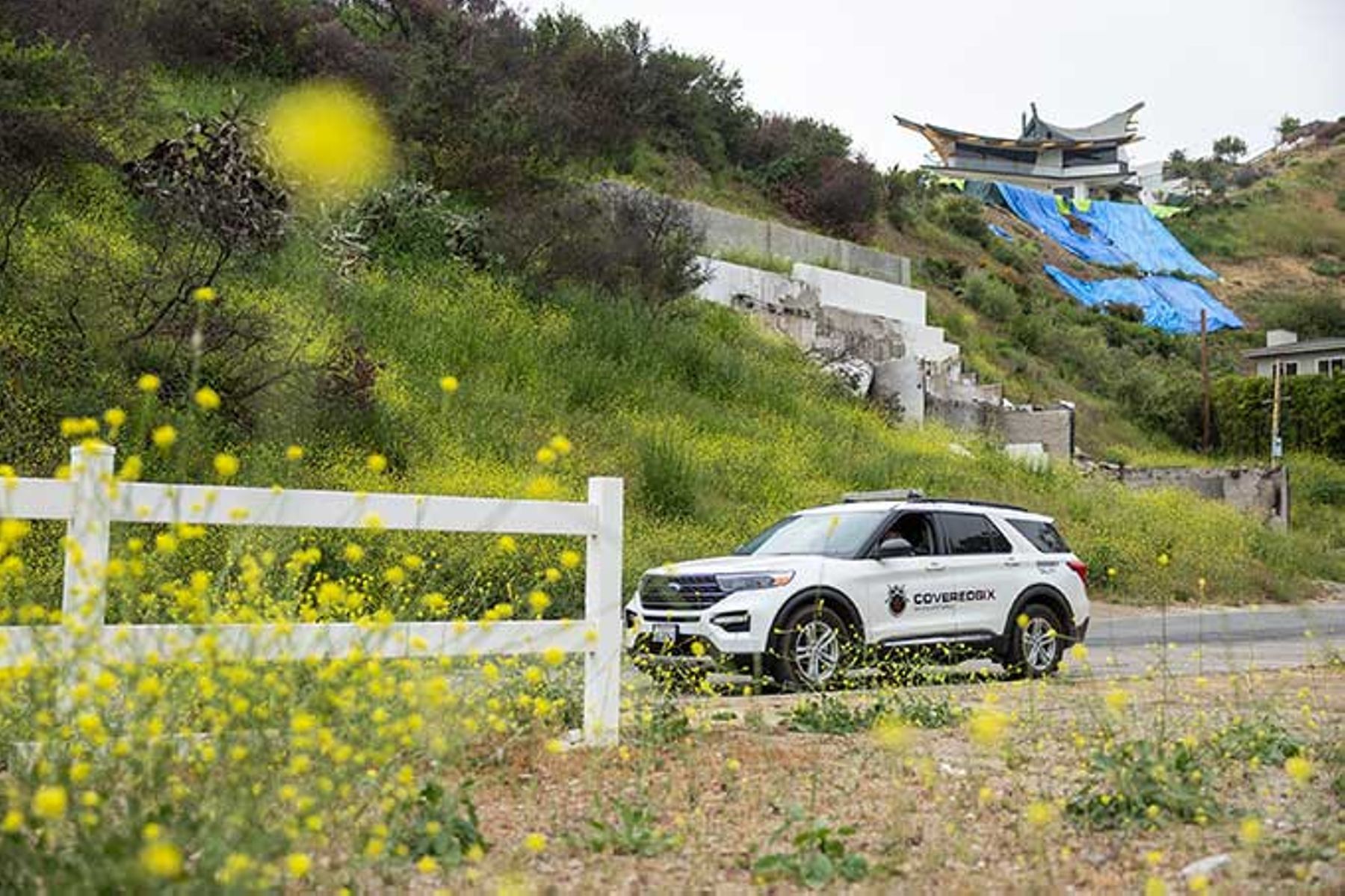
The Hollywood Reporter article also complained that the use of security contractors was increasing inequality in Los Angeles. Futurism, a media company that ostensibly covers technology, called the Protector and Patrol apps “dystopian.” But if the state isn’t providing a service, why shouldn’t the private market do it?
My parents’ street is now considering these services, following the lead of other neighborhoods that have already done so. This past summer—the summer between college graduation and my first job—my family and I would spend 15 minutes each night checking that every door was locked and every window shut. At dinner or in our family group chat, my parents updated my brother and me on which houses on our street had been robbed. At a conference last month, an Angeleno I spoke with about our situation urged us—based on personal experience—to hire private security and split the cost with our neighbors.
Anecdotally, crime in L.A. is spiking. As I was walking in Westwood (the college town next to UCLA), on the way to a workout class, a homeless man grabbed my shoulders and yelled at me to buy him food. At the class, a woman with a black eye told me how she had been assaulted on the street a month prior.
Statistical evidence shows that things have generally gotten worse over the past few years. Data from the Real-Time Crime Index show that violent crimes in Los Angeles County increased from a rolling 12-month total of 11,210 in January 2022 to 12,893 in January 2023. The current 12-month total as of June 2025 is 12,172. Property crimes peaked in June 2024 at 61,456 for the trailing 12 months. As of May 2025, the equivalent number is 56,524—a drop, but not one that has meaningfully changed how people feel about the security of their property.
I am a fourth-generation Angeleno. My Bubbie and Zeide (Yiddish for grandmother and grandfather) met at a high school dance in L.A. My Bubbie’s dad had moved here from Missouri and opened a liquor store in Los Feliz; my Zeide’s family moved here from Chicago after escaping Poland during the Second World War. Though my dad wasn’t born in L.A., some of his best memories of the city were from high school, where he read Plato and ran his school paper.
As Hollywood slowly dies, so, too, do the public amenities that long ago, I’m told, made Los Angeles livable. The ultra-wealthy can afford their own security details, or live in gated neighborhoods like Beverly Park, which requires all houses to be larger than 5,000 square feet. Meantime, the merely wealthy—those who live in the five neighborhoods where Patrol operates—are living in an increasingly anarcho-capitalist order. They send their kids to private schools. They hire private police and private firefighters. The poor are left to suffer.
At least, it would be an anarcho-capitalist order—if residents weren’t already footing the bill for our governments’ extraordinary failures to provide these things. Some wealthy residents of Los Angeles fork over half of their paychecks to a government that cannot provide adequate policing, fire control, education, or public safety.
Or perhaps the best those millions of dollars in taxes can get us is the sheriff’s office partnering with the local government to teach us how to protect ourselves. If so, I’ll pass.
Top Photo: Genaro Molina/Los Angeles Times via Getty Images