
Los Angeles hosts the nation’s largest unsheltered homeless population. In recent years, despite billions in city and county spending, L.A.’s once-pristine streets have become littered with tents, drugs, and feces. City leaders have made elaborate promises about managing the homeless problem, but few seem to have asked a simple question: Where, exactly, are these people coming from?
There is a reason for that. In 2020, the city-county Los Angeles Homeless Services Authority (LAHSA) found that one-third of “unsheltered Angelenos” became homeless outside of Los Angeles County. In 2024, the nonprofit RAND Corporation reported that 41 percent of the street homeless surveyed across three Los Angeles neighborhoods—Hollywood, Venice, and Skid Row—were “last housed” somewhere other than L.A. County.
Finally, a reason to check your email.
Sign up for our free newsletter today.
Both reports cut against the narrative of left-wing politicians and activists, who insist that any claim that out-of-town homeless are flooding L.A. is a “myth.” In 2021, LAHSA stopped publishing previous-location data. In 2025, RAND removed the metric from the organization’s annual report and included it in a separate, lesser-read “annex.”
We asked LAHSA and RAND why they buried this data. LAHSA said it stopped publishing previous-location figures because of respondents’ “varying interpretations of the question.” RAND claimed that it moved the data to the annex “due to a need to save costs on publishing,” and confirmed that the data would remain there in the group’s upcoming report.
Another reason might be that the massive migration of homeless people to Los Angeles violates progressive pieties—and these groups would rather suppress those data than face their implications. (In response to this accusation, LAHSA said it stopped publishing results for the previous-location question “solely due to the statistical uncertainty,” but noted that the “question is in the queue for revision and validation”; RAND again cited “scarce resources” and the need to “streamline the main report.”)
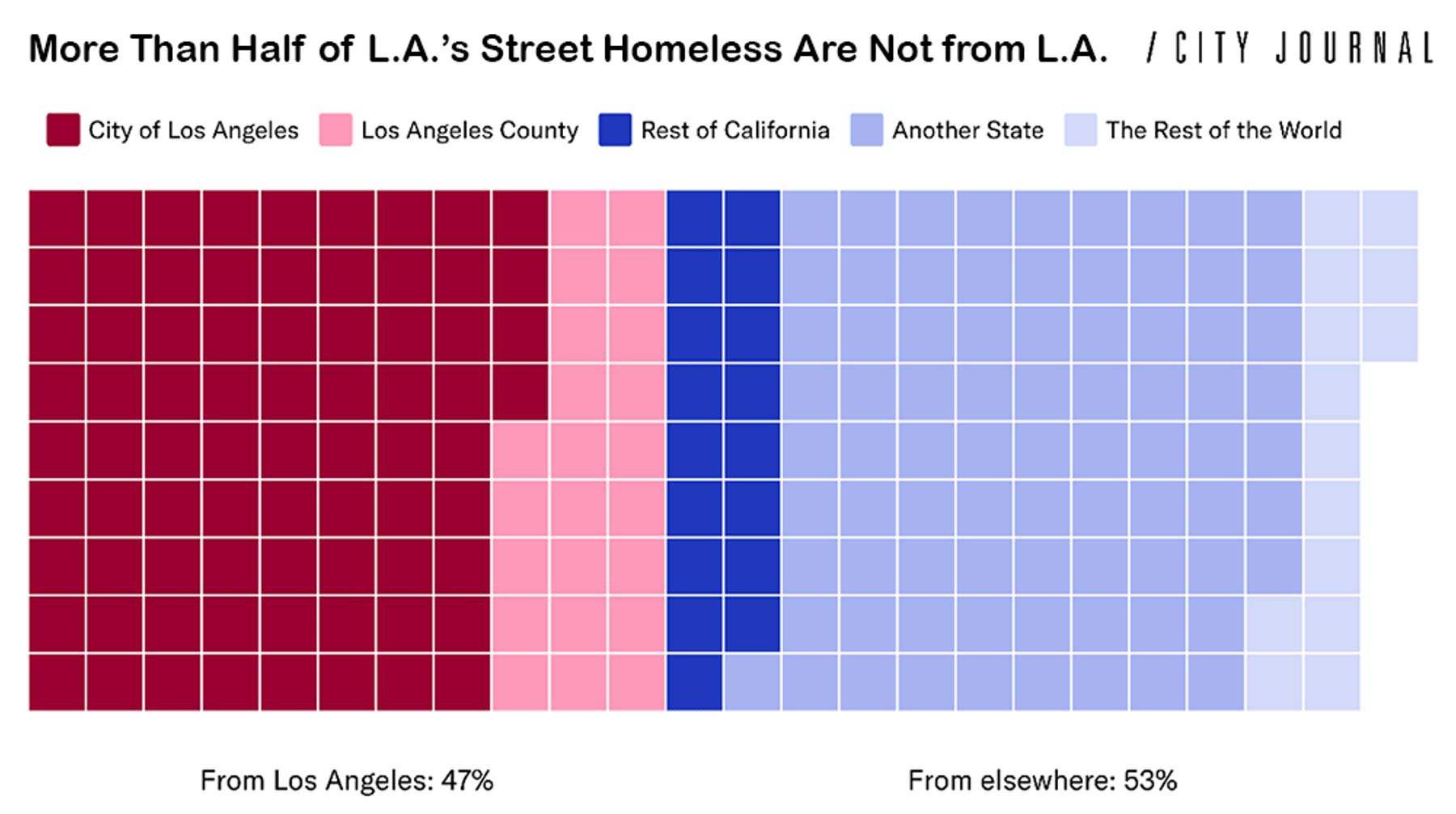
If these groups wouldn’t publish or promote this information, we decided to get it ourselves. We spent two days recreating RAND’s 2024 study of L.A.’s homeless population, using a slightly larger sample size to ensure precision. We approached people on the streets of the same three neighborhoods—Hollywood, Venice, and Skid Row—and, after identifying ourselves, asked more than 200 homeless a simple question: “Where are you from, originally?”
The results were astounding: 64 percent of the L.A. street homeless said they were from outside the City of Los Angeles, and 53 percent said they were from outside Los Angeles County—a significant increase compared with the LAHSA and RAND studies. Nearly 40 percent told us they were from other states, mostly from states that voted for President Trump in 2024. Six percent told us that they were from other countries, including Cuba, Venezuela, and North Korea.
Several of these non-L.A. residents were candid, describing their migration to the city for its fair weather or generous services. In Hollywood, a young woman named Norika said that after being a foster child in New York, she served in the Marine Corps, and had just arrived in L.A. days before. Proudly pointing to a full set of clean, straight teeth, she said that she did not use drugs. Holding a plastic bottle of vodka, she said she was drinking to cope with the pain of living on the streets, where, she said, she has already been raped.
On Skid Row, we encountered a young man as he was about to administer intravenous drugs. He told us that he came to Los Angeles from a small town in upstate New York for sobriety treatment but had departed the facility due to concerns about the program director’s “shady” activities. He would not elaborate and returned to his drug preparation.
Later, we encountered an earnest-looking elderly black woman sitting primly on her suitcase outside of a Skid Row shelter. She told us that she had purchased her own Greyhound ticket from Washington, D.C. at a cost of $379. She seemed to be in shock.
For years, Los Angeles’s homelessness policy has been rooted in the idea that the condition is a housing problem. The city and county have spent hundreds of millions of dollars on “housing first” and “harm reduction” programming—in a nutshell, providing housing and drug paraphernalia instead of mandating treatment—while failing reliably to punish quality-of-life crimes, such as public camping, drug consumption, and petty theft.
The homeless respond to incentives. They flock to places where it is easy to camp, do drugs, and commit crimes, and where the government provides housing, benefits, and drug paraphernalia. That’s exactly what Los Angeles has done. As a result, there is a “magnet effect” that continuously attracts the homeless from around the world.
The implications of our survey are clear: just building housing won’t solve Los Angeles’s homelessness problem. The wrong kind of housing program might even make it worse. Giving more homeless people a permanent home, with no strings attached, simply inspires nonresidents to come here.
The real way to solve Los Angeles’s homelessness crisis is to reverse the polarity of the magnet: enforce drug and camping laws, mandate treatment, and insist on clean and orderly streets. The only alternative is lawlessness—the end result of an approach that has turned the City of Angels into an open-air homeless encampment.