New York State was already five weeks past the start of its 2027 fiscal year when Governor Kathy Hochul appeared in the Capitol’s ceremonial Red Room on the morning of May 7 for what was billed as a special announcement. Flanked by top aides and applauded by a friendly audience of staff members, Hochul began: “Today’s the day! I’m very proud to announce that we have reached a general agreement for the fiscal year 2027 state budget.”
What followed was a 20-minute presentation focused on nonmonetary initiatives that Hochul had injected into this year’s negotiations: auto-insurance reform, easing the state’s now-unreachable greenhouse-gas-reduction targets, trimming the environmental-review process to encourage housing construction, and banning 3-D-printed guns.
Finally, a reason to check your email.
Sign up for our free newsletter today.
The governor spent much less time on the dollars-and-cents items that would shape the actual budget bills, including her plan to “invest” an additional $1.7 billion in preschool childcare, a $1 billion one-time “energy refund” for residential utility customers, and the state’s approval of a $500 million pied-à-terre tax on high-priced second homes in New York City, along with additional aid for counties.
As reporters peppered Hochul with questions about the deal, it became clear that she had exaggerated its completion. She had barely left the Red Room when Assembly Speaker Carl Heastie met reporters in an upstairs Capitol hallway to contradict her. There was, in fact, no budget deal, he said, citing “many open issues on money,” and adding: “I’m never doing this again. Budgets are supposed to be about money, not policy.”
The speaker’s frustration was understandable, if confusingly phrased. Money, of course, is the essence of policy, especially in a state that spends so much. But in each of her five fiscal-year cycles as governor, Hochul has added another layer of opacity to the already-murky annual process that produces the nation’s second-largest state budget. Alongside spending and tax increases that fellow Democrats routinely push even higher, she has insisted that the legislature take up unrelated issues—the sort of “policy” that Heastie meant.
Though Hochul did not finalize crucial details of the budget agreement until later in May, the broader trajectory was evident much earlier. Under New York’s strong executive-budget law, the buck stops with the governor. But Hochul barely tapped the brakes on spending growth in her January executive budget, the traditional opening bid in a legislative negotiating process that almost invariably drives the final number higher.
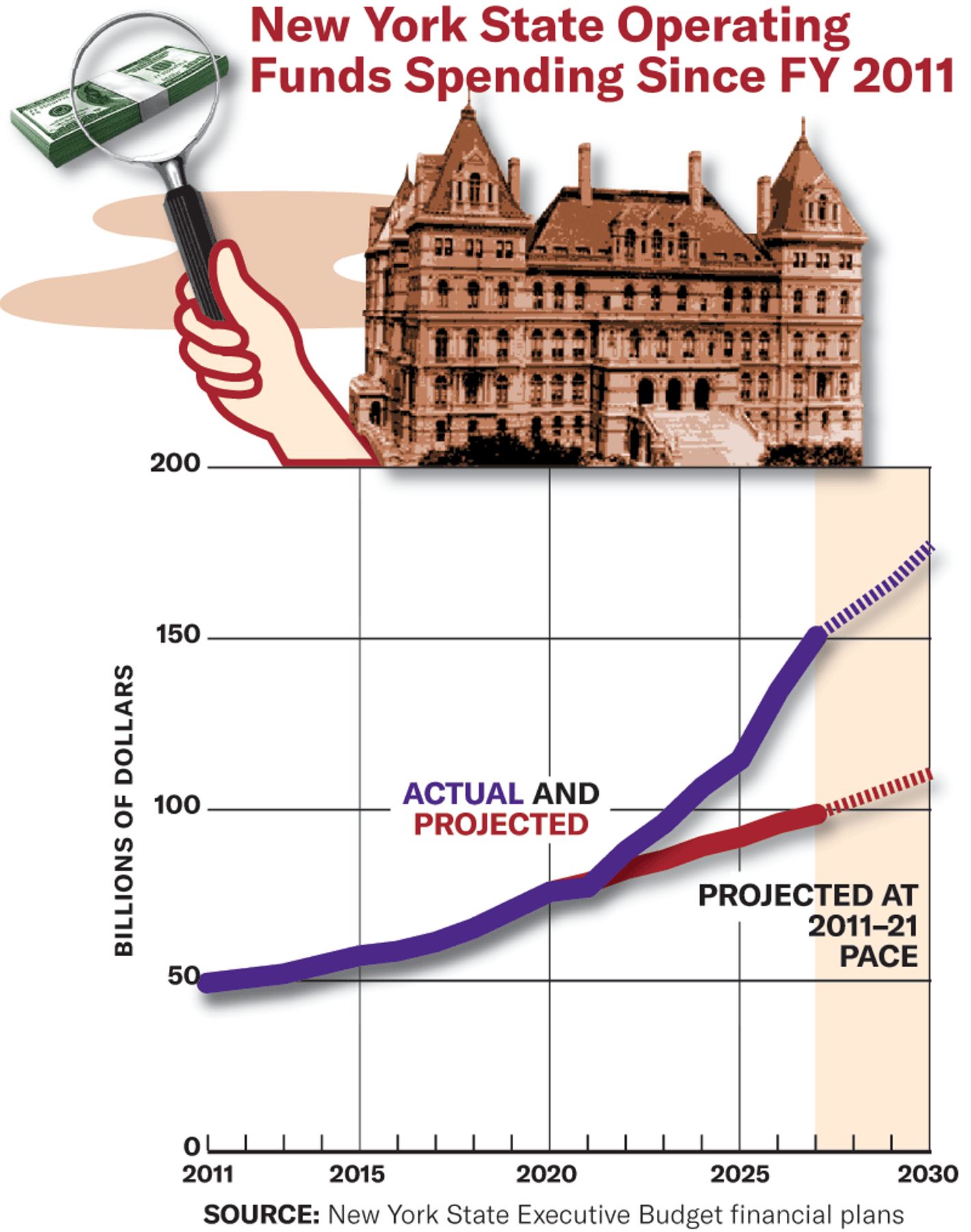
Adjusted for bookkeeping gimmicks, Hochul’s initial financial plan projected a hike of at least 8 percent in the state-funded portion of the operating budget—more than double her administration’s inflation forecast, and high even by New York standards. Including her latest budget, Hochul has increased the state operating budget (excluding federal aid and debt proceeds) by at least $46 billion, or 40 percent, over her five fiscal years as governor. In real terms, that marks the largest five-year increase since the late 1980s. Spending had surged far above the trend-line during the ten years before Hochul took office (see chart on page 60).
Six years after the disruption of the Covid-19 pandemic, New York’s budget has entered uncharted fiscal territory: larger than ever, structurally unbalanced, and growing at an unsustainable pace, yet temporarily flush with more surplus cash than Albany has ever seen. How the state arrived here adds a fresh twist to a jagged long-term trajectory best captured by the motto beneath the state seal: Excelsior—“Ever Upward.”
New York State has been synonymous with fiscal excess since the era of Nelson Rockefeller, who was elected in 1958 and served a record 15 years as governor. Rockefeller’s tenure coincided with a broader expansion of spending at every level of government. Even by those standards, however, he made New York an outlier—quadrupling the state budget and quintupling its debt, creating the nation’s most expansive Medicaid program, authorizing public-sector collective bargaining, and vastly enlarging the state university system. When Rockefeller took office, state and local taxes as a share of New Yorkers’ personal income sat slightly below the national average. By the time he left office, they were well above it.
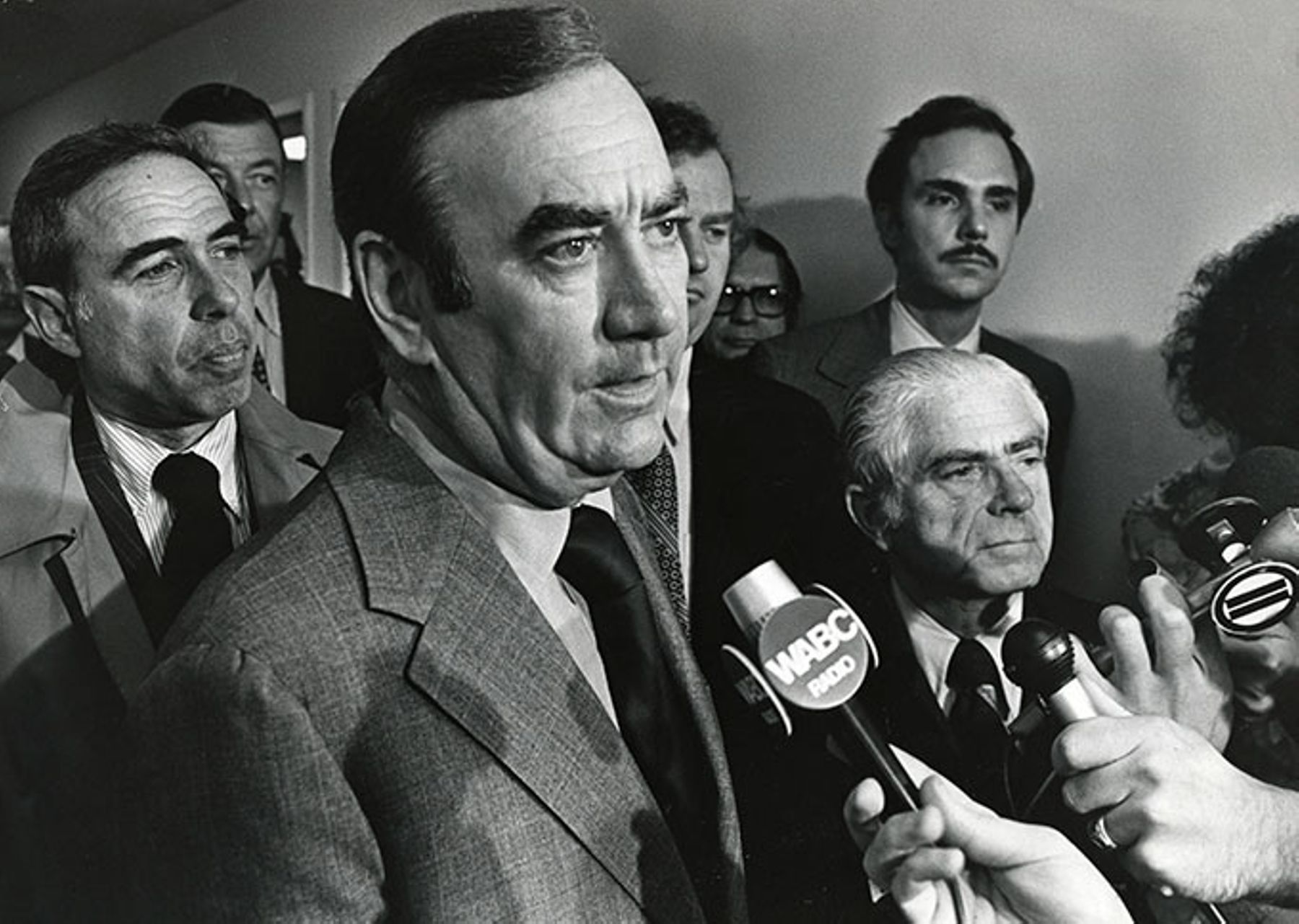
Over the past half century, New York’s state budgets have gone through periods of retrenchment and relapse. The first corrective came under Governor Hugh Carey, the Democrat who took office in 1975, just in time for a New York City fiscal crisis. Carey’s first State of the State address set the tone for what would follow. “Now the times of plenty, the days of wine and roses, are over,” he memorably announced. Carey not only held inflation-adjusted state spending virtually flat across his eight years in office but in his second term reduced Rockefeller’s sky-high income-tax rates by one-third.
Carey’s successor, Democrat Mario Cuomo, ushered in a new era of extravagance, enabled by the Wall Street boom of the 1980s and compounded by Cuomo’s annual struggle to reconcile the expansive but non-overlapping agendas of the legislature’s majorities—Democrats in the assembly and Republicans in the senate. For a time, prompted partly by a major federal tax reform, Cuomo and the legislature managed to keep slashing taxes, even as spending surged. But the severe New York regional recession of 1989 left Cuomo dealing, in his third term, with a fiscal hangover that ultimately contributed to his 1994 election defeat by George Pataki.
Pursuing his agenda of additional income-tax cuts that brought the top rate below 7 percent—less than half the Rockefeller-era peak—Pataki held spending nearly flat during his first term, loosened his belt during the second, and then fought (and mostly lost) veto fights with the legislature that yielded a new spending boom in his third.
Around this time, lawmakers made decisions that continue to shape state spending. The federal practice of matching most state Medicaid spending dollar-for-dollar (or more) proved too tempting for Albany, as Pataki and state lawmakers significantly expanded both the eligibility and scope of the state’s program.
Eliot Spitzer’s first budget as governor in 2007 raised state-funded spending by 8 percent, including the first year of a historic expansion of state aid to what soon became, and have remained, the nation’s highest-spending school districts. This profligacy left the budget once again at an elevated level, just in time for the market crash and Great Recession that followed.
Spitzer resigned in disgrace after just over a year in office, leaving David Paterson to grapple with collapsing state receipts as capital gains, a key element of the state’s top-heavy income-tax base, plunged about three-quarters in two years. Paterson made cuts and even layoffs—and also agreed to a supposedly temporary hike in taxes on high incomes—but the state was still drowning in red ink when he departed at the end of 2010.
Taking office on the heels of the Great Recession, Andrew Cuomo offered a necessary course correction. “We need radical reform, we need a new approach, we need a new perspective, and we need it now,” the younger Cuomo declared in his first State of the State speech in 2011. He froze state employee salaries, launched a cost-cutting “redesign” of Medicaid, successfully pushed for a cap on local property taxes, and slashed state aid to local schools by a record $1.3 billion in his first year.
Cuomo also set a target of 2 percent growth in state operating expenses. Even after adjusting for his bookkeeping gimmicks to reach that target, his first two terms produced New York’s most sustained period of fiscal restraint since the Carey years. By the end of the decade, however, Cuomo’s model was strained. Medicaid expenditures, in particular, had burst his earlier boundaries, a problem he dealt with by delaying $1.7 billion in payments from the end of one fiscal year into the start of another, adding to a growing gap in the program’s funding at the start of 2020.
Then came the pandemic, which for New York, as for most states and localities, began as a fiscal crisis and ended as a cash bonanza. The Empire State received billions from the federal government’s initial pandemic-aid package in March 2020, followed by a second round of aid later that year. Capping off this largesse was President Joe Biden’s American Rescue Plan Act of early 2021, handing Albany nearly $13 billion in additional unrestricted aid that would not be fully spent for another four years.
At the same time, after years of insisting that raising taxes on millionaires would be a mistake, Andrew Cuomo’s final budget targeted high earners with what became the state’s largest income-tax increase in 60 years (and its highest top rate in 40). Meantime, defying nearly every prediction, the stock market surged through the final three quarters of 2020 and kept climbing in 2021, pushing tax revenues far beyond Cuomo’s initially pessimistic projections.
Thanks to the pandemic-aid windfall and the enormous surge in tax revenues, the state’s general fund cash balance tripled in fiscal 2022 to more than $30 billion—and kept rising over the next three years until it was the equivalent of more than 50 percent of annual general fund spending. The surplus was so large that, at a time of rising interest rates, the state earned another $14 billion in short-term interest income over four years simply from idle cash balances.
But Andrew Cuomo would not be around to enjoy the gusher. In August 2021, four months into fiscal 2022, he resigned following a sexual harassment scandal and was succeeded by Lieutenant Governor Kathy Hochul.
Hochul’s emphasis on policy initiatives distracts from the ongoing rise in spending, now dominated more than ever by two programs: Medicaid, the joint state-federal health-care program for the poor and disabled; and state aid to local school districts.
Since 2022, New York’s share of Medicaid spending has soared 60 percent, adding $16 billion in annual costs to what is already the nation’s most expensive public-health safety net. As Bill Hammond of the Empire Center for Public Policy has chronicled, New York’s Medicaid program was spending $4,492 per resident as of 2024, 77 percent above the national average. “New York could have shed $18 billion from its program and still ranked No. 1,” Hammond notes. Hochul herself has called the spending “unsustainable,” yet her latest budget boosted the state share by another 10 percent, or $4.3 billion.
One of the biggest drivers of Medicaid spending growth over the past decade has been New York’s abuse-ridden Consumer Directed Personal Assistance Program. Lax state rules allowed new agencies to proliferate and advertise ways for people to get paid for caring for family members. Costs ballooned 13-fold between 2016 and 2023, with the annual burden on state and federal taxpayers reaching $11 billion. While moving to reduce the number of middlemen, Hochul has tacitly encouraged 1199SEIU to unionize the program’s purported 400,000 caregivers and extract dues from them involuntarily.
With public K–12 enrollment down from pre-pandemic levels, down still further from its 1999–2000 peak, and projected to keep falling because of declining birthrates and domestic outmigration, Hochul has also preserved—after a brief attempt to change it two years ago—the costly “save harmless” provisions of the state school-aid formula, which generally guarantee districts at least as much aid as they received the year before. This year’s budget provides a minimum 2 percent aid increase, even to districts with shrinking enrollments.
Another factor likely to drive state spending even higher might as well be a line item in Hochul’s budget: New York City’s new mayor, Zohran Mamdani.
The fiscal affairs of New York State and New York City have always been deeply intertwined. Though Gotham has a larger population, economy, and tax base than most states, it remains dependent on Albany in crucial respects. The city’s largest budget items—public education and social services—are shaped and partly financed by state aid. Except for the property tax, the city’s major local revenue sources are also ultimately controlled by the legislature and governor. State law governs the structure of the property tax itself.
Mamdani’s predecessors, Bill de Blasio and Eric Adams, were hardly parsimonious; their city budgets boosted spending more than 60 percent over 12 years. But fully realized, Mamdani’s Democratic Socialist agenda envisions a vast expansion of already-generous entitlements.
The main point of contention between the new mayor and Hochul has been taxes. Candidate Mamdani promised a 51 percent increase in city resident income taxes on millionaires and backed a significant hike in the state corporate tax, without explaining how the resulting revenue would flow to the city. Hochul opposed both proposals, though her posture was somewhat disingenuous. Just ahead of the mayoral primary, she extended Cuomo’s higher personal income-tax rate, originally set to expire in 2027, through 2032. She also extended the state’s corporate-tax surcharge.
Soon after taking office, Mamdani raised the stakes by declaring a “generational fiscal crisis” and threatening to seek a 9.5 percent increase in city property taxes if the state didn’t back his “tax the rich” agenda. The tactic backfired, annoying Hochul and igniting a hostile reaction from homeowners and city politicians alike. A month later, Mamdani endorsed Hochul for reelection, and in early May, the governor agreed to a series of measures widely mischaracterized as a $4 billion “bailout” of the city. In reality, the governor’s budget package consisted mainly of permission for the city to impose the pied-à-terre tax and to indulge in an egregious financial gimmick—effectively borrowing billions of dollars from its pension funds by pushing a portion of its required pension contributions off until the mid-2030s.
Albany’s appetite for spending is nothing new. But the “robust” economy that Hochul cited in this year’s opening budget message has lost momentum in the 2020s.
From the recession-ending year of 2010 through 2019, personal income growth in New York slightly lagged the national average but remained above the 50-state median. From 2019 through 2025, however, the state ranked dead last, with income growth of just 32 percent, far behind the national rate of 42 percent.
A broader measure of economic growth tells a similar story. From 2010 to 2019, New York’s GDP grew faster than the national average, ranking 15th among the states. But from 2019 through 2025, the Empire State fell below both the national average and the 50-state median in GDP growth. Part of that decline reflected the severity of the pandemic recession, but the recovery since 2022 has also been weak by national standards.
The 12-county downstate region—including New York City, Long Island, and five lower Hudson Valley counties—has long been the state’s economic engine, accounting for virtually all private-sector job growth during the 2010s. The 50 counties north of the mid-Hudson, the truer definition of “upstate,” spent the decade falling further behind, generating few new private-sector jobs. Since 2020, all of New York’s net job growth has come from the publicly subsidized health and social-assistance sector.
Andrew Cuomo, mindful that his father’s narrow 1994 defeat stemmed from losing the counties north of New York City by 26 points, became fixated on reviving upstate regional economies through billions of dollars in state-backed megaprojects. Those interventions—including a heavily subsidized Tesla solar-panel factory in Buffalo that became a billion-dollar boondoggle—produced little lasting benefit, largely because Cuomo was unwilling to confront the many Albany-imposed barriers that stifled organic growth in the first place.
Hochul has continued Cuomo’s practice of showering struggling upstate downtowns with tens of millions of dollars while placing another massive state bet, further boosted by federal CHIPS subsidies, on a Micron Technology plant near Syracuse that remains years away from operation. To slow the rise of New York’s already-high utility rates, which threaten both job creation and “affordability,” Hochul has supported modest delays in the timetable for meeting the state’s stringent carbon-emissions targets. But the state still faces, before the end of the decade, Albany’s planned suite of restrictions, bans, and taxes meant to crush fossil-fuel consumption. Beyond these limited adjustments, her replacement for Cuomo’s economic strategy amounts to little strategy at all.
With a gubernatorial election looming in November, a late-spring Siena poll showed Hochul’s favorability and approval ratings sinking to their lowest levels in a year, though her lead over Republican challenger Bruce Blakeman widened slightly. The incumbent still enjoys two major advantages: the Democratic Party’s overwhelming statewide enrollment edge; and President Donald Trump’s enduring unpopularity in the deep-blue Empire State.
Beyond routinely denouncing Hochul as “the worst governor in America,” Blakeman has hardly emerged as a forceful advocate for fiscal change. During a three-day strike by Long Island Rail Road workers in mid-May, he effectively sided with the union in criticizing Hochul. “When I’m Governor, labor will finally have an ally in the Governor’s mansion,” he wrote in an X post—not reassuring in a state where high taxes are driven in large measure by organized labor’s influence and demands.
Reducing New York’s tax burden would require substantial and sustained reforms to public education and Medicaid, both of which would mean confronting the state’s powerful public-sector unions, something that Hochul has shown little appetite for doing.
The state’s annual spending commitments already exceed projected recurring revenues, pointing to multibillion-dollar budget gaps beyond the current fiscal year. Looking ahead to a hoped-for second full term, the 67-year-old governor appears to be betting that tax revenues remain strong and the economy resilient enough to sustain another term spent sympathizing with voters over the state’s “affordability crisis.”
For now, New York is more dependent than ever on income taxes paid by multimillionaires and highly profitable businesses, the very taxpayers most likely to feel targeted by the agenda of Mamdani, whose views many state lawmakers share. To the extent that Hochul has a plan for confronting even a routine recession or bear market—both inevitable eventually—it seems to rest on the hope that roughly $15 billion in budget reserves, along with a similar amount of unrestricted cash still generating short-term interest income, will be sufficient to bridge the next fiscal downturn.
Two years ago, in her budget message, Hochul offered a rhetorical warning: “The truth is, we can’t spend like there’s no tomorrow, because tomorrow always comes.” Assuming that the governor is reelected, that’s a message she should heed—before it’s too late.