Like an American George Orwell, the writer Murray Kempton dipped his toe in Communism, and then, while remaining a man of the Left, became one of its most penetrating critics. For many years, Kempton wrote for what was then New York’s most liberal newspaper, the New York Post, and later for The New Republic, Newsday, and The New York Review of Books. A new collection of his reportage, Going Around, has been expertly edited by Andrew Holter.
Though he sometimes called himself a socialist, Kempton acknowledged that he was a liberal when explaining his support for Franklin Delano Roosevelt in 1936. He defended the New Deal’s ameliorative impact against Communists and other radical critics, who believed incremental reform only hindered the revolutionary cause. He supported FDR as a leader who confronted fascism at home and abroad. Kempton recognized that fascism and Nazism had created “a crisis in world democracy” that made “a clear-cut victory over the forces that make for reaction in America . . . of incalculable importance,” adding: “As one who calls himself a liberal, I couldn’t hope for anything else.” Yet Kempton was also a conservative in his love of church, tradition, honor, fidelity, virtue, and friendship. His conservatism, though, was a fundamentally left-leaning one, grounded in an abhorrence of greed, materialism, inequality, sectarianism, and arrogance.
Finally, a reason to check your email.
Sign up for our free newsletter today.
Kempton, who died at 79 in 1997, is not well known to modern readers. Yet his admirers included Joan Didion, Garry Wills, Elizabeth Hardwick, Christopher Hitchens, Geoffrey Ward, and William F. Buckley Jr., all of whom valued his blend of anti-dogmatism, wit, wisdom, erudition, and gift for character study. All this is on display in Holter’s collection.
There are two distinct strands of the American Left. The first is progressivism, an American utopian impulse that, despite all evidence, lacks a concept of evil and anticipates the end of history. The second roots for the little guy. Sentimental and sometimes short on good sense, this version of the Left is nonetheless grounded in the reality of suffering and oppression. Kempton belonged to this latter breed—a self-admitted sentimentalist with no illusions about human nature. Immune to progressivism, he had a gift for puncturing the bubble of abstraction and accepting human nature as it was, not as progressives wished it to be. A Christian steeped in the idea of original sin, he was a conservative not by conviction but by instinct; a portrait of Lord Acton hung above his desk.
Kempton loved Edmund Burke, Holter recounts elsewhere, not for Burke’s conservative philosophy but for what Kempton called “his eye for the specific . . . . I mean the Burke who knew that a government that cut off Marie Antoinette’s head was not going to turn out all right.” As Holter observes, “Getting the specific right was attainable—reporters help to do that—but what about the general?” Kempton was indifferent: “Who’s ever right in the general?”
He loved the Syracusan monasteries and decried their desecration by the anticlerical Kingdom of Italy: “This triumph over superstition was followed by one of those cataclysms for the life spirit that serve to teach even the most radical temperament that it cannot keep in touch with reality unless it keeps a few reactionary ideas firmly in place.”
Holter notes the centrality of Kempton’s sense of sin and the symbolic importance of his funeral, which strictly followed the Church of England’s Order for the Burial of the Dead. The name of the deceased was mentioned only once. No eulogies. No funny stories. No “celebration of life.” Holter quotes the rector of Saint Ignatius, where Kempton was a congregant and where the funeral took place: “The service is typically Anglican. . . . [T]he focus is on God and His mercy and His love, and not the American obsession with self and lionization of the individual.” Kempton was immune to false gods because he adhered to the one God.
Kempton did not call himself a journalist, let alone a commentator. He was a reporter. He got up in the morning, rode his bicycle to the newsroom, read the AP wire, and then got back onto his bicycle and went out to get the story. The bicycle enabled his obsession with observation: his destination was often too far to walk, but if he took a train, bus, or cab, he might miss something important along the way.
Sometimes his keen observation led him to revise preconceived judgments. His most famous article, “The Underestimation of Dwight D. Eisenhower,” grew out of just such a fact-based reinterpretation. Kempton did not much like presidents. He grudgingly approved of FDR. He had no kind words for Harry Truman. His least favorite appears to have been Bill Clinton: “The blitherings of his insincerities, the mouth that refused to close even when he shut up, the dubieties of his promises, the fraudulence of his hugs, even his grin—fell upon me all together with a force like an indecent assault’s.” But while Kempton may not have liked Eisenhower, close observation of—and conversation with—Ike forced him to depart from conventional liberal opinion and recognize the former general’s remarkable gifts of cunning, subterfuge, and impartiality.
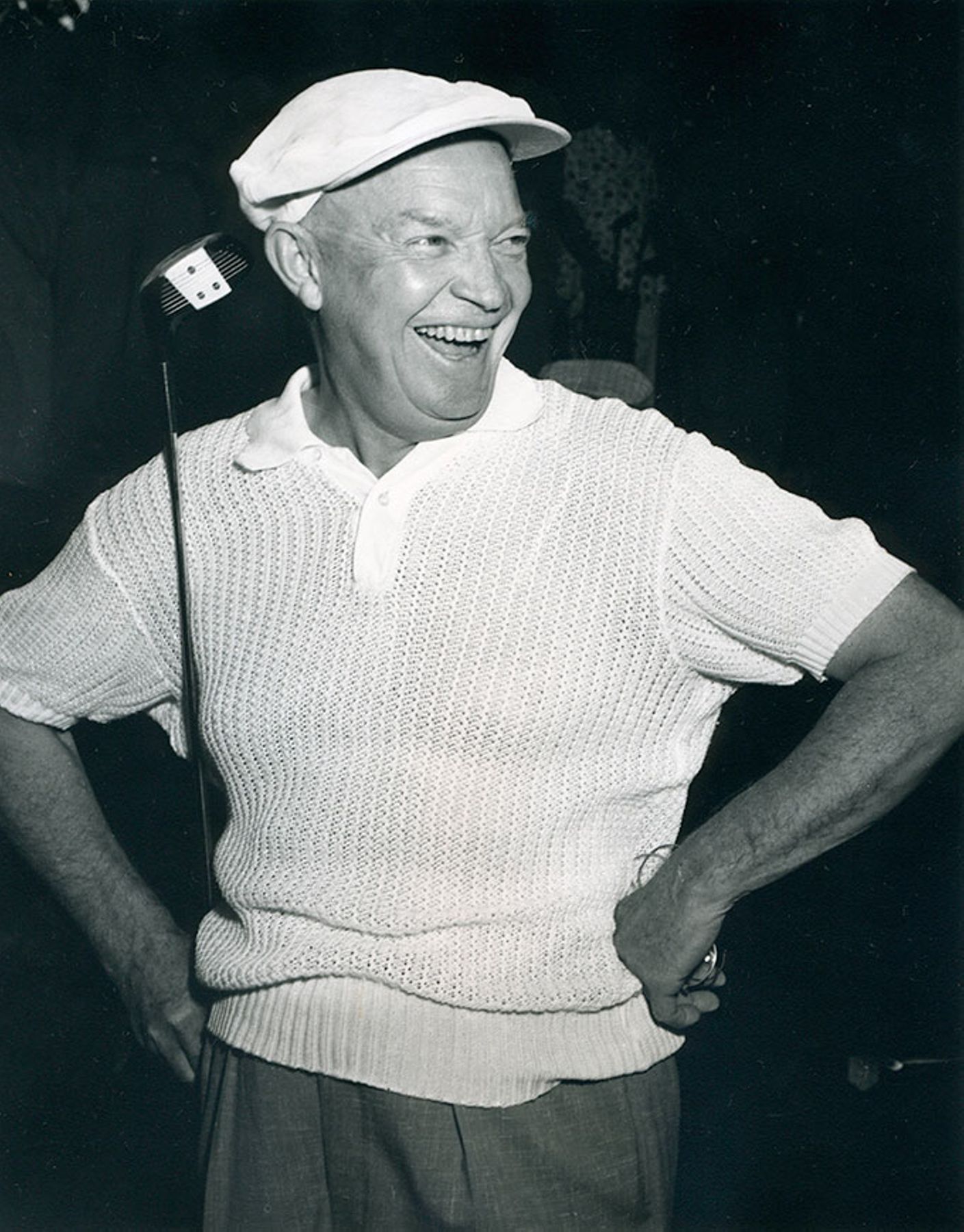
“Eisenhower, who understood everything, seems to have decided very early that life is nothing if it is not convenient; to show the living flesh of greatness to one’s contemporaries means to show one’s face in combat and to be argued about,” Kempton wrote. “The only convenient greatness is to appear as a monument.” Kempton quoted White House chief of staff Sherman Adams: “[Eisenhower] told Nixon and myself that he was well aware that somebody had to do hard-hitting infighting, and he had no objections to it as long as no one expected him to do it.”
Eisenhower enjoyed—indeed, benefited from—his reputation as a golf-addicted, amiable bumbler. When he fired his chief of staff, Sherman Adams, Adams blamed then–Vice President Nixon. When Eisenhower debated whether to replace Nixon as his running mate, Nixon blamed Thomas E. Dewey. Kempton did not regard Eisenhower as wholly immoral: “Being moderate in all things means, after all, being moderate in the expenditure of immorality.” Kempton may have disdained Machiavelli, but this judgment echoes Machiavelli’s defense of the economy of violence.
When the Formosa Straits incident—a 1954 skirmish between the People’s Republic of China and the Taiwanese regime that had recently ruled the mainland—was at peak tension, Press Secretary James Hagerty urged Eisenhower to avoid the topic at an upcoming press conference. “Don’t worry, Jim. . . . If that question comes up, I’ll just confuse them,” Eisenhower said. Press conferences, Kempton writes, were Eisenhower’s “highest achievements as craftsman in masks.” Kempton considered Ike to be the president “most superbly equipped for truly consequential decision we may ever have had, a mind neither rash nor hesitant, free of the slightest concern for how things might look, indifferent to any sentiment, as calm when he was demonstrating the wisdom of leaving a bad situation alone as when he was moving to meet it on those occasions when he absolutely had to.” I do not know of a better description of the art of statesmanship.
Kempton’s writing radiates acerbic wit, incisive character depiction, consummate irony, and striking juxtapositions. He referred to his essays about the 1930s, collected in Part of Our Time: Some Ruins and Monuments of the Thirties, as novellas. Educated at Johns Hopkins, he freely laced his work with references to poets, philosophers, and figures from the past. Some critics found those allusions excessively arcane or out of place. Tom Wolfe complained that Kempton’s prose contained “so many elegant British double and triple negatives, half the time you couldn’t figure out what he was saying”—though Wolfe himself, Holter notes wryly, was “a pot with scarcely the right (to use a Kemptonian phrase) to call a kettle black on matters of elaborate syntax.”
Describing the audience at a revival meeting hosted by Reverend Billy Graham, Kempton noticed “a few old women whose faces reminded Baudelaire of old oranges.” He reported on a meeting of the Migrant Ministry of the National Council of Churches, at which Mrs. Norman Vincent Peale, wife of the famous apostle of The Power of Positive Thinking, served as toastmaster. “I can see,” said Mrs. Peale, “that you have all told your faces that you are a happy group.” “Read your husband’s book,” Kempton observed. “That’s more than you can say for Mrs. Spinoza.” Arcane? Yes. Mrs. Peale, and most of Kempton’s New York Post readers, had probably never heard of the great philosopher. Inappropriate? Hardly. Some readers surely had read Spinoza and would have been moved—and amused—by the juxtaposition of Peale, the promoter of happiness, and Spinoza, who, to put it mildly, was no happiness buff. Others, unfamiliar with the philosopher, might have been intrigued enough to look him up. Kempton feared an egalitarianism that pulled the best downward; he hoped for an egalitarianism of uplift.
Kempton’s writing about Communism was scathing and incisive. He admired Marx’s chronicles of events for their empirical grounding and observational acuity. His favorite was The Eighteenth Brumaire. “If The Eighteenth Brumaire remains on a plane above even the best of this work,” Kempton wrote, “the difference, along with its higher passion, must be his direct experience with its events; he was acquainted with some of its personages and had at least seen many of the others.”
He had no time, however, for Marx the philosopher or political economist, and he recognized that Marxists were deluded. Marxism was a myth, and not an edifying one. Kempton’s lifelong distrust of abstractions grew out of the foolishness of Marxist abstractions about “the people,” labor, youth, and history. Worst of all, Kempton understood, Marxism was a myth parading as science:
Marx had said that history, by its own iron and necessary laws progresses towards the breaking of nations and the destruction of the rich and mighty. The triumph of the wage earner, the most abject victims of society’s injustice, was to Marx a matter of inevitability. . . . [M]an’s course is dictated by chance and heart far more often than Marx’s laws of historic necessity would seem to allow. . . . [N]o law of history has been able to dispose of the pilgrim soul of man.
Kempton was particularly dismissive of Communist literature. “Yeats said once that out of the quarrel with others we make rhetoric and out of the quarrel with ourselves we make poetry,” he wrote. “The subjects of this chapter [American Communist writers], the buried ones at least, had a different view; they believed that to be a great writer one need simply be on the side of the future.”
Part of Our Time does not exonerate the Communists who dominate the book. “My subjects who became communists were terribly flawed by their acceptance of a gospel that had no room for doubt or pity or mercy,” Kempton writes. Yet he seeks to understand why they found the Communist myth so compelling and why and how they trod the different paths that led them to this obsession. “To understand the thirties it is, of course necessary to understand what the thirties themselves would have called their social forces. But it is far more important to try to understand the people who lived in that long-gone time.”
The most poignant of Kempton’s “novellas” is the one about Alger Hiss and Whittaker Chambers, especially Hiss. Kempton identified with him: both were Episcopalians from Baltimore, raised in similar “shabby genteel” circumstances, and both wound up at Johns Hopkins.
“The world of shabby gentility is like no other,” Kempton wrote. “Its sacrifices have less logic; its standards are harsher; its relation to reality is dimmer than comfortable property or plain poverty can understand.” Kempton’s mother became a widow early and went to work at Hutzler’s Department Store—something mothers in his neighborhood did not do. “She had acquired the pride of a function and I the unforgivable shame of her being reduced to the need to have one.”
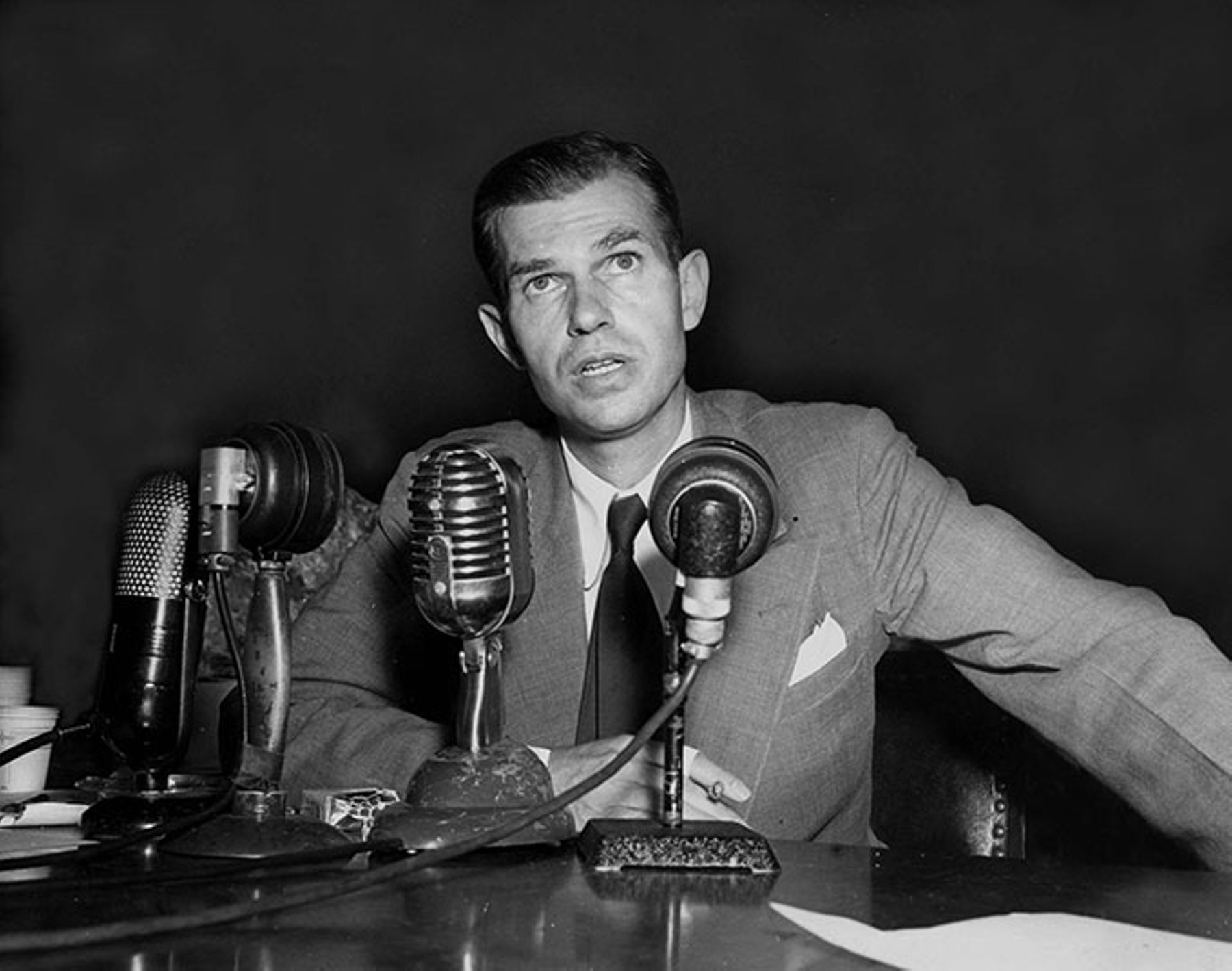
He recognized that both he and Hiss were better off being shabby genteel than merely shabby. Still, the effort to maintain gentility without quite having the means or social background was anxiety-producing. In a family like the Hisses’, Kempton observed, “it was better to be a boy than a girl, if only because Baltimore needed more boys than girls at debutante parties.” Hiss grew up in the epicenter of shabby genteel Baltimore, Lanvale Street:
The threat of an alien scent against which no window is proof is inherent in the shabby-genteel tradition. . . . Lanvale Street was in Baltimore’s Fourth Assembly District; in one depression Democratic primary, its residents were confronted with a ballot bulging with Jewish names. In desperation they voted for an alternative candidate whose name was unfamiliar but indubitably old Virginia. They awoke to find they had helped nominate a Negro.
Alger Hiss was a success by every conventional measure. After Johns Hopkins, he attended Harvard Law School, where he became a protégé of Felix Frankfurter, who then secured him a clerkship with Justice Oliver Wendell Holmes Jr. Hiss built a distinguished career at the State Department, rising to director of the Office of Special Political Affairs, and eventually became president of the Carnegie Endowment for International Peace. Yet, as Kempton points out, he ultimately disappointed Frankfurter, who came to see him as merely a conventional success, someone who had failed to fulfill the brilliant potential that he had shown as a law student, perhaps because his creative energy had been spent on being a Communist spy.
Why would a man who had escaped shabby gentility turn against the country that had rewarded him so handsomely? Some blamed Hiss’s wife: when a visiting friend complained of freezing all day, “her reply was a suggestion that he think of the Okies.” But most husbands married to puritanical wives do not become Communist spies. Kempton instead points to Hiss’s shabby-genteel childhood: “A product of that childhood would have felt a certain comfort in the party-dictated procedure which allowed him at once to be a private Communist and an entirely respectable public man.” Hiss clung to respectability while privately rebelling against it. Most shabby genteels do not rebel, but Hiss carried an overpowering sense of sin—the very thing, Kempton says, that someone of his background could least afford.
Kempton abhorred Communism, but he prized the Christian virtue of forgiveness so highly that he also abhorred the excessive persecution of sinners. Thus, a large portion of his book on the 1950s, America Comes of Middle Age, is devoted to the excesses of anti-Communism embodied by Joseph McCarthy. Many of those interrogated and persecuted were indeed Communist dupes. But who among us has not been taken in by some destructive passion or myth?
Unlike many on the left who turned Hiss into a martyr, Kempton knew that Hiss was guilty. Yet those hauled before the McCarthy Subcommittee or the House Un-American Activities Committee, or blacklisted by Hollywood, were not all spies or traitors. Their greatest fault was self-deception, worthy of our contempt, perhaps, but not of congressional inquisition.
Some of them, including Lillian Hellman, Langston Hughes, Dashiell Hammett, Dorothy Parker, and Granville Hicks, signed the infamous 1938 artists’ and writers’ letter in New Masses, defending the Moscow purge trials and damning their critics. I find Kempton too forgiving of this act—but then, I am not a Christian.
A crucial part of Kempton’s conservatism was, as Geoffrey Ward has noted, his admiration for nobility. His nobles made for strange bedfellows. Some were clearly worthy: Phil Murray, successor to John L. Lewis as head of the Congress for Industrial Organizations, whom Kempton called “the finest man I have ever known”; and A. Philip Randolph, godfather of the civil rights movement. But Kempton also found nobility in figures whom others viewed far less favorably.
Consider his portrait of Tammany Hall leader Carmine DeSapio on the night in 1961 when he was defeated by the New York insurgent reformers whom James Q. Wilson dubbed the “Amateur Democrats.” As the child of Upper West Side reform Democrats, I was taught that DeSapio was the devil incarnate—a boss with a capital B, utterly corrupt and autocratic. Instead of cape and horns, he wore shiny suits and tinted glasses. Kempton taught me differently.
When DeSapio realized that he had lost, he showed no bitterness toward the victor. Addressing those still lingering at election headquarters, he said, “I can’t tell you how grateful I am. We’re not going to close the club. Things will adjust as we go along. That’s the democratic form of government. Nobody likes to lose, but everybody can’t win.” Kempton, however, had few illusions about the self-appointed reformers who had toppled Tammany. He wrote of how, that night, he
walked into the streets and noticed that there were no slums any more, and no landlords, and the Age of Pericles had begun because we were rid of Carmine DeSapio. One had to walk carefully to avoid being stabbed by the lilies bursting in the pavements. I wish the reformers luck—with less Christian sincerity than Carmine DeSapio does. I will be a long time forgiving them this one.
Kempton cut his teeth as a labor reporter, and the labor movement remained near and dear, even as it broke his heart. At first, he saw the movement as “the instrument of providence.” Walter Reuther, he believed, would “build Jerusalem in Highland Park,” triumphing over General Motors, which sought to crush the union, and the Communist Party, which sought to subvert it. He soon learned that the New Jerusalem would never rise in Detroit’s green and pleasant land. Its failure to fulfill his utopian dream was rooted in its very success. Autoworkers were not striving for utopia. They were reveling in the bourgeois life—pensions, medical coverage, single-family homes, and one- or even two-car garages. As with his view of the New Deal, Kempton accepted this disenchantment and remained a friend of labor as it lifted blue-collar workers into the middle class. And just as he disdained Communists and fat cats, he loathed the venal, corrupt labor leaders who betrayed the rank and file.
In the 1950s, before it was fashionable to do so, Kempton went south to report on the evils of segregation. The bravery of those who fought resonated with his love of nobility. His accounts of their struggles are among his most sentimental writings. In 1956, he wrote about Autherine Lucy, the first black person to attend the University of Alabama, and of the courage and grace she showed as students rioted to get her removed—and about the white Alabama student body president, Dennis Holt, who, amid the riots, introduced a resolution in favor of Lucy, which then passed with only one dissenting vote. Kempton wrote of Lucy: “This side of God, every observer can only wonder at the resources of the human spirit.”
Kempton’s gravest error was to go easy on those who betrayed the cause he cherished—Huey Newton, Bobby Seale, Jesse Jackson, Angela Davis—figures as destructive, in their way, as the corrupt labor bosses he denounced so scornfully. The Briar Patch, his book about the trial of a Black Panther, contains subtle character studies and sharp critiques of the criminal-justice system. But neither there nor in his other portraits of black radicals does he acknowledge the lasting harm that the Panthers and their ilk did to the cause of racial justice.
Civil rights champions from Frederick Douglass to A. Philip Randolph and Martin Luther King understood that their greatest weapon was the moral high ground. I grew up watching live television coverage of the brave black teenagers entering Little Rock’s Central High School under a hail of epithets and missiles; of peaceful Birmingham demonstrators shocked by Bull Connor’s cattle prods; of stoic black college students punched and bloodied as they sat in at whites-only lunch counters. These acts did infinitely more for racial justice than the Black Panthers who stormed the California State Capitol with M-1 rifles and shotguns.
I found no writing by Kempton condemning the 1969 torture and murder of suspected FBI informant Alex Rackley in New Haven by four Black Panthers. Consider, too, Kempton’s obituary for Huey Newton, the Panthers’ cofounder. Newton was a convicted felon who fled to Cuba rather than face charges of murdering a 17-year-old prostitute and pistol-whipping his tailor. A jury had earlier convicted him of voluntary manslaughter for killing a police officer in a gunfight—an offense defined as a killing committed in the heat of passion and without malice. Kempton accepted the jury’s verdict, but his sympathy lay with Newton, not the slain officer: “[Newton] would be the symbol in whose name more Black Panthers were killed than ever killed; and, all through those terrible years, there abided unresolved the incompatibility of his image: Huey Newton was at one and the same time the baddest and the goodest—so bad he killed the cop and yet so good that he could not have killed the cop.”
Kempton’s conception of malice here is deeply unsatisfying, and his Christian charity could sometimes verge on excess. All the more reason, then, to relish the moments when he summoned a righteous Christian wrath.
Top Photo: Kempton was a conservative in his love for church, tradition, honor, and fidelity. (The Syndicate/Alamy Stock Photo)