
In the Declaration of Independence, debated and approved at Philadelphia’s Independence Hall, the Founders took aim at King George III. Yet at the President’s House Site exhibit across the street, open since 2010, the National Park Service trained its sharpest criticism on George Washington. This striking juxtaposition, casting the Revolution’s chief hero as a villain within Independence National Historical Park, suggests that something has gone seriously awry in the telling of America’s story.
Fortunately, the President’s House Site exhibit is being redesigned with new interpretive signage. Revealed publicly here for the first time, the new NPS panels mark a significant improvement over the old ones and will be installed once the Department of the Interior receives approval from the federal courts.
Finally, a reason to check your email.
Sign up for our free newsletter today.
When the NPS took down the old signs at the President’s House Site in January, the City of Philadelphia sued the Department of the Interior. Federal District Court Judge Cynthia Rufe called the signs’ removal Orwellian and ordered their reinstallation. On appeal, and after some signs had gone back up, her order was stayed by Circuit Court Judge Thomas Hardiman. He ordered the site to remain static—no other signs were to be re-hung, none were to be taken back down, and no replacement signs were to be installed—pending expedited review by a three-judge panel of the Third Circuit Court.
The mainstream press has portrayed the Trump administration’s efforts to improve this deeply flawed exhibit as an assault on historical truth. Last month, CBS Sunday Morning ran an interview with Alan Spears, the “resident historian” of the National Parks Conservation Association, which calls itself “the voice of America’s national parks.” Spears claimed that the prior exhibit was “too much for some people to bear” because it represented “the complex, nuanced nature of our history.”
“Some of the history might make people who are visiting these sites think critically,” Spears said. “And I think that’s the concern from people” who “just want a really sterilized experience. . . . Sterilized, whitewashed, controlled, censored—all those words apply.” As for those who “don’t want to . . . think critically” at national parks, advises Spears, “Knock yourself out at Six Flags. But don’t ruin it for the rest of us.”
CBS Sunday Morning also interviewed Charles Sams, NPS director under President Joe Biden, who charged the Trump administration with “taking us back to a past that didn’t really exist.” Pennsylvania Governor Josh Shapiro earlier asserted that the administration “will take any opportunity to rewrite . . . history” and avoid telling “the full story of where we came from.”
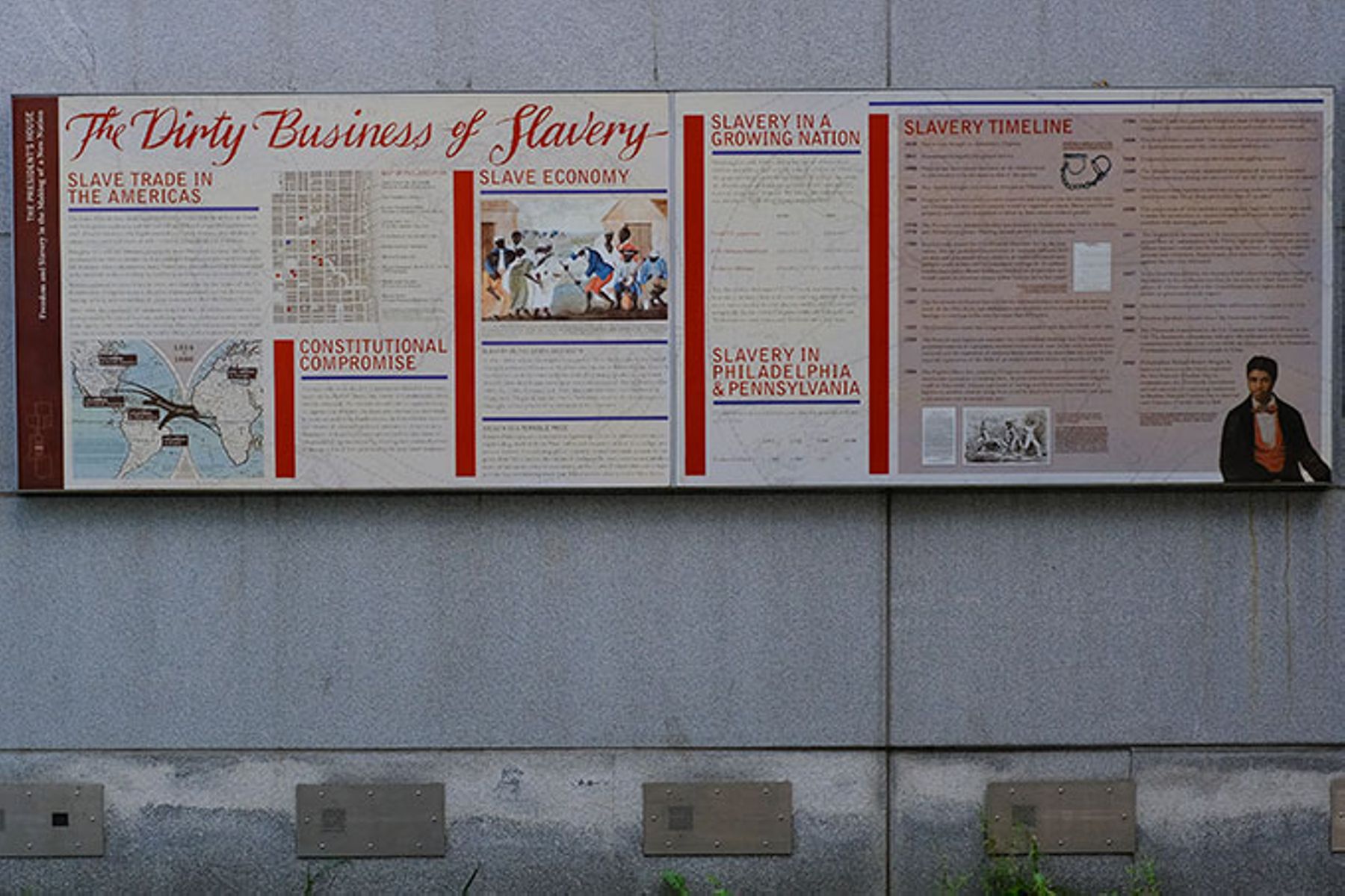
Shapiro, Sams, and Spears have this backward. Leftist activists hijacked the design and construction of the President’s House Site to advance an oppressor-versus-oppressed narrative. The exhibit’s signage largely ignored the momentous events of the nation’s first two presidencies, treated slavery in a reductive way that erased its historical complexity, and pushed a woke agenda casting many Founders as tyrants—George Washington chief among them.
As I initially reported for a Claremont Review of Books essay, though the site was of great historical importance for various reasons, the NPS devoted 25 of its 30 signs to slavery or race relations. The rationale was that Washington had brought a small number of enslaved people from Mount Vernon to Philadelphia. The signage described his actions as “deplorable” and “profoundly disturbing,” claimed they “mocked the nation’s pretense to be a beacon of liberty,” and accused Washington and other Founders of “injustice” and “immorality.” Headings included “Washington’s Deceit” and “Washington’s Death and a Renewed Hope for Freedom.”
As for the exhibit’s treatment of slavery itself, its “Slavery Timeline” failed even to note the Civil War (though it did acknowledge Juneteenth). Its interpretive signage claimed that “[e]nslaved labor played a dominant . . . role in the nation’s economy” and that slaves “built . . . the nation.” The site essentially ignored Washington’s, and other Founders’, disdain for slavery and their successes and struggles in moving toward eradicating it.
Worse still, the signage largely pinned the blame for slavery—long practiced across many societies and inherited in the colonies from the British—on the men who led the American Revolution, especially on the one who did the most to secure the Revolution’s success. The overarching message was that the Founders were hypocrites not worth celebrating.
The new signs stand in marked contrast to this simplistic presentation. They are more informative, address the site’s broader history, and offer the complexity that Shapiro, Sams, and Spears claim to want. They aim to teach rather than condemn, to illuminate rather than lecture, and to educate Americans about a key historical site rather than use it to advance a woke agenda.
The previous exhibit had almost nothing to say about the Constitution and slavery beyond portraying our charter of government, vaguely, as a pro-slavery document. It noted that “the Constitution did not act against slavery” and that “Northern delegates . . . compromised on congressional representation by allowing each enslaved person to be counted as 3/5 of an individual for population purposes”—implying that enslaved people should have been fully counted.
The new signage notes that “slave-holding delegates wanted enslaved people counted as whole persons to increase their political power.” In other words, the injustice of the three-fifths compromise was not that enslaved people weren’t counted fully, but that they were counted at all, thereby inflating Southern representation in the House. The sign also observes: “At the insistence of the Carolinas and Georgia, and over the objections of Virginia, the Constitution prevented Congress from banning the importation of slaves until 1808.” The previous signage had simply claimed that “slaveholders” pushed for this provision, ignoring that Virginia—whose delegation included Washington and James Madison—opposed it.
The sign then quotes from Abraham Lincoln’s 1858 Chicago speech: “Lincoln declared that most Americans viewed slavery as ‘a vast moral evil’ and ‘have rested in the belief that slavery was in course of ultimate extinction.’ He noted that this ‘was the belief of the framers of the Constitution itself.” The sign observes that it “took Lincoln and a bloody Civil War to finish the work that the Founders had begun and end slavery in the United States once and for all.” It also quotes Frederick Douglass: “I hold that the Federal government was never, in its essence, anything but an antislavery government.”
A sign entitled “Fighting for Freedom” talks about Harriet Tubman and the Underground Railroad, Frederick Douglass and his belief in the “saving principles” of the Declaration, and the political rise of Lincoln and the newly formed Republican Party “in response to the passing of the Kansas-Nebraska Act and the Supreme Court’s decision in Dred Scott v. Sandford, which promoted the growth of slavery in the territories and denied citizenship rights to African Americans.” It concludes by quoting in its entirety the Thirteenth Amendment, which abolished slavery after the Civil War.
Perhaps the best thing about the new signs is that they seek to understand, rather than to slander, George Washington. A sign entitled “Presidents Washington and Adams on Slavery,” for example, lets visitors actually learn how Washington wrestled with the troubling issue that he and the other Founders had inherited. It observes that Washington “often expressed discomfort with the institution and a desire to see it abolished,” yet “as a Virginia plantation owner, his wealth and livelihood were deeply tied to it.” It continues: “In 1774, Washington helped draft the Fairfax Resolves at Mount Vernon. These condemned the slave trade as ‘wicked,’ ‘cruel,’ and ‘unnatural’ and called for putting ‘an entire Stop’ to it.”
The panel also quotes Washington’s 1786 letter to Robert Morris: “There is not a man living who wishes more sincerely than I do, to see a plan adopted for the abolition of it [slavery] . . . but there is only one proper and effectual mode . . . & that is by Legislative authority.” It concludes that, while Washington placed national unity above immediate abolition, he hoped for gradual legislation to end slavery—and notes that he explored selling or leasing land to finance emancipation.
Finally, the sign details the following:
In his last will, Washington freed his personal enslaved workers and made provisions that the elderly and sick be supported by his estate for the rest of their lives. He also insisted that formerly enslaved children be taught to read and write, and work a useful trade. . . . Among all of the Founders, Washington carried out the largest manumission of enslaved people. In death, George Washington committed his most public and personal anti-slavery act.
Biographer Ron Chernow calls Washington’s example in freeing his slaves “glorious.”
As these examples make clear, no one can reasonably claim that the new, aesthetically appealing signs avoid the issue of slavery. Out of deference, presumably, to the Park Service’s original agreement with Philadelphia—to honor the enslaved people who lived and worked there—the redesigned site will continue to focus heavily on slavery, but in a far more informative way. The names of the nine enslaved people who lived there will remain carved into the walls, and information about their lives will still appear on the signage. But visitors will no longer experience the whiplash of reading the old panels’ incessant condemnations of Washington and then turning to see that, among all Americans, he alone is honored with a statue on the north side of Independence Hall.
Additional new signs cover the history of the home before Philadelphia temporarily became the nation’s capital, and the city’s central role in commemorating America’s 100th, 150th, and 200th anniversaries. In 1876, President Ulysses S. Grant gave remarks in Philadelphia, and France sent the hand and torch of the then-in-progress Statue of Liberty to the city. In 1926, President Calvin Coolidge spoke, and a four-story replica of the Liberty Bell was “lined with 26,000 lightbulbs” and “lit up the night sky.” In 1976, President Gerald Ford said that America was “still going strong at 200,” and between 14 million and 20 million people, including Queen Elizabeth II, visited the city where so many of the crucial events of America’s founding took place.
This year, we celebrate America’s 250th birthday. Of all the actions that will mark this momentous anniversary of American independence, redesigning the prominently situated, heavily visited, historically significant President’s House Site at Independence Park is one of the most important. How a country tells its story matters: a nation that denigrates its past and its heroes, rather than recognizing what it owes them, weakens its prospects for the future—especially when those heroes include a founding generation that ranks among the finest political leaders in history.