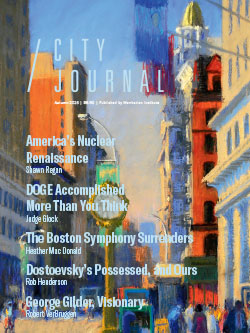
After decades of decline, nuclear power is poised for a major comeback, says Shawn Regan in “America’s Nuclear Renaissance.” An economy embracing artificial intelligence demands ever more electricity, and nuclear energy may be able to provide much of it, thanks to sweeping deregulation and a surge of private investment funding advances in reactor technology and modular design. Mothballed plants are being restarted, while tech giants, including Microsoft, Google, and Amazon, are committing billions of dollars to securing reliable, round-the-clock power. New reactor designs are also safer, Regan explains. As demand for dependable electricity grows, America may finally be learning how to build the supply to meet it.
At a time when technological change is again unsettling American life, Robert VerBruggen revisits the work of a thinker who has spent decades trying to understand the forces that drive innovation. In “The Gilderverse,” he profiles George Gilder, the visionary social theorist whose ideas have ranged across economics, technology, entrepreneurship, and the institutions that sustain human inventiveness. “I don’t think there’s a conflict between order and creativity,” Gilder tells VerBruggen—a conviction that runs from his early writing on family and social order through his analyses of computers, microchips, fiber-optic communications, and now AI. At 86, Gilder remains a prophet of the technological future.
Finally, a reason to check your email.
Sign up for our free newsletter today.
Elon Musk’s short-lived Department of Government Efficiency, launched by the Trump administration in early 2025, was often dismissed after falling short of its ambitious savings targets. But as Judge Glock shows in “DOGE Achieved More than You Think,” the initiative produced the fastest contraction of the federal civil service since World War II, reducing it by 12 percent. DOGE naysayers warned that the cuts would result in a massive breakdown in government services, but nothing like that happened—suggesting that Washington needed far fewer bureaucrats than many assumed.
If DOGE sought to shrink government, Chicago’s newly ascendant socialists have something else in mind. In “Second-City Socialism,” Aidan Grogan traces the rise of the six-member socialist caucus on Chicago’s 50-member city council, supported by a fellow traveler in leftist Mayor Brandon Johnson, with further gains on the horizon. Grogan sees Chicago as a test of what happens when America’s municipal Left gains real governing power.
In “Classical Music’s Misguided Quest for ‘Relevance,’” Heather Mac Donald reports on the Boston Symphony Orchestra’s recent firing of its celebrated music director, Andris Nelsons, after a clash over the institution’s direction. Nelsons remained committed to musical excellence and the classical tradition; BSO leaders increasingly sought “relevance” through identity politics and a trendy progressive cultural agenda. The episode shows how deeply progressive ideology remains embedded in America’s elite cultural institutions.
In “Dostoevsky’s Possessed, and Ours,” Rob Henderson surveys the politically motivated assassinations and attempted assassinations of the last several years and finds unsettling echoes in Dostoevsky’s great political novel, The Possessed. The 1872 book depicted young radicals consumed by nihilism and revolutionary phantasms—and the older liberal intellectuals who encouraged their rage without reckoning with where it might lead. Dostoevsky understood the dangers.
There’s much more in this issue, including Adam Lehodey on New York’s counterproductive land-use policies, Robert Almelor Delfeld on a GOP opportunity in Colorado, and two stories on misplaced priorities in health care: Christina Buttons describes how mental-health caregivers are focusing increasingly on those with mild disorders at the expense of the truly needy, while Ian Kingsbury chronicles how the persistence of DEI in general medicine works to the detriment of black patients above all.
—Brian C. Anderson