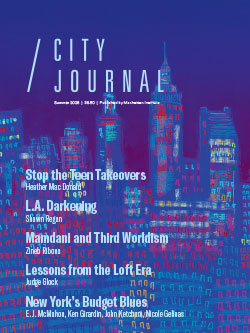
Organizing themselves via social media, swarms of youths, mostly black, have shut down streets, malls, beaches, and entertainment districts nationwide—assaulting bystanders, looting stores, and terrorizing residents. Many commentators dismiss these “teen takeovers” as the product of loneliness, Covid-era isolation, a lack of safe spaces, or limited opportunities, or blame those raising the alarm.
In “The Scourge of Teen Takeovers,” Heather Mac Donald argues that the phenomenon reflects the corrosion of institutions that once imposed discipline—families, schools, policing—combined with an elite culture reluctant to hold offenders accountable, especially when they are minorities. Drawing on extensive interviews with cops, prosecutors, and community leaders across the country, Mac Donald explains why jurisdictions that restore consequences for lawbreaking are more likely to regain control than those that reach for new government social programs.
Finally, a reason to check your email.
Sign up for our free newsletter today.
In “Saving Memphis,” Rafael A. Mangual shows what such a restoration of muscular law enforcement looks like in practice. Reporting from inside the Memphis Safe Task Force, he details how its coordinated federal, state, and local crackdown has produced dramatic reductions in violent crime, offering a replicable model for other troubled cities.
As New York Governor Kathy Hochul seeks reelection this November and New York City Mayor Zohran Mamdani pursues an ambitious expansion of government, Albany and city hall are edging toward a fiscal cliff. In three incisive essays, E. J. McMahon and Ken Girardin, Nicole Gelinas, and John Ketcham demonstrate that New York’s problems owe to decades of unchecked spending. The essays make clear why New York’s fiscal reckoning may arrive sooner than its leaders expect—and what it will take to avert it.
New York’s future is being shaped by more than fiscal policy. Anti-Israel activism has become central to the progressive movement, especially in the nation’s largest city. In “Mamdani’s Moral Universe,” Zineb Riboua argues that the mayor’s hostility toward Israel reflects a Third-Worldist ideology driving the American Left. Riboua traces it from the 1955 Bandung Conference and Frantz Fanon’s anticolonialism through postcolonial theory, campus anti-Zionism, and the Islamist-progressive alliance now roiling the Democratic Party.
Empty office towers remain one of post-pandemic America’s defining urban challenges. In “Lessons from the Loft Era,” Judge Glock looks back to the successful conversion of abandoned industrial lofts into thriving neighborhoods. Cities can adapt again, he maintains, if they remove the zoning and regulatory barriers that prevent markets from responding to changing demand.
Shawn Regan’s “Los Angeles Darkening” chronicles the self-inflicted struggles of an iconic American city. Despite its wealth and natural advantages, L.A. has neglected fundamental governance, leaving one in ten streetlights dark, roadways cratered with potholes, and thousands of people encamped on sidewalks and in parks.
Martin Gurri’s “QAnon vs. the Omnicause” explores the “constructed worlds” contorting our national debate. While conspiracism exists on both sides, Gurri argues that the Left’s variant is more dangerous because it enjoys institutional backing, letting once-fringe ideas gain mainstream acceptance. John Tierney’s “The Political Violence Double Standard” reinforces this point, showing how left-wing violence is minimized, while right-wing violence is exaggerated.
The issue covers much more, including the national property-tax revolt, the anti-bullying movement in schools, AI-driven fears of a “permanent underclass,” the need for a new urban vision, unions’ partial comeback, a wonderful British school, a prophetic Walker Percy novel, and other important matters.
—Brian C. Anderson