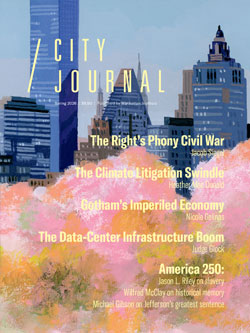
The right-wing “civil war” that has dominated headlines in Donald Trump’s second administration is largely artificial, argues Jacob Siegel in “The Phantom Base”—manufactured within a political environment shaped by digital platforms. Influencers and aligned elites, claiming to speak for MAGA, broke with Trump over his purported failure to come clean about the Epstein files and his support for Israel.
As Siegel shows, political leverage in the digital age increasingly comes from orchestrating online attention, often untethered from underlying public opinion. A small but active minority within the GOP—younger, permanently online, and ideologically volatile—helps drive recurring social-media swarms that pressure political actors to respond to the loudest online signals rather than voters’ signals. Republicans, Siegel warns, now risk repeating the Democrats’ recent errors: confusing the distorted digital reflection of public opinion with the public itself.
Finally, a reason to check your email.
Sign up for our free newsletter today.
A different form of political distortion influences the environmental movement. Progressive-led cities and states, unable to impose climate policy through legislation, have turned to the courts, charging major energy companies with causing local environmental harms and seeking vast damages. But as Heather Mac Donald shows in “The Climate Litigation Swindle,” these cases rest on implausible theories of causation, even as they bypass constitutional limits. At a deeper level, Mac Donald argues, the litigation reflects an attack on the achievements of Western science and rationality that have created modern prosperity.
Utah is undertaking a striking environmental experiment: saving the rapidly shrinking Great Salt Lake through voluntary, market-based water transfers instead of mandates. Shawn Regan explains how time, legal pressures, and deep-rooted constraints on water use may determine whether this effort becomes a model success or a costly failure.
With the nation’s 250th birthday looming, this issue features three reflections on the American project. For Wilfred McClay, the occasion should inspire gratitude for the Founders’ extraordinary achievements, without ignoring the darker chapters of our history; we must educate the next generation to sustain a shared national identity. Jason L. Riley contends that slavery was a global and long-standing institution, not uniquely central to America’s founding or prosperity, and that America’s true distinction lies not in slavery but in the ultimately successful movement to abolish it. And Michael Gibson celebrates the genius of the Declaration of Independence and the ongoing experiment in liberty it launched.
Nicole Gelinas continues her coverage of New York as it enters the Zohran Mamdani years with “Unresilient City,” a look at the city’s precarious economic condition. Without greater fiscal restraint and a renewed focus on economic growth—both unlikely under Mayor Mamdani’s far-left vision—the city risks discovering that its expanding welfare ambitions have outstripped its capacity to sustain them.
Two stories examine the intensifying debate over artificial intelligence. As tech-world enthusiasm for AI collides with growing political backlash—including efforts to block the energy-hungry data centers that power the technology—Sanjana Friedman says that the real divide is philosophical: whether a risk-averse society can continue to innovate. Judge Glock’s report from Loudoun County, Virginia, shows what is at stake, detailing the enormous economic gains from a data-center boom that the community, until recently, embraced.
Finally, among other important stories in this issue, Ed Latimore’s “The Red Pill’s False Promise” offers a timely rebuttal to an online subculture that claims to have all the answers for today’s troubled young males.
—Brian C. Anderson