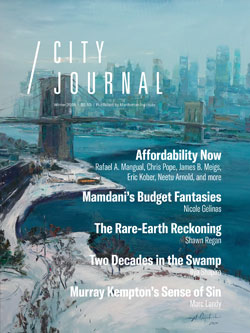
Few issues have loomed larger in American politics recently than affordability. Polling has consistently shown that inflation and the cost of living rank at or near the top of voters’ concerns—a reality that has reshaped electoral outcomes across the political spectrum. In 2024, Donald Trump won the White House for a second time by channeling frustration over prices, wages, and economic insecurity, particularly among voters who felt that the basic promises of middle-class life were slipping out of reach. And in New York City in 2025, Zohran Mamdani’s mayoral victory reflected widespread anxieties—especially among younger voters—about a city where housing, food, and other everyday necessities have become punishingly expensive. Mamdani’s socialist prescriptions—from a rent freeze to “free” bus service to city-run grocery stores—are deeply misguided, but the problem that his campaign sought to address is real.
This issue of City Journal confronts that problem directly with a comprehensive Affordability Agenda. A distinguished group of policy analysts and urbanists—including Chris Pope, Eric Kober, James B. Meigs, Judge Glock, and Neetu Arnold—examines why so many essential goods and services have become artificially scarce or needlessly expensive, and how they might be made affordable again. The essays address health care, housing, food, energy, higher education, sales taxes, and other core costs of modern life, advancing reforms that emphasize supply, competition, institutional discipline, and effective governance over price controls or ever-expanding subsidies. The package opens with Rafael A. Mangual’s “Nothing Costs Like Crime,” a bracing reminder that public safety is the precondition for any prosperous—and affordable—society.
Finally, a reason to check your email.
Sign up for our free newsletter today.
Mayor Mamdani’s to-do list is about to collide with the hard constraints of New York City’s budget, as Nicole Gelinas shows in a comprehensive analysis. Many of his marquee proposals, she notes, would require approval and funding from Albany. It’s far from clear that Governor Kathy Hochul will want to underwrite the new mayor’s most ambitious plans. Whether Mamdani responds by moderating his agenda or pursuing ideological confrontation will be one of the defining questions facing the city in the year ahead.
In “The Rare-Earth Reckoning,” Shawn Regan explores a largely hidden source of American vulnerability: the materials that power modern technology and national defense. Rare earths are fundamental to everything from smartphones and electric vehicles to missiles and fighter jets; yet the United States now depends overwhelmingly on China to supply and process these metals. Regan shows how regulatory paralysis and strategic neglect ceded control of these materials to Beijing. The essay asks whether America can rebuild its industrial capacity without drifting toward the same state-directed model that it seeks to counter—and offers a path toward doing so.
In “What Would the World Look Like Without Trump?” Martin Gurri argues that the president is less the cause of today’s upheavals than their most vivid expression. By mentally removing Trump from the frame, Gurri reveals a deeper transformation under way—not just in the United States but throughout the developed world: mass migration, institutional decay, populist revolt, and an information environment that has shattered elite control over truth itself. Gurri offers an incisive account of a world in which democracy has become perpetual conflict and the struggle over who defines reality may prove more decisive than any single election.
There is much more to consider in this issue, including Ilya Shapiro’s humorous and insightful memoir of two decades in the Washington swamp; Rob Henderson on meeting Charlie Kirk shortly before the conservative activist’s assassination; Heather Mac Donald on Trump’s truth-telling about crime; and Steven Malanga on state-level DOGE projects.
—Brian C. Anderson