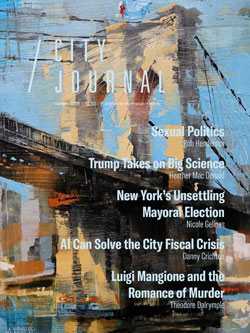
How did New York City wind up with a 33-year-old, anti-Israel, anti-cop socialist as the Democratic Party’s mayoral nominee in 2025? Nicole Gelinas’s “New York’s Unsettling Mayoral Race” dissects a strange primary in which far-left Assemblyman Zohran Mamdani defeated the heavily favored Andrew Cuomo, who was attempting a political comeback after resigning as governor in 2021 amid sexual harassment allegations. As Gelinas shows, Mamdani ran a savvy campaign promising free child care, free buses, frozen rents, and city-run grocery stores—funded, supposedly, by steep tax hikes on the wealthy. Cuomo pitched himself as a centrist focused on crime and competence, but his campaign never matched Mamdani’s energy or clarity. Now, with November approaching, Mamdani stands a real chance of becoming mayor. Can New York afford a leader whose ideas resemble Black Lives Matter’s more than Michael Bloomberg’s?
Heather Mac Donald’s “Trump Takes on Big Science” examines the administration’s controversial cuts to the National Science Foundation, long seen as a pillar of American research. Critics warn that the cuts will cripple U.S. science, but as Mac Donald details, the agency has strayed far from its core mission, channeling billions into politicized education programs and identity-driven social science. Mac Donald makes a persuasive case for restoring merit and scientific focus to federal research funding.
Finally, a reason to check your email.
Sign up for our free newsletter today.
Cities like New York should be preparing not to resist artificial intelligence but to harness it. In “AI Can Solve the Fiscal Crisis for Cities—If We Let It,” Danny Crichton argues that AI, used wisely, can streamline bureaucracies, upgrade essential services like education and policing, and help unlock a new era of urban prosperity. Crichton offers a practical road map for mayors and city leaders willing to embrace the future.
Neetu Arnold’s “The High Costs of Classroom Disorder” examines how Positive Behavioral Interventions and Supports (PBIS), widely promoted as a flexible, evidence-based discipline model, has instead driven classroom chaos and teacher burnout. In practice, PBIS often means sidelining punishment, undermining authority, and elevating equity metrics over order. Arnold explores PBIS’s ideological roots and weak research claims and describes the fallout: disorderly classrooms, demoralized teachers, and compromised learning.
Even as women have made historic gains in education and earnings, young men and women are growing farther apart, especially in their politics. In “Sexual Politics,” Rob Henderson traces this divergence to enduring biological and psychological differences between the sexes. Henderson offers a bracing account of one of the most consequential cultural shifts of our time—and a warning about what it means for the future of politics, family, and social cohesion.
In “Eat, Pray, Leave,” a second foray in this issue into social relations and the sexes, Kay Hymowitz examines a new literary subgenre: the midlife divorce memoir, in which professional-class women abandon marriage not in crisis but in pursuit of self-actualization. Framed as stories of empowerment, these narratives celebrate “radical self-love,” sexual reawakening, and domestic liberation. But beneath the glamour, Hymowitz notes, the new divorce story frequently omits children, overlooks class privilege, and disregards the essential social function that marriage has long served.
This issue is packed with lots more cutting-edge content, including Theodore Dalrymple on the alarming public celebration of accused killer Luigi Mangione, Christina Buttons on residential treatment for troubled youth, Ilan Wurman on district courts’ unprecedented attempts to block President Trump’s policies, Steven Malanga and Jordan McGillis on America’s new industrial economy, Judge Glock on the legacy of the Biden administration’s Bipartisan Infrastructure Law, and William Voegeli on the legacy of William F. Buckley.
—Brian C. Anderson