
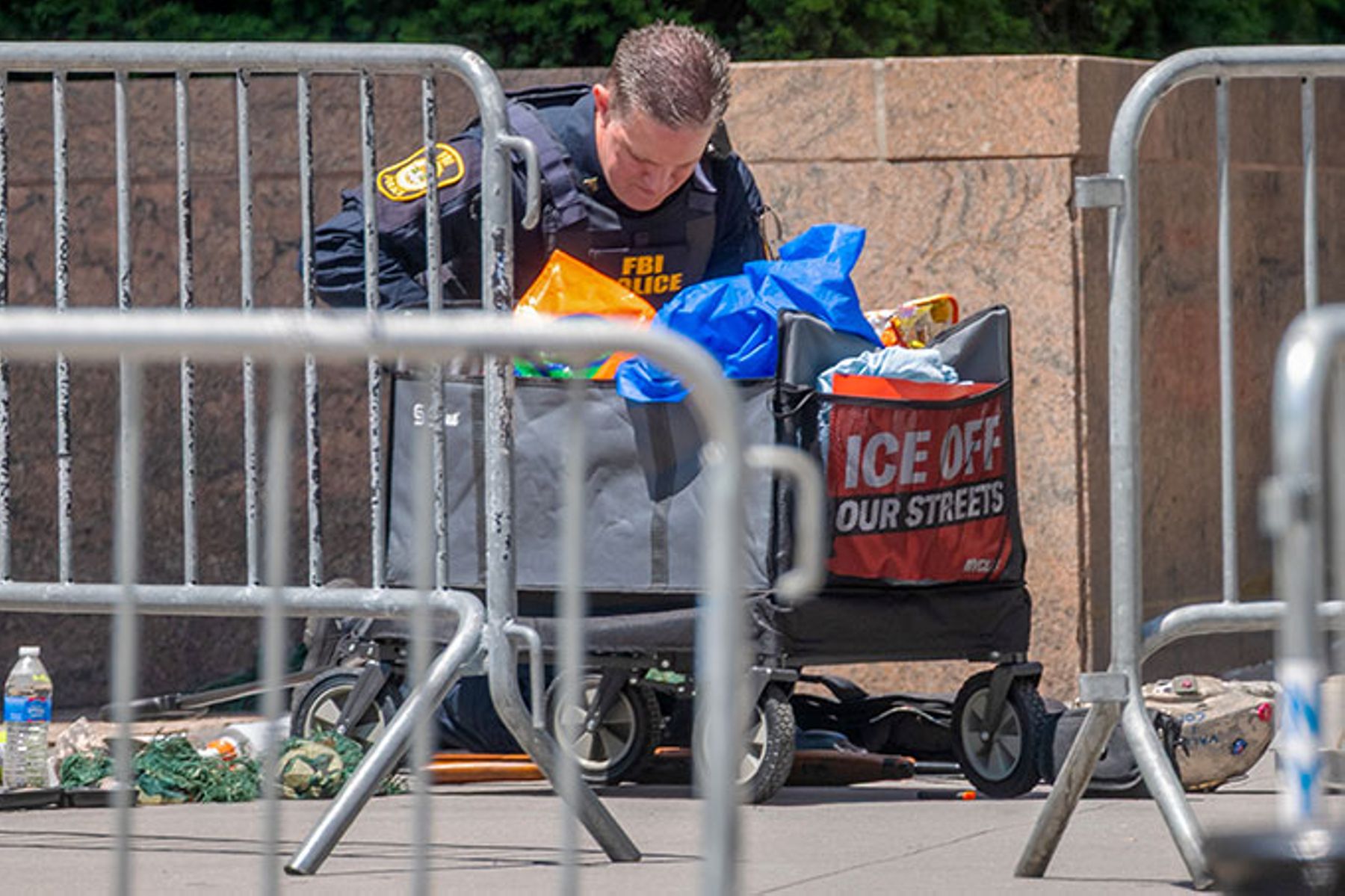
“ICE off our streets!” read the sign on a small wagon belonging to the man accused of firebombing 26 Federal Plaza in New York City yesterday, using what appeared to be a makeshift incendiary device consisting of gasoline and fireworks. He was also armed with numerous other weapons, including knives, a machete, and airsoft rifles, and has had prior encounters with federal authorities, officials said, without elaborating. While sole responsibility for the deed lies with the individual who carried it out, this latest act of anti-ICE terrorism is not shocking given the escalating rhetorical attacks against the immigration enforcement agency, including those coming from New York’s City Hall.
The broadsides from Mayor Zohran Mamdani began long before he took office early this year. On the campaign trail in 2025, the then-longshot-mayoral-candidate made news when he had to be held back by New York State Police as he screamed at federal immigration enforcement czar Tom Homan, whom he accused of “carry[ing] out the assault on working class New Yorkers.”
Finally, a reason to check your email.
Sign up for our free newsletter today.
Mamdani had repeatedly spoken about the immigration enforcement agency in a manner best reserved for genuinely oppressive government operations whose historical analogs might be found in East Germany, Mao’s China, or Stalin’s Russia. He referred to immigration arrests as “kidnappings” reflective of a boundless “cruelty.”
Last December, Mayor-elect Mamdani made news again with a viral video, during which he encouraged viewers to “stand up to ICE.” When the video—framed as an explainer of New Yorkers’ rights when dealing with federal authorities—came out, I warned that it seemed “calibrated to unleash more violence, more clashes, and more disorder.” It appeared just after a group of agitators had violently clashed with immigration enforcement authorities in downtown Manhattan. The timing of the video and the context in which it was presented, I wrote then, seemed to constitute “an endorsement of resistance to the enforcement of duly enacted federal immigration law, as well as tacit encouragement of chaotic, disruptive, and potentially violent clashes between anti-Trump activists and immigration-enforcement authorities.”
A month later, in January 2026, anti-immigration activists took over a New York City hotel—a crime—targeting the ICE agents whom they believed it was housing. The response from the newly sworn-in Mamdani administration? A commendation. Shortly afterward, Mamdani signed an executive order further limiting the city’s cooperation with ICE, which he called “more than a rogue agency,” an organization so “rotten” that it was beyond “reform,” and repeated his support for abolishing it. Most recently, of course, there was the mayor’s repellent Fourth of July address, during which he rhetorically asked, “As we mark 250 years, what do we see?” Flanked by immigrants, he answered: “We see masked agents terrorizing our streets, eating food cooked by our undocumented neighbors before spiriting them away in unmarked vans.”
Is it any wonder, then, that those Mamdani supporters and fellow travelers who share his views but reject principles of nonviolence are taking such extreme measures as we saw this Monday? I don’t think so. Nor is it a coincidence, in an environment of escalating rhetoric against immigration enforcement, that assaults on ICE agents and terroristic attacks on the agency itself are on the rise. Homan said earlier this year that assaults on ICE agents were up some 1,500 percent and more recently cited a 9,000 percent increase in threats. Terroristic attacks targeting the agency include a September 2025 sniper attack at a Dallas area ICE facility and a July 4, 2025, attack on a different facility in Alvarado, Texas, during which a local law enforcement officer was shot. Monday’s firebombing in Manhattan is just the most recent incident. It almost surely won’t be the last.