
Today, on International Transgender Day of Visibility, advocates will likely claim that transgender people are facing an “epidemic” of deadly violence driven by white supremacy, transphobia, and politicization by the far Right. For more than a decade, the Human Rights Campaign (HRC) has pushed this narrative, publishing annual “Epidemic of Violence” reports documenting transgender homicide victims in the United States. Relying on the HRC’s analysis, activists, presidents, members of Congress, the American Medical Association, celebrities, journalists, and scholars have repeated the HRC’s claims so often that for many they feel like established facts.
The problem is that many of these claims just don’t add up. Transgender people are less likely to be murdered than the rest of the population, most transgender people are murdered by members of their own race, and intimate partner violence—not hate—is the leading identified motive for most such murders.
Finally, a reason to check your email.
Sign up for our free newsletter today.
We reached this conclusion using the HRC’s own victim lists as the starting point. We independently verified every case from 2015 through 2024 (304 victims) using court records, police statements, local news reports, and other public documentation. We examined what the record could actually confirm about suspects, motives, circumstances, and case outcomes. You can find the full dataset, methodology, and case-level documentation in our T-CLEAR report (Transgender Comprehensive Lethal Evidence Analysis Report).
While every death is doubtless a tragedy, we think the evidence is clear: the “epidemic” narrative has no basis in reality. Continuing to point the finger of blame at white supremacy and hatred will do nothing to serve the transgender people whose lives are taken every year for different—and preventable—reasons.
First: the transgender homicide rate is below the general population rate. The only peer-reviewed study to estimate transgender homicide rates, by Alexis Dinno in 2017, found a cumulative general population homicide rate of 25.8 per 100,000 over the five-year study period (2010–2014). Using the Williams Institute population estimate that the HRC itself relies on and assuming no undercount of transgender deaths, the transgender rate over the same period was approximately 3.66 per 100,000, roughly one-seventh the general population rate.
That low average is pulled downward by the fact that most transgender people face very low risk. Homicide risk is concentrated in one subgroup: young black men who identify as women (that is, black transgender women). Misleadingly, these male victims are usually compared with black non-transgender women (females), which makes their homicide rate look unusually high for “women.”
With the appropriate biological comparison, the “epidemic of violence” framing falls apart. Nobody knows exactly how many young black biological males identifying as women exist in the United States. The Williams Institute, the most widely cited source, estimates roughly 56,000 to 70,000 in this age group. Using that figure as the denominator, the implied homicide rate is about 24 for black, biological males who identify as women, aged 15–34. By comparison, the rate derived from the Dinno study is approximately eight per 100,000 per year for black, non-transgender women aged 15–34 and about 73 for young, black, non-transgender men, aged 15–34. In other words, black “transgender women” are about a third as likely as their non-transgender, same-sex peers to be murdered.
The HRC’s own data further debunk the claim that “white supremacy” is a cause of violence against transgender-identifying Americans. Among identified suspects, black suspects account for 65.1 percent of perpetrators, while white suspects account for 18 percent.
Racial Disproportionality—Suspects and Victims (2015–2024)
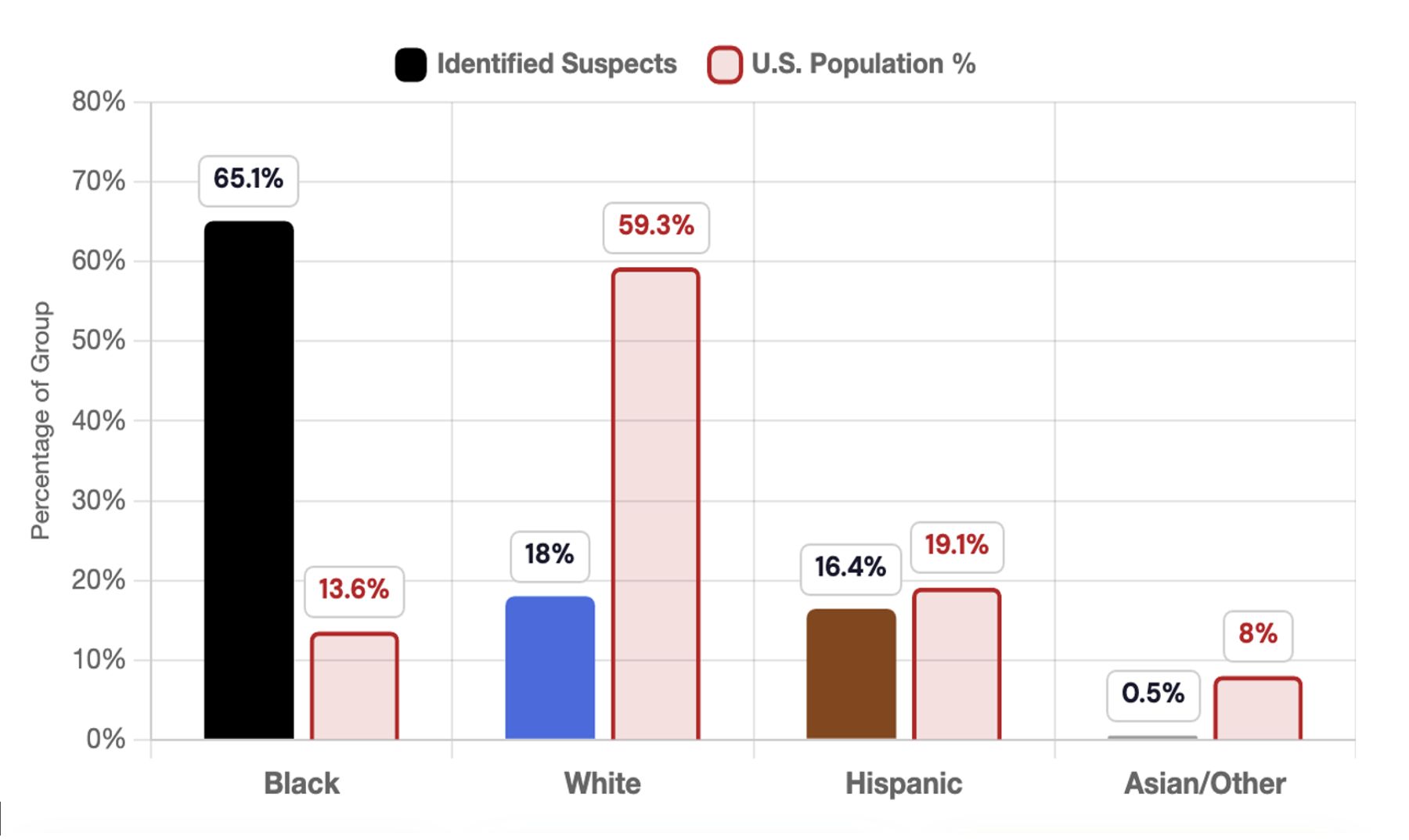
This finding is not the result of one bad year or a handful of outlier cases. And in 2020, the year the Human Rights Campaign published a statement attributing the deaths of “our Black trans siblings” to “an epidemic of violence” fueled by “systems of white supremacy,” not a single white suspect was identified in the cases we verified.
Identified Suspects by Race/Ethnicity Over Time
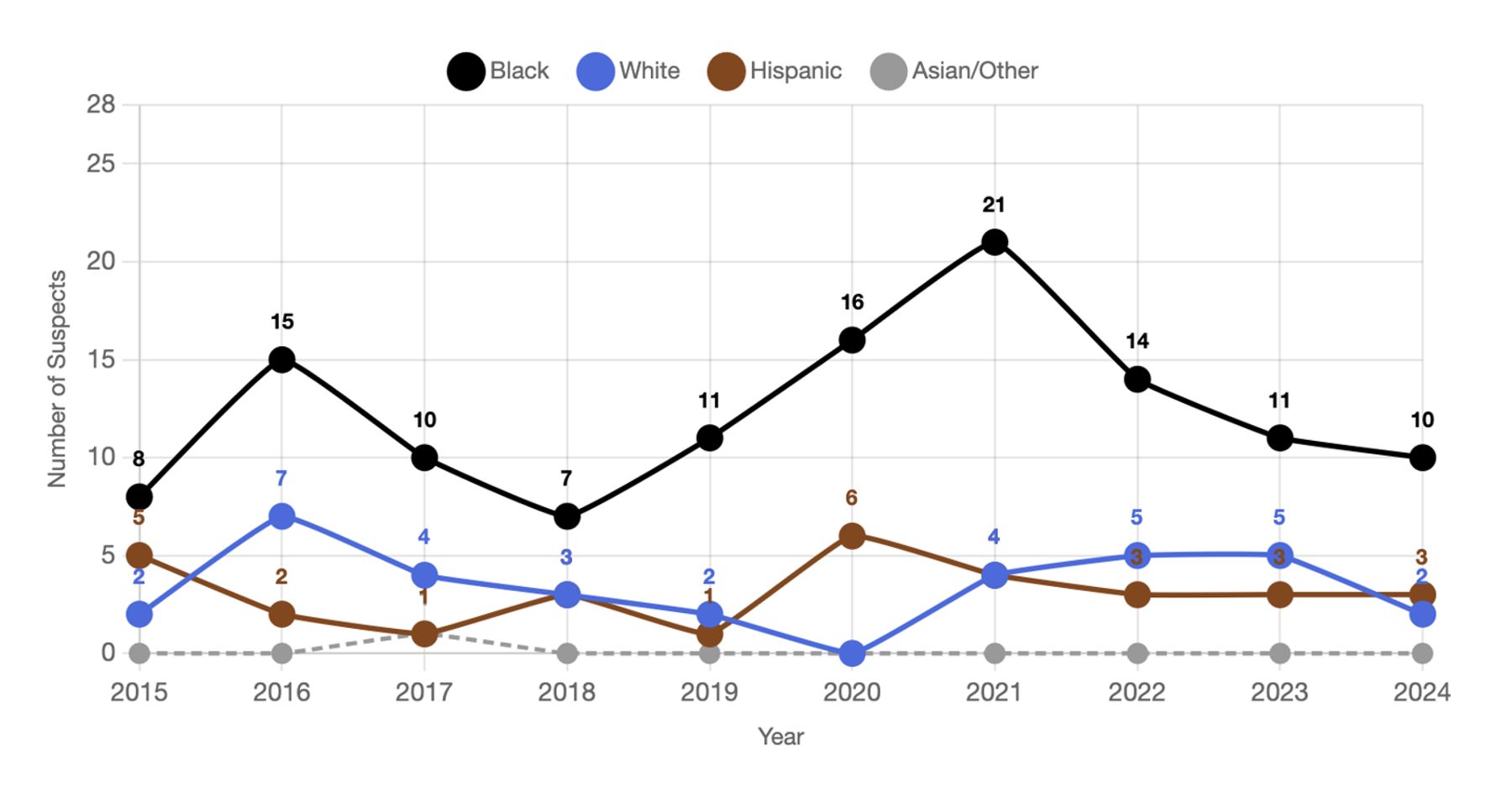
Of the 304 victims in our dataset, 118 cases remain unsolved. Even if we assign a white perpetrator to every one of those unsolved cases, black suspects would still account for 40.5 percent of all perpetrators—about three times their percent share of the population. White suspects would rise to only 50 percent, still below their population share.
To see how the mismatch between narrative and reality is manufactured, consider the deaths of “four Black transgender women” that the HRC cited in a 2021 report titled “Black LGBTQ People and Compounding Discrimination” as proof that “white supremacy” was driving an “epidemic of violence.” One case, the drive-by shooting of Tyianna Alexander, remains unsolved, with no public evidence of anti-trans bias, a hate crime, or anything tied to white supremacy.
In the other three cases, every identified suspect was a black man. Bianca Bankz was killed by a black man named Moses Allen, who shot Bankz and then killed himself. Dominique Jackson’s killing led to the arrest of a black man named Branden McLaurin; police said there was “no evidence supporting a hate-crime” in this case. Fifty Bandz was killed by boyfriend Michael Joshua Brooks, a black man, in what looks like a straightforward case of intimate partner violence.
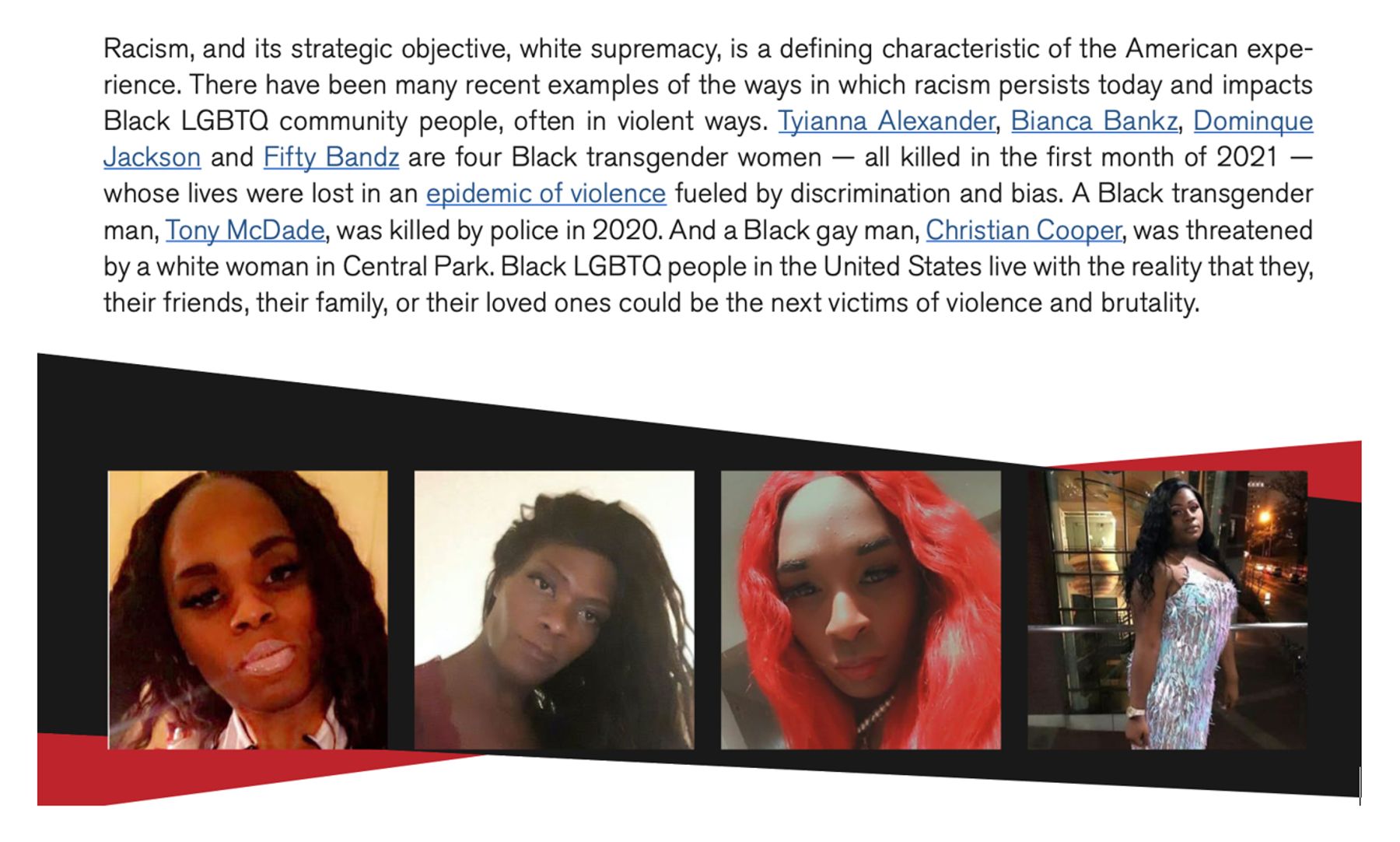
By the time the HRC published that report, Brooks and McLaurin had already been arrested, and the basic facts were public. But instead of reporting those facts, HRC took four cases and spun them as evidence of violence fueled by white supremacy.
The data we collected on motive also upset the HRC’s narrative: only 3.3 percent of cases resulted in confirmed hate-crime determinations. The leading identified circumstance of the murders in was instead intimate partner violence. Other common circumstances included sex-work encounters, disputes, robbery, and other forms of interpersonal conflict.
In other words, the dominant pattern is not hateful white men hunting down black transgender victims because of racism and transphobia. It is violence between people who know each other, sleep with each other, live around each other, or encounter each other in high-risk contexts.
These facts are more than academic. If the deaths of transgender people are the result of a hate-crime epidemic driven by white supremacy and transphobia, then a reasonable response might be more anti-bias campaigns. But if the main problem is intimate partner violence, then the most effective interventions would likely include domestic-violence services tailored to trans-identified victims, emergency housing for people trying to flee abusive relationships, and other violence-reduction efforts in the places where these killings occur.
This mistake isn’t new. The Biden administration, for example, directed considerable effort and funding premised on the hate-crime explanation for violence against transgender-identifying Americans. In June 2021, the White House created the first Interagency Working Group on Safety, Inclusion, and Opportunity for Transgender Americans, spanning ten federal departments and producing more than 45 action items built around hate, stigma, and legislative hostility as the main causes of anti-trans violence. Not one identified intimate partner violence as the leading driver of these deaths.
Similar efforts show up at the state level. California created the nation’s first dedicated Transgender, Gender Nonconforming, and Intersex Wellness and Equity Fund and has spent hundreds of millions on anti-hate programs since 2019. New York created the Lorena Borjas Transgender Wellness and Equity Fund as part of a larger LGBTQ spending package. In each case, the political justification was that transgender people were under attack from hateful people and hostile laws. Intimate partner violence was never mentioned.
The HRC’s commitment to progressive politics had led it to collapse a messy reality into a much simpler moral story. Complex social problems are translated into familiar oppressor-oppressed binaries—white versus black, cis versus trans, and men versus women. That framework is easy to sell to donors, journalists, elected officials, and the public.
But if our goal is to reduce the number of dead transgender people, then our first obligation is to describe the problem honestly. That means admitting that most of these killings were not confirmed hate crimes, that the suspect pool looks the opposite of what public rhetoric about white supremacy would lead people to expect, and that the violence that does occur is usually intra-racial, intimate, and concentrated in a much narrower subgroup than the word “epidemic” suggests.
Now that the facts are public, ignorance is no longer an excuse. The HRC has a choice: keep repeating a false story that serves progressive ideology, or face facts and respond to the problem as it actually exists.
Top Photo by Ira L. Black/Corbis via Getty Images