
A dead man; police accused of racism; horrific video footage; protesters taking to the streets; a racial reckoning. This describes not America in 2020 but Britain in 2026. And the dead man this time is not black but white.
The U.K.’s mirror-image George Floyd moment began on December 3, 2025. Henry Nowak, an 18-year-old man from Essex, was enjoying a night out with friends to celebrate the end of his first term at university in Southampton. On his way home, he encountered Vickrum Digwa, a Sikh who was carrying an eight-inch ceremonial knife. A conversation between the two led to Digwa grabbing Nowak’s mobile phone. A physical struggle ensued, and Digwa stabbed Nowak five times. Still conscious, Nowak was heard saying, “I’m going to die” as he attempted to flee. Digwa was then joined at the scene by his brother, Gurpreet, who finally got around to contacting the police. But when he did so, it was to claim that Nowak had racially abused Digwa, not the fact that Nowak had been stabbed. Digwa’s parents were next to arrive, and Digwa asked his mother to dispose of the knife.
Finally, a reason to check your email.
Sign up for our free newsletter today.
When the police finally got on the scene, over 15 minutes after Nowak was stabbed, events took an even darker turn. Nowak, surrounded by Digwa’s family, was filmed by police cameras saying, “I’ve been stabbed, I can’t breathe, call an ambulance.” Yet the police officers appeared far more concerned about Digwa, whom they believed was the victim of a racist assault, than the dying Nowak. When Nowak again said that he had been stabbed, an officer told him, “I don’t think you have, mate.” This horrific reversal of victim and villain, and flippant, dismissive treatment of a man bleeding profusely, continued. Police arrested Nowak, not Digwa. His limp, ghostly white wrists were handcuffed by blue-gloved officers as he said nine times: “I can’t breathe.”
Only after Nowak had been formally arrested did an officer begin taking his claims seriously. She asked him, “Where do you think you’ve been stabbed?” before saying to a colleague: “We have to check, don’t we?” Finally, with Nowak now unconscious, an ambulance was called. An hour later, Nowak was pronounced dead at the scene. Digwa was finally arrested and taken into custody, but unlike the dying Nowak, he was never handcuffed. At the police station, he was allowed a meal of his choice. As Nowak’s father later said, Digwa was “afforded decency” that his son was denied.
These details only became public earlier this month, when Digwa was tried and convicted of murder. His 21-year prison sentence is currently subject to appeal on the grounds that it is unduly lenient. What followed was a far broader discussion about racial double standards in Britain’s police force and other public institutions.
Nowak’s final words spoken to police officers—“I can’t breathe”—make comparisons with George Floyd inevitable. The police were not directly responsible for Nowak’s death. However, their credulity in believing Digwa to be a victim of racism and, crucially, their decision to take his accusation of racism far more seriously than Nowak’s claim to have been stabbed prevented potentially life-saving medical help from being secured more quickly. In a mirror image of events six years ago, the case led to accusations of anti-white institutional racism, angry protests on the streets of Southampton, and politicians publicly declaring sympathy for Nowak’s family.
But further comparisons with the response to George Floyd’s death don’t track. In 2020, British celebrities joined their American counterparts in blacking out their social-media profiles. Pandemic restrictions were ignored as people across the U.K. took to the streets in protest. Social distancing could be dispensed with, doctors reassured the British people, because racism was also a pandemic. At some demonstrations, uniformed policemen were photographed taking the knee. At others, violence broke out. During one protest, 27 officers were injured, but the BBC reassured the British public that this was a “largely peaceful” event. At one point, then-Leader of the Opposition Sir Keir Starmer posted a photograph of himself kneeling in support of Black Lives Matter.
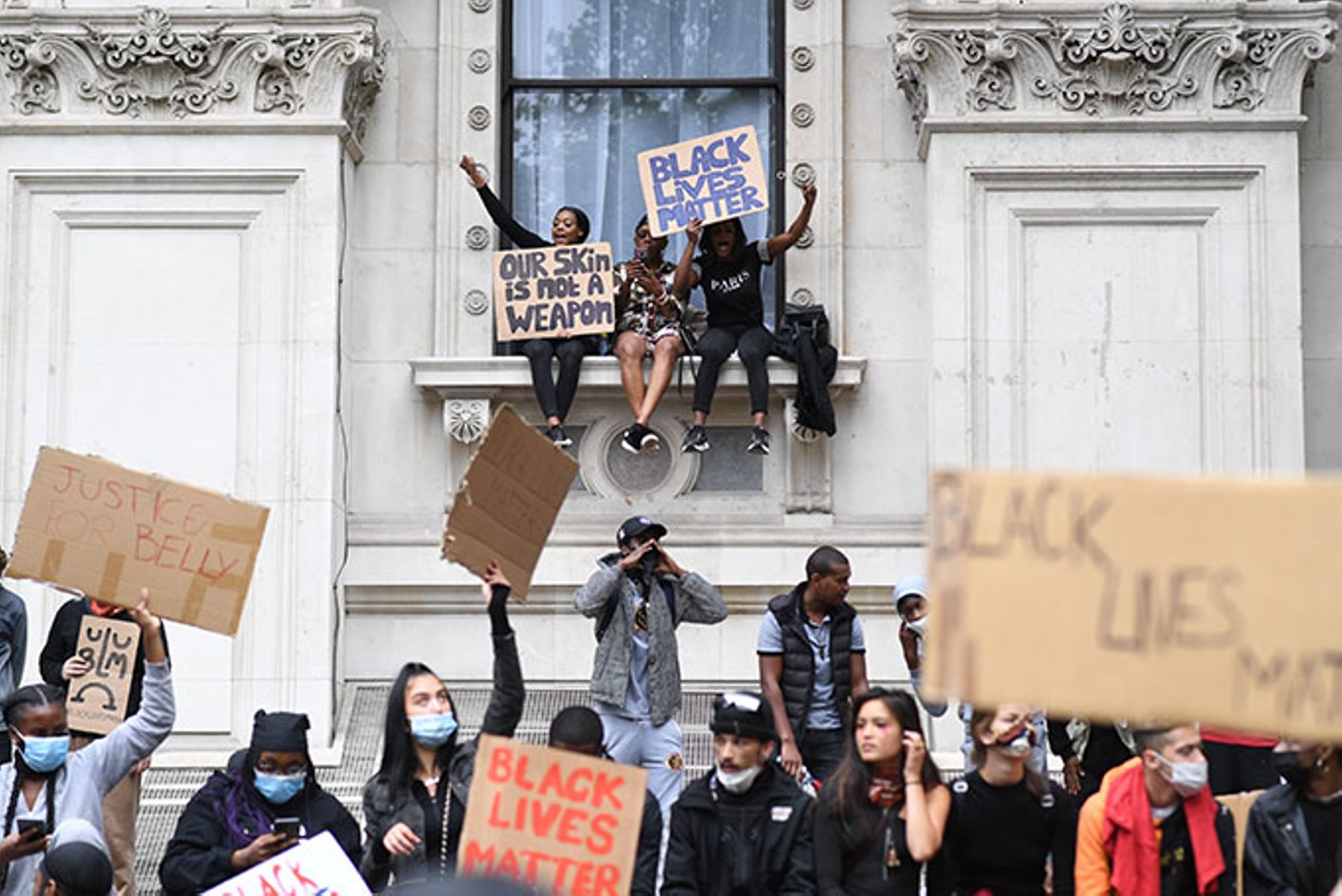
In contrast, the response to Henry Nowak’s murder has been notably muted: no celebrities have expressed sympathy, and no politicians have knelt in solidarity. Britain’s Foreign Secretary, David Lammy, tied himself in knots trying to explain why taking the knee for Nowak would be mere symbolism, whereas it was somehow a meaningful gesture in 2020. When Vice President J. D. Vance declared that “righteous anger” was “the only response” to Nowak’s murder, all hell broke out. The same politicians who, in 2020, had rushed to rebuke American police and called on the U.S. government to bring about systemic change suddenly discovered a loathing of foreign interference. And while street protests have been sparse and largely confined to Southampton, the few disturbances that did occur were condemned by the BBC as “violent disorder.”
In 2020, the first wave of protests following Floyd’s death sparked an institutional reckoning with racism in the United States and Britain. Universities apologized for racism, and schools “decolonized” their curriculums. In workplaces across the country, diversity policies were rewritten, and staff were required to attend anti-racism training. Bookshops sold out of copies of How to Be an Antiracist by Robin DiAngelo, who became a household name.
It’s precisely this climate that led Britain’s police force to implement changes to police training, placing greater focus on antiracism and the promotion of diversity, equity and inclusion. An “antiracism commitment,” which emerged from the Police Race Action Plan, led Chief Constables to declare “their ongoing support for a police service that is anti-racist and continues to work towards racial equity.” Diversity schemes imposed a block on recruiting white officers in a bid to increase the numbers of ethnic-minority candidates. In one force alone, the equivalent of 46 constable salaries was spent on diversity and inclusion initiatives and staff training. This included 19 uniformed and civilian staff working in diversity roles.
U.K. police now stand accused of “two-tier policing”—treating people differently based on race. Starmer, before announcing his resignation on Monday, rejected this criticism, but it seems all too evident to many Britons, including former police officers. Indeed, constables in Southampton, the force that oversaw Nowak’s arrest, now say they felt “controlled and pressured” during a day-long diversity-training course titled “Inclusion Matters.” More than one in seven officers who attended the workshop, which covered topics including racism, unconscious bias, privilege, and “the importance of being an ally,” said they felt pressure “to be certain ways.” It’s hard not to conclude that when it came to Nowak, police were so concerned about following diversity directives that they wound up arresting, instead of helping, a mortally wounded 18-year-old man.
Britain has a long way to go if it is to restore colorblind law enforcement based on the principles of equality. Henry Nowak’s murder has shone a light on racialized policing, but unlike in the aftermath of George Floyd’s death, politicians and public institutions seem more concerned with silencing dissent and stemming protests than with addressing racial double standards. The political cost of not confronting this problem, and allowing public anger and distrust to fester, will be high.