The small and pleasant town of Hay-on-Wye (current population: 1,675, or 500 fewer than in 1870), just on the Welsh side of the border between England and Wales, has been one of my favorite destinations for upward of 55 years.
Hay-on-Wye was the first town in the world to make the sale of secondhand books its principal business; at its apogee, it boasted 30 used bookstores. Even now, despite the decline of the book as the sine qua non of intellectual life, the town still has nearly 20 such shops. Only 52 miles from my home in England, it continues to benefit from my regular visits, during which I do my part for its economy with steady purchases. I am not a bibliophile but a bibliomaniac: I have always lived partly through books, and now I live predominantly through them.
Finally, a reason to check your email.
Sign up for our free newsletter today.
It helps that the journey from my home is a beautiful one, passing through lovely and largely unspoiled countryside. Whenever the Black Mountains come into view—mountains in Britain are never very high and would be counted as mere hills in genuinely mountainous countries, though they still manage to be imposing—I recall the pun, of which I was inordinately proud, that I made years ago when I first visited the town with some friends. The weather was fine, and we were approaching the little town in my tiny car, when dark, menacing clouds appeared over the crest of the Black Mountains. “Let’s make Hay while the sun shines,” I said.
Until the 1960s, when a man named Richard Booth founded a bookstore there, Hay was known chiefly for its ancient sheep and cattle markets. It briefly achieved national fame in 1922, when a local solicitor, Major Herbert Armstrong, was tried and hanged for murdering his wife with arsenic that he had ostensibly purchased to kill the dandelions on his lawn. He was a fussy, pompous, immaculately dressed but henpecked little man, and the only solicitor in Britain ever to be hanged.
Many years later, another lawyer in the town, Martin Beales, not only occupied the same offices as Major Armstrong but lived in his house. He published a gripping book about the case, The Hay Poisoner, arguing that Armstrong was innocent—the victim of a plot by a rival solicitor and of a grossly unfair trial. Certainly, Armstrong went to his death with dignity, and his last letter to his defense lawyer, written on the eve of his execution and thanking him for the utmost efforts made on his behalf, strikes me as that of an innocent man resigned to his fate. Armstrong, after all, had turned down a newspaper’s offer, worth the equivalent of $1 million today, for a last-minute confession of guilt.
His daughter, orphaned early in life, was told that her mother had died of gastroenteritis and that her father, Armstrong, had been killed in a fall that broke his neck, which was true, in a sense, though far from the whole truth. She received a terrible shock when, on a school outing, she came upon a wax effigy of her father in the Chamber of Horrors at Madame Tussaud’s, displayed as a notorious murderer. She then spent the next half-century concealing the fact that she was the daughter of the infamous Hay poisoner, who may not have been a poisoner at all.
Hay briefly became famous again when, between 1938 and 1940, the diaries of Francis Kilvert were first published. The Reverend Kilvert served as curate of Clyro, a village only a mile and a half from Hay, from 1865 until 1872; during this time, Hay was almost his metropolis. The vicar to whom he was subordinate, the Reverend Richard Lister Venables, had married the daughter of a Russian general and published a book about his year’s residence in Russia in 1837.
Kilvert’s charming diary of rural life appeared at a moment propitious for its reception, for the outbreak of World War II created an instant nostalgia for an age that seemed contented and changeless, full of charm and freedom—though not without tragedy and, of course, deep impoverishment. Such evil as it recorded was on a human, local, and therefore comprehensible scale.
Who could not be enchanted by the story of a local girl, Miss Child, and her sister, who went to London but missed the train back?
they went to London Bridge hotel with little money and no luggage except [their pet] owl in a basket. The owl hooted all night in spite of their putting it up the chimney, before the looking glass, under the bedclothes, and in a circle of lighted candles which they hoped it would mistake for the sun. The owl went on hooting, upset the basket, got out and flew about the room. The chambermaid almost frightened to death dared not come inside the door. Miss Child asked the waiter to get some mice for [the owl] but none could be got.
And who would not find the tragedy implicit in the following brief story moving? “Yesterday there was [a coroner’s] inquest at the Blue Boar, Hay, on the body of the barmaid of the Blue Boar who a day or two ago went out at night on an hour’s leave, but went up the [River] Wye to Glasbury and threw herself into the river. She was taken out at Llan Hennw. She was enceinte [pregnant].”
The Blue Boar remains in business. The Reverend Kilvert’s diary shows how much of human nature may be found and captured in the compass of a small town and an even smaller village.
After World War I, an interesting literary figure, Harold Dearden, settled in Hay-on-Wye, where he lived until his death in 1962. Dearden had served as a doctor with the Royal Army Medical Corps and later practiced as a psychiatrist. He left medicine after co-writing, with Roland Pertwee, a successful play, Interference, which Paramount adapted in 1928 into its first full-length, all-talking feature film. His diary Medicine and Duty, published that same year, offers a vivid, ambivalent record of his service, including the injury that cost him an eye, and deserves to be better known. Here is one episode:
One of our working parties last night came unexpectedly upon one of the enemy forward posts. The leading man of our party, an Irish navvy in private life, lifted his head with infinite caution and peered into the black hole of the trench, where he saw an unsuspecting Boche leaning on his rifle and dozing gently. Withdrawing his head as cautiously as before, the Irishman leaned down towards his mate and said, in a tense whisper: “For the love of Mercy, lend us your shovel.” His whole frame a-quiver with expectancy, shovel in hand, hung poised for a second like a veritable shadow of death over the dreamy Boche, and then, with one terrific blow, almost severed his head from his shoulders. “It’s a fine tool, is a shovel,” said he, and returned it, one feels almost reluctantly, to its owner.
And Dearden adds this spontaneous reaction to the terrible scene: “That pleases me, the cobbler returning instinctively to his last.” Yet only nine pages later, he describes a sergeant at a funeral for an officer (despite the general slaughter, formal funerals were still often held): “The sergeant in charge was a typical ‘regular,’ with a square, hard, expressionless face and a thick red, hairy neck; and his clothes, his hyper-polished belt and leathers, and the whole set of his self-confident, earnest, stupid head on his magnificent shoulders, was enough to epitomize the hopeless waste and uselessness of the whole system to which he belongs.”
Dearden’s outrage is expressed in the introduction to the diary, explaining its title, Medicine and Duty, whose meaning is not what you might think:
When a soldier presented himself for treatment, especially in or near the trenches, his physician—by much training—was led to adopt towards him an attitude of mind guaranteed to ruin the same physician . . . in any other place on earth. That is to say, he endeavoured to prove, exclusively to his own satisfaction, that there was nothing whatever the matter with the patient. . . . Having arrived at this conclusion (and to the sufferer it must have seemed that nothing short of an audible death-rattle would prevent him from doing so) he was accustomed to administer a brisk aperient and mark his card “Medicine and Duty.”
And yet, in his envoi to the diary, Dearden—who survived by sheer luck, so many men having been killed within a few yards of him—wrote: “it is curious, in retrospect, to find out how much one had enjoyed it. One had shared a common task with men of every type and station, and had been admitted therefore to a fellowship and intimacy so rare as to outweigh even the beastliness that made it possible.”
After the war, Dearden turned to writing popular psychology and self-help books, as well as works on the psychology of crime. In one of these, he included a chapter on the Hay poisoner, Major Armstrong, whose guilt he took for granted.
At the beginning of World War II, Dearden was recalled to the colors as a psychiatrist and assigned to interrogate German prisoners suspected of espionage. He employed techniques such as starvation and sensory and sleep deprivation, methods that would now be regarded as torture.
Dearden is not remembered in Hay nowadays, but the town has yet another literary association: Bruce Chatwin. Though he never lived there, Chatwin loved the border country between England and Wales and returned often. One of his finest novels, On the Black Hill—about a pair of aging twins whose bond is so strong that they have never managed to live apart—is set near Hay, which appears in the book thinly disguised. Major Armstrong appears even more thinly disguised as Armitage: a well-dressed little solicitor, proud of his dandelion-free lawn; owner of a pseudo-Tudor house much like Armstrong’s; of an uncertain past, also like Armstrong; married to an ailing, henpecking wife; and suspected by the townsfolk of various irregularities of conduct. Several of the names in Chatwin’s book also appear in Kilvert’s diary, though this may be coincidence, since the Welsh have never been especially imaginative in such matters. A film was made of Chatwin’s book in which Hay appears, as it did in a popular period television miniseries about Major Armstrong, Dandelion Dead.
But the main source of Hay’s modern fame was undoubtedly the eccentric, not to say bizarre, entrepreneurialism of Richard Booth (1938–2019). Born into a conventional upper-middle-class family, he was a congenital rebel. Expelled from Rugby School, he nevertheless managed to get into Oxford, which he left without taking a degree. In 1962, he bought an antique shop in Hay and began selling books there, as well, despite warnings that no one in the town read them.
Booth’s methods were unorthodox, to say the least. Unlike most booksellers, who buy only what they think they can sell, he bought everything he could find. He toured—indeed, scoured—the country for books, purchasing them by the truckload and eventually importing them by the container-load from America. He bought entire libraries in Europe. His methods, including his accounting, were chaotic, and suppliers were sometimes left unpaid for years; though he had a good eye for antiquarian treasures, he was always more eager to sell at any price (to keep the cash flowing) than to hold out for the highest one. Once, he bought the library of a Belgian aristocrat that, sold properly, would have netted him a small fortune; but it was those to whom he sold it who benefited.
He was contemptuous of formal education, especially of diplomas, and employed local people to move books and eventually to sell them. He paid wages in cash, often without record. Charming yet exasperating, and utterly convinced of his own ideas, he could not be diverted from his schemes. He inspired great loyalty as well as irritation. Attractive to women, despite his perpetual shabbiness, he married three times (one marriage lasted just a day), and only the third proved successful.
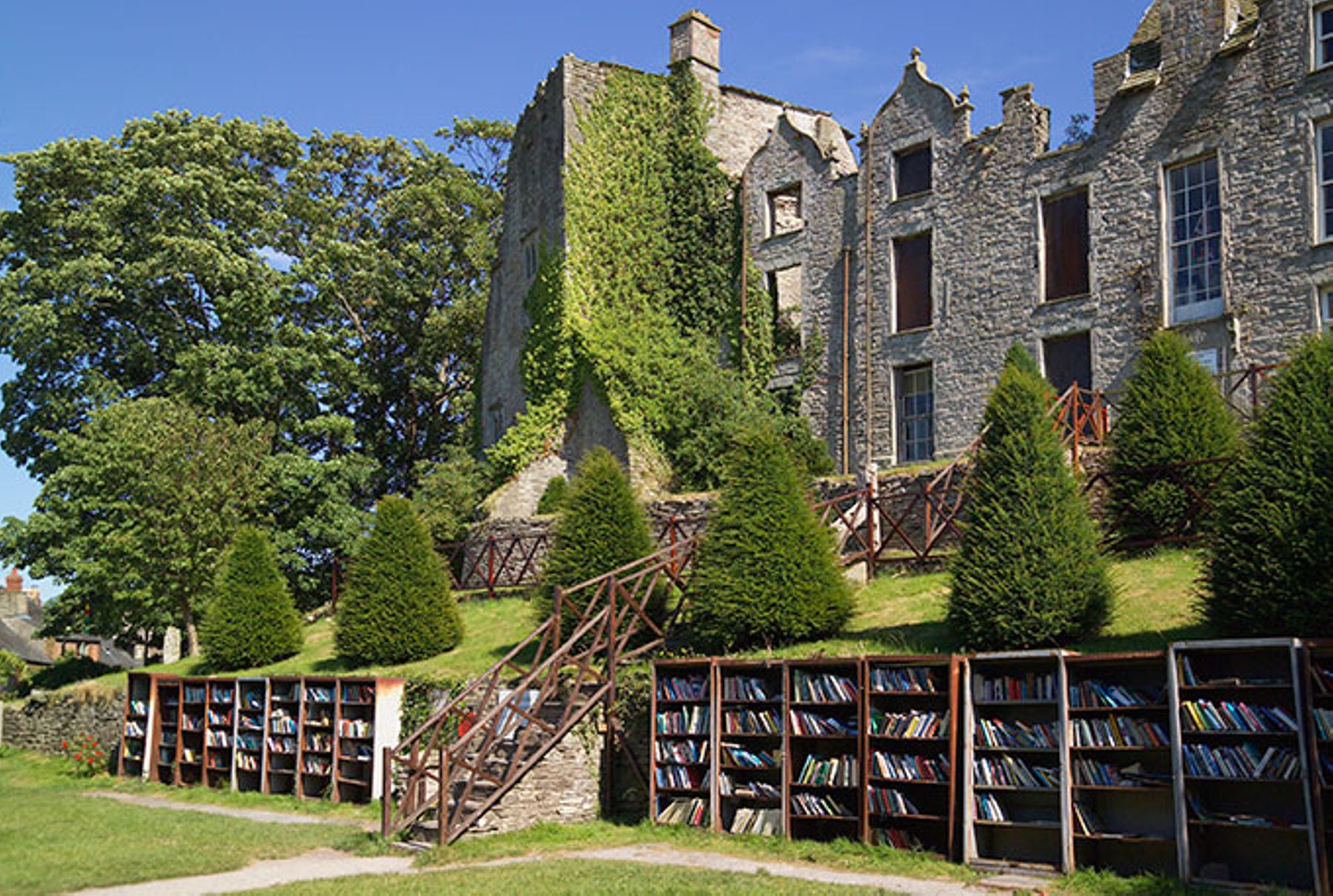
Booth made little distinction between profit and turnover, and at first appeared hugely, and unexpectedly, successful. He bought the ancient castle that overlooks the town, much altered over the centuries, and staged concerts of baroque opera on its grounds. He bought a white Rolls-Royce and then, in a blaze of publicity, declared Hay independent of Britain and made himself king, granting titles of aristocracy and appointing farm laborers as ministers. These days, given officialdom’s diminished sense of humor, he would probably have been arrested and charged with something.
Booth wrote pamphlets lamenting the loss of the Welsh peasant way of life and its replacement by a bureaucratically corrupt and unproductive corporatism, a diagnosis not without merit, even if his proposed remedy, a return to unmechanized farming and handicraft, was impractical.
His lack of method and carelessness with accounts inevitably led to the collapse of his empire—or kingdom—of books. He had to sell his assets, and some of his former employees struck out on their own. More business-conscious than he, they are still trading in the town.
There are now fewer bookshops in Hay than there once were; but according to the current owner of the Poetry Bookshop, Christopher Prince—successor to the poet Anne Stevenson, who opened her shop in the room where the town’s dead were once laid out—the decline is not necessarily a bad thing. Prince remembers me because, while writing an essay on the poets W. E. Henley and W. H. Davies, both of whom had legs amputated, I asked whether he knew of any other one-legged poets, a question he had never been asked before or since. (He didn’t.) On a recent visit, he pointed out something I had not previously considered: since bibliomania is chiefly a male obsession, the arrival of shops selling things other than books has made Hay more appealing for family outings.
Hay was the first town in the world to live mainly by secondhand books, but now it has imitators, including Charité-sur-Loire in France. Richard Booth, without any clear plan in his mind but possessed of forceful personality and strong ego, created something entirely new and, for people like me, life-enhancing.
It was because of its association with books that, in 1988, a literary festival was established in Hay. It has since grown into one of the largest events of its kind in the world and has spawned many imitators. Booth, who saw himself as the onlie begetter of Hay, initially disapproved of the festival, dismissing it as merely a vehicle for promoting authors’ egos. “New books,” he said, “are for the ego; old ones for scholarship.” The success of the festival, which lasts ten days and draws up to 300,000 people a year to Hay, forced Booth to change his mind: it was a phenomenon that has now lasted more than three decades.
The speakers at the festival range from Nobel Prize winners to minor journalists such as I. There are two parts to it: one purely literary, the other more concerned with ideas political, social, philosophic, and scientific. I have spoken three or four times at the second part.
For reasons unknown, I have twice found myself on a panel about prostitution, the organizers evidently knowing or suspecting something about me of which I remain unaware. It is true that I have treated a few prostitutes as patients, including an international dominatrix who traveled the world caning judges and the like, but my experience of prostitution is otherwise limited. On the panel with me sat the chairwoman of a prostitutes’ union and a proper, ladylike sociology researcher, who maintained, among other things, that prostitutes valued their work for its flexible hours—convenient for raising children—and its relatively high pay. In her view, it was simply a job like any other.
I pointed out that the German social security system had briefly toyed with the same idea, suggesting that women (or, for that matter, men) might be obliged to take up sex work, as it is now delicately called, before receiving unemployment benefits.
“Not everyone can be a prostitute,” responded the head of the prostitutes’ organization. “I am sure everyone could learn,” I said, somewhat surprised that no one in the audience—400 people, under a large tent—laughed. At this point, a woman of ample size spoke from the front row. She was Thai and said that in Bangkok, there was a school for prostitutes. I thought of Sylvia Plath’s poem:
Dying
Is an art, like everything else. I do it exceptionally well.
I suppose that, to adapt slightly:
Prostitution
Is an art, like everything else. It can be done exceptionally well.
Richard Booth, a man from whom ideas flew like sparks from a sparkler, some good and many quite mad, would have relished the notion of a school for prostitutes, despite his general contempt for formal education.
Once, he went to Christopher Prince and told him that he wanted to offload thousands of unsalable poetry volumes that were cluttering miles of his shelves. Prince, whose approach was more traditional—he bought only what he thought he could sell—declined, but he had a suggestion. “Why,” he said, “don’t you offer books of poetry to pubs for use as beer mats? That would get people reading poetry.” Booth liked this idea, offered as a joke, and acted on it for a time.
He was fortunate to have lived when the country was freer and more tolerant, though also more prejudiced, than it is today (freedom, tolerance, and prejudice tend to go together). Among his friends and helpers in the 1970s was April Ashley, the famous transsexual model, before transsexualism became a full-blown ideology.
Hay, the small town on the border of Wales and England, contains multitudes, and I often think that, if I had my time again, I would choose to live there: millions of books in the middle of surpassingly beautiful countryside. My paradise!
Photo: The Richard Booth bookstore, one of nearly 20 bookstores in a town of just 1,675 people (Ian Bottle/Alamy Stock Photo)