
Universities across the country have wound down their diversity, equity, and inclusion (DEI) programs in recent years, following criticism of the programs’ patterns of racial discrimination and compelled speech. In some cases, DEI roles were not removed but simply renamed and moved to other departments. In fact, a recent Inside Higher Ed survey found that 43 percent of universities have rebranded their DEI initiatives. The names change; the agenda remains the same.
Minnesota parent Matthew Stanton saw what this rebrand looked like firsthand at the University of Wisconsin–Madison when accompanying his daughter for a school visit in April. UW–Madison’s School of Education is the nation's top-ranked education department—a big draw for Stanton’s daughter, who wants to be an elementary school teacher. But when Stanton arrived at the School of Education, he was met with a “disturbing exhibit” in the building’s main concourse.
Finally, a reason to check your email.
Sign up for our free newsletter today.
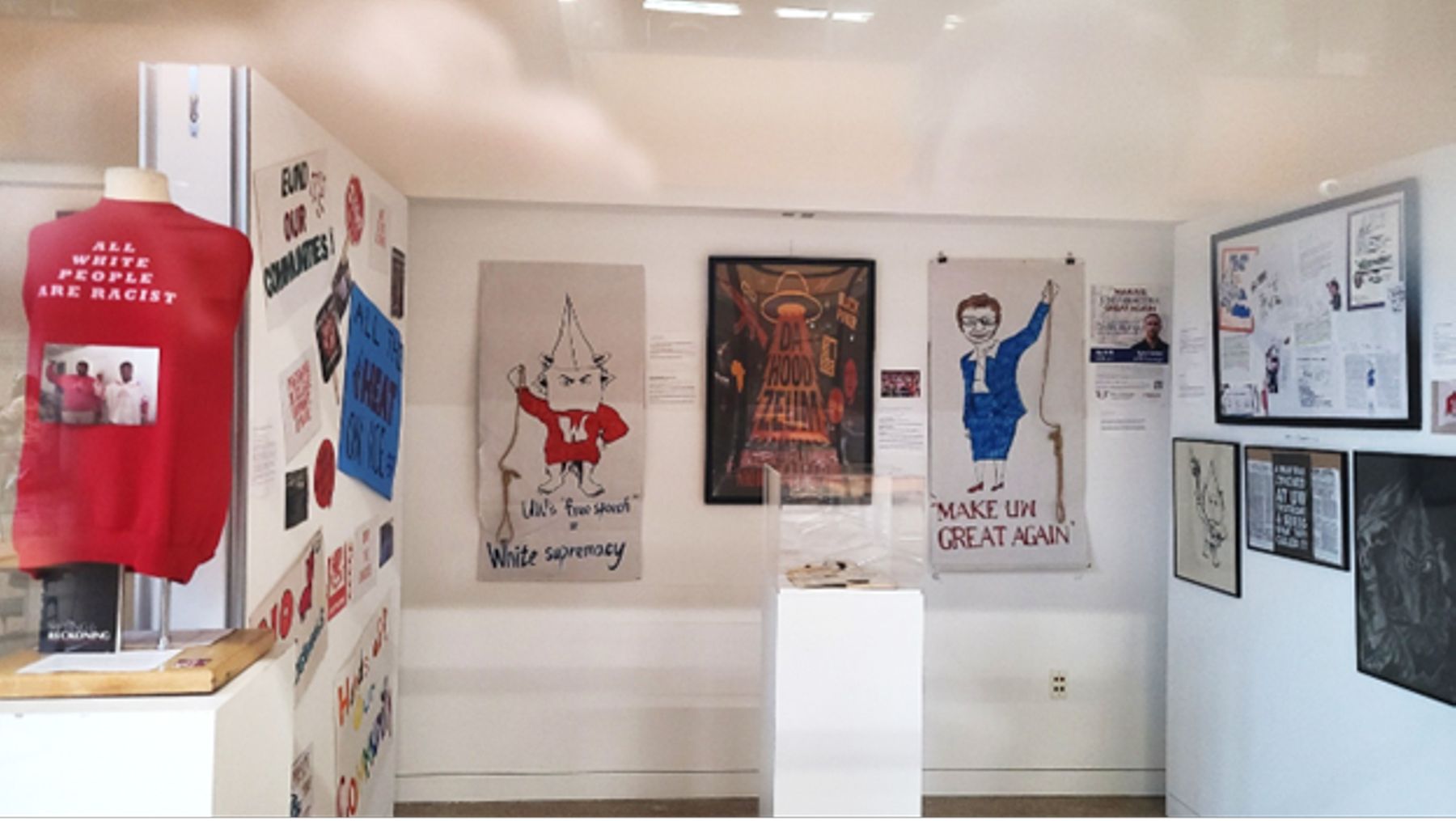
A red sweatshirt read, “All White People are Racist.” One sign said, “UW’s Free Speech = White Supremacy,” accompanied by the school’s badger mascot wearing a KKK hood and holding a noose. Student publication The Madison Federalist also found a sweatshirt showing the severed heads of Donald Trump and Mike Pence.
The exhibit was entitled “Da Hoodzeum presents: In Direct Action—A decade of Activist Art at University of Wisconsin–Madison.” It was part of the university’s annual Line Breaks festival, hosted by the Office of Multicultural Arts Initiative (OMAI) from March 20 to April 24. OMAI was originally in the university’s former DEI division, parts of which were moved to the Division for Teaching & Learning last year.
Michael Davis, Da Hoodzeum’s curator and a UW–Madison education doctoral student, compiles artifacts that focus on a “radical aspect of history.” (Davis did not respond to a request for comment.) A description of the April 24 exhibit said that it shows “how activist art at UW is . . . part of an ongoing tradition of creativity as action, care, and collective struggle.”
University spokesman John Lucas told City Journal via email that the “display did not represent the views of UW–Madison or its School of Education, which support free expression,” that the university “did not receive complaints” about the display, and that “no university funding was provided to the exhibit.”
But the exhibit was part of a public university-sponsored event. In such events, “the university has the power to determine what art is displayed,” according to Zach Greenberg, Director of Faculty Legal Defense at the Foundation for Individual Rights and Expression. OMAI’s festival consisted of “invited professional artists” and students selected into the university’s First Wave full-tuition Hip-Hop & Urban Arts scholarship program.
As an administrative unit, OMAI also can’t claim the same protections of academic freedom that an academic department could. “We’re not talking about a case where a professor says something controversial in class,” Manhattan Institute Constitutional Studies Director Ilya Shapiro said. “Instead, it’s about viewpoint discrimination by a public school that’s bound by the First Amendment not to play favorites among political positions.” That seems to run contrary to UW–Madison’s institutional neutrality policy, which it adopted in 2024.
OMAI’s website lists Davis on the staff page as a “graduate mentor.” According to his biography, he “teaches and mentors in the First Wave program at UW–Madison, supporting young scholar-artists at the intersections of art, activism, and academia.” Lucas and OMAI failed to answer questions about whether Davis received compensation.
UW–Madison has been trying to fight “misperceptions among state residents” that the university is “too radical/leftist.” Offices like OMAI are not helping in that effort.
The display was a clear red flag for Stanton, who felt that the College of Education had misled him. Stanton said presenters used language that was “deliberately vague,” avoiding politically contaminated terms like “intersectionality” and “CRT” (Critical Race Theory). Instead, they used terms like “equity” and “inclusion” separately on several occasions. Stanton believes that the ideological bent of the program went over many people’s heads: “I suspect most people think equity is a synonym for equality, and who would be against inclusion?”
The mixed messages from the exhibit and the College of Education presentations prompted Stanton to investigate courses more carefully. He found classes like “Race, Intersectionality, and Equity in Education,” in which students examine policies that “sustain white privilege and dominance.” Another course, “Pedagogical Content Knowledge for Teaching Elementary Mathematics 2,” requires students to “think beyond standardized mathematical practices,” which Stanton suspected was “injecting” activism into math. At least one instructor for this course focuses on “advancing racial justice in middle school mathematics.”
Stanton was initially open to sending his daughter to UW–Madison. Now, he’d prefer that she go elsewhere.
He’s almost certainly not alone. Universities will struggle to earn back public trust when official units continue to promote one-sided ideological views and fail to take ownership of those decisions.