Social conservatism and free-market capitalism have long defined the American Right’s domestic agenda. To some, the defenders of tradition and the forces of disruption make an uneasy alliance. George Gilder sees things differently. “I don’t think there’s a conflict between order and creativity,” he says. “I think creativity is dependent on a culture that provides predictability and a marital structure of sexual order.”
Those twin commitments have anchored Gilder’s thought throughout his long career as a public intellectual. Few writers have combined social and economic conservatism so consistently or naturally.
Finally, a reason to check your email.
Sign up for our free newsletter today.
Gilder first made his name tangling with the ascendant feminists of the 1970s. In the following decade, he became a leading advocate of supply-side economics and Ronald Reagan’s most-quoted living author. His fascination with innovation and entrepreneurship soon expanded into a passion for technology. Studying the breakthroughs of the 1980s and beyond, he not only celebrated the dawn of the information age but also anticipated many of its defining features: powerful computers built on transistor-dense microchips, high-speed fiber-optic communications, and smartphones.
Now in his mid-eighties, Gilder continues to write and speak around the country. I caught up with him—fittingly, via teleconference to his home in Tyringham, Massachusetts—between a busy slate of engagements, including a recent appearance at FreedomFest in Las Vegas.
Gilder’s childhood combined privilege with hardship. He came from a distinguished family. His father, Harvard alumnus Richard Watson Gilder II, edited the Crimson, joined the Signet Society, and became the youngest member of the Council on Foreign Relations. “He was a really notable figure,” Gilder says. His family tree also includes glass artist Louis Comfort Tiffany and the original Richard Watson Gilder, editor of Century. “My father was David Rockefeller’s roommate at Harvard, one of several roommates, and after they graduated in 1936, they visited Germany,” Gilder recounts. “My father saw Hitler and decided in 1936 that Hitler would have to be stopped.”
The elder Gilder gave his life pursuing that end. “He led a squadron of Flying Fortresses at a time when half of them crashed,” Gilder says. On June 27, 1943, when Gilder was three, his father’s B-17 took off from Newfoundland and vanished.
His mother remarried, and Gilder grew up on a dairy farm in Tyringham. He remembers throwing hay bales and shoveling silage, as well as a barn fire that destroyed Tiffany glass his father had preserved.
He also milked plenty of cows. When Gilder was ten, “my stepfather went to New York to arrange the funeral for his father,” he recalls. “And I was left with the farm and a couple of workers . . . one of whom got drunk and disappeared. So I found myself milking these cows. I can still hardly believe it, but I was capable of doing that.”
“I can say that I experienced reality,” he observes. “I knew how making a farm work, selling milk and cheese and all the dairy products, and keeping 100 cattle alive was all a big challenge. At the same time, I experienced the Rockefellers.”
David Rockefeller remained a family friend and had agreed to help Gilder through school if anything happened to his father during the war. Gilder attended Exeter and then enrolled at Harvard before flunking out, spending time in the Marines, and eventually returning to graduate. At Harvard, his interests centered on defense and military strategy, and his mentors included Henry Kissinger and Thomas Schelling.
Another formative influence arrived when Gilder discovered a copy of José Ortega y Gasset’s The Revolt of the Masses in a Harvard bookstore. “This is one of the great books of political and philosophical historical theory. It gave me an appreciation of genius—that human progress was not something that was automatic; it was something forged by brilliant men, mostly,” he says. “And I was astonished to discover a few years later that Revolt of the Masses was my father’s favorite book. . . . It was an amazing thing that happened, almost as if he’d reached down and guided me to this particular great work of conservative vision.”
Gilder also formed a lifelong friendship during these years with Bruce Chapman, a partnership that would produce a magazine, a book, and eventually a think tank. In college, the two were liberal Republicans when the term was not yet an oxymoron, campaigning for Nelson Rockefeller and wearing buttons that read, “I am an Extreme Moderate.”
They founded a magazine and called it Advance. After graduation, they tried to expand the magazine to national reach, but it met an untimely end in late 1963. “We had a big issue, which was a critique of the Kennedy administration. The title was ‘The Unprepared Meets the Unforeseen,’ and it had a caricature of President Kennedy on the cover,” Gilder remembers. “We had chosen this issue for a mass mailing”—and then Kennedy was assassinated. “We had to go back to the post office and pay 400 bucks, I think it was, to retrieve it. That was the death of Advance.”
In 1966, the duo published The Party That Lost Its Head. They were furious over the GOP’s 1964 nomination of Barry Goldwater, who had lost to Lyndon Johnson by more than 20 points, as well as the party’s broader effort to attract Southern Democrats at the expense of other constituencies, including minorities. Within the book’s first 30 pages, they took swipes at Ronald Reagan (the “pop-politician”), Phyllis Schlafly, and William F. Buckley.
“Our complaint against the Right at the time was over two issues,” Chapman recalls. “One was about the John Birch Society and the Radical Right; we didn’t think they had any place in the Republican Party. And then the other issue was segregation. We thought the party should be absolutely firm on civil rights.”
Eventually, those matters receded, and Gilder shifted his focus. “I was associating with many of the Rockefeller girls,” he says, “and I noticed they all became feminists.” Gilder calls Sexual Suicide his “first big original work.” It was published in 1973, the year of Roe v. Wade and a time, as the book described it, “of wife swapping, group swinging, and gay liberation.”
Gilder’s take on these developments earned him notoriety. Harper’s ran an excerpt as its cover story. The National Organization for Women and Time named him Male Chauvinist Pig of the Year. During Gilder’s appearance on The Dick Cavett Show, two lesbian feminists (their term) interrupted the program to present an urn filled with ashes from “the women who’ve been murdered at the altar of male supremacy.”
To this day, the book—as well as Men and Marriage, its updated and expanded 1986 version—remains a classic of social conservative thought on gender roles and the breakdown of the modern family. It advances its controversial arguments with panache, engaging with leading feminists, popular sexual-liberationist books, and a wide range of scientific literature. It also clearly benefited from being “written among people who disagree with it,” as Gilder notes in the book’s acknowledgments.
At the core of Gilder’s thesis is the claim that women are sexually superior to men. “Although the man is needed in intercourse, artificial insemination has already been used in hundreds of thousands of cases,” wrote Gilder. “Otherwise, the man is altogether unnecessary. It is the woman who conceives, bears, and suckles the child. Those activities which are most deeply sexual are mostly female; they comprise the mother’s role, defined organically by her body.” Biology, Gilder argues, orients women toward children and thus the future. Men, by contrast, depend far more on the institutions and guidance of society—a conclusion he supports with anthropological evidence showing that the role of fathers varies widely across cultures.
Men crave a “special arena of glorified achievement from which women are excluded,” Gilder contended. In primitive societies, men compensate for their sexual inferiority with physical strength: “They can control women by force and are needed to protect them from other men.” But in more civilized societies, “men counterbalance female sexual superiority by playing a crucial role as provider and achiever. Money replaces muscle.”
Feminists decried this arrangement for making women dependent on men. But Gilder claimed that it civilized men, too, by subordinating them to women’s longer “sexual horizons.” It directed male energies—which could otherwise be diverted into vice and violence—toward supporting families. Sexual liberation, coupled with efforts to make women the statistical equals of men in the workforce, threatened to dismantle this crucial restraint on male nature. The drive to erase natural differences between the sexes was what Gilder meant by “sexual suicide.”
“I think most of Sexual Suicide is vindicated,” Gilder says today. “My family was full of women like Mary O’Hara, who wrote [the 1941 coming-of-age novel] My Friend Flicka. In my family, the women were more eminent intellectuals than the men, largely. . . . I knew that the depiction of women as somehow suppressed or [having] their possibilities restricted was just nonsense. Women could write books, they could be intellectuals, they could teach; they just weren’t treated identically with men and with the assumption that the sexual differences were insignificant.”
He notes that even in societies that have gone furthest in equalizing the sexes, such as Sweden, men still dominate corporate leadership. He is especially proud that, drawing on Daniel Patrick Moynihan’s work, Sexual Suicide warned about the decline of the black family. Gilder followed the book in 1974 with Naked Nomads, on the travails of the nation’s unmarried men, and in 1978 with Visible Man, a slow-selling work of journalism about a black veteran’s struggles in Albany with unmarried parenthood, violence, alcohol, work, the welfare state, and the law.
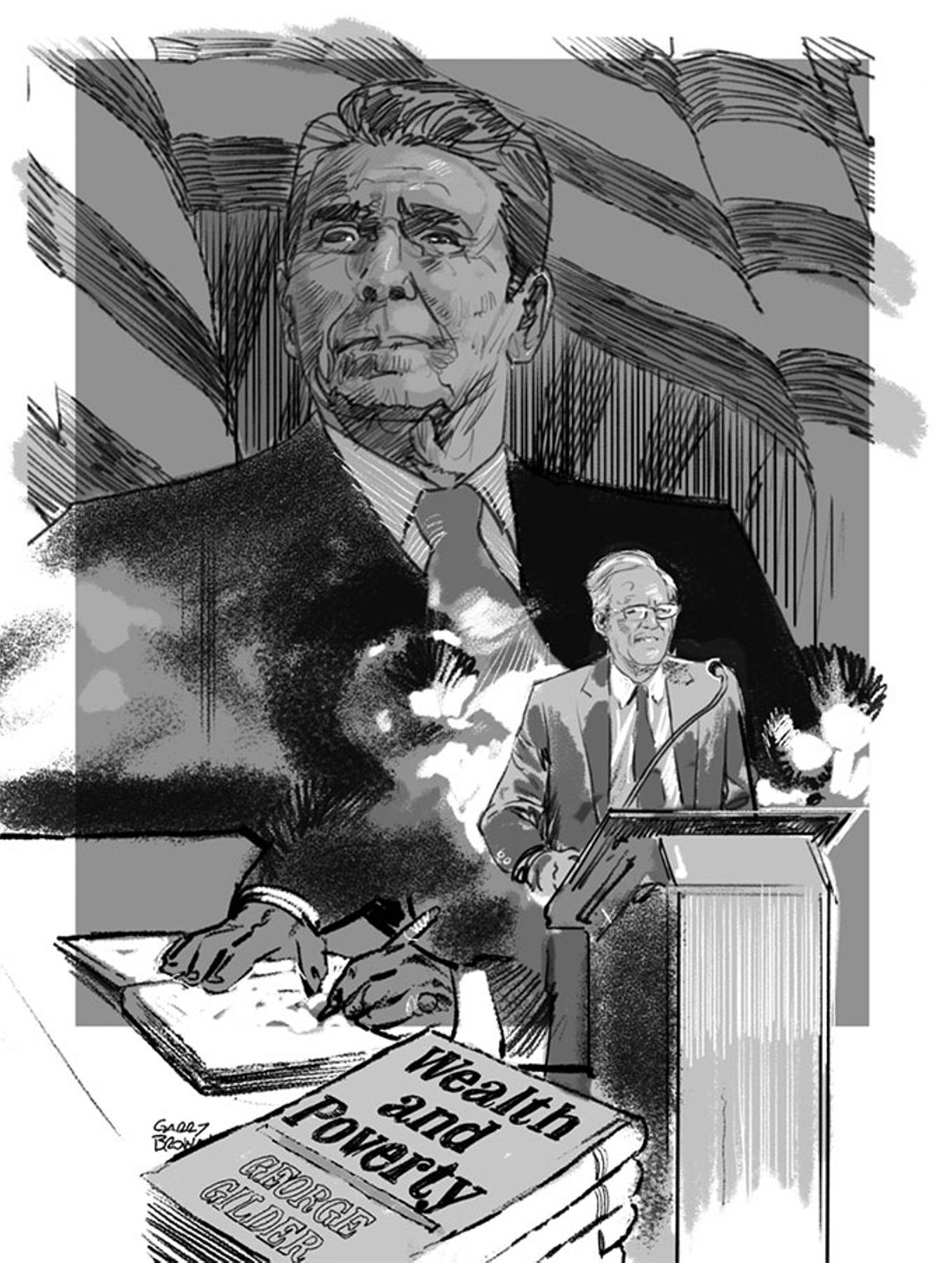
Gilder found his Reagan-era breakthrough with Wealth and Poverty (1981), a defense of free markets and a celebration of the then-young supply-side movement. It has been credited with helping spur the Reagan tax cuts, and it laid the foundation for a series of Gilder economics books, from 1984’s The Spirit of Enterprise to 2013’s Knowledge and Power. The success of Wealth and Poverty “just startled me,” Gilder says. “It was in the windows of the bookstores on Fifth Avenue in New York.” David Stockman, Reagan’s budget director, promoted the book within the administration, and the president himself was known for handing out copies. “He gave Bob Dole a copy of Wealth and Poverty and told him to read it because Dole was resisting his tax cuts,” Gilder recalls. Speaking offers worth tens of thousands of dollars poured in, and the book ultimately sold more than 1 million copies.
Many defended the free market before Gilder, but Wealth and Poverty cast capitalism in a new light. Since Adam Smith, a leading justification for capitalism had been that it channels the self-interest of money-grubbing butchers, brewers, and bakers, whose benevolence cannot be counted upon, into benefits for broader society. Even capitalism’s most ardent defenders, such as Ayn Rand, have generally accepted that self-interest is central to how the system works; they simply celebrate selfishness as well.
But capitalism isn’t about greed, Gilder insists, again turning to anthropological evidence to make his case. He traces its origins not to a redirected impulse to plunder but to widespread traditions of gift-giving. Those who give may hope for loyalty and reciprocity, but they are guaranteed neither—just as entrepreneurs offer innovations with no assurance of success and at substantial risk of failure. Capitalism works, in other words, not by redirecting humanity’s worst instincts but by calling forth its best. At its core, it is about serving others’ needs and having faith in the future.
This argument irritated many intellectuals, from the socialist economist Robert Lekachman, whom Gilder debated on Firing Line, to Rand herself, who attacked him in one of her final speeches. “Altruism, declares George Gilder in a recent speech, is the essence of capitalism—yeah, believe it or not!” Rand intoned to laughter from a 1981 audience. All these years later, Gilder remains steadfast. “Self-interest is just as dominant in communism as in capitalism,” he notes. “It’s not something that explains why an economy succeeds.”
Gilder’s focus on the supply side flows from this emphasis on giving and entrepreneurship. To him, “demand” is barely a coherent concept—people often don’t know what they want until someone creates it. He frequently invokes Say’s Law, commonly summarized as “supply creates its own demand.” And he chides economists for getting lost in graphs of supply-and-demand equilibrium, when what really drives progress is the entrepreneur who shatters the old equilibrium with a new idea.
He further contends that wealth is, far from an unearned privilege, a burden on those who possess it and a grave responsibility. Fortunes are often lost or squandered; the only way to grow one is to invest it, continuing the cycle of risk, innovation, and—on Gilder’s account—giving. Wealth, he argues, should gravitate toward those best able to put it to productive use.
Gilder has advanced other important economic ideas. He has written extensively about monetary policy, why gold made such an effective currency, and the trade-offs of cryptocurrencies. He has also emphasized the concept of “time prices,” arguing that time is the best measure of value: as the economy has developed, people have been able to obtain more and more with an hour’s worth of work, making money, in his formulation, essentially “tokenized time.” In The Israel Test (2009), he proposed that one can learn a great deal from a person’s view of that tiny, highly developed state: “What is your attitude toward people who excel you in the creation of wealth or in other accomplishment? Do you aspire to their excellence, or do you seethe at it?”
In Knowledge and Power, Gilder proposed uniting economics with information theory, the branch of mathematics that studies how information moves through noisy channels. Information is surprising by definition, but the channel carrying it must be reliable. Gilder argues that the same is true of the economy, which, as Friedrich Hayek famously observed, depends on vast amounts of widely dispersed information. Innovation should be radical and unexpected, but it can flourish only within stable institutions. “Order,” Gilder wrote, “which is expressed in law, tradition, predictable politics, stable families, and reliable currencies, is necessary for an innovative society full of unexpected discoveries.”
But how did Gilder know so much about information theory, a field best known for its applications in computing, by 2013? “I encountered microchips in an article in Time magazine. It wasn’t some inside vision,” Gilder says. “I realized that the movement of technology from manipulating material from the outside to actually unleashing the forces of individual atoms and molecules was a revolution that would be more important than the Industrial Revolution.” Beginning in the 1980s, Gilder immersed himself in technology, studying it in remarkable depth.
He asked the venture capitalist Ben Rosen for a free subscription to his electronics newsletter. “He said, ‘You don’t know the first law of newsletters. There’s no free subscription. But how would you like to write it?’ ”
Gilder also developed an enduring friendship with Carver Mead, a Caltech engineering professor whose work upended the computer industry. Introduction to VLSI Systems, the groundbreaking 1979 textbook on microchip design that Mead wrote with Lynn Conway, was controversial at the time. “In traveling through Silicon Valley, George noticed that all the executives had that book on their bookshelf, but they were very quick to tell him all the reasons it was wrong,” Mead recalls. “He said he wanted to get my side of the story.”
Over time, Mead and Gilder would have many deep conversations about developments in tech. “It was always interesting discussing things with George because he had his own take,” Mead says. “We would argue and talk, and we just had a great time. I always figured out more from talking to him than it cost me. It was a win-win deal with him and still is.”
Gilder not only chronicled the rapid advance of technology as it unfolded but anticipated where it was headed years in advance. His predictions appeared in newsletters, articles, and a series of books, including Microcosm (1989) and Telecosm (2000), which explored the explosive growth of computing power and communications bandwidth, respectively.
For today’s readers, especially those less steeped in technology, Life After Television (1990) is the ideal Gilder entry point. Writing when most observers were preoccupied with the coming transition to high-definition TV, Gilder recognized that the top-down model of television was on a collision course with far more versatile and interactive technologies. The book offers strikingly accurate predictions of products and services that are now commonplace.
Steven Buri, president of the Discovery Institute, where Gilder is a cofounder and senior fellow, considers Life After Television his most prophetic work. “He talks about an interconnected web of glass and light,” Buri says—fiber optics and the internet. Gilder also foresaw telecommuting, distance learning, and the smart TV, describing an early version of the last called the “Frox,” whose cheapest models would cost about $7,000. The book’s 1994 edition predicted that the next decade’s “most common personal computer” would be a digital cell phone “connecting to thousands of databases of all kinds.” Around the same time, Gilder predicted that such devices would be “as portable as your watch and as personal as your wallet,” with speech recognition, turn-by-turn navigation, and banking capabilities.
The entertainment mogul Ariel Emanuel later credited Life After Television with his decision to start his own business. “You can still call that box in your house a TV, but the TV business as we knew it in those days is gone,” he wrote in 2017. “We didn’t have the words to describe all the inventions George talked about back then, like ‘teleputers’ and ‘channels of information.’ But today we know them as iPhones and the web.”
How did Gilder pull it all off? “He had a lot of sources, and he could remember everything,” Mead observes. “When he got on to something, he could just hold it all in his head and see the way it was going. . . . He can see relations that the rest of us can’t.”
Gilder also counseled optimism about technology’s effects on society and culture. In Life After Television, he predicted stronger democracies and more diverse, individualistic art as mass culture gave way to decentralized media. Television, he argued, was vulgar not because people were vulgar but because they “are similar in their prurient interests and sharply differentiated in their civilized concerns.” In Telecosm, he predicted that profits would “migrate toward newspapers and magazines” on the internet, since—unlike television—print media lets audiences consume content on their own schedule and at their own pace.
Gilder’s Life After Google, published in 2018, confronted the online world’s later concentration of power. “Much of Life After Television has come true,” he wrote, but the internet had not “delivered on some of its most important promises.” He suggested that blockchain technology might help fix things, moving websites away from ad-supported finances, decentralizing the net again, improving security, and providing a sounder currency.
How does Gilder judge his forecasts over the years? “I think the grand predictions panned out,” he says. “I sometimes got infatuated with companies that didn’t pan out, as happens, but I was very proud of Micron, and I was very proud of Qualcomm.” The first made crucial advancements in memory, the second in cell-phone networks; early on, Gilder saw the promise in both.
A gift for seeing the future of technology is valuable to investors, and at the turn of the century, Gilder’s newsletter—The Gilder Technology Report—was riding that wave. In 2000, The New Yorker ran a profile called “The Gilder Effect.” In each month’s newsletter, the piece explained, Gilder
elaborates on what he calls his paradigm: his vision of the future of technology, in terms both sweeping (bandwidth will become virtually free) and specific (CDMA phone systems like Qualcomm’s will displace TDMA systems like those of AT&T Wireless). On the last page of his report, Gilder publishes a list of the thirty-odd companies whose products exemplify his paradigm. The list isn’t supposed to be a list of investment bargains—Gilder has no interest in a company’s financial history, and he doesn’t analyze how well a stock is currently valued—but it has been taken as such by many of his readers. Once a month, at the appointed hour, these readers—who pay two hundred and ninety-five dollars a year for a subscription—rush on-line, scan his report for any new company, and then hurry to buy that company’s stock. Since there are now approximately sixty-five thousand subscribers, this produces quite a startling effect. … Now that many thousands of people buy whatever stock he recommends, his judgments have become self-fulfilling. He no longer predicts markets; he steers them.
Those who came of age in the early 2000s know what happened next. “I’d hired 50 people or more, and I was running five newsletters and several conferences and was on schedule to go public at a valuation of millions,” Gilder says. “And the dot-com crash came, and I didn’t predict it.” Some assured him he could lose three-quarters of his subscribers and still have a viable business. He lost almost all of them.
“The 1994 edition of Life After Television predicted a digital cell phone ‘connecting to thousands of databases of all kinds. ’ ”
Eventually, though, things turned back around. Already in 2003, a New York Times profile (“The Revolution Is Coming, Eventually”) pointed out that “shares of the companies Mr. Gilder recommends in The Gilder Technology Report—a more diverse mix than it used to be—have outperformed the Nasdaq by a healthy margin for the past year, and his adherents are cheering up.”
Gilder still publishes the Technology Report and has much to say about the future of computing. Two of his current passions, he says, are graphene and wafer-scale computing. He describes graphene—a two-dimensional form of carbon—as a potential replacement for silicon, thanks to its superior electrical properties. In a recent Wall Street Journal essay, he also highlighted companies moving beyond conventional microchips to wafer-scale computing, including Cerebras, whose wafer-scale engines, he notes, have been stacked 16-fold, shrinking what once required an entire data center into a small box containing 64 trillion transistors.
Are we still on the road to a life after Google? “I think wafer scale is going to break down the increasing concentration of the internet and of social networks—and possibly blockchain still can be the foundation for money based on time,” he says. “But it’s happening slowly.”
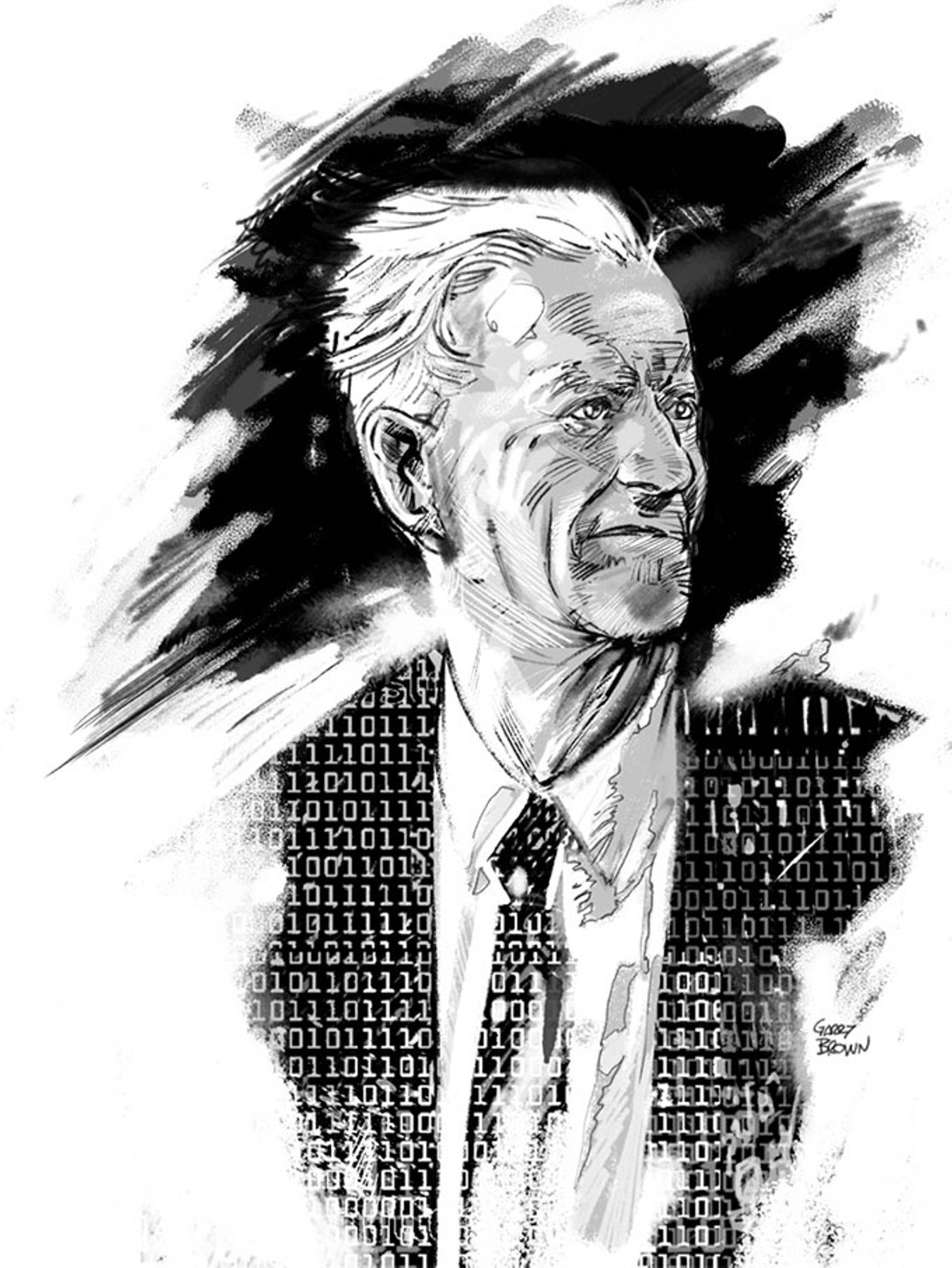
For all his influence on public policy, Gilder projects an unassuming persona—animated by his intellectual passions and untouched by professional polish. Media profiles over the years have been filled with absentminded-professor stories: driving to Philadelphia, flying home, and then wondering where his car was; turning over a full soup bowl to inspect the bottom; or wearing mismatched socks with a suit. Friends also recount his habit of disappearing into a coffee shop or heading out for a run when he was supposed to be giving a speech or an interview.
Chapman has tales going back to their Advance magazine days. “We had a problem with George, which was that he didn’t have a decent suit,” he says. Friends pooled their money to buy him a Brooks Brothers suit, but Gilder left it in an unlocked car while visiting friends on Manhattan’s Upper East Side and returned to find it gone.
“I think one of the things about his personality is that everybody knows that,” Chapman says. “They find his qualities endearing and cut him a lot of slack.”
In the early 1990s, decades after they first became friends, Gilder helped Chapman found the Discovery Institute, which reflected his interest in combining faith, family, free markets, and technological innovation. The institute became influential in telecommunications policy and, more controversially, for its challenges to Darwinism with its advocacy for intelligent design.
“It had a technology theme and an antimaterialist theme,” Gilder says. “Common to my entire career is a critique of the materialist superstition.” By that, Gilder means the belief that everything can be reduced to the material world. “The neurophysiology of the brain does not explain consciousness and transcendence and genius,” he says.
Today, the rise of artificial intelligence raises fresh questions about technology’s ability to mimic the abilities that make humans special—and to displace human workers from the economy. Gilder is once again ahead of the curve: he has addressed these topics in his writing for decades, and he published the short book Gaming AI in 2020, two years before the launch of ChatGPT.
“I’m skeptical about apocalyptic AI,” Gilder summarizes. “I think it’s kind of a distraction.”
Gaming AI recognizes that artificial intelligence can “transform jobs,” as many technologies have before—making humans more productive and employable and their work more interesting. But Gilder argues forcefully against the idea of a “singularity,” which he summarizes as the “trigger point when human history ends and artificial intelligence prevails in an exponential cascade of self-replicating machines rocketing toward godlike supremacy in the universe.”
More generally, he contends that AI can’t truly think in the same sense that people can: the human mind is more than a “meat machine” that one might rebuild in computer form. His arguments span the realms of brain science, computer science, information theory, philosophy, and more.
Yet late this summer, a full-blown panic captured the discourse around AI. Worries mounted over improvements too rapid for humans to control, incidents where rogue AIs had infiltrated systems they shouldn’t have had access to, amid claims that AI had a 10 percent chance of causing human extinction. Major industry figures called for government regulation or a coordinated “slowdown” of development so that protections could keep pace with the technology’s capabilities.
When I reached out again to Gilder, he explained that the situation wasn’t as novel as some made it out to be. “It’s not that AI isn’t terrific, but this is pretty much the history of the computer business,” he said—recalling a 1956 Dartmouth conference organized around the idea that every aspect of human intelligence could be replicated by machines. “They imagine they’re making minds, but these are not minds. These are processors.”
Of course, there are risks involved with any technology that has access to important systems. So what’s the way forward? If companies can’t control their programs, “then those have got to be suppressed until they can be rendered manageable as products,” Gilder says. “Products are predictable devices—not some kind of mystical introduction into the world of possibly apocalyptic powers.”
He still sees strict government control as dangerous and the calls for oversight from within the industry as troubling, though. “Anything can be abused, but you don’t turn to the government and say, ‘Oh my Lord, my own product is so dangerous I can’t release it without government certification and subsidy,’” Gilder says. “This is being cited as a pretext for socialism.”
Once again, the worlds of economics, technology, and human ingenuity are colliding, and few see their interplay quite the way George Gilder does.