
Melania, the new movie from Amazon Studios, follows First Lady Melania Trump through the 20 days before the second inauguration of her husband, President Donald J. Trump. Within this narrow yet consequential window, the film offers both a behind-the-scenes look at the preparations for Inauguration Day and a glimpse into Melania’s world.
A natural curator with an exacting eye, Melania was one of the film’s producers, carefully balancing access and restraint. The resulting portrait is purposeful, revealing what matters most to the First Lady: family, excellence, and style; her immigrant experience and advocacy for children; and preserving her individual identity, even while occupying one of the world’s most scrutinized roles.
Finally, a reason to check your email.
Sign up for our free newsletter today.
A former model, Melania demonstrates an instinctive understanding of fit, proportion, and presentation. The camera captures her making subtle tailoring adjustments, debating whether her now-famous Christian Dior–inspired Inauguration hat should sit straighter, and ensuring the collar of a chiffon blouse lies perfectly beneath a structured suit. Every detail in these scenes is intentional, meant to communicate Melania’s authority and precision.
That precision extends far beyond fashion. While reviewing plans for the Inauguration, Melania weighs every element of the guest experience, from table settings and invitations to the symbolism behind bold-red keepsake cards, and even the golden egg and caviar to be served at the Inaugural Ball.
Melania does not shy away from the weightier realities of the then-incoming First Lady’s role. A brief detour to Palm Beach, through the manicured grounds of Mar-a-Lago, captures Melania and her husband coordinating transportation logistics with the Secret Service. Concerned for her and her family’s safety on the heels of her husband’s having survived two assassination attempts, she asks, “Is it safe?”
The film also explores Melania’s quieter decisions: assembling a small, trusted team; overseeing the rapid transformation of the White House into a family home; and selecting furniture and artwork for a residence that must be vacated and reoccupied in a matter of hours between Inauguration events. The quickest interior design job in history, Tham Kannalikham, the interior designer in charge of the transition, calls it.
Interwoven throughout is Melania’s personal reckoning as she resumes her role as First Lady. While selecting crystal for the Inaugural Ball, she references traditional Slovenian patterns—an homage to her heritage and her life before coming to America.
At the same time, she grieves the one-year anniversary of her mother’s passing. The documentary captures intimate moments of mourning, including a visit to Saint Patrick’s Cathedral in New York City, where she lights a candle and quietly tells the priests, “She used to come here a lot.”
Still, the film makes room for levity, too. A soundtrack featuring classics like “Billie Jean,” “Gimme Shelter,” Aretha Franklin’s rendition of “Amazing Grace,” and “Sunny” by Boney M overlays the film’s lighter moments, including Melania’s admission that Michael Jackson is her favorite artist of all time and her recollection of personally meeting him. Audiences even see Melania do a little dance.
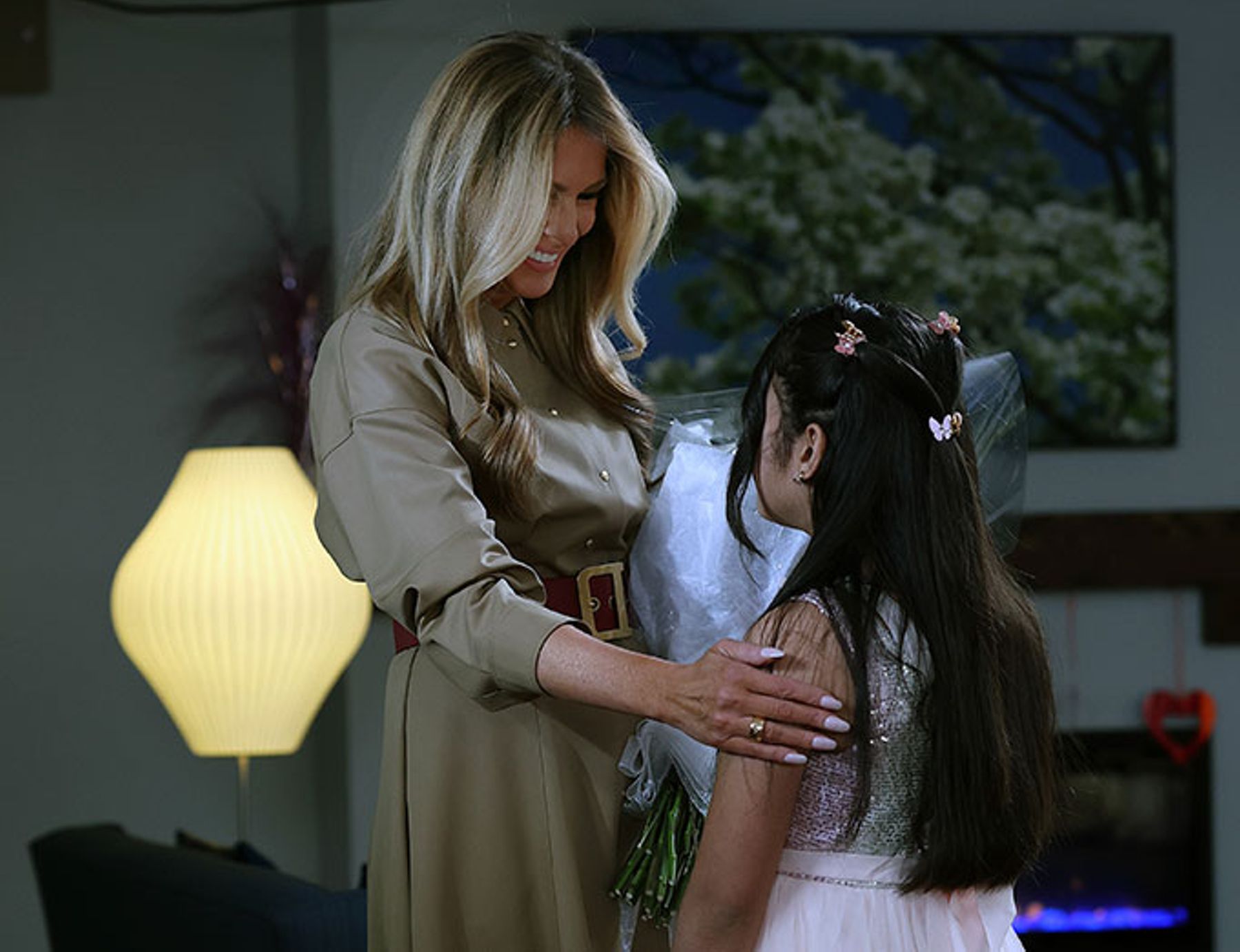
At the heart of Melania’s legacy as First Lady is her commitment to children. Conversations surrounding her “Be Best” initiative—a public-awareness campaign that addresses online safety, opioid abuse, and general well-being among children—form the film’s emotional backbone. She appears alongside international figures including France’s First Lady Brigitte Macron and Queen Rania of Jordan, reinforcing her global approach to advocacy.
Rather than following a traditional narrative arc, Melania unfolds as a series of private moments that illuminate how the creative choices and behind-the-scenes duties of a First Lady differ from the more public-facing demands made on a president. The president focuses on policy, while the First Lady leads on philanthropy—a much less political role than the president’s, as Melania demonstrates in the film.
Her inner circle—senior adviser Marc Beckman, CEO of DMA United and her publicist for over two decades; her longtime photographer Regine Mahaux; and designer Hervé Pierre—play a central role in shaping the First Lady’s public image and brand.
In a recent review, Time argued that
Melania has been marketed as a documentary, but it can more accurately be defined as a one-hour and 44-minute branding exercise, or an extended piece of reputation management presented in the visual language of nonfiction cinema. When viewed through this lens, the box office figure does not represent a triumph of documentary filmmaking so much as the successful activation of a political brand.
That branding effort extends far beyond the screen. Surprise billboards and advertisements for the film appeared across 27 countries, with public transportation ads, billboards, and signage in cities such as Madrid, Berlin, and Mexico City—signaling a push to amplify the First Lady’s work well beyond the 50 states.
As one might expect, critical reaction to the film is sharply divided. Rotten Tomatoes, the review aggregator, currently shows a 11 percent “Tomatometer” score across 53 critic reviews, while the audience-driven “Popcornmeter” stands at 98 percent across more than 1,000 verified ratings from moviegoers.
Commercially, however, the response has been decisive. Over its premiere weekend, Melania grossed more than $7 million—nearly $3 million on opening night alone —prompting an expansion of its run to 200 additional theaters nationwide. That’s a significant jump for a documentary film, reflecting the better-than-expected reaction to the film’s release.
Melania offers an intimate, first-of-its-kind view into the life of a First Lady and the wife of one of the most powerful figures in modern history. It’s a carefully composed study in image, intention, and identity—revealing a woman determined to define her legacy on her own terms.
Top Photo by Kevin Dietsch/Getty Images